Showing posts with label mania nate. Show all posts

Saturday, July 24, 2010

A Finished Hillbilly, Still Truckin' Along With the FJ, Looking Backwards, and Another Zipper

And the Nate is Done

It shouldn't have taken this long to do it, except I didn't have a whole lot of time to finish the thing. The Bottom Line is that it's finally completed, and there are some photos below to prove it.

The kit itself is a treasure, and has held its age quite well against its more modern competition (of which there is absolutely none in 1/48th scale!). You'd never know the thing was pushing 40, and it's easy to see why Hasegawa keeps reissuing the kit. It's quite a tribute to those guys at Mania that the model is viable after so many years, and that it produces such a great replica with very little work on the part of the builder. We've already discussed most of what was done in our previous installments, but there are a couple of things worth noting before we get to the photos.

First, the canopy (either one) fits relatively poorly, but it does fit after a fashion and the gap created by its attachment is nothing a little bit of white glue can't fix. I'm not sure but I don't think anybody makes a vacuum-formed replacement for it, but with a little effort you can use the kit part with no ill effect.

Second, the upper portion of the landing gear struts (those little post thingies that stick up through the wing over the main mounts) really do look better if you cut the kit representation of same off the wings, drill an appropriate-sized hole, and insert a piece of plastic rod after the airframe is painted. The tiny bit of extra work is well worth the effort in terms of final appearance.

Third, the pitot tube is very much over-scale. The one on my model wasn't rebuilt, but it should have been. It's a lesson relearned, so to speak.

As for painting, which we'd may as well discuss, all of the colors are pretty much out-of-the-bottle. The lower surfaces are Testor IJAAF Gray-Green enamel, while the upper surface brown is Testor RAF Dark Earth. The lighter of the two greens is new Floquil Coach Green (which honestly bears no resemblence whatsoever to the real Coach Green---so much for progress!) while the darker shade is Floquil Pullman Green, which doesn't in any way resemble its honored predessesor either. I think they work together fairly well in this case, but you're more than welcome to do it another way if you don't care for the shades or tonal values. (And if you do, please send along a picture or two of your model---I'd really like to see what you're doing out there! The address is replicainscale@yahoo.com .


See, I told you it was done. The stripes aren't perfect but I can live with that, although the ones on the real airplane were a little more precise than these! The tops of the landing gear oleos are painted to match the top surfaces of the wings---that's a guess on my part but it's a logical one and that's how I did it. Feel free; etc, etc.... Weathering is minimal because the airplane in That One Famous Photo doesn't look too gnarly, or at least it doesn't to me. The base is a bamboo cutting board (appropriate, that), while the figure is from a Fine Molds Ki-10 Perry. And yes, the white glue on the radio antenna is still drying. I'm not terribly patient these days...

And a better view of those stripes. I really like the way the colors work on this one, and it's definitely something different for the JAAF shelf! Banzai, ya'll!

Still Crankin' Along With the Fury

We should've finished up with the FJ series a couple of installments ago, but the photos that Doug Siegfried sent along were just too good to ignore, so tonight we're going to take a look at the Ultimate Fury, the FJ-4, also known as the F-1E and AF-1E in the McNamara realignment of America's military aircraft designation system in 1962.

Your Humble Servant first began to care about the FJ back in 1980 or so, which was when he (that would be me) decided to put together a unit list. I sent it off to our mutual friend Rick Morgan for annotation and correction and he was was kind enough to re-do it and send it back to me. Here, with considerable apologies to Morgo, is that compilation from Way Back When, scanned in from its typed (anybody out there remember typewriters?) original. It'll be easier to read if you remember that Rick appended both previous and subsequent aircraft types to the lists.


Rick was quite a scholar even then, and these lists definitely show why his books are so darned good. You might note that I did a little editing on the sketch of the Marine emblem on the last page. If you were in the Nav or the Corps you know what the missing phrase said. If you weren't, it may not matter. I covered it over just in case there might be folks of a sensitive nature reading this thing. Oh yeah, and please note that there's no attempt whatsoever to edit the piece.

And now for a couple of pictures:

Here's a gorgeous photo of 143549, an FJ-4B from VA-144. Note the color inside the wing fold; it ain't yellow green! Modelers take note: the airplane is lightly weathered.  Tailhook Association via Doug Siegfried

GMGRU-1 hung some interesting stuff off their FJs. Note how the pylon sweeps around to conform to the aft end of this particular store. Kindof makes you wish somebody would do a decent set of 50s/early 60s-vintage tanks/stores/pods/etc., doesn't it?  Tailhook Association via Doug Siegfried

The FJ-4 was a transition aircraft in many ways, and a lot of them ended up in utility squadrons. 139439 is shown while serving with VU-7; colors are Engine Gray, Chrome Yellow, and International Orange. It was an ignominious if colorful end to the career of a great fighter.  Tailhook Association via Doug Siegfried

VX-5 flew the Fury in several variations. Their treatment on the -4 was particularly pretty, I think, and this shot of 139549, an FJ-4B, displays it well.  Tailhook Association via Doug Siegfried


When most of us think of VF-126 we think of the late, lamented West Coast F-14 RAG, but they were the Real Deal when they were VA-126 flying the FJ-4. Love those markings!  Tailhook Association via Doug Siegfried


And another really pretty FJ-4B scheme, this one from VA-151 on display at an airshow. In reality the FJ series wasn't much of an attack aircraft, putting the lie to their assignment to attack squadrons, but then no other Navy jet of their era was much better. It could be argued that the A-4 only became viable with the advent of the MER and TER, while the A-6 represented the next generation of VA birds. Tailhook Association via Doug Siegfried

The Saga of Reptiles and Scales

No, this isn't another flying dinosaur thing, gang. It's a true story from Those Good Old Days when Jim and I were trying to birth the original RIS which does, I suppose make it old, but it ain't that old, ya'll! Stay with me and I'll tell you a tale.

Jim and I had met in the late 1960s, back when I was going to college and "working" at a San Antonio hobby shop. We'd talked about the mutual disappointment we felt in regard to the modeling magazines available to us, and then decided we could do better than those other guys were doing. It couldn't be that tough, could it? And no, at the end of the day it really wasn't that tough to do the magazine, although I'll admit the business end of it was a little tricky.

Anyway, we'd decided that a modeling magazine, one done our way, was in our future, so we began work on our Very First Issue. It took a lot of hard work, a lot of planning, and a substantial (to us, at least) infusion of cash, but The Big Day came and we submitted our copy to the printer (a quick-print sort of place, because it was all we could afford for that first issue) for production. What we got back wasn't bad at all, and served its purpose well in terms of launching the magazine. It was the bill that surprised us.

That first bill wasn't all that bad in monetary terms; just a few hundred bucks (we're talking early 1970s, remember?), but the printer's invoice was for a periodical called "Reptiles and Scales". It was hilarious then, and it's funny now, at least to me. It's possible that it wasn't terribly humorous to the poor soul who wrote it out, since we called the owner of said Quick-Print-Sort-of-Place and told him about it, but we thought it was a riot. It didn't take a whole lot to amuse us back then, I guess.

There's no moral to this story, and there really isn't much of a punch line either, but it caused us to refer to ourselves as "Reptiles and Scales" for years to come. It could've been worse.

A Well-Used Zipper

Don Jay sent me this F-104A a while back, but I'm just now getting around to publishing it:


This F-104C-5-LO was photographed at Edwards back in the mid-60s. The aircraft is 56-0934, and it's shown prior to being transferred to NASA as a space re-entry trainer. This is one of the few times, not counting the use of the aircraft in SEA, when a Century Series fighter appeared as heavily weathered as most modelers depict them.  via Don Jay

Better Late Than Never

Which is what we could've titled this installment since it's appearing almost a week later than it should have. Life got in the way again, ya'll! Anyway, I'll try to do better next time, so until then be good to your neighbor.

phil

Monday, July 12, 2010

A Nimrod Song, I Happen to LIKE the Fury, Even More Corsairs, An Oddball B-47, That Nate, and Any Old Albatros in a Storm

You Gotta Have a Theme Song, So Here's One For the Nimrods

Don Jay is our official Nimrod, having served with them and all, and he's sent us another bit of information on the outfit in the form of their unofficial song. This one's a little different than most Air Force songs because you can actually sing it in semi-polite company!

First, the lyrics:

On November 20, 1966, four Cricket FACs wrote this song in honor of the Nimrods. Woke up ops officer (Joe Kittinger) to sing it to him. Sung to the music of ""NIMROD BALLAD"


An old VC truck driver went out
One dark and rainy night

He would have to drive that dark trail
Without a beam of light

He knew that Uncle Ho Chi Minh
Would be so proud of him

So he loaded up his P-O-L
And headed out of Vinh


[chorus]
Nimrods, Nimrods, those truck killers of the night

He rattled through Mugia Pass
(missing verses)

The call came through the night ... Nimrod Lead this is Gombey 105 *
Lead your cleared in hot if you've got that truck in sight

They bombed and strafed and flared ... and blew that bastard up
Oh Nimrods, Nimrods ... Truck Killers of the night


[chorus]
Nimrods, Nimrods, those truck killers of the night.

(*) Gombey - call sign for the Cessna O1-E Bird Dog FAC

And he also gave us a link to a performance of the song, which hopefully will work if you copy and paste it into your browser bar (I think that's what they call it---this audio/visual stuff is a new wrinkle for me!)

http://www.woolyfsh .com/seasongs/ Nimrod.mp3

You Can Never Have Too Many FJ-3s!

That's how I feel about it, anyway! Here are another couple of shots of one of my favorite birds, obsolescent as it was when it was operational. (As were the CougarBanshee, and Demon too, come to think of it...)


Here's Randolph's flight deck ca. 1958. The FJ-3Ms are from VF-84 back before they assumed the Jolly Roger from VF-17---it's a heritage thing, right? Lots of aeroplanes on that flight deck!  Tailhook Association via Doug Siegfried


And some more FJ-3Ms from Fighting 121 during 1957. I don't think I ran this one before (I've had computer issues all day & am trying to get this thing published before the next crash!) but if I did please forgive the duplication. Stuff happens sometimes!  Tailhook Association via Doug Siegfried


The Argonauts of VF-33 had a crack at the Fury too. Here's one of their glossy sea blue FJ-3s in flight while deployed to the Med aboard Lake Champlain in 1955. It's possible that I'm just the least little bit prejudiced, but I don't think the Navy ever had prettier airplanes than the glossy sea blue jets!   Tailhook Association via Doug Siegfried

And finally, another blue bird. This one's from VF-51 as deployed aboard the Kearsarge during 1955. You modelers might note that both the leading edge slats and the tail bumper are deployed on this FJ-3
Tailhook Association via Doug Siegfried

Old Hose Nose

The F4U series is one of my all-time favorites, and it's time for another picture of one, or maybe even more than that. Our first shot's from the collection of Jim Sullivan and shows a -5 on the boat:


An F4U-5 launches off the USS Wright on 3 November 1948. It's peacetime and this VF-21 bird is clean, with no ordnance or gas bags to ruin its lines. The -5 was, in my opinion, the most pugnacious appearing of the Corsairs, but what an airplane!  Sullivan Collection

This -5 is loaded for bear but it's not headed for combat. The photo was taken during July of 1951 and the bird is from VX-3 while based in Atlantic City. I don't think I'd want to be on the receiving end of that salvo!  Sullivan Collection

The Reserves used the -5 too. This Glenview bird is taxiing out in early 1952. Note the absence of that pesky "V" prefix to the BuNo!  Sullivan Collection

And another Glenview bird. This one shows the International Orange fuselage band and the matte blue anti-glare treatment to advantage. Few people model Reserve aircraft but I can't understand why---this one's a beauty!  Sullivan Collection

The Navy Flew Some Oddball Stuff From Time to Time

And here's a prime example of same. Rick Morgan dropped us a quick note after the last shots from Douglas Tulsa and commented that the Navy had a couple of EB-47Es there at one time. He's right, of course, and I'm thinking we need to see a photo or two of at least one of them:


A Navy EB-47E, originally AF52-0410 and flown as BuNo 24100 by the Navy, at Douglas Tulsa ca. 1974. Note the pylon with the Whatsis (either telemetry gear or a sensor pod, but I don't know which) hanging from it. I await your letters with anticipation!  Tulsa Air & Space Museum via Mark Nankivil


What a neat photo of 42100! Of considerable interest is the OU helmet on the nose; wish we knew what that tic-tac-toe thingy was for! Guess it's time to go look up some info on this program, huh?  Tulsa Air & Space Museum via Mark Nankivil


And here's the entire airplane. Note the pylon, which appears under both wings.  When the Navy first took possession of their two EB-47E-80s (52-0410 and 52-0412) the pylons were used for the mounting of podded sensors and telemetry gear. Later on the left pylon was used to mount a GE TF34 turbofan for testing. Tulsa Air & Space Museum via Mark Nankivil

And one final shot of 4120 . I think it's time to seriously investigate this program and see if I can turn up a little more photography on it. We aren't finished with this one, gang!  Tulsa Air & Space Museum via Mark Nankivil

As a postscript, 52-0412 (not illustrated here) ended up as a display aircraft at Dyess Linear Air Park in Abilene, Texas. It's not displayed in Navy markings, though!

And another postscript, because I just checked my e-mail! Rick Morgan is pretty sure the pod under that EB-47E is in fact an ALQ-31. Here's a shot of one on an RF-8G of VFP-62 to finish out our day:


And with this photo (and the additions you may have noticed on the preceeding B-47 piece) we really and truly are done with this for today. We are. I promise...  USN via Rick Morgan

So Where's the Nate?

Not done is where it is. I'm doing the panel lines right now, and it's so close to finished that it could almost fly off on its own, but it still isn't ready and there's nothing to show you that you haven't already seen, so No Nate Today! Instead, here are a couple of photos to prove that you can build the unbuildable, even though it might be a little bit of a challenge to do it!


Back before there were Wingnut Wings kits, Roden were pretty much it as far as Great War kits in 1/32nd scale were concerned. They did some neat subjects, but you could never call the kits easy to build. Here, as a case in point, is their 1/32nd scale Albatros DIII, more or less done in the markings of Otto Hartmann from Jasta 28 ca. 1917. 


Here's a 3/4 front view. The plywood effect was done with a stiff brush and pastels over light buff paint, each panel being done individually. I don't like the way I did the prop and may redo it some day, presuming I ever build another 1/32nd scale WWI model to go with this one.


This shot shows beyond any doubt why everybody hates Roden decals. Check out the cross on the left wing. Arghhh!


It looks pretty good in this view, though. There's truth in the saying that the camera never lies, but it's entirely possible to make it fib a little bit...


I like this shot quite a bit, but that's mostly because of the lighting. I don't like the prop, but we already discussed that. The rigging, which I don't think I mentioned before, is stainless steel wire; it actually serves a structural purpose on this model which might have fallen apart by now if it hadn't been used. Roden does their struts and affiliated attachment points in scale thickness, ya'll!

Eduard makes a photo-etch set for this kit, and it was used on the model you see before you. It's a great set and is essential if you're going to build this thing! In addition to that PE I also scratch-built the engine rocker arms and wound all the individual valve springs, which was fun but pretty much counterproductive at the end of the day. I like the model, but that's mostly because I'm a sucker for biplanes. It looks ok though, doesn't it?

Sometimes We Build Stuff For Our Kids

and that's where this came from, built back in the late 80s, I think. I put it in here just to see if you guys were paying attention. Letters to the editor are not necessary; it won't happen again!


And on that note I think it's probably time to say goodbye 'til next week! In the meantime, be good to your neighbor!
phil

Saturday, July 3, 2010

Nate Moves Along, Air Group 1, Another B-47, Some Gorgeous Furies, A Destroyer or Two, and a Holiday

Progress is Our Most Important Product, But It Happens So Rarely These Days

Still, there's been a little bit of it on the Ki-27 project. Progress, that is.  In fact, we might even say there's been some major progress on "Nate", because there's not a whole lot left to do. I was able to get the red on those stripes and do the preliminary work on the canopy a couple of evenings ago, as well as stick on the final couple of parts (which I'll probably manage to knock right off of there when I go to touch up the paint) to almost finish things up. Those modest accomplishments have made the model look a whole lot more like an airplane. Wanna see?


It's beginning to look a whole lot more like a "Nate", isn't it? Significant additions include the telescopic gunsight, turnover pylon, and the radio antenna mast. The red parts of the stripes have been painted in, and the preliminary work has been done on the canopy. It's getting pretty colorful around here!


This view shows the canopy, and its masking, to advantage. The transparency was masked with Tamiya masking tape (the wide stuff, whatever size that is---I'm not metric!), burnished down around the frames with a toothpick, and then cut with the tip of a really sharp #11 blade. When the narrow strips are removed you have the beginnings of a canopy frame! It seems as though most Japanese aircraft of the WW2 period had flat black inside the canopy frames, so the first coat of paint was black, followed by JAAF Grey Green, both being Testor model master colors. Note that there are some ragged demarcations on that canopy; let the paint dry for a day or two, then go back and re-mask/re-shoot any place where there's a gap. After that's dry, take a flat toothpick that's had the big end made into a chisel with your ubiquitous Really Sharp # 11 Blade and trim the paint demarcation. That hasn't been done to this model yet but will help that semi-sloppy canopy no end.


And our final shot for this installment, which shows those tail stripes a little bit better. They need some light touch-up too, which will require re-masking, but we're nearly there. Those white blobs on the wingtips are paint, which will be trimmed to the shape of the navigation lights by that chisel-edged toothpick we made to do the canopy with. Then, after all the weathering is done, the lenses will be painted in the appropriate transparent Tamiya color. The part of the fuselage deck where the canopy sits will be touched up so the only grey-green that shows is the stuff that's on the canopy frames and the decking that's under said canopy and then, after everything else is done, we'll add the antenna wire out of That Old Standby Stretched Sprue.

It's beginning to look like I may be doing a P-35A to go with this thing. Eduard made an interior for that old Hobbycraft kit, you know...

Better Late Than Never

Two installments or so ago we took a look at a really neat F4U-5 photo from Jim Sullivan. It was a CAG bird from Air Group 1, and it got Rick Morgan interested in finding the group emblem. He contacted Doug Siegfried at The Tailhook Association, who in turn found and sent the emblem so, without further ado:


And here it is, the 1947-50 insignia of Air Group 1. Let's let Rick explain it: Phil: Here’s the insignia on the cowl of that CAG-1 Hosenose via Doug Siegfried at Tailhook; it depicts the five primary squadrons in the group c.1950, VF-11 (the shield), VF-12 and -13 (bomb), VF-14 (Tophat) and VA-15 (Lion). Pretty clever although obsolete the moment one of them moves to another Group.  Rick

Many thanks to Doug and Rick for the extra help on this one!

Bad Day For a Boeing Bomber

Boeing's B-47 was a beautiful airplane, well-proportioned and absolutely gorgeous in flight. This shot shows the aircraft in a somewhat less-than-flattering situation---stuff happens, you know...


Oopsie! 51-2151, originally built as a B-47B-35-BW but subsequently converted to DB-47B status, lies forlornly in a field in this tantalizing shot, the details of which are unknown to either the contributor or myself. The fact that it's a DB-47 and has the legend "Nike 2" painted on the nose could imply that the airplane was brought down during missile testing, although it's my opinion that there's too much intact airplane sitting there for that to be the case. If anybody has any thoughts on this photo I'd sure like to here them! (Dave Menard or Norm Taylor; are you out there?)  Tulsa Air & Space Museum via Mark Nankivil

Are These Pretty or What?

Sometimes you find really neat stuff when you weren't looking for it at all, which is the case with these next images. I'd begun an FJ-4 project, the results of which will appear here sooner or later, and had requested help from Doug Siegfried over at The Tailhook Association. Doug sent the requested images but added some FJ-3s for good measure. Here are a few of those images but be forewarned; they're going to make you really Jones for a decent FJ-3 kit!


This shot's a little soft but Holy Cow! VF-121 definitely knew how to paint an airplane! There's color everywhere on this CAW-12 FJ-3M, and there are even a pair of "Sidewinders" peeking out from behind those tanks. If this doesn't whet your appetite for a decent kit of the Fury nothing ever will! Tailhook Association via Doug Siegfried


And a clean bird in flight. Note the staining behind the fuel dump; this sort of thing is often overlooked by modelers.  Tailhook Association via Doug Siegfried


A couple of VF-121 birds mixed in with photo Cougars. These aircraft are from Air Group 12 ca. 1958, and the F9F-8Ps are from VFP-61.  Tailhook Association via Doug Siegfried


BuAer regulations during what's been called NavAir's "Easter Egg Period" specified insignia white control surfaces, which are shown to good advantage on this VF-121 FJ-3M. This bird's armed up and ready to rumble, at least in theory. The FJ-2/FJ-3s were peacetime aircraft and, theoretically at least, never saw combat anywhere. How's that for an anti-glare treatment?  Tailhook Association via Doug Siegfried


So you want to do a flight deck diorama, do you? How about this for inspiration! "Double Nuts" is getting ready to move off the angle and into position for launch---note the aircraft director preparing to guide her into position. Those guys in the V-1 division probably have the most dangerous job on the boat, but their ballet-like movements are something to watch! Let's see now; you'd have to scratch-built part of the boat, come up with a bunch of decent figures in properly-animated poses, and then hope that someone will issue a decent kit of the Fury. Oh well, we can dream, can't we?  Tailhook Association via Doug Siegfried


Cat Shot! An FJ-3M from VF-121 takes to the air off the Lexington during her days as an attack carrier. I've included this one because it shows the airframe behind the deployed flaps; that area appears to be painted in Mil-P-8585 Zinc Chromate Primer. If we ever get a kit...  Tailhook association via Doug Siegfried


Sometimes you run a shot because you really like it, and this is one of those times. This picture really defines the nose treatment on these aircraft! Note the crew chief's name (illegible, unfortunately) under the canopy. The removable IFR probe is readily visible in this photo.  Tailhook Association via Doug Siegfried

You Just Don't See That Much On the B-66, Do You?

At least until today. Mark Nankivil sent along these photos of Douglas B-66 Destroyers in the process of production and overhaul at the Douglas Tulsa plant:


I've always liked shots of military aircraft in production or undergoing maintenance, which makes this next series a natural for today's effort. Here's the production line at Douglas Tulsa. This represents shot, taken in October of 1962, represents organized chaos at it's best!  Tulsa Air & Space Museum via Mark Nankivil


This view, taken during the Vietnam War, shows a hangar full of B-66s undergoing overhaul. The 363rd TRW RB-66 is noteworthy.  Tulsa Air & Space Museum via Mark Nankivil

It's a Fact, I Think

Many years ago, way back when I was a whole lot younger than I am now, I read some place (maybe in Boy's Life magazine?) the the Declaration of Independence was actually signed on the 3rd of July, then ratified on the 4th. There's no telling whether or not I'm remembering that correctly, but either way this day, or more likely tomorrow, is important to a lot of us. If you're an American you might want to take a minute or two to reflect on the meaning of the day. (It's also a holiday around here, which is a Good Thing too!)

Which brings us to a story. Back when I worked at Mooney Airplane one of my co-workers asked our production manager, who happened to be English, if they celebrated the day too. I thought it was an odd question and was really interested in his answer, which wasn't long in coming; John grinned at the non-historically-minded inquirer and said "Yes, we do celebrate the day. We call it Thanksgiving!"  I guess it's all a matter of opinion!

Have yourselves a great and glorious 4th, and be good to your neighbor. We'll meet again soon!
phil


Monday, June 14, 2010

Complain, Complain, Complain, More On That CalSpan Invader, Even More CalSpan Birds, A Look at Color, Fixing The Big Stick, and Progress On Nate


If You Can't Say Something Nice

Time was when I read multiple internet modeling boards pretty much each and every day of the week, mostly to learn things but, it must be said, also for the amusement offered from time to time. Let's face it, ya'll; most internet boards, and that includes boards of pretty much anything you could possibly imagine that folks would have a board (or "forum", which is the fancy name that most of them are called) about, end up being sounding boards for for Instant Experts and people with some sort of axe to grind. I've never quite understood the concept ("Hey Moderator, don't you have a DELETE button over there someplace?") but there's a whole big chunk of Internet Humanity who seem to live for confrontation, and who seem to take some sort of strange pleasure by exhibiting their knowledge at the expense of others. It's a sad fact of virtual life, but it's also an Essential Truth of same.

That takes us to the part where I said I used to read the boards. I don't read 'em any more because I can't; things have changed around here to the point where I barely have time to do this blog, much less concern myself with the slings and arrows that some of the forum folks throw at each other on the aforementioned boards. In many respects that's too bad, at least on a personal level, because I've learned a lot about modeling from some of those Board Folks---there are some really good ones out there too and, quite frankly, they outnumber the "bad" ones by a considerable amount. I've also learned to shake my head and think things such as "don't those guys have anything better to do?" when I read the missives of The Complainers.

As a case in point, and to take us to what's going to pass for the reason I'm writing this thing, let's look at a new kit; the Airfix 1/48th scale Bf109-E. It's getting airplay on The Boards right now because it's new, and because it doesn't meet the standards of the day, whatever those are. I haven't seen the kit, just the sprue shots, and I doubt I'll buy one based on what I've seen, but that's primarily because the kit doesn't seem to offer any significant improvement over my own personal Gold Standard for that airplane, which is the Tamiya Bf109E-3 and Bf109E-4/E-7. That doesn't make the kit bad by any means; it just means I've got several unbuilt Tamiya kits and the new one from Airfix doesn't improve on them in any way.

On the other hand, more than a few modelers, and I'd expect most of them to be people relatively new to the hobby, will buy the Airfix kit, build it, and be happy with it. I also anticipate that more than a few experienced modelers will buy it, maybe out of curiousity, build it, and possibly be happy with it as well. There's a place in our hobby for kits like that one, and there's got to be a viable financial reason why Airfix chose to kit it. After all, it costs a fairly substantial chunk of change to tool for a new kit and it would seem obvious that Airfix thinks they have a market for it.

That takes us to the "specific" complaints about the kit, which seem to consist of chunky parts (in some places) and Great Big Honking Panel Lines. Those things do exist, and they need to be mentioned in a serious review, which I'm certain somebody has already done. With any luck the astute modeler will read those reviews and make up his or her own mind about whether or not they want the kit, leaving it to those previously-mentioned Forum Folks to bash the "clunkiness" and the panel lines ad nauseum. Me, I'm going to go build a model, and probably not complain about it too much while I'm doing it---most recent kits are far better than my very own personal abilities and I'm honestly just pretty darned happy to have something to choose from. Kudos to Airfix for issuing their new 109E, and to those of you who choose to build it. Enjoy it, and enjoy the hobby too. After all, it's just a kit, ya'll; it's only a kit.

Let's move on.

When Getting It Wrong Is The Right Thing To Do

A while back I started a thread (that's Internet Talk) on the Douglas A-26 Invader and, somewhere along the line, ran a photograph of a civil A-26 owned by CalSpan. I surmised it to be a corporate transport and so described it in the caption. Boy, was I ever wrong! Keith Svendsen, who was in the Air Force at the time and was there with the CalSpan Invader wrote to me ( replicainscale@yahoo.com ) to provide the real story on the airplane. I'm re-running the shot so you can see the airplane again without having to scroll down to find it, and appending Sven's comments as the caption:

 Just to add to the info on this Invader. It was built as s/n 44-34653. The Air Force Research Lab had the aircraft modified to a Variable Stability testbed in the early 1960s. It was used for both AFRL projects and USAF and USN Test Pilot School curriculum flights. The Calspan instructor pilot served as the safety pilot in the left seat while the right seat flight control system was programmable and used by the student or project pilot. This aircraft was used by the test pilot schools until 3 March 1981, when it  disintegrated during a curriculum flight north of Edwards AFB. The left wing separated after spar failure. Unfortunately, the parachutes were normally tied down in the aft fuselage and neither the Calspan pilot or the two TPS engineering students got out. One of the engineers was a good friend of mine of mine since college. Her husband and I both became students at TPS that July.


Timing is everything. AFRL knew that this aircraft, and its sister ship TB-26B s/n 44-34165 (N9146), were at the end of their useful service life and were due to be replaced by a single variable stability Learjet with the next TPS class. The surviving variable stability A-26 is held by the Air Force Flight Test Center Museum at Edwards and is in the same markings as the aircraft that was lost.   Sven
 
Here's a shot of the other CalSpan A-26 after being inducted (and, presumably, restored) to the museum at Edwards AFB, also courtesy Sven:
 
 
N9146H, the sister ship to N9417H sitting in the Edwards museum holding area in 1990.  Keith Svensen
 
Almost makes you want to build a "civil" A-26, doesn't it?!
 
And While We're At It
 
Here are a couple of additional CalSpan aircraft for your enjoyment today:


The variable stability Lear Jet LJ24. Took over the mission of the lost/retired TB-26. When I went through the "School House", it was standard to break the class up into teams of three or four and practice what we had learned in the flight controls course. We were given the pitch system as originally designed in the YF-16. If you remember the unofficial "Flight Zero", where during a high-speed taxi test the aircraft became unstable and the GD pilot elected (correctly) to take off and evaluate the situation rather than trying to keep the aircraft on the runway, then you'll understand why we were tasked with designing a fix to that control system. The incentive to doing a good job was that the CALSPAN pilot was going to program whatever we came up with into the VS Lear and we had to fly it. All of our evaluations took place 'up and away' though - thank goodness.    Sven


The NC-131H Total In-Flight Simulator, my class didn't get to fly this beast - I think it was down for depot maintenance. It wasn't generally used in the set curriculum, but it was used for class projects which took place in the last third of the one-year course. The aircraft had at least two interchangeable noses, one with the evaluation control station (shown) and a bulbous nose used for sensors testing.     Sven

We'll come back to the CalSpan birds another day. Meanwhile:

Just Paint It Some Old Color

Once upon a time, just a few short years ago, the early-twenties daughter of a friend of mine referred to something in her life as having occured "back in the day". It seemed an odd comment given her distinct lack of seniority on life, but it's what she said, which takes us to a Paint Thing.

Back in The Day, as it were (the particular day being the late 1960s), Floquil was a major player in the hobby paint market. They weren't owned by anybody else yet and were still Floquil, a division of...  FLOQUIL! And they made what was arguably the best hobby paint on the planet. (It may still be the best too, because nothing's ever been released that's capable of topping its performance, but that's a story for another day.) Floquil made railroad colors, and they made hobby colors, but they didn't make airplane colors, which meant you had to do some mixing to get what you needed. Floquil saw the need for something more, and issued their very own mixing guide covering most of the colors that modelers Back in The Day needed for their projects. They also provided a little bit of philosophy regarding those paint colors, which I'm going to share with you today courtesy of the letter that accompanied each and every mixing guide. Given the general lunacy that tends to surround "correct colors" in our hobby I'm going to say it's well worth a read:


Boy, did they ever hit that whole color nail on the head! There's no telling what your personal take on this color thing is, but I personally agree with Floquil's approach. It's worth remembering next time you get into one of those pointless discussions with The Folks Who Know Everything. Philosophy, as it were!

Taking the Big Stick to The Shop

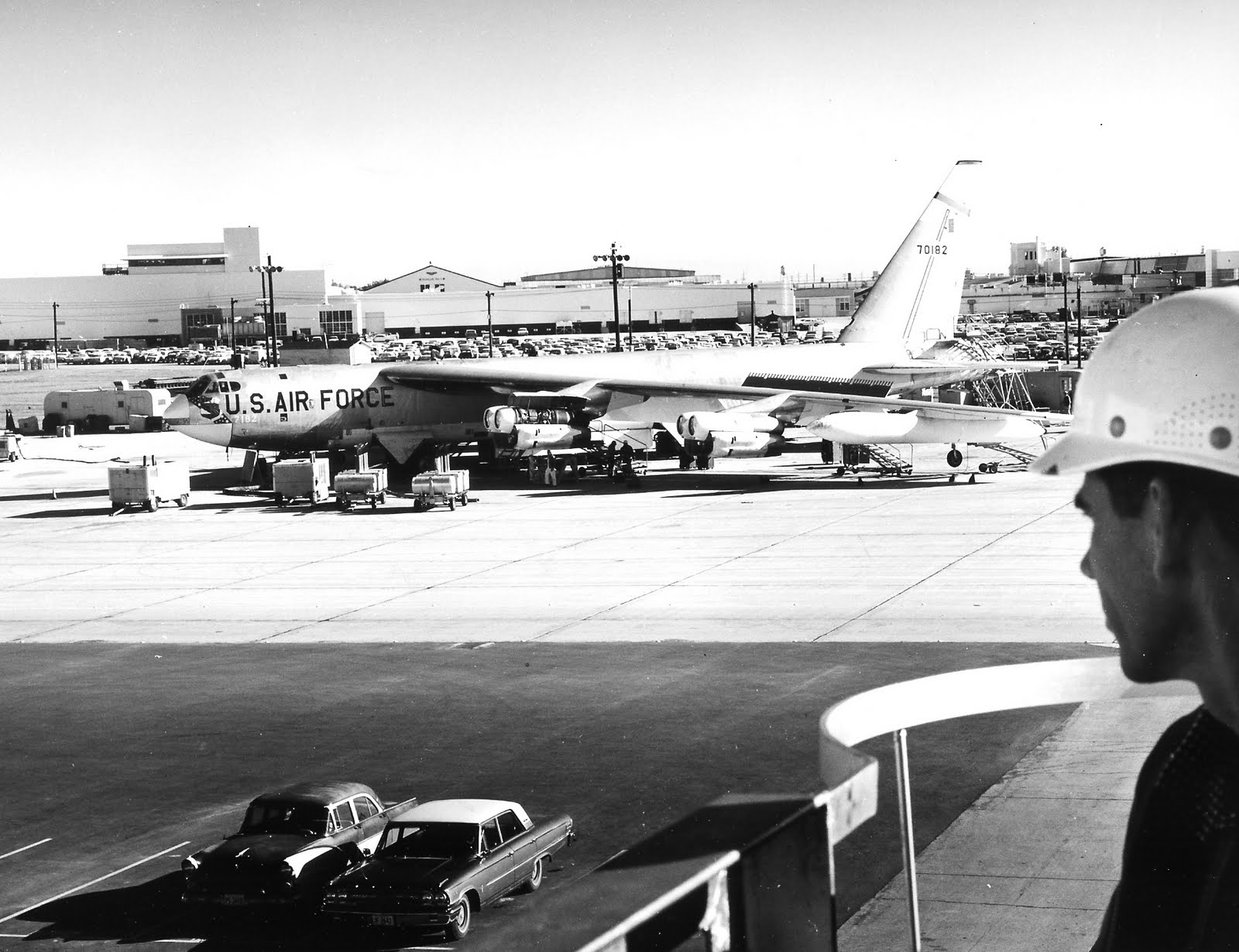
As you may or may not know, the LogAir depot at Kelly Air Force Base was prime on the B-52. Let's do a quick photo essay on The Big Stick. (Or the BUF if you'd rather. Me, I'm saying Big Stick, at least for today.) Today's time capsule deals with the aircraft during the last days of its "peacetime" paint.


57-0182, a B-52F-70-BW, gets ready for delivery on the ramp at Kelly. The year is post-1964 judging from the '64 Ford Fairlane we can see at the bottom of the photo. 0182 ended up at MASDIC in 1971.  Kelly AFB History Office


It's a long way to the top. In this early shot (with no handy cars to help us identify the year) we see 53-0387 (A B-52B- 30-BO) getting touched up on the ramp. The tail gunner's position is shown to advantage here. None of the B-models made it to Vietnam and 0387 ended up at the MASDC facility in 1966. Note the maintenance stand up against the vertical stab of the next B-52 in line---it must've been pretty sporty up there on a windy day!   KAFB History Office 3204116

Kelly was the depot for the BUF, which means that they all came back there for overhaul multiple times. This unidentified B-52 has seen the elephant as connoted by the mission markers on the side of the fuselage. You have to wonder if anybody at Kelly bothered to photograph the nose art (there was some) and the mission markers before inducting aircraft for maintenance. (If they did such a thing, I haven't been able to find out where it's housed---anybody out there got any ideas, or maybe some more BUF noses? If you do, please get in touch with me at the ubiquitous replicainscale@yahoo.com !)  KAFB History Office 61252711

That wascally wabbit sure got around, as attested to by the nose art on B-52D 55-0078. If you've never been around an aircraft during overhaul you just can't conceive how cluttered things are on the hangar floor! There's method (and planning) to the madness, but you'd never know it just by looking. This bird survived Vietnam only to be lost on 30 October 1981 near La Junta, Colorado, during a low-level night training mission.  KAFB History Office 4991546


A rampant bull, a palm tree, and five mission markers adorn this unidentified B-52. Sure wish we knew the story behind those markings!  KAFB History Office 6259649

I Told You This Would Take a While

I've been putzing around a little bit more on the "Nate", but we aren't getting anywhere fast. Here's what I've done since last we met---pathetic, ain't it?!


That One Famous Photo clearly shows a light color under the canopy, so I've gone back and painted it in Testor JAAF Light Gray Green, which is what I strongly suspect was under there. Note the rough demarcation line---there's no real point in getting this part perfect since the base of the canopy will hide any irregularities. My personal jury's still out on dusting some dark green over that anti-skid on the port wing root, but I'm probably going to do it before I call this thing finished, mostly because that murky photograph inplies it was actually done.


The prop got painted too. I generally use a subdued yellow for the striping on such things in the belief that a really bright "Hey look at me!" prop stripe detracts from the model. That's personal philosophy, of course, and you may want to do otherwise on your own creations. I'm going to go mask some stripes on the tail and aft fus as soon as we finish this installment of my ongoing ramblings; maybe next time you're here this thing will be almost done. Maybe...

It Must Be Time to Go

Mostly because I'm all typed out! We'll see you next week, or maybe a little bit later in this one. Meanwhile, be good to your neighbor!
phil