Showing posts with label floquil paint. Show all posts

Sunday, November 14, 2010

Reflections on Disaster, A Couple from Korea, and a few More Demons

Sometimes Stuff Just Happens

There's an old expression not used much anymore that goes "if you're going to make an omelet you've got to break some eggs". I've personally never cared for omelets although I have broken my share of eggs if the truth be known, but this isn't a cooking show and we aren't going to talk about that at all; it was just my ever-wordy means of introducing the Fine Art of Modeling Disaster as this edition's mindless ramble.

There can be no doubt whatsoever that anybody who's ever built a plastic model has messed one up, or had some sort of tragedy/drama/whatever-you-might-want-to-call-it as a result of some ill-advised attempt at building a replica airplane. These disasters come in a wide variety of flavors, and I've got enough seniority on life that I could easily fill several of these columns with There I Was stories, but this time around only a few examples will suffice, I think.

Let's start off with low-key, because that's the most common sort of Disaster and the kind most easily fixed. In my own personal world that sort of thing generally revolves around something easily botched, easily fixed, but ultimately noticed by almost everybody (although not in this case). Our example of this sort of disaster concerns a 1/72nd scale Hasegawa F-15 I built back in the '80s, painted and marked for the 18th TFW. It wasn't the easiest thing I'd ever built (precious few Hasegawa kits from that era were shake-and-bake; that came later) but the airframe actually came out pretty good, and the paintwork wasn't bad either. The decals were ok, and there was a local club meeting coming up, a fine venue to show off my brand spanking new F-15. The airplane was a hit, albeit an extremely modest one (and quite possibly more in my mind than in reality, but what the hey...), and I was hip-deep in explaining the model to a friend when It suddenly came to me: There were no national insignia on the model anywhere. None. Nada. Zip. No stars, no bars, nary one single scale 15-inch reduced-scale national insignia any place on the model. I didn't say anything and nobody ever noticed, giving me the graceful opportunity to go home and finish putting the decals on. I attribute the event to un-respirated exposure to too much Dio-Sol.

After low-key, we get to ratchet things up a little bit to Medium, which I classify as something that's unfixable but never seen by Model-Kind. In my own personal world it involved a 1/72nd scale Lindberg He162, which wasn't unduly bad (or good either, for that matter) considering its 1966-67 vintage. It did, however, have a one piece wing that slotted through the fuselage halves of the model. The fit wasn't all that great but I got it done, and once the bodywork was complete it even looked all right under primer. That was when I made The Terrible Discovery. It seems the leading-edge slats looked a little bit goofy, what with them each being two-piece and one of them being bigger than the other. And yep, you've guessed it; I'd put that wing in backwards, producing a fine version of an unintended swept-wing Volksjager. There was no attempt at salvation---it was straight to the trash can for the tiny futuristic little "People's Fighter".

We could go on and on, running right up through mis-steps and accidents that actually induced physical pain, but I've saved what I think must surely be the best for last. This one far surpasses almost any There I Was story I've ever heard and, for once, didn't directly involve me---I heard it from the guy who did it. And yes, Virginia, it's a true story; Frank Emmett can back me up on this one because he knows the guy who did it and heard the story too (and nobody, and we mean nobody, could have made this up!).

Anyway, Frank and I had this mutual friend who I'm going to call Zeke, mostly because I've never actually known anyone by that name. We're protecting the semi-innocent here, folks! Zeke was a pretty busy kind of guy, working a real job by day, helping out with an established family business by night and sometimes on weekends, and modeling whenever he could. I tell you that because it helps set the stage and explains why Zeke was sitting up late one night in his skivvies (ask an old GI if you don't know what they are) getting ready to airbrush. Like all of us back then, Zeke painted with Floquil, which meant he thinned and cleaned up with DioSol, a solvent/thinner that was a little bit on the hot side. (You can't buy DioSol anymore---that ought to tell you something about its properties.)

So there Zeke was, airbrushing away, when it got to be time to finish up and clean the airbrush. He did that very thing, putting a pint can of opened DioSol on the edge of his modeling desk. He reached for something, moved his arm (you do that when you Reach for Something), and knocked over the previously mentioned open can of DioSol, the contents of which began making that gluck-gluck-gluck noise that liquids make when they're pouring out of a knocked-over can and heading for the floor. The problem was, there was an obstacle to be negotiated between them and said floor, because our skivvy-clad friend Zeke was sitting right smack betwixt and between the two, the aforementioned skivvies soaking up most of the contents of the dumped-over and rapidly-emptying can and ensuring that the anatomical bits underneath said skivvies received full and prolonged exposure to The DioSol Bath.

We were told, Frank and I, that it wasn't much fun, and I expect that Zeke's entire neighborhood got to hear how former Marines recently returned from the Southeast Asia War Games sounded when they were unhappy. I know for a fact the second-hand version that we heard was pretty ding-danged sporty. Thinking about that whole deal still makes me grin...

So next time you mess something up while modeling, or next time you spill that itty-bitty bottle of relatively benign acrylic on the floor, think of Zeke. Things could be a whole lot worse!

More From Korea

Today's lead photo feature is pretty brief, but I think it's something special. Don Jay rediscovered some old photos in his collection and sent them in to share with us. Let's let him tell about it: 

Hi Phil,

Every so often, you run across old photos stuck away in attics or at antique stores, etc. Most of the time we just give them a cursory look and they are gone, forgotten, and disappear forever. I'm sure all of us have misplaced photos over the years or lost track of them somehow.  Attached are some Korean (circa '53) era photos from an old album labeled FEAF HQS that I came across years ago ('90) that I scanned. It appears they were taken at the end of the Korean War in June of 53 and I think (warning) that they are from K-13 which would be Suwon. Anyway, sorry for the quality-remember I said scanned in the early '90s. dj

Somewhere (maybe K-13?) in Korea, a C-119 taxis in this evocative photo. My personal archives don't include a whole lot on the C-119 in any guise, so reader input as to unit, etc, would be appreciated. A great many, if not most, of Korean War Flying Boxcars wore nose art, and this example may well have that sort of thing on the port side of the nose. We'll never know...  via Don Jay


Another "Boxcar", also from an unknown unit, and with the same comment regarding nose art. Sure wish we could take a better look at the Sabres in the background!  via Don Jay


It's a little-known fact that the C-46 hung around PACAF into the mid-60s (I rode in one from Misawa down to Yokota when my dad PCSd back to the States in late 1965), and a number were used in Korea.
Here 44-78027, a C-46D-15-CU, taxis past the camera at a soggy K-13. She didn't last long after the War, crashing to destruction off Hokkaido in February of 1954, killing all aboard.  via Don Jay


The B-17 was another bird that lasted long past her time, and more than a few operated in and out of Korea during the War. This G-model, once again from an unknown unit, sits on the ramp tantalizing us. Note the legend "Ankara Turkey" on her nose, the black paint around the tail-wheel well, and what appears to be black paint aft of her engines. Was that paint just protecting areas that got messy easily, or were they the remnants of a former life? Once again, we may never know.  via Don Jay

I Think We Promised More Demons, Didn't We?

Actually that's kind of a goofy question, since I know darned well I said there'd be more. Without further ado, let's look at some pictures.


We're having a party and everybody's invited! OK, maybe not everybody, but one of the prototype"Banjos" with 500 flights to her name attended the festivities, along with one of the two XF3H-1s after accomplishing her 200th flight. This view doesn't show it particularly well but there's a lot of the XF-88 Voodoo to be seen in the F3H series; it's particularly noticeable from a 3/4 rear view. This airplane must've looked like something from another planet to the folks used to the more conventional shapes of the time.  Greater St Louis Air and Space Museum via Mark Nankivil  

I've never been big on prototypes, so we're going to skip way ahead to the grey birds, which are mostly going to be production aircraft. You know, the kind we'd all like to build models of. That means we're also going to skip all the Glossy Sea Blue F3Hs, but we honestly aren't missing all that much from a markings standpoint by doing that.


The F3H series started life with a one-piece windscreen, a technical marvel (it was really hard to make something like that back in the fifties) that was highly prone to bird strike damage. This classy air-to-air was taken on 27 April 1955 and shows a very early production F3H-2N in flight. That big honkin' test boom did absolutely nothing for the airplane's looks.  Greater St Louis Air and Space Museum via Mark Nankivil


Air defense of the Fleet was a primary mission for the F3H, but the technology available at the time made the mission highly problematical. Here's an early F3H-2M dragging a quartet of AIM-7 Sparrows on a test flight. The missiles shown are early Sparrow Is, really limited in performance (but then so was the launch platform). Look on this as a starting place.  Greater St Louis Air and Space Museum via Mark Nankivil  


The Demon was a very unconventional aircraft in appearance, but wore squadron colors well and really looked good when she was all dressed up. This F3H-2 from Oriskany's VF-41 proves the point. She's fitted out with a set of pylon-mounted rails for the AIM-9B Sidewinder, and her deployed speedboards should be a treat for modelers.  Greater St Louis Air and Space Museum via Mark Nankivil

And another F3H-2 with deployed brakes for you detailers. VF-151's birds were pretty Plain Jane during this time (January of 1963) but the airplane still looks neat!  Duane Kasulka via Greater St Louis Air and Space Museum via Mark Nankivil


I'll guarantee you that the naval aviators in our audience (and there are a few) are looking at this shot thinking "I'm really glad I'm not driving 102 today!". That sea state is nothing to be sneezed at, ya'll! The Demon is an F3H-2N off the Saratoga, ca. 1958. Greater St Louis Air and Space Museum via Mark Nankivil 


One of the things I really like about the F3H family is that the airplane is so busy, making it an ideal candidate for the modeler. This -3M from VF-161 proves the point. Everything that could possibly be deployed is deployed in this January, 1963 shot. By this time the writing was pretty much on the wall for the Demon, though, as those parked aircraft in the background can attest. The marginal performance of the 1950s was about to become a thing of the past.  Duane Kasulka via Greater St Louis Air and Space Museum via Mark Nankivil


Thanks to Robert McNamara's 1962 aircraft designation standardization program the F3H became the F-3. This is an F-3B from Fighting 213 as seen in November of 1963. There are Phantoms back there on that ramp to the far right; the Demon's days were nearly done. She's still a pretty airplane, though. Duane Kasulka via Greater St Louis Air and Space Museum via Mark Nankivil 


The Demon left the Fleet in 1964. Unlike her some of her contemporaries she didn't serve with the Reserves, going straight into storage and ultimately the scrap yard instead. If you love airplanes this photo will be somewhat poignant, or maybe even outright sad, to look at. Unlike old soldiers, old airplanes do die...  Greater St Louis Air and Space Museum via Mark Nankivil

The Relief Tube

I've said some fairly uncomplimentary things about the Douglas F4D-1 Skyray during the course of the last couple of blogs, with a perspective taken primarily from the point of view of its operational capabilities, failings admittedly caused by the avionics and powerplant technology of its day. It was quite the performer regardless of how it worked out in the Fleet, and here's a comment from reader Dave Kochersberger to reenforce that fact:

I was just reading your post last week on the F4D. I loved the article and pictures. However, I'm puzzled by the comment you made, where you said "The Real Airplane wasn't all that hot, but it sure looked good!" I agree that it looked good, but the aircraft was a very hot performer for its day. The original design specifications were for an interceptor that could reach 50,000 feet in five minutes from the scramble signal. The Ford met this requirement easily and looked good doing it. It was the first carrier-based fighter to break the world's absolute speed record and was the first Navy fighter capable of exceeding Mach 1 in level flight. In May 1958, Marine pilot Major Edward N. LeFaivre set five time to climb records in the Ford. The problems with the aircraft had to do with its bad manners in a spin and twitchy carrier landing characteristics. It was a difficult aircraft to fly, but for good pilot that respected its quirks, it was a "pilots dream". Unfortunately for the F4D, the 50's and 60s were a period of rapid technological advancment, so it was quickly outclassed by fighters such as the F8U and F-4 Phantom which not only performed better, but also had more versatility.

Joe Baugher has some excelent notes about the F4D on his website ( http://www.joebaugher.com/navy_fighters/f6_2.html ) and the Smithsonian's Air and Space magazine had an interesting article ("Beautiful Climber") in the July 2006 issue. ( http://www.airspacemag.com/history-of-flight/skyray.html )

Anyway, I love the blog. Thanks for posting all the comments and those cool pictures. Dave

And thanks to you Dave, both for your comments and for providing those links.

While I prefer to get comments/criticism/whatever-you'd-like-to-say by way of e-mail at replicainscale@yahoo.com , the blog format also allows for reader comments to come straight in to the site. I don't allow the software to automatically publish those, but we get some nifty comments that way. Here's an addition to the information on the VC-137 we ran a while back, submitted from a reader presently known only as ea757grrl:

That picture definitely depicts a VC-137A in the delivery scheme. (I can't tell, but I imagine it's 58-6970.) Notice the non-fan engines; those were replaced with JT3Ds when the three VC-137As were modified to VC-137B configuration (and repainted) in 1962-63.

SAM 26000 (based on the larger 707-320B airframe) wasn't delivered until October 1962, and never wore the white top/day-glo livery. Even with that, I love the picture.

And I appreciate the commentary---thanks for writing in!

Two final things, neither of which directly involve commentary or corrections but need to be said before I forget them yet again, increasing senility on my part being what it is!

First, Rick Morgan sent me several shots of VX-3 during the early 1950s a couple of months ago, and I've yet to run them. I lost one or two of them in the computer somehow, then mis-filed the whole bunch, and just generally made a mess out of getting them published. We're definitely going to look at them, and we're going to do it soon, but not today. Apologies to Rick, and a promise both to him and to you: We're going to see those photos!

Second, I was working on yet another in a seemingly endless stream of Bf/Me109 models last week, and that led me to drag out my copy of John Beaman's seminal 1973 work Last of the Eagles. It's an amazing effort, and has stood the test of time really well. Subsequent research has produced a small amount of information that John didn't have at his disposal when he did the manuscript and drawings, but that book is excellent, and in my world a must-have if you're interested in the 109. John was a regular contributor to the Relief Tube back in our print days, although I haven't heard from him since (although he's still producing excellent books, but for others rather than as self-published efforts). That 109 tome has been out of print almost from the day it was first published, but if you ever find one for sale I would strongly suggest grabbing a copy.

And that's about all I've got for this time around. Be good to your neighbor, and we'll meet again soon.
phil

Monday, June 14, 2010

Complain, Complain, Complain, More On That CalSpan Invader, Even More CalSpan Birds, A Look at Color, Fixing The Big Stick, and Progress On Nate


If You Can't Say Something Nice

Time was when I read multiple internet modeling boards pretty much each and every day of the week, mostly to learn things but, it must be said, also for the amusement offered from time to time. Let's face it, ya'll; most internet boards, and that includes boards of pretty much anything you could possibly imagine that folks would have a board (or "forum", which is the fancy name that most of them are called) about, end up being sounding boards for for Instant Experts and people with some sort of axe to grind. I've never quite understood the concept ("Hey Moderator, don't you have a DELETE button over there someplace?") but there's a whole big chunk of Internet Humanity who seem to live for confrontation, and who seem to take some sort of strange pleasure by exhibiting their knowledge at the expense of others. It's a sad fact of virtual life, but it's also an Essential Truth of same.

That takes us to the part where I said I used to read the boards. I don't read 'em any more because I can't; things have changed around here to the point where I barely have time to do this blog, much less concern myself with the slings and arrows that some of the forum folks throw at each other on the aforementioned boards. In many respects that's too bad, at least on a personal level, because I've learned a lot about modeling from some of those Board Folks---there are some really good ones out there too and, quite frankly, they outnumber the "bad" ones by a considerable amount. I've also learned to shake my head and think things such as "don't those guys have anything better to do?" when I read the missives of The Complainers.

As a case in point, and to take us to what's going to pass for the reason I'm writing this thing, let's look at a new kit; the Airfix 1/48th scale Bf109-E. It's getting airplay on The Boards right now because it's new, and because it doesn't meet the standards of the day, whatever those are. I haven't seen the kit, just the sprue shots, and I doubt I'll buy one based on what I've seen, but that's primarily because the kit doesn't seem to offer any significant improvement over my own personal Gold Standard for that airplane, which is the Tamiya Bf109E-3 and Bf109E-4/E-7. That doesn't make the kit bad by any means; it just means I've got several unbuilt Tamiya kits and the new one from Airfix doesn't improve on them in any way.

On the other hand, more than a few modelers, and I'd expect most of them to be people relatively new to the hobby, will buy the Airfix kit, build it, and be happy with it. I also anticipate that more than a few experienced modelers will buy it, maybe out of curiousity, build it, and possibly be happy with it as well. There's a place in our hobby for kits like that one, and there's got to be a viable financial reason why Airfix chose to kit it. After all, it costs a fairly substantial chunk of change to tool for a new kit and it would seem obvious that Airfix thinks they have a market for it.

That takes us to the "specific" complaints about the kit, which seem to consist of chunky parts (in some places) and Great Big Honking Panel Lines. Those things do exist, and they need to be mentioned in a serious review, which I'm certain somebody has already done. With any luck the astute modeler will read those reviews and make up his or her own mind about whether or not they want the kit, leaving it to those previously-mentioned Forum Folks to bash the "clunkiness" and the panel lines ad nauseum. Me, I'm going to go build a model, and probably not complain about it too much while I'm doing it---most recent kits are far better than my very own personal abilities and I'm honestly just pretty darned happy to have something to choose from. Kudos to Airfix for issuing their new 109E, and to those of you who choose to build it. Enjoy it, and enjoy the hobby too. After all, it's just a kit, ya'll; it's only a kit.

Let's move on.

When Getting It Wrong Is The Right Thing To Do

A while back I started a thread (that's Internet Talk) on the Douglas A-26 Invader and, somewhere along the line, ran a photograph of a civil A-26 owned by CalSpan. I surmised it to be a corporate transport and so described it in the caption. Boy, was I ever wrong! Keith Svendsen, who was in the Air Force at the time and was there with the CalSpan Invader wrote to me ( replicainscale@yahoo.com ) to provide the real story on the airplane. I'm re-running the shot so you can see the airplane again without having to scroll down to find it, and appending Sven's comments as the caption:

 Just to add to the info on this Invader. It was built as s/n 44-34653. The Air Force Research Lab had the aircraft modified to a Variable Stability testbed in the early 1960s. It was used for both AFRL projects and USAF and USN Test Pilot School curriculum flights. The Calspan instructor pilot served as the safety pilot in the left seat while the right seat flight control system was programmable and used by the student or project pilot. This aircraft was used by the test pilot schools until 3 March 1981, when it  disintegrated during a curriculum flight north of Edwards AFB. The left wing separated after spar failure. Unfortunately, the parachutes were normally tied down in the aft fuselage and neither the Calspan pilot or the two TPS engineering students got out. One of the engineers was a good friend of mine of mine since college. Her husband and I both became students at TPS that July.


Timing is everything. AFRL knew that this aircraft, and its sister ship TB-26B s/n 44-34165 (N9146), were at the end of their useful service life and were due to be replaced by a single variable stability Learjet with the next TPS class. The surviving variable stability A-26 is held by the Air Force Flight Test Center Museum at Edwards and is in the same markings as the aircraft that was lost.   Sven
 
Here's a shot of the other CalSpan A-26 after being inducted (and, presumably, restored) to the museum at Edwards AFB, also courtesy Sven:
 
 
N9146H, the sister ship to N9417H sitting in the Edwards museum holding area in 1990.  Keith Svensen
 
Almost makes you want to build a "civil" A-26, doesn't it?!
 
And While We're At It
 
Here are a couple of additional CalSpan aircraft for your enjoyment today:


The variable stability Lear Jet LJ24. Took over the mission of the lost/retired TB-26. When I went through the "School House", it was standard to break the class up into teams of three or four and practice what we had learned in the flight controls course. We were given the pitch system as originally designed in the YF-16. If you remember the unofficial "Flight Zero", where during a high-speed taxi test the aircraft became unstable and the GD pilot elected (correctly) to take off and evaluate the situation rather than trying to keep the aircraft on the runway, then you'll understand why we were tasked with designing a fix to that control system. The incentive to doing a good job was that the CALSPAN pilot was going to program whatever we came up with into the VS Lear and we had to fly it. All of our evaluations took place 'up and away' though - thank goodness.    Sven


The NC-131H Total In-Flight Simulator, my class didn't get to fly this beast - I think it was down for depot maintenance. It wasn't generally used in the set curriculum, but it was used for class projects which took place in the last third of the one-year course. The aircraft had at least two interchangeable noses, one with the evaluation control station (shown) and a bulbous nose used for sensors testing.     Sven

We'll come back to the CalSpan birds another day. Meanwhile:

Just Paint It Some Old Color

Once upon a time, just a few short years ago, the early-twenties daughter of a friend of mine referred to something in her life as having occured "back in the day". It seemed an odd comment given her distinct lack of seniority on life, but it's what she said, which takes us to a Paint Thing.

Back in The Day, as it were (the particular day being the late 1960s), Floquil was a major player in the hobby paint market. They weren't owned by anybody else yet and were still Floquil, a division of...  FLOQUIL! And they made what was arguably the best hobby paint on the planet. (It may still be the best too, because nothing's ever been released that's capable of topping its performance, but that's a story for another day.) Floquil made railroad colors, and they made hobby colors, but they didn't make airplane colors, which meant you had to do some mixing to get what you needed. Floquil saw the need for something more, and issued their very own mixing guide covering most of the colors that modelers Back in The Day needed for their projects. They also provided a little bit of philosophy regarding those paint colors, which I'm going to share with you today courtesy of the letter that accompanied each and every mixing guide. Given the general lunacy that tends to surround "correct colors" in our hobby I'm going to say it's well worth a read:


Boy, did they ever hit that whole color nail on the head! There's no telling what your personal take on this color thing is, but I personally agree with Floquil's approach. It's worth remembering next time you get into one of those pointless discussions with The Folks Who Know Everything. Philosophy, as it were!

Taking the Big Stick to The Shop

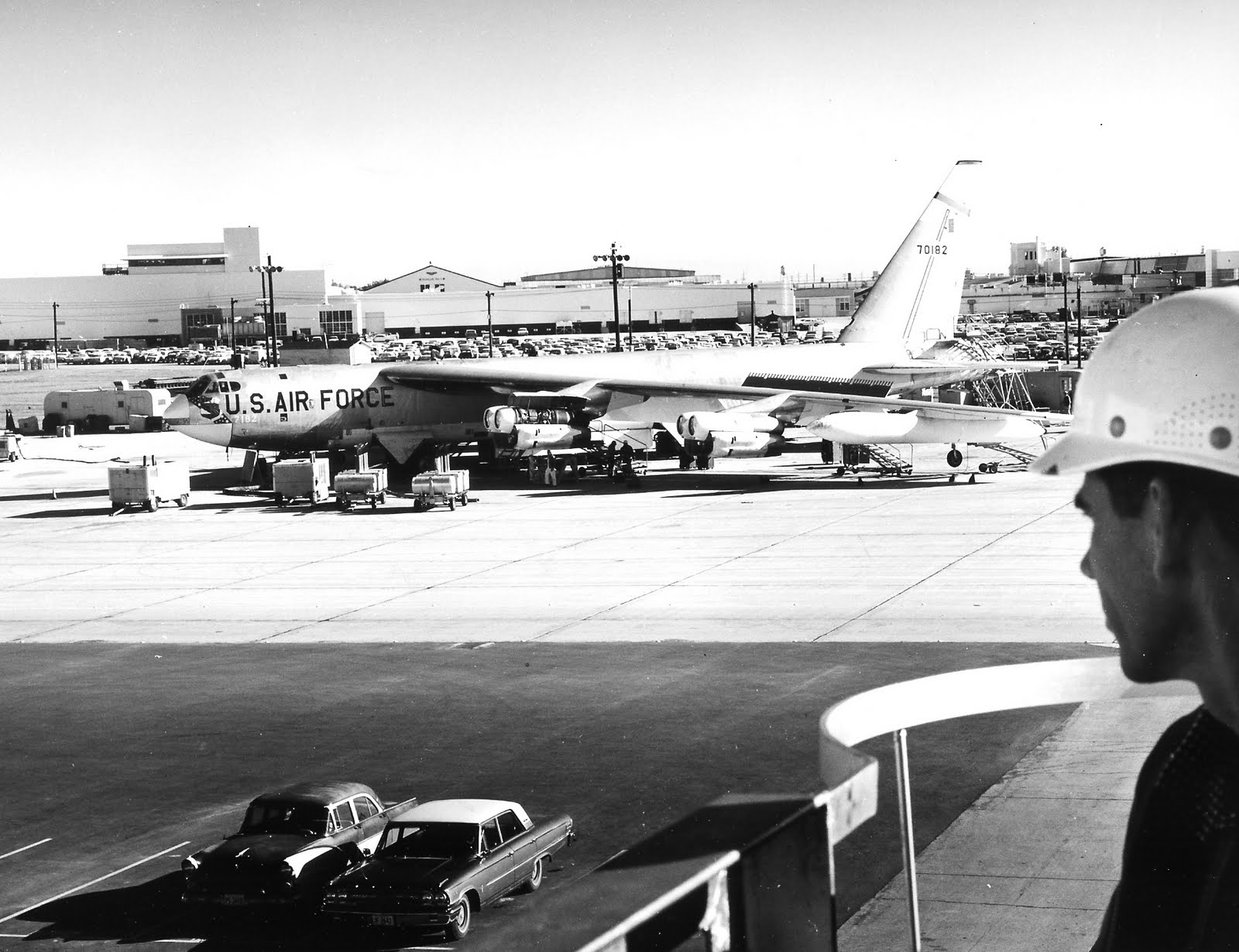
As you may or may not know, the LogAir depot at Kelly Air Force Base was prime on the B-52. Let's do a quick photo essay on The Big Stick. (Or the BUF if you'd rather. Me, I'm saying Big Stick, at least for today.) Today's time capsule deals with the aircraft during the last days of its "peacetime" paint.


57-0182, a B-52F-70-BW, gets ready for delivery on the ramp at Kelly. The year is post-1964 judging from the '64 Ford Fairlane we can see at the bottom of the photo. 0182 ended up at MASDIC in 1971.  Kelly AFB History Office


It's a long way to the top. In this early shot (with no handy cars to help us identify the year) we see 53-0387 (A B-52B- 30-BO) getting touched up on the ramp. The tail gunner's position is shown to advantage here. None of the B-models made it to Vietnam and 0387 ended up at the MASDC facility in 1966. Note the maintenance stand up against the vertical stab of the next B-52 in line---it must've been pretty sporty up there on a windy day!   KAFB History Office 3204116

Kelly was the depot for the BUF, which means that they all came back there for overhaul multiple times. This unidentified B-52 has seen the elephant as connoted by the mission markers on the side of the fuselage. You have to wonder if anybody at Kelly bothered to photograph the nose art (there was some) and the mission markers before inducting aircraft for maintenance. (If they did such a thing, I haven't been able to find out where it's housed---anybody out there got any ideas, or maybe some more BUF noses? If you do, please get in touch with me at the ubiquitous replicainscale@yahoo.com !)  KAFB History Office 61252711

That wascally wabbit sure got around, as attested to by the nose art on B-52D 55-0078. If you've never been around an aircraft during overhaul you just can't conceive how cluttered things are on the hangar floor! There's method (and planning) to the madness, but you'd never know it just by looking. This bird survived Vietnam only to be lost on 30 October 1981 near La Junta, Colorado, during a low-level night training mission.  KAFB History Office 4991546


A rampant bull, a palm tree, and five mission markers adorn this unidentified B-52. Sure wish we knew the story behind those markings!  KAFB History Office 6259649

I Told You This Would Take a While

I've been putzing around a little bit more on the "Nate", but we aren't getting anywhere fast. Here's what I've done since last we met---pathetic, ain't it?!


That One Famous Photo clearly shows a light color under the canopy, so I've gone back and painted it in Testor JAAF Light Gray Green, which is what I strongly suspect was under there. Note the rough demarcation line---there's no real point in getting this part perfect since the base of the canopy will hide any irregularities. My personal jury's still out on dusting some dark green over that anti-skid on the port wing root, but I'm probably going to do it before I call this thing finished, mostly because that murky photograph inplies it was actually done.


The prop got painted too. I generally use a subdued yellow for the striping on such things in the belief that a really bright "Hey look at me!" prop stripe detracts from the model. That's personal philosophy, of course, and you may want to do otherwise on your own creations. I'm going to go mask some stripes on the tail and aft fus as soon as we finish this installment of my ongoing ramblings; maybe next time you're here this thing will be almost done. Maybe...

It Must Be Time to Go

Mostly because I'm all typed out! We'll see you next week, or maybe a little bit later in this one. Meanwhile, be good to your neighbor!
phil

Tuesday, April 13, 2010

Banshee Addendum, A Demon or Two, A Wrinkly Bomb, and a Bipe

A-24 Paint; A Slight Return

Or in other words, go back to yesterday's blog and take a second look at the part about painting the very first A-24s. I don't have a clue why I didn't do it when I should have done it, but I left out the BuAer letter that goes with the spec. I've appended that letter and cleaned up a couple of dates which should, with any luck, make the piece easier to read and understand. Another thing I failed to mention is that I anticipate some folks will disagree with the conclusion I've reached regarding those nonexistant blue/gray A-24s. Feel free to drop me a line at replicainscale@yahoo.com if you'd like to offer up your thoughts on the topic, or if you'd like to discuss anything else, for that matter. I enjoy hearing from you.

Photos of the Phantom's Phather

I know, I know; even I can hardly bear to read that title, but it seemed to fit the mood of the moment. I won't do it again until the next time I get the chance. Meanwhile: After years of waiting there are finally a couple of pretty decent kits of the McDonnell F3H Demon for us to work with, even though the mainstream manufacturers still haven't snapped to the notion that a good injection-molded, state of the art 1/48th scale F3H, FJ, F2H, F7U, swept-wing F9F, or F11F kit (or even 1/32nd scale; these airplanes aren't that big) would sell like the proverbial hotcakes. The short-run guys aren't really doing much for us in that regard either, come to think of it, but these are mainstream airplanes, for cryin' out loud, and they deserve more attention than they've been given thus far. Somebody please hold off on that "new tool" (I had to say it!) Me109 or A6M-Anything and give us some decent 50s Navy jets instead. Go boldly forth, etc, etc.

And on and on he rambles, never stopping and barely coming up for air, but the point should've been made by now so let's look at a couple of pictures:

An F3H-2 on the Franklin D Roosevelt during one of her early-60s Med deployments. The aircraft is being spotted on deck; note the towbar extending from the NLG. It's interesting to observe the people in these old photos; there's no doubt who the Chief is in this picture! No BDUs or Zumwalt uniforms here, by Jingo!  (Minimal use of cranials too---it was a simpler time, and a far more dangerous one if duty put you on the flight deck during ops.)  Frank Garcia

Home again. This Demon has just recovered; the cross-deck pendant (that would be the "arresting wire" if you don't speak Navy) has just disengaged and is beginning to retract. Flaps and slats haven't been retracted yet, but that's about to happen. Note the position of the horizontal stabilator.  Frank Garcia

Our official Gee What's Going On Here shot of the day. These Tophatter F3H-2s appear to be on either a pier or a lighter, but I can't figure out which although the line running from the tug to the upper left of the shot would suggest the latter. I'm guessing the airplanes are being transferred , either from the boat to shore or vice versa, but I don't know which. Flaps and slats are deployed and the horizontal stab is in the full "down" position. The photo provides a legitimate reason to model a Demon with everything hanging, although that would only be relevant in a diorama of this sort. There's never a dull day on The Boat.  Frank Garcia

Let's Get Bombed

Remember back several installments when we were discussing Vietnam-era Navy ordnance? Somewhere in one of those discourses I mention that the Nav's bombs began receiving coatings to the exterior of their casings to make them less likely to cook off in a fire aboard ship. Here's a fine example of that very thing:

This Mk 82 is hanging of an FA-18A during a mid-1980s WesPac deployment on the Constellation and illustrates that nasty coating to advantage. Paint your bombs like this and they'll probably throw you right out of the old model airplane club, but this was/is a fairly normal appearance for Navy bombs. Note how rough the surface texture is, how wide those yellow stripes are, and how the entire weapon contrasts with that light gray tail assembly. This Bad Boy is fused and ready to rock!  Rick Morgan

And Speaking of Weapons, and Maybe of Druts

OK, who knows the history of the Douglas F3D Skyknight? More specifically, what was it designed for? If you answered Fleet defense, you hit the nail on the head, although in all honesty the F3D was woefully underpowered throughout its service career and probably wouldn't have posed much of a threat to any serious intruder bent on sinking the boat. (During the Late Southeast Asia War Games it was given the nickname of "Drut". Spell "drut" backwards and you'll gain a better understanding of that whole power-to-weight thing with this particular airplane... ) Interception duties fell by the wayside pretty quickly for the F3D and the type ended up being used for limited electronic warfare (Vietnam), utility, and test duties. Let's take a look at a Skyknight that falls into the latter category.

Our last Navy photo for the day shows an F-10B (Mr. McNamara's designation for the F3D after the 1962 designation realignment), BuNo 124630, preparing to take off from China Lake during 1964.

 The aforementioned F-10B preparing to launch during AGM-45 Shrike testing at China Lake on 7 February, 1964. The airplane is an old stager and her skin tells the story; she's been around the block a time or two! The second seat is occupied by a civilian engineer---what a job!  US Navy KN-8883

A Blue and Red Airplane Because We Haven't Had a Model in a While

So how about a bipe to end our day with? The model is the Eduard Pfalz DIIIa done up to represent Rudolph Berthold's bird. It's the Eduard kit and is 100% bone stock, but that's usually not a bad thing with Eduard's Great War offerings; none of them are perfect and most have errors that require correcting, but they sure look the part when they're done!

Boy, does that paint just jump right out at you or what?  This exceptionally striking scheme was used on a number of aircraft assigned to Jagdgeschwader II during April of 1918 and makes for a really pretty model. The Eduard Pfalz is a great kit to build if you've never done a biplane before; it looks daunting in the box but the Pfalz DIII family were robustly designed and that simplicity extends itself to the model as well. Caution is required during construction but it's not as tough a date as you might imagine. What you see here took approximately two weeks of part-time work to accomplish.

Here's a 3/4 nose shot that graphically illustrates why you should always pay attention to what you're doing. On my model the entire nose is red, but there's extremely strong evidence that the bottom of it was silver on the real thing. Phooey! It looks ok anyway, though. (The phrase "don't turn it upside-down" comes to mind here.) Rigging is stretched sprue (this is me talking; could it possibly be anything else?) and could stand to have turnbuckles added, which I may go back and do some day. Unless I don't...

And a photo of the Pfalz being plucked from the modeling desk by a Giant Hand. Run away! No, wait---don't run away--- let me tell you about a couple of other things first! The rubber available to just about anybody during The Great War rarely had carbon black added to it when it was processed and was almost never black in consequence. Aircraft tires of the day ran the color gamut from light gray to a dark grayish-brown, and some had a distinctly pinkish cast to them. The "rubber" color here is a mix of my own and is of the pinkish-gray variety. The red and blue are Testor paint out of those little bitty square bottles that used to cost ten cents when some of us were kids (they most assuredly don't cost that anymore!), thinned about 75% with ModelMaster thinner and squirted on with a Badger 150, after which a thinned topcoat of new-formula Floquil Clear Flat was applied to knock off some of that super high gloss that comes from using Testor paint that comes in those little square bottles! Stickies are straight out of the kit as is the photoetch that you mostly can't see unless you look into the cockpit. The dust is one of those things that just happens sometimes. ("Dust Happens." What a slogan!)

And We're Done!

At least for a while. For now, why don't you go write a letter to all the major, mainstream manufacturers and tell them we need good 1/48th scale kits of 1950s Navy fighters, then build yourself a Pfalz? Either one, or both, of those things will keep you occupied for at least a minute or two! Oh, and be good to your neighbor too. We'll see you again real soon.

phil

Wednesday, March 17, 2010

Hustler Maintenance, Bad Day in Birmingham, and a Token Zero

All Tore Down; Hustlers in the Barn

I saw my first real B-58 in 1961, when one flew over our quarters at Sheppard AFB. It was loud (four J-79s, remember?) and it looked like something from another world. It also looked like the landing gear was about to fall off, a characteristic of the Hustler's MLG trucks when in flight and a visual that's stayed with me to this day. (In retrospect I think my friends and I were all hoping the wheels would fall off so we could have them. It's funny how the 12-year-old mind works...) That was, if memory serves, the only time I ever saw a B-58 in flight; we went to Japan the next year and SAC started phasing the aircraft out of service shortly after we got back. It seemed that PACAF just didn't have much use for the beast, Southeast Asia War Games notwithstanding.

To get to the point for once, the Air Force operates several Air Logistics Centers around the country (but fewer than before thanks to that BRAC thing), each depot dedicated to a number of different aircraft, engines, and weapons systems. Kelly AFB in San Antonio was prime on the B-58, and it wasn't unusual for several Hustlers to be there at the same time undergoing maintenance. Here are a couple of photos of the B-58 for those of you who like to open things up on your models. Anybody out there brave enough to turn one of these shots into a diorama?

OK Gang, here's a project for you; how about three Monogram Hustlers undergoing depot level maintenance? This 1965-vintage photo shows three B-58s with various panels removed and work well underway. The escape pods have been removed and a small amount of cockpit console detail is visible on the aircraft in the foreground, while 61-2068 shows extensive use of paper and masking tape on the intakes and windscreen.   KAFB History Office 51832277

Here the escape pods are ready for installation on a 305th BW B-58A. This photo provides us with an excellent view of the nose gear and landing light detail as well. It's hard to imagine the clutter that surrounds an aircraft that's undergoing major maintenance until you've seen it first-hand, but the area is properly squared away. There's a lot to be seen here including jacks and access stands.  KAFB History Office 6672184

So You Think You're Having a Bad Day?

Contract maintenance for military aircraft isn't a new thing; it's been going on for years. Mostly it's a business-as-usual sort of deal, but every once in a while there's Drama. Sometimes there's a lot of Drama. Sometimes there's so much drama that you need fire trucks to get it to stop being Drama so you can go back to Business-As-Usual, which is what's happened in the series of photos below. The ramp is the Hayes Aircraft Corporation facility in Birmingham, Alabama (now Pemco); the year is 1957. I don't know much about the incident except that Hayes must've been big into KB-50 maintenance at the time, and either Hayes, the Alabama ANG,  or the airport had a really good fire team.

This is how things are supposed to be when you work in the aircraft maintenance business; just a nice quiet ramp with nothing much going on. In addition to KB-50 work, there was apparently some C-119 and B-25 activity at Birmingham as well.  Hayes AC 1-57-863

This bird's been burning for a while, but the fire team has it under control. Note the color of the smoke; this wasn't a fuel fire. (It would be normal for the aircraft to be de-fueled while undergoing maintenance.) Notice the proximity of other aircraft to the fire scene. Yikes!  Hayes AC 57-375

This closeup shows how the aircraft has broken in two at the wing. Note the fireman standing between the fus and the inboard engine still playing a stream of foam onto the fire. As bad as this looks, it could have been far worse. Somebody was definitely on the ball when this one started.  Hayes AC 1-57-362

The fire is out and the investigation begins. The KB-50 is a write-off, but as far as is known nobody was injured.   Hayes AC 1-57-374

Just how bad could this have been? Take a look at the rows of KB-50s parked near 8052 and figure that one out for yourself. There's no doubt that a tremendous amount of skill went into extinguishing the fire and minimizing the damage, but there had to have been a fair amount of good luck going on as well. You might want to think about this series of photos the next time something goes wrong where you work---maybe things aren't so bad after all!  Hayes AC 1-57-376

A Token Model For Today

Today's been a Real Airplane kind of day, so here's a shot of a model to keep things in perspective. It is, after all, Replica in Scale and it's a model airplane sort of deal, right? Right!

You can never have too many Zeros. This is Hasegawa's 1/48th scale A6M3 Type 32 marked as V-190 of the Tainan Ku as based at Buna during 1943. My dad was there, helped to take the place in fact, and may have even gotten a first-hand look at V190. That's something I can never know, but I always liked the airplane and wanted to build something from the Tainan Ku that wasn't a Type 21. Here's the result.


I'm lazy at heart, so extensive mixing of paint to get to the Flavor of the Month for the Zero's factory color just had no appeal for me at all. I'd read someplace that Floquil's "Concrete" (we're talking about the New Floquil here, not the much-loved DioSol-based paint of our youth) was a pretty close match to what the color faded to when exposed to the tropical sun for a while. That, plus the fact that the color comes reasonably close to matching the few chunks of Real Zero that I've been priviledged to examine clinched the deal; Concrete it was! The hinomarus were painted rather than decalled---it's really easy to mask and paint a Great Big Spot on a model---while all other markings were from the kit's decals. The back of the prop blades should be brown primer and not black as shown and it's in the plan to repaint them some day, but that pretty obviously hasn't happened yet. I mention it only to quell those of you who are poised to commence jumping up and down shouting things like "look at the prop blades, look at the prop blades".

Anyway, the model has the ubiquitous Eduard belts and harness but the rest of the cockpit is courtesy of the kit. The radio mast has been sawn off flush with the canopy per the Tainan Ku's long-established habit of removing the com gear(which apparently didn't work any too well in any case) from their aircraft. Hasegawa molds a radio into the side of the cockpit and removing it from the model to ensure that last bit of scale accuracy would be what an English modeler might term "fraught with difficulties", so it's still there should you care to pick up the model and take a look. I did give thought to removing it, but so doing would require a fairly extensive rework of the cockpit and I just didn't feel inclined to jump into that particular bucket, thus giving the Jump-Up-and-Downers an opportunity to do that again.

One final thing about the Hasegawa Zeros before we sign off. They all have a little triangular doohickey molded in front of the arresting hook well, and it shouldn't be there. Sand it off and fair in the hook because this airplane didn't have one installed. Build the model. Move on.

Something I Keep Forgetting

A few days ago I ran a color photo of a really pretty T-28B from VT-27 that a friend of mine shot at NAS Corpus Christi back in 1980. Robert Perry wrote me (at replicainscale@yahoo.com ) to let me know that the bird ended up at War Eagles Air Museum in New Mexico. There's a photo of it in its present guise at http://www.airliners.net/photo/North-American-T-28B/1313760/L/ if you're interested in what it looks like today. Robert let me know about this back on the 12th, which may mean I forgot to mention his update until now. Late is better than never, right?

And Something Else I Keep Forgetting to Remember

I've got a project underway and am looking for photography and/or personal recollections on the 21st TFW while they were flying F-100s out of Misawa AB, Japan during the late 1950s up through 1964-65. The squadrons would be the 416th and 531st TFS, and their operations included frequent TDYs to Kunsan AB, RoK. Any help would be greatly appreciated and all loaned materials returned promptly. Please contact me at, you guessed it:  replicainscale@yahoo.com if you can help.

And that's what I know for a Wednesday. Be good to your neighbor and we'll meet again soon.
phil