Back to the North Country (Northern Japan, That Is)
Without further ado, or any ado at all for that matter, here are another couple of images from Misawa AB, Japan, taken during the late 1950s/early 1960s. Misawa was a humming sort of place back then, and seemingly a haven for all sorts of neat airplanes. Let's look.
A "Hun" on the ramp. Not too colorful, but a "Hun" nontheless. 56-3333 was an F-100D-90-NA, photographed shortly after her assignment to the 39th AD (most likely the 531st TFS) during the winter of 1964. Dave Menard was on the ramp trying not to get "detained" for taking this shot, while I was a sophomore at Misawa HS a half-mile away. 3333 was later converted to QF-100D status and expended. Long ago and far away... A1C David Menard
This "Hun's" a little more like we'd expect to see. F-100D-40-NA 55-2870 was also expended as a QF-100D drone at the end of her life, but she's in all her 531st TFS livery in this shot. Sharing the ramp with her is F-102A-50-CO 55-3463 of the 4th FIS. That's the base steam plant in the background. Misawa's ramp was usually well patrolled and closed to non-authorized personnel, which makes me wonder about the two Japanese civilians visible in front of the small building on the left. Menard Collection
I think we can safely say we've saved the best for last! SB-17G 43-39361 was built as a B-17G-110-BO, then converted to SB-17 configuration post-War. This shot was taken near base ops at Misawa in 1950, making it contemporary with some of the F-80s we looked at last time around. That must have been a fascinating ramp! M. Zelnak via Menard
We Don't Do Warbirds Around Here, Except for This Time
A lot of my friends like Warbirds, and I have a couple of friends who prefer them to almost any other form of aviation. Me, I could take 'em or leave 'em, mostly because I don't much care for the way they get restored. If you're wondering what that might mean, try thinking of your average Warbird as a Great Big Model Airplane, being painted and marked by the person building same. Sometimes the results are pretty good, but sometimes they aren't, and it honestly kills my soul to see a vintage airplane all tarted up looking like a badly-done model airplane.
You could counter, of course, by saying that each airplane is privately owned and the owner gets to do what they want. I'd certainly agree with that notion, but my personal preference is to do it Right if you're going to do it at all, and a lot of warbirds just look odd to me. The modern com gear and associated antennae don't help, and I don't much care for those "N" numbers either, even though they're both necessary and, generally, tiny. It's a personal preference and nothing more. (On the other hand, we do get to hear and see them fly, for which I say a great big THANK YOU to all the folks who take the time and spend the money to keep those treasures in the air!)
That said, today I'm going to offer up a photo of a Warbird for your consideration:
Hoo-hah! If you have to own a Warbird, this is the way to do it. This sort of thing could almost make me like Warbirds!
Don Jay
On the Ramp at Douglas Tulsa
The old Douglas facility in Tulsa was quite an operation while in its prime, although a lot of folks aren't all that familiar with the place. It may therefore come as a surprise that a fair number of Boeing B-47s were built there under contract, while a bunch of them were overhauld and modded there as well. MarkNankivil sent these shots in several months ago, and todays a good day to run them.
There may be one or two of you out there who don't know what a nose dock is. This shot explains the concept better than words could ever do; a ramp full of B-47s are undergoing what would amount to IRAN on the Douglas ramp. At least three different fiscal year's worth of production are represented here. Of interest is the B-47 recovering on the active runway in the background. Greater St Louis Air and Space Museum via Mark Nankivil
Pretty birds all in a row. These Stratojets are of interest because they show us yet another sort of nose dock---that's two different kinds to use in a diorama, ya'll. Note the legend "Mod Unit" painted over the numbers on the aft fuselage. These B-47s are being reworked. Greater St Louis Air and Space Museum via Mark Nankivil
Sometimes You Just Get Bored, Ya Know?
Which is what's happened to me with two different projects (three, actually; theres that still-not-finished A-4C that we started this whole thing with almost a year ago). I've just gotten bored. Not burned out, I don't think, but seriously, severely bored.
First up in the Boredom Sweepstakes is that big P-40N I've been working on. It's almost done, in point of fact it's so close to finished that you can almost smell it, but I've ground to a stop on the thing. It's probably the masking of that doggoned spinner---the bottom half came out just fine but I've re-done the tip twice now and I'm still not happy with it. I've also been balking on the canopy and windscreen, both of which are easy enough to mask because of the way Hasegawa designed the kit (all the frames are engraved). That one falls into the realm of the cosmically unexplained; I just don't feel like doing it.
Anyway, here's where we got to before the project ran out of steam:
It's on its gear, has most of its decals, and now sports twelve, count-'em; twelve, individual exhaust stacks up there on the nose. A lot of the weathering has been done and it's been squirted with DullCote. In this view you can't really see what a mess the spinner is, but it comes right off of there and will soon be repainted. Well, maybe not soon, but it will be repainted. Someday. Those Zotz decals were interesting to work with too; the nose are went on as good as any decals I've ever used, while the national insignia suffered from a little bit of silvering, an issue that was ultimately resolved with the application of full-strength SolvaSet. Go figure.
If you saw one side you have to see the other. That awful spinner demarcation is shown to advantage (?) here, but the view also shows us the nice tire/wheel ensemble provided with the kit. All P-40 wheels were spoked alloy, but the pre-N versions mostly seem to have worn wheel covers. The wheels, and therefore the tires as well, on the P-40N were of a smaller diameter than those that came before, this being because the N-model was a "lightweight" variant of the Warhawk. The Hase kit gives both early (big, as found on their P-40E and K offerings) and late wheels, a nice touch. I didn't manage to mess up the demarcation on the wheels, although in fairness that's mostly because the wheels themselves are separate components, not molded to the tires. Yay, Hasegawa!
The sharp-eyed among you may also notice that the images are a little soft this time. That's because Jenny just got me a Brand Spanking New Digital Camera and I don't have a clue how to use it yet. This is what happens when you close your eyes and jump right in. It'll get better...
And the Other One I Burned Out On
Everybody builds a P-38 sooner or later, and nobody builds more than one, or at least nobody I know does. I think that's because the airframe is a pain in the wazoo to model, with alignment issues abounding in most kits. This one got started over a year ago, and it's been sitting like this for the past six months. All it needs is some touch-up and its transparencies but, once again, it's stuck where it is.
This photograph has been deleted by the staff of RIS. ed.
Here's Hasegawa's P-38G marked as "Hold Everything" from the 431st FS/475th FG ca. 1943. The decals are AeroMaster (the decal company that some of the Internet Experts love to hate) and went on without a hitch. They're a lot more accurate than I could've done by hand, and gave me an opportunity to build a colorful mid-War SWPA Lightning from the Pacific's premier P-38 outfit. The kit doesn't quite have that characteristic P-38 "squat" and the mlg doors are a bear to align, but otherwise it wasn't a tough build at all. The Hase Lightning kits have a reputation for being difficult but I'm here to tell you it just ain't so! They do have too many pieces in some areas, but if you're the least bit careful you end up with something that sure looks like a P-38.
Here's the whole reason for this model getting built. Almost everything our side flew in the Pacific ended up looking beat to pieces after a short period of operating off dirt airfields in the tropical sun. This P-38 is actually an exercise in fading; there are at least four shades of OD, plus a little zinc chromate primer courtesy of a colored pencil (lightly sprayed-over with one of those afore-mentioned olive drabs so simulate paint worn down to primer) on that airframe. I think it looks ok but I'm not quite done with it yet. Time will tell. Time might also tell if the transparencies ever get painted...
Almost a Boring Airplane
Sometimes you come into a photo that's just plain boring until you start paying attention to what it is. Here's an example:
143562, an FJ-4B from VA-216, is about as Plain-Jane an airplane as you can get. This example is on the static line at an early-60s airshow and is nothing to write home about until you notice what's hanging underneath it. I'll guarantee you nobody at that airshow knew what it was! (PC? What's PC?) Tailhook Association via Doug Siegfried
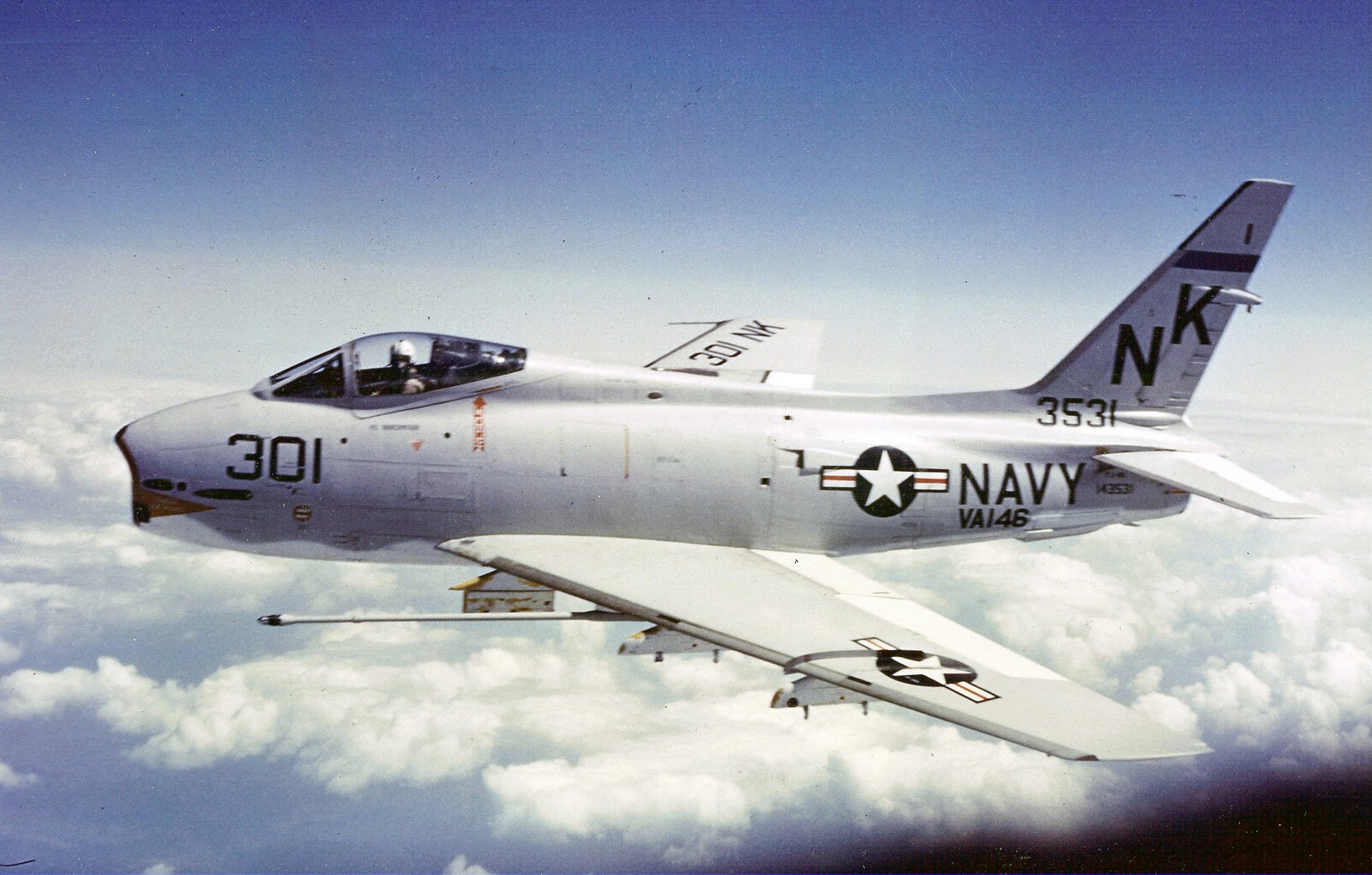
Here's another one that's pretty boring; this time it's an FJ-4B from VA-146 in flight. The shot's of interest to us because of the weathering on the pylons (note the Mil-P-8585 Zinc Chromate showing through) and the Corrogard on the leading edges. Although the shot's a little soft, it also gives us a fair idea of stencil placement, even though you can't actually read them. Tailhook Association via Doug Siegfried
VF-216 again, and still no squadron markings! There's a colored fin tip but that's just about it---143569 is just about as plain a fighter as you'll ever see. We've included it because it provides a lot of detail for the modeler. The sharp-eyed among you (and I'm presuming that to be just about everybody) will notice the lack of underwing stations. I'll bet the FJ was a joy to fly in this condition! Tailhook Association via Doug Siegfried
And one final FJ-4B shot, just to show we haven't given up on colorful airplanes. This VF-151 bird is sitting in the static line at yet another un-named airshow, but this time sans hardpoints and with a little bit of color. The squadron markings are subdued and tasteful and really work well with the Fury's lines. The tiny little stars around the tail of the big star are a nice touch. Tailhook Association via Doug Siegfried
The Relief Tube
We've got a couple of comments and corrections ( replicainscale@yahoo.com ) to share with you this week. Let's see what's going on:
First, from Don Jay: Hi Phil, Just looked at your latest edition of replica in scale. Some info for you:
The T-birds are not mine but I can help to pinpoint the time frame for you as between 10/78 and 4/79. In the background of -3679 is 53-5285 which arrived 10/78 and departed 4/79. I think (caution) that all the T-Birds belonged to the 21st Composite Wing. They were used for targets, ecm-spoofers, liaison, and to keep (the) HQ staff happy with some flying time. Thanks Don! Now, will the real owner of those T-Bird photos please stand up?!
And a kudo from a reader known only as Yeepie Jeepy:
I've always loved the FJ-4. I'm not sure why. they look pretty ungainly on the ground with that long nose wheel strut. On the other hand, they look really good in flight. Kinda like the Sabre Jet's brawny cousin. Thanks for sharing the pics.
Thanks Yeepie, and thanks for giving me a chance to define something for our readers. Although most blog sites allow reader comments with moderation (or sometimes without---how crazy is that?), we don't do that around here. I mention this so nobody takes offense if a comment doesn't show up on the blog---we'd love to hear from you but please send your comments to replicainscale@yahoo.com rather than to the comments part of the blog. It's easier for me to deal with it that way since this is still a one-person show. And I couldn't agree more with Yeepy about the FJ!
And that's what I know. Be good to your neighbors and we'll meet again real soon.
phil
Showing posts with label boeing b-47. Show all posts
Sunday, October 3, 2010
Saturday, July 3, 2010
Nate Moves Along, Air Group 1, Another B-47, Some Gorgeous Furies, A Destroyer or Two, and a Holiday
Progress is Our Most Important Product, But It Happens So Rarely These Days
Still, there's been a little bit of it on the Ki-27 project. Progress, that is. In fact, we might even say there's been some major progress on "Nate", because there's not a whole lot left to do. I was able to get the red on those stripes and do the preliminary work on the canopy a couple of evenings ago, as well as stick on the final couple of parts (which I'll probably manage to knock right off of there when I go to touch up the paint) to almost finish things up. Those modest accomplishments have made the model look a whole lot more like an airplane. Wanna see?
It's beginning to look a whole lot more like a "Nate", isn't it? Significant additions include the telescopic gunsight, turnover pylon, and the radio antenna mast. The red parts of the stripes have been painted in, and the preliminary work has been done on the canopy. It's getting pretty colorful around here!
This view shows the canopy, and its masking, to advantage. The transparency was masked with Tamiya masking tape (the wide stuff, whatever size that is---I'm not metric!), burnished down around the frames with a toothpick, and then cut with the tip of a really sharp #11 blade. When the narrow strips are removed you have the beginnings of a canopy frame! It seems as though most Japanese aircraft of the WW2 period had flat black inside the canopy frames, so the first coat of paint was black, followed by JAAF Grey Green, both being Testor model master colors. Note that there are some ragged demarcations on that canopy; let the paint dry for a day or two, then go back and re-mask/re-shoot any place where there's a gap. After that's dry, take a flat toothpick that's had the big end made into a chisel with your ubiquitous Really Sharp # 11 Blade and trim the paint demarcation. That hasn't been done to this model yet but will help that semi-sloppy canopy no end.
And our final shot for this installment, which shows those tail stripes a little bit better. They need some light touch-up too, which will require re-masking, but we're nearly there. Those white blobs on the wingtips are paint, which will be trimmed to the shape of the navigation lights by that chisel-edged toothpick we made to do the canopy with. Then, after all the weathering is done, the lenses will be painted in the appropriate transparent Tamiya color. The part of the fuselage deck where the canopy sits will be touched up so the only grey-green that shows is the stuff that's on the canopy frames and the decking that's under said canopy and then, after everything else is done, we'll add the antenna wire out of That Old Standby Stretched Sprue.
It's beginning to look like I may be doing a P-35A to go with this thing. Eduard made an interior for that old Hobbycraft kit, you know...
Better Late Than Never
Two installments or so ago we took a look at a really neat F4U-5 photo from Jim Sullivan. It was a CAG bird from Air Group 1, and it got Rick Morgan interested in finding the group emblem. He contacted Doug Siegfried at The Tailhook Association, who in turn found and sent the emblem so, without further ado:
And here it is, the 1947-50 insignia of Air Group 1. Let's let Rick explain it: Phil: Here’s the insignia on the cowl of that CAG-1 Hosenose via Doug Siegfried at Tailhook; it depicts the five primary squadrons in the group c.1950, VF-11 (the shield), VF-12 and -13 (bomb), VF-14 (Tophat) and VA-15 (Lion). Pretty clever although obsolete the moment one of them moves to another Group. Rick
Many thanks to Doug and Rick for the extra help on this one!
Bad Day For a Boeing Bomber
Boeing's B-47 was a beautiful airplane, well-proportioned and absolutely gorgeous in flight. This shot shows the aircraft in a somewhat less-than-flattering situation---stuff happens, you know...
Oopsie! 51-2151, originally built as a B-47B-35-BW but subsequently converted to DB-47B status, lies forlornly in a field in this tantalizing shot, the details of which are unknown to either the contributor or myself. The fact that it's a DB-47 and has the legend "Nike 2" painted on the nose could imply that the airplane was brought down during missile testing, although it's my opinion that there's too much intact airplane sitting there for that to be the case. If anybody has any thoughts on this photo I'd sure like to here them! (Dave Menard or Norm Taylor; are you out there?) Tulsa Air & Space Museum via Mark Nankivil
Are These Pretty or What?
Sometimes you find really neat stuff when you weren't looking for it at all, which is the case with these next images. I'd begun an FJ-4 project, the results of which will appear here sooner or later, and had requested help from Doug Siegfried over at The Tailhook Association. Doug sent the requested images but added some FJ-3s for good measure. Here are a few of those images but be forewarned; they're going to make you really Jones for a decent FJ-3 kit!
This shot's a little soft but Holy Cow! VF-121 definitely knew how to paint an airplane! There's color everywhere on this CAW-12 FJ-3M, and there are even a pair of "Sidewinders" peeking out from behind those tanks. If this doesn't whet your appetite for a decent kit of the Fury nothing ever will! Tailhook Association via Doug Siegfried
And a clean bird in flight. Note the staining behind the fuel dump; this sort of thing is often overlooked by modelers. Tailhook Association via Doug Siegfried
A couple of VF-121 birds mixed in with photo Cougars. These aircraft are from Air Group 12 ca. 1958, and the F9F-8Ps are from VFP-61. Tailhook Association via Doug Siegfried
BuAer regulations during what's been called NavAir's "Easter Egg Period" specified insignia white control surfaces, which are shown to good advantage on this VF-121 FJ-3M. This bird's armed up and ready to rumble, at least in theory. The FJ-2/FJ-3s were peacetime aircraft and, theoretically at least, never saw combat anywhere. How's that for an anti-glare treatment? Tailhook Association via Doug Siegfried
So you want to do a flight deck diorama, do you? How about this for inspiration! "Double Nuts" is getting ready to move off the angle and into position for launch---note the aircraft director preparing to guide her into position. Those guys in the V-1 division probably have the most dangerous job on the boat, but their ballet-like movements are something to watch! Let's see now; you'd have to scratch-built part of the boat, come up with a bunch of decent figures in properly-animated poses, and then hope that someone will issue a decent kit of the Fury. Oh well, we can dream, can't we? Tailhook Association via Doug Siegfried
Cat Shot! An FJ-3M from VF-121 takes to the air off the Lexington during her days as an attack carrier. I've included this one because it shows the airframe behind the deployed flaps; that area appears to be painted in Mil-P-8585 Zinc Chromate Primer. If we ever get a kit... Tailhook association via Doug Siegfried
Sometimes you run a shot because you really like it, and this is one of those times. This picture really defines the nose treatment on these aircraft! Note the crew chief's name (illegible, unfortunately) under the canopy. The removable IFR probe is readily visible in this photo. Tailhook Association via Doug Siegfried
You Just Don't See That Much On the B-66, Do You?
At least until today. Mark Nankivil sent along these photos of Douglas B-66 Destroyers in the process of production and overhaul at the Douglas Tulsa plant:
I've always liked shots of military aircraft in production or undergoing maintenance, which makes this next series a natural for today's effort. Here's the production line at Douglas Tulsa. This represents shot, taken in October of 1962, represents organized chaos at it's best! Tulsa Air & Space Museum via Mark Nankivil
This view, taken during the Vietnam War, shows a hangar full of B-66s undergoing overhaul. The 363rd TRW RB-66 is noteworthy. Tulsa Air & Space Museum via Mark Nankivil
It's a Fact, I Think
Many years ago, way back when I was a whole lot younger than I am now, I read some place (maybe in Boy's Life magazine?) the the Declaration of Independence was actually signed on the 3rd of July, then ratified on the 4th. There's no telling whether or not I'm remembering that correctly, but either way this day, or more likely tomorrow, is important to a lot of us. If you're an American you might want to take a minute or two to reflect on the meaning of the day. (It's also a holiday around here, which is a Good Thing too!)
Which brings us to a story. Back when I worked at Mooney Airplane one of my co-workers asked our production manager, who happened to be English, if they celebrated the day too. I thought it was an odd question and was really interested in his answer, which wasn't long in coming; John grinned at the non-historically-minded inquirer and said "Yes, we do celebrate the day. We call it Thanksgiving!" I guess it's all a matter of opinion!
Have yourselves a great and glorious 4th, and be good to your neighbor. We'll meet again soon!
phil
Still, there's been a little bit of it on the Ki-27 project. Progress, that is. In fact, we might even say there's been some major progress on "Nate", because there's not a whole lot left to do. I was able to get the red on those stripes and do the preliminary work on the canopy a couple of evenings ago, as well as stick on the final couple of parts (which I'll probably manage to knock right off of there when I go to touch up the paint) to almost finish things up. Those modest accomplishments have made the model look a whole lot more like an airplane. Wanna see?
It's beginning to look a whole lot more like a "Nate", isn't it? Significant additions include the telescopic gunsight, turnover pylon, and the radio antenna mast. The red parts of the stripes have been painted in, and the preliminary work has been done on the canopy. It's getting pretty colorful around here!
This view shows the canopy, and its masking, to advantage. The transparency was masked with Tamiya masking tape (the wide stuff, whatever size that is---I'm not metric!), burnished down around the frames with a toothpick, and then cut with the tip of a really sharp #11 blade. When the narrow strips are removed you have the beginnings of a canopy frame! It seems as though most Japanese aircraft of the WW2 period had flat black inside the canopy frames, so the first coat of paint was black, followed by JAAF Grey Green, both being Testor model master colors. Note that there are some ragged demarcations on that canopy; let the paint dry for a day or two, then go back and re-mask/re-shoot any place where there's a gap. After that's dry, take a flat toothpick that's had the big end made into a chisel with your ubiquitous Really Sharp # 11 Blade and trim the paint demarcation. That hasn't been done to this model yet but will help that semi-sloppy canopy no end.
And our final shot for this installment, which shows those tail stripes a little bit better. They need some light touch-up too, which will require re-masking, but we're nearly there. Those white blobs on the wingtips are paint, which will be trimmed to the shape of the navigation lights by that chisel-edged toothpick we made to do the canopy with. Then, after all the weathering is done, the lenses will be painted in the appropriate transparent Tamiya color. The part of the fuselage deck where the canopy sits will be touched up so the only grey-green that shows is the stuff that's on the canopy frames and the decking that's under said canopy and then, after everything else is done, we'll add the antenna wire out of That Old Standby Stretched Sprue.
It's beginning to look like I may be doing a P-35A to go with this thing. Eduard made an interior for that old Hobbycraft kit, you know...
Better Late Than Never
Two installments or so ago we took a look at a really neat F4U-5 photo from Jim Sullivan. It was a CAG bird from Air Group 1, and it got Rick Morgan interested in finding the group emblem. He contacted Doug Siegfried at The Tailhook Association, who in turn found and sent the emblem so, without further ado:
And here it is, the 1947-50 insignia of Air Group 1. Let's let Rick explain it: Phil: Here’s the insignia on the cowl of that CAG-1 Hosenose via Doug Siegfried at Tailhook; it depicts the five primary squadrons in the group c.1950, VF-11 (the shield), VF-12 and -13 (bomb), VF-14 (Tophat) and VA-15 (Lion). Pretty clever although obsolete the moment one of them moves to another Group. Rick
Many thanks to Doug and Rick for the extra help on this one!
Bad Day For a Boeing Bomber
Boeing's B-47 was a beautiful airplane, well-proportioned and absolutely gorgeous in flight. This shot shows the aircraft in a somewhat less-than-flattering situation---stuff happens, you know...
Oopsie! 51-2151, originally built as a B-47B-35-BW but subsequently converted to DB-47B status, lies forlornly in a field in this tantalizing shot, the details of which are unknown to either the contributor or myself. The fact that it's a DB-47 and has the legend "Nike 2" painted on the nose could imply that the airplane was brought down during missile testing, although it's my opinion that there's too much intact airplane sitting there for that to be the case. If anybody has any thoughts on this photo I'd sure like to here them! (Dave Menard or Norm Taylor; are you out there?) Tulsa Air & Space Museum via Mark Nankivil
Are These Pretty or What?
Sometimes you find really neat stuff when you weren't looking for it at all, which is the case with these next images. I'd begun an FJ-4 project, the results of which will appear here sooner or later, and had requested help from Doug Siegfried over at The Tailhook Association. Doug sent the requested images but added some FJ-3s for good measure. Here are a few of those images but be forewarned; they're going to make you really Jones for a decent FJ-3 kit!
This shot's a little soft but Holy Cow! VF-121 definitely knew how to paint an airplane! There's color everywhere on this CAW-12 FJ-3M, and there are even a pair of "Sidewinders" peeking out from behind those tanks. If this doesn't whet your appetite for a decent kit of the Fury nothing ever will! Tailhook Association via Doug Siegfried
And a clean bird in flight. Note the staining behind the fuel dump; this sort of thing is often overlooked by modelers. Tailhook Association via Doug Siegfried
A couple of VF-121 birds mixed in with photo Cougars. These aircraft are from Air Group 12 ca. 1958, and the F9F-8Ps are from VFP-61. Tailhook Association via Doug Siegfried
BuAer regulations during what's been called NavAir's "Easter Egg Period" specified insignia white control surfaces, which are shown to good advantage on this VF-121 FJ-3M. This bird's armed up and ready to rumble, at least in theory. The FJ-2/FJ-3s were peacetime aircraft and, theoretically at least, never saw combat anywhere. How's that for an anti-glare treatment? Tailhook Association via Doug Siegfried
So you want to do a flight deck diorama, do you? How about this for inspiration! "Double Nuts" is getting ready to move off the angle and into position for launch---note the aircraft director preparing to guide her into position. Those guys in the V-1 division probably have the most dangerous job on the boat, but their ballet-like movements are something to watch! Let's see now; you'd have to scratch-built part of the boat, come up with a bunch of decent figures in properly-animated poses, and then hope that someone will issue a decent kit of the Fury. Oh well, we can dream, can't we? Tailhook Association via Doug Siegfried
Cat Shot! An FJ-3M from VF-121 takes to the air off the Lexington during her days as an attack carrier. I've included this one because it shows the airframe behind the deployed flaps; that area appears to be painted in Mil-P-8585 Zinc Chromate Primer. If we ever get a kit... Tailhook association via Doug Siegfried
Sometimes you run a shot because you really like it, and this is one of those times. This picture really defines the nose treatment on these aircraft! Note the crew chief's name (illegible, unfortunately) under the canopy. The removable IFR probe is readily visible in this photo. Tailhook Association via Doug Siegfried
You Just Don't See That Much On the B-66, Do You?
At least until today. Mark Nankivil sent along these photos of Douglas B-66 Destroyers in the process of production and overhaul at the Douglas Tulsa plant:
I've always liked shots of military aircraft in production or undergoing maintenance, which makes this next series a natural for today's effort. Here's the production line at Douglas Tulsa. This represents shot, taken in October of 1962, represents organized chaos at it's best! Tulsa Air & Space Museum via Mark Nankivil
This view, taken during the Vietnam War, shows a hangar full of B-66s undergoing overhaul. The 363rd TRW RB-66 is noteworthy. Tulsa Air & Space Museum via Mark Nankivil
It's a Fact, I Think
Many years ago, way back when I was a whole lot younger than I am now, I read some place (maybe in Boy's Life magazine?) the the Declaration of Independence was actually signed on the 3rd of July, then ratified on the 4th. There's no telling whether or not I'm remembering that correctly, but either way this day, or more likely tomorrow, is important to a lot of us. If you're an American you might want to take a minute or two to reflect on the meaning of the day. (It's also a holiday around here, which is a Good Thing too!)
Which brings us to a story. Back when I worked at Mooney Airplane one of my co-workers asked our production manager, who happened to be English, if they celebrated the day too. I thought it was an odd question and was really interested in his answer, which wasn't long in coming; John grinned at the non-historically-minded inquirer and said "Yes, we do celebrate the day. We call it Thanksgiving!" I guess it's all a matter of opinion!
Have yourselves a great and glorious 4th, and be good to your neighbor. We'll meet again soon!
phil
Monday, June 28, 2010
Tweety Plumage, A Couple of Stratojets, Some More Invaders, and No Progress Whatsoever On The Nate
When Tweety Got New Feathers
Way back in 1987 (anybody besides me remember 1987?) the Air Force decided it would be a really good idea to put some color on their T-37 and T-38 fleets, not for the amusement of aviation enthusiasts such as ourselves but rather for conspicuity purposes. They'd tried once before with the late, lamented Candy Cane Air Force T-37s (a story for another time), but were a little more serious about things in the 80s. The scheme that Randolph AFB's corrosion control folks came up with (assisted by the not-inconsiderable input of some fellow named Keith Ferris) resulted in a scheme that remained on the T-37 until it was finally retired from service.
It was my good fortune to be on a shoot at Randolph during the transition, and I ended up with a fair amount of paint and markings-related T-37 photography as a result. Most of what I shot was on slides and I don't have a decent scanner yet, so I'm going to share some official USAF photography with you instead. Sure hope you like the "Dog Whistle"!
The first T-37B to wear the new high-vis scheme was 66-7982 of the 12th FTW. It was nicknamed "Tweet 1" and is seen here in the initial version of the scheme. The color is more of a royal blue than the later Insignia Blue worn by ATC's T-37s and T-38s, while the gear legs, wheels, and inner gear doors (along with the wheel wells) remained Insignia White. USAF
Here's the starboard nose. Note the crew chief's name painted under the anti-glare panel, as well as how the difference in lighting has perceptably changed the hue of that royal blue! USAF
ATC's birds were, and still are, well-used. 7982's rudder shows the effects of 21 years of continuous use! The bird proudly wears its RA tailcode at the top of the rudder. USAF
And the starboard side. This photo offers a fine example of the reason you don't normally want to shoot with backlighting! USAF
A detail of the empennage, useful primarily because it gives a pretty good idea of that original royal blue. 7982 was funded by the Federal Luftwaffe and was originally assigned to the 80th FTW at Sheppard before ending up with the 12th FTW at Randolph. The airframe was subsequently sold to Greece, finally ending up at the AMARC in 2006. USAF
If you're going to have a "Tweet 1", it only stands to reason that you'd have a "Tweet 2" to go with it. Here she is, parked on the T-37 Ramp at RAFB. 67-14737, another T-37B, ended up wearing the final scheme which used Insignia Blue rather than the royal blue of "Tweet 1". The "Dog Whistle" would wear this scheme until its ultimate retirement from the inventory. I think it's kindof pretty. USAF
And the upper wing up the same aircraft. That fuel cap treatment is reminiscent of the one used on the P-38 and adds an interesting touch to the upper surface of the aircraft. USAF
The guys at Randolph were kind enough to give me a blank form out of their corrosion control files. Here are my original notes on the scheme worn by 67-14737. (Note that I mis-identified the serial number when I did this. Some things never change...)
It's a Good Day to Run a Picture of the BUF's Daddy
The Boeing B-47 was ground-breaking in every way; a true pioneer of aviation engineering. The following shots don't really fit into any sort of format but are interesting nontheless. Enjoy!
It's a long, skinny photograph, but a photograph at any rate. 53-1915 was built at Lockheed-Marietta as a B-47E-70-LM, and was converted to EB-47E status at some point prior to its ultimate retirment to the MASDC in 1965. This early shot was taken during its time as a bomber and no; I don't know where those smudges came from either! For that matter, I'm not sure where I found this shot but I like the picture, mostly because of that antenna running from the vertical stab to the forward fus. Friddell Collection
The LOGAIR depot at Kelly AFB was prime on the B-47, and usually had a bunch of them in various stages of repair and overhaul. This maintenance hangar contains enough B-47s to equip a full SAC Wing!
Those were the days! KAFB History Office13066008
Two More Invaders For Your Consideration
If I had it in me to do a monograph on the Douglas A-26/B-26 family I'd probably include these next shots, but I'm not so I won't. You'll just have to settle for seeing them here...
This photo, poor as it is, is highly significant because of the time and the place: Clark Field, early 1945. The aircraft are from the 3rd but the image is too poor to make out much in the way of details. Once again the source is unknown, which is a shame. I wonder if there are any more photos of this lineup out there someplace... Friddell Collection
Here's something really dumb you can do to a photograph if you've a mind to. The original of this is a slide, which I shot at Randolph AFB on 18 June, 1972 during an open house. I figured I needed a print of it and had one made, but didn't specifiy the type of paper the print was to be on, so the image ended up on this crinkly stuff. You can see everything ok, but it's definitely not the way to run the railroad, just in case you ever wondered about doing such a silly thing yourself. The aircraft is an A-26B-61-DL (44-34610) of the Air National Guard Bureau. If I ever get a decent scanner I'll re-do this and run it again. Until that happens, let this be a lesson to me! Phillip Friddell
A Distinct Lack of Progress
On "Nate", that is. Nothing's happened to it between now and the last time you saw it, so we'll shine it on by for today. Meanwhile, be good to your neighbor. We'll talk again soon.
phil
Labels:
boeing b-47,
cessna t-37a,
douglas a-26 invader,
randolph afb
Tuesday, April 6, 2010
How's the Weather, More Gas Passing, and Some Tasty Intruders
When a Bomber Ain't a Bomber
The Boeing B-47 series must surely have been one of the most graceful families of aircraft to take flight; if you don't believe me just watch "Strategic Air Command" some time. Yep, the B-36 is nothing short of Majestic, but those B-47s are just about ten kinds of pretty. 'Nuff said.
Most of us think of the Stratojet as a bomber, or as a recon platform, but the type also performed sterling service as a weather ship. Let's start out the day with a couple of photos of B-47s, first as a bomber, then as a weather bird.
Here's a whole pack of B-47Es for your consideration. This lineup is interesting because it contains both early and late styles of anti-radiation flash paint (that would be the white on the bottom, for those of you who might not have been around when we were standing toe-to-toe against The Godless Communists during the Cold War). In the foreground is 52-0228, a B-47E-20-LM. USAF via M. Morgan
WB-47E AF 51-7063, a B-47E-75-BW that was converted to WB-47E standard. This one was assigned to the 55th WRS at McClellan AFB at the time the photograph was taken. Note the MATS shield on the aft fuselage and the "Weather" placard on the fin tip. USAF via M. Morgan
Sometimes the Shoe's on The Other Foot
We're all used to seeing the B-50 refuelling other aircraft in its KB-50 tanker role, but it's a little unusual to find photos of them on the receiving end of the operation. Here's a shot of an unidentified B-50D gassing up.
Something different: An unknown B-50D topping off the tanks. Note how the forward turret has been rotated to port in order to allow use of the refuelling receptacle. USAF via Morgan
A Couple of A-6 Shots
The A-6 Intruder was a positively amazing airplane for its day, with then-state-of-the-art avionics and a payload that would make your eyes water. It was an airplane that could take the proverbial lickin' and keep on tickin' too, yet another tribute to the glory days of The Grumman Iron Works. We're doing that free-form thing today because we don't have a whole lot of time, so why not throw in a couple of Intruders while we're at it?
A flight deck full of Bad News. Here's a division of VA-96 A6Es preparing to launch during the Constellation's 1984 WesPac deployment. A glance under with wing root of 504 will reveal a load of practice bombs. Rick Morgan
Ever hear of the AGM-53A Condor? Here's a test round hanging off an A-6E of the Naval Weapons Center during 1969. The missile was optimized for ship-killing and featured an electro-optical seeker/guidance system. Navy Photographic Center 19358
Every day I try to run at least one photograph that falls into the "Have Mercy!" category, also known as The Grabber Shot. This is one of the two we're going to feature today. The subject is an A-6E (BuNo159579) flying as Connie's CAG bird, which I think is from VA-196. This was my friend Mark Morgan's Christmas card photo one year! It must be nice... Mark Morgan
The Other Have Mercy shot; not the best of photos, but my-oh-my... Here's a photo from 1965 showing one of the experimentally-camouflaged A-6As from either VA-65 or VA-85. Pretty cool, huh? I wouldn't want to get shot down in that "Please Capture Me" orange zoom bag, though... via R. Morgan
And We're Done
Like I said before, it's a short day. With any luck we'll be back tomorrow; time will tell. Until then, be good to your neighbor!
phil
The Boeing B-47 series must surely have been one of the most graceful families of aircraft to take flight; if you don't believe me just watch "Strategic Air Command" some time. Yep, the B-36 is nothing short of Majestic, but those B-47s are just about ten kinds of pretty. 'Nuff said.
Most of us think of the Stratojet as a bomber, or as a recon platform, but the type also performed sterling service as a weather ship. Let's start out the day with a couple of photos of B-47s, first as a bomber, then as a weather bird.
Here's a whole pack of B-47Es for your consideration. This lineup is interesting because it contains both early and late styles of anti-radiation flash paint (that would be the white on the bottom, for those of you who might not have been around when we were standing toe-to-toe against The Godless Communists during the Cold War). In the foreground is 52-0228, a B-47E-20-LM. USAF via M. Morgan
WB-47E AF 51-7063, a B-47E-75-BW that was converted to WB-47E standard. This one was assigned to the 55th WRS at McClellan AFB at the time the photograph was taken. Note the MATS shield on the aft fuselage and the "Weather" placard on the fin tip. USAF via M. Morgan
Sometimes the Shoe's on The Other Foot
We're all used to seeing the B-50 refuelling other aircraft in its KB-50 tanker role, but it's a little unusual to find photos of them on the receiving end of the operation. Here's a shot of an unidentified B-50D gassing up.
Something different: An unknown B-50D topping off the tanks. Note how the forward turret has been rotated to port in order to allow use of the refuelling receptacle. USAF via Morgan
A Couple of A-6 Shots
The A-6 Intruder was a positively amazing airplane for its day, with then-state-of-the-art avionics and a payload that would make your eyes water. It was an airplane that could take the proverbial lickin' and keep on tickin' too, yet another tribute to the glory days of The Grumman Iron Works. We're doing that free-form thing today because we don't have a whole lot of time, so why not throw in a couple of Intruders while we're at it?
A flight deck full of Bad News. Here's a division of VA-96 A6Es preparing to launch during the Constellation's 1984 WesPac deployment. A glance under with wing root of 504 will reveal a load of practice bombs. Rick Morgan
Ever hear of the AGM-53A Condor? Here's a test round hanging off an A-6E of the Naval Weapons Center during 1969. The missile was optimized for ship-killing and featured an electro-optical seeker/guidance system. Navy Photographic Center 19358
Every day I try to run at least one photograph that falls into the "Have Mercy!" category, also known as The Grabber Shot. This is one of the two we're going to feature today. The subject is an A-6E (BuNo159579) flying as Connie's CAG bird, which I think is from VA-196. This was my friend Mark Morgan's Christmas card photo one year! It must be nice... Mark Morgan
The Other Have Mercy shot; not the best of photos, but my-oh-my... Here's a photo from 1965 showing one of the experimentally-camouflaged A-6As from either VA-65 or VA-85. Pretty cool, huh? I wouldn't want to get shot down in that "Please Capture Me" orange zoom bag, though... via R. Morgan
And We're Done
Like I said before, it's a short day. With any luck we'll be back tomorrow; time will tell. Until then, be good to your neighbor!
phil
Subscribe to:
Posts (Atom)