Showing posts with label Hasegawa model kits. Show all posts

Saturday, July 24, 2010

A Finished Hillbilly, Still Truckin' Along With the FJ, Looking Backwards, and Another Zipper

And the Nate is Done

It shouldn't have taken this long to do it, except I didn't have a whole lot of time to finish the thing. The Bottom Line is that it's finally completed, and there are some photos below to prove it.

The kit itself is a treasure, and has held its age quite well against its more modern competition (of which there is absolutely none in 1/48th scale!). You'd never know the thing was pushing 40, and it's easy to see why Hasegawa keeps reissuing the kit. It's quite a tribute to those guys at Mania that the model is viable after so many years, and that it produces such a great replica with very little work on the part of the builder. We've already discussed most of what was done in our previous installments, but there are a couple of things worth noting before we get to the photos.

First, the canopy (either one) fits relatively poorly, but it does fit after a fashion and the gap created by its attachment is nothing a little bit of white glue can't fix. I'm not sure but I don't think anybody makes a vacuum-formed replacement for it, but with a little effort you can use the kit part with no ill effect.

Second, the upper portion of the landing gear struts (those little post thingies that stick up through the wing over the main mounts) really do look better if you cut the kit representation of same off the wings, drill an appropriate-sized hole, and insert a piece of plastic rod after the airframe is painted. The tiny bit of extra work is well worth the effort in terms of final appearance.

Third, the pitot tube is very much over-scale. The one on my model wasn't rebuilt, but it should have been. It's a lesson relearned, so to speak.

As for painting, which we'd may as well discuss, all of the colors are pretty much out-of-the-bottle. The lower surfaces are Testor IJAAF Gray-Green enamel, while the upper surface brown is Testor RAF Dark Earth. The lighter of the two greens is new Floquil Coach Green (which honestly bears no resemblence whatsoever to the real Coach Green---so much for progress!) while the darker shade is Floquil Pullman Green, which doesn't in any way resemble its honored predessesor either. I think they work together fairly well in this case, but you're more than welcome to do it another way if you don't care for the shades or tonal values. (And if you do, please send along a picture or two of your model---I'd really like to see what you're doing out there! The address is replicainscale@yahoo.com .


See, I told you it was done. The stripes aren't perfect but I can live with that, although the ones on the real airplane were a little more precise than these! The tops of the landing gear oleos are painted to match the top surfaces of the wings---that's a guess on my part but it's a logical one and that's how I did it. Feel free; etc, etc.... Weathering is minimal because the airplane in That One Famous Photo doesn't look too gnarly, or at least it doesn't to me. The base is a bamboo cutting board (appropriate, that), while the figure is from a Fine Molds Ki-10 Perry. And yes, the white glue on the radio antenna is still drying. I'm not terribly patient these days...

And a better view of those stripes. I really like the way the colors work on this one, and it's definitely something different for the JAAF shelf! Banzai, ya'll!

Still Crankin' Along With the Fury

We should've finished up with the FJ series a couple of installments ago, but the photos that Doug Siegfried sent along were just too good to ignore, so tonight we're going to take a look at the Ultimate Fury, the FJ-4, also known as the F-1E and AF-1E in the McNamara realignment of America's military aircraft designation system in 1962.

Your Humble Servant first began to care about the FJ back in 1980 or so, which was when he (that would be me) decided to put together a unit list. I sent it off to our mutual friend Rick Morgan for annotation and correction and he was was kind enough to re-do it and send it back to me. Here, with considerable apologies to Morgo, is that compilation from Way Back When, scanned in from its typed (anybody out there remember typewriters?) original. It'll be easier to read if you remember that Rick appended both previous and subsequent aircraft types to the lists.


Rick was quite a scholar even then, and these lists definitely show why his books are so darned good. You might note that I did a little editing on the sketch of the Marine emblem on the last page. If you were in the Nav or the Corps you know what the missing phrase said. If you weren't, it may not matter. I covered it over just in case there might be folks of a sensitive nature reading this thing. Oh yeah, and please note that there's no attempt whatsoever to edit the piece.

And now for a couple of pictures:

Here's a gorgeous photo of 143549, an FJ-4B from VA-144. Note the color inside the wing fold; it ain't yellow green! Modelers take note: the airplane is lightly weathered.  Tailhook Association via Doug Siegfried

GMGRU-1 hung some interesting stuff off their FJs. Note how the pylon sweeps around to conform to the aft end of this particular store. Kindof makes you wish somebody would do a decent set of 50s/early 60s-vintage tanks/stores/pods/etc., doesn't it?  Tailhook Association via Doug Siegfried

The FJ-4 was a transition aircraft in many ways, and a lot of them ended up in utility squadrons. 139439 is shown while serving with VU-7; colors are Engine Gray, Chrome Yellow, and International Orange. It was an ignominious if colorful end to the career of a great fighter.  Tailhook Association via Doug Siegfried

VX-5 flew the Fury in several variations. Their treatment on the -4 was particularly pretty, I think, and this shot of 139549, an FJ-4B, displays it well.  Tailhook Association via Doug Siegfried


When most of us think of VF-126 we think of the late, lamented West Coast F-14 RAG, but they were the Real Deal when they were VA-126 flying the FJ-4. Love those markings!  Tailhook Association via Doug Siegfried


And another really pretty FJ-4B scheme, this one from VA-151 on display at an airshow. In reality the FJ series wasn't much of an attack aircraft, putting the lie to their assignment to attack squadrons, but then no other Navy jet of their era was much better. It could be argued that the A-4 only became viable with the advent of the MER and TER, while the A-6 represented the next generation of VA birds. Tailhook Association via Doug Siegfried

The Saga of Reptiles and Scales

No, this isn't another flying dinosaur thing, gang. It's a true story from Those Good Old Days when Jim and I were trying to birth the original RIS which does, I suppose make it old, but it ain't that old, ya'll! Stay with me and I'll tell you a tale.

Jim and I had met in the late 1960s, back when I was going to college and "working" at a San Antonio hobby shop. We'd talked about the mutual disappointment we felt in regard to the modeling magazines available to us, and then decided we could do better than those other guys were doing. It couldn't be that tough, could it? And no, at the end of the day it really wasn't that tough to do the magazine, although I'll admit the business end of it was a little tricky.

Anyway, we'd decided that a modeling magazine, one done our way, was in our future, so we began work on our Very First Issue. It took a lot of hard work, a lot of planning, and a substantial (to us, at least) infusion of cash, but The Big Day came and we submitted our copy to the printer (a quick-print sort of place, because it was all we could afford for that first issue) for production. What we got back wasn't bad at all, and served its purpose well in terms of launching the magazine. It was the bill that surprised us.

That first bill wasn't all that bad in monetary terms; just a few hundred bucks (we're talking early 1970s, remember?), but the printer's invoice was for a periodical called "Reptiles and Scales". It was hilarious then, and it's funny now, at least to me. It's possible that it wasn't terribly humorous to the poor soul who wrote it out, since we called the owner of said Quick-Print-Sort-of-Place and told him about it, but we thought it was a riot. It didn't take a whole lot to amuse us back then, I guess.

There's no moral to this story, and there really isn't much of a punch line either, but it caused us to refer to ourselves as "Reptiles and Scales" for years to come. It could've been worse.

A Well-Used Zipper

Don Jay sent me this F-104A a while back, but I'm just now getting around to publishing it:


This F-104C-5-LO was photographed at Edwards back in the mid-60s. The aircraft is 56-0934, and it's shown prior to being transferred to NASA as a space re-entry trainer. This is one of the few times, not counting the use of the aircraft in SEA, when a Century Series fighter appeared as heavily weathered as most modelers depict them.  via Don Jay

Better Late Than Never

Which is what we could've titled this installment since it's appearing almost a week later than it should have. Life got in the way again, ya'll! Anyway, I'll try to do better next time, so until then be good to your neighbor.

phil

Saturday, July 3, 2010

Nate Moves Along, Air Group 1, Another B-47, Some Gorgeous Furies, A Destroyer or Two, and a Holiday

Progress is Our Most Important Product, But It Happens So Rarely These Days

Still, there's been a little bit of it on the Ki-27 project. Progress, that is.  In fact, we might even say there's been some major progress on "Nate", because there's not a whole lot left to do. I was able to get the red on those stripes and do the preliminary work on the canopy a couple of evenings ago, as well as stick on the final couple of parts (which I'll probably manage to knock right off of there when I go to touch up the paint) to almost finish things up. Those modest accomplishments have made the model look a whole lot more like an airplane. Wanna see?


It's beginning to look a whole lot more like a "Nate", isn't it? Significant additions include the telescopic gunsight, turnover pylon, and the radio antenna mast. The red parts of the stripes have been painted in, and the preliminary work has been done on the canopy. It's getting pretty colorful around here!


This view shows the canopy, and its masking, to advantage. The transparency was masked with Tamiya masking tape (the wide stuff, whatever size that is---I'm not metric!), burnished down around the frames with a toothpick, and then cut with the tip of a really sharp #11 blade. When the narrow strips are removed you have the beginnings of a canopy frame! It seems as though most Japanese aircraft of the WW2 period had flat black inside the canopy frames, so the first coat of paint was black, followed by JAAF Grey Green, both being Testor model master colors. Note that there are some ragged demarcations on that canopy; let the paint dry for a day or two, then go back and re-mask/re-shoot any place where there's a gap. After that's dry, take a flat toothpick that's had the big end made into a chisel with your ubiquitous Really Sharp # 11 Blade and trim the paint demarcation. That hasn't been done to this model yet but will help that semi-sloppy canopy no end.


And our final shot for this installment, which shows those tail stripes a little bit better. They need some light touch-up too, which will require re-masking, but we're nearly there. Those white blobs on the wingtips are paint, which will be trimmed to the shape of the navigation lights by that chisel-edged toothpick we made to do the canopy with. Then, after all the weathering is done, the lenses will be painted in the appropriate transparent Tamiya color. The part of the fuselage deck where the canopy sits will be touched up so the only grey-green that shows is the stuff that's on the canopy frames and the decking that's under said canopy and then, after everything else is done, we'll add the antenna wire out of That Old Standby Stretched Sprue.

It's beginning to look like I may be doing a P-35A to go with this thing. Eduard made an interior for that old Hobbycraft kit, you know...

Better Late Than Never

Two installments or so ago we took a look at a really neat F4U-5 photo from Jim Sullivan. It was a CAG bird from Air Group 1, and it got Rick Morgan interested in finding the group emblem. He contacted Doug Siegfried at The Tailhook Association, who in turn found and sent the emblem so, without further ado:


And here it is, the 1947-50 insignia of Air Group 1. Let's let Rick explain it: Phil: Here’s the insignia on the cowl of that CAG-1 Hosenose via Doug Siegfried at Tailhook; it depicts the five primary squadrons in the group c.1950, VF-11 (the shield), VF-12 and -13 (bomb), VF-14 (Tophat) and VA-15 (Lion). Pretty clever although obsolete the moment one of them moves to another Group.  Rick

Many thanks to Doug and Rick for the extra help on this one!

Bad Day For a Boeing Bomber

Boeing's B-47 was a beautiful airplane, well-proportioned and absolutely gorgeous in flight. This shot shows the aircraft in a somewhat less-than-flattering situation---stuff happens, you know...


Oopsie! 51-2151, originally built as a B-47B-35-BW but subsequently converted to DB-47B status, lies forlornly in a field in this tantalizing shot, the details of which are unknown to either the contributor or myself. The fact that it's a DB-47 and has the legend "Nike 2" painted on the nose could imply that the airplane was brought down during missile testing, although it's my opinion that there's too much intact airplane sitting there for that to be the case. If anybody has any thoughts on this photo I'd sure like to here them! (Dave Menard or Norm Taylor; are you out there?)  Tulsa Air & Space Museum via Mark Nankivil

Are These Pretty or What?

Sometimes you find really neat stuff when you weren't looking for it at all, which is the case with these next images. I'd begun an FJ-4 project, the results of which will appear here sooner or later, and had requested help from Doug Siegfried over at The Tailhook Association. Doug sent the requested images but added some FJ-3s for good measure. Here are a few of those images but be forewarned; they're going to make you really Jones for a decent FJ-3 kit!


This shot's a little soft but Holy Cow! VF-121 definitely knew how to paint an airplane! There's color everywhere on this CAW-12 FJ-3M, and there are even a pair of "Sidewinders" peeking out from behind those tanks. If this doesn't whet your appetite for a decent kit of the Fury nothing ever will! Tailhook Association via Doug Siegfried


And a clean bird in flight. Note the staining behind the fuel dump; this sort of thing is often overlooked by modelers.  Tailhook Association via Doug Siegfried


A couple of VF-121 birds mixed in with photo Cougars. These aircraft are from Air Group 12 ca. 1958, and the F9F-8Ps are from VFP-61.  Tailhook Association via Doug Siegfried


BuAer regulations during what's been called NavAir's "Easter Egg Period" specified insignia white control surfaces, which are shown to good advantage on this VF-121 FJ-3M. This bird's armed up and ready to rumble, at least in theory. The FJ-2/FJ-3s were peacetime aircraft and, theoretically at least, never saw combat anywhere. How's that for an anti-glare treatment?  Tailhook Association via Doug Siegfried


So you want to do a flight deck diorama, do you? How about this for inspiration! "Double Nuts" is getting ready to move off the angle and into position for launch---note the aircraft director preparing to guide her into position. Those guys in the V-1 division probably have the most dangerous job on the boat, but their ballet-like movements are something to watch! Let's see now; you'd have to scratch-built part of the boat, come up with a bunch of decent figures in properly-animated poses, and then hope that someone will issue a decent kit of the Fury. Oh well, we can dream, can't we?  Tailhook Association via Doug Siegfried


Cat Shot! An FJ-3M from VF-121 takes to the air off the Lexington during her days as an attack carrier. I've included this one because it shows the airframe behind the deployed flaps; that area appears to be painted in Mil-P-8585 Zinc Chromate Primer. If we ever get a kit...  Tailhook association via Doug Siegfried


Sometimes you run a shot because you really like it, and this is one of those times. This picture really defines the nose treatment on these aircraft! Note the crew chief's name (illegible, unfortunately) under the canopy. The removable IFR probe is readily visible in this photo.  Tailhook Association via Doug Siegfried

You Just Don't See That Much On the B-66, Do You?

At least until today. Mark Nankivil sent along these photos of Douglas B-66 Destroyers in the process of production and overhaul at the Douglas Tulsa plant:


I've always liked shots of military aircraft in production or undergoing maintenance, which makes this next series a natural for today's effort. Here's the production line at Douglas Tulsa. This represents shot, taken in October of 1962, represents organized chaos at it's best!  Tulsa Air & Space Museum via Mark Nankivil


This view, taken during the Vietnam War, shows a hangar full of B-66s undergoing overhaul. The 363rd TRW RB-66 is noteworthy.  Tulsa Air & Space Museum via Mark Nankivil

It's a Fact, I Think

Many years ago, way back when I was a whole lot younger than I am now, I read some place (maybe in Boy's Life magazine?) the the Declaration of Independence was actually signed on the 3rd of July, then ratified on the 4th. There's no telling whether or not I'm remembering that correctly, but either way this day, or more likely tomorrow, is important to a lot of us. If you're an American you might want to take a minute or two to reflect on the meaning of the day. (It's also a holiday around here, which is a Good Thing too!)

Which brings us to a story. Back when I worked at Mooney Airplane one of my co-workers asked our production manager, who happened to be English, if they celebrated the day too. I thought it was an odd question and was really interested in his answer, which wasn't long in coming; John grinned at the non-historically-minded inquirer and said "Yes, we do celebrate the day. We call it Thanksgiving!"  I guess it's all a matter of opinion!

Have yourselves a great and glorious 4th, and be good to your neighbor. We'll meet again soon!
phil


Monday, March 29, 2010

Helping a Friend With Some Photos

Helpin' When I Can, Or Thoughts On a Speedy-Dee

We all have favorite airplanes, and I've made no bones about the fact that mine is the Lockheed F-104. This isn't about that, though, so don't go looking for pictures of pointy little airplanes here. There won't be any of those, not this time anyway. (Probably later, though...)

What there will be is the Douglas SBD, or A-24 if you prefer, although it won't really be an A-24 deal at all because I've got some really tasty photos of 3rd Attack Banshees at Port Moresby to share with you, and that's going to be a whole separate thing on another day. Today's just going to be the SBD, and more specifically, the SBD-2 and -3. So why is that, you might reasonably ask?

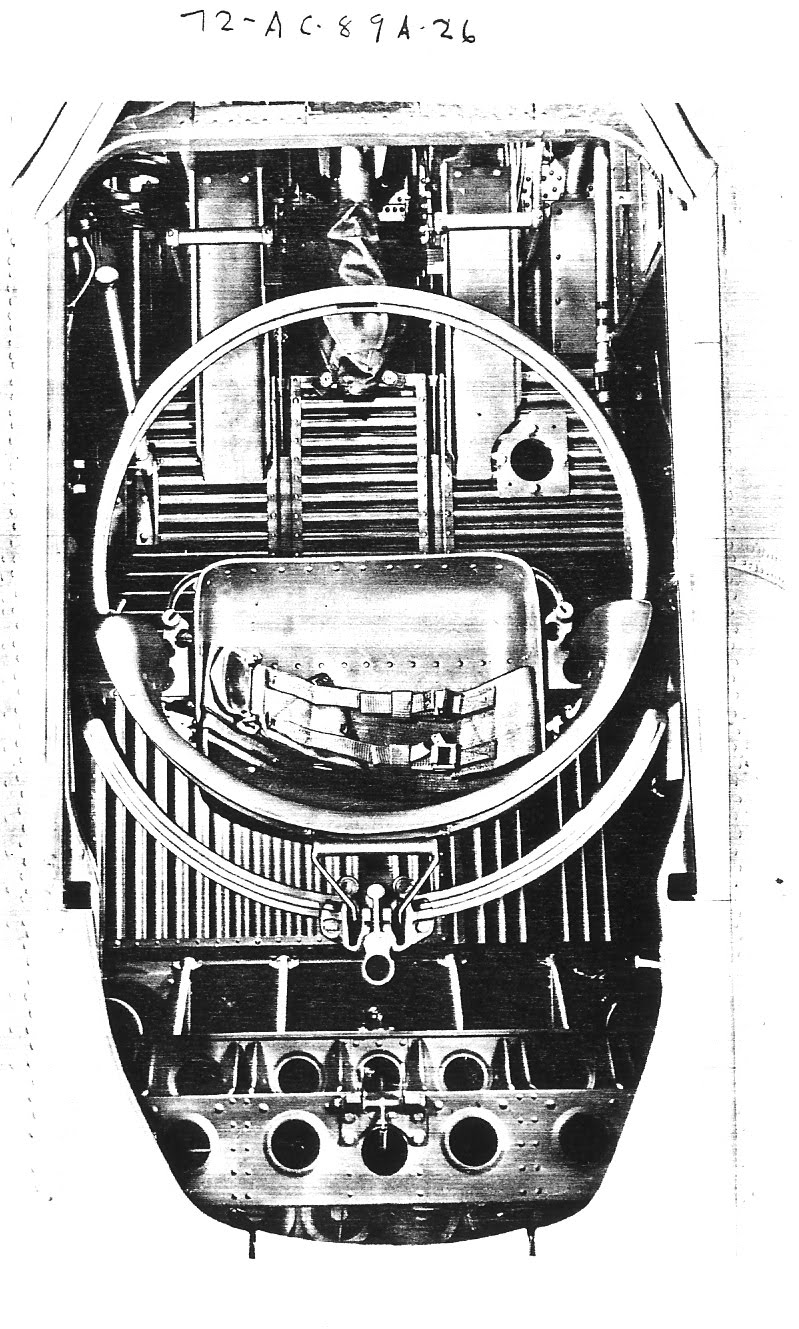
It's really simple. My friend Frank has started a Midway-based -2 using the Accurate Miniatures kit and I wanted to help out. What follows (after I finish talking, anyway) are some scans from a Douglas manual that will give a really good idea of what a wartime (as opposed to a contemporary restored warbird, which are, I can assure you, two dramatically different animals!) Dauntless radio operator's turret (and that's what both Douglas and the Navy called it; a turret, and the guy that sat back there was the radio operator) should look like. (Another highly convoluted sentence, that. It's probably a good thing I'm not in school anymore!)I've thrown in a couple of other goodies too just in case they might end up being of use. You would reasonably expect to see cockpit photos too, but they're deliberately conspicuous by their absence since every book you've ever seen on the SBD details that area pretty well and I'm pressed for time just now.

First, and pressed for time or not, here's some more talking! Frank builds primarily in 1/48th scale. So do I. That means we're going to take a half-minute or so and discuss the three kits that are contenders in that scale, even though two of the three are worthwhile with an enormous caveat attached to them. You can get a pretty good SBD model out of any one of these kits even though you're going to laugh at two of them, and maybe even exercise some of that Internet Expertise that can be so pervasive in our hobby and which may even cause you to say something Profound. Then again, maybe not.

The first kit that you can laugh at, or be snobby at, or whatever you might want to do at, is the now-ancient Monogram SBD-more-or-less-3. It truly is old (1960 or 61, I think), and it's got lots of working features such as retractable landing gear, working flaps, and a droppable bomb. It's also got poorly-detailed landing gear and no cockpit to speak of, and on top of all that it's covered in rivets. OK, so let's throw it away, right? No. Let's don't do that, but let's clarify why I'm saying what I'm saying. The basic kit is accurate dimensionally. The working features can be un-done (Modeling 101 rears its ugly head again; no Instant Gratification here, gang!) and missing details added. The landing gear can be fixed. And the rivets are ok, mostly, because the real SBD was covered with universal head rivets (those round-headed ones that stick up from the surface). The rivets are accurate and no other 1/48th (or 1/32nd) scale kit gets them right. In the rivet department it's Monogram's race, although it would be far easier and infinitely more practical to build your model off something a little more modern. It would be extremely labor intensive to construct a good model from this kit, although it can be done. The Monogram kit suffers from being the first one in the scale, and I would probably agree with you that it's best built box-stock, as a representative of days gone by. The pain ain't worth the gain anymore. You can, however, produce an outstanding model from it if you want to do that.

The next contender is from Hasegawa, which I think was issued as a -3 and a -4, and maybe (although I'm not certain about it) as a -5 or -6 too. It's a good kit dimensionally and is easy to build, but in many ways it's as tough a date as the old Monogram one. Simply put, it's not up to what anybody would consider to be The Normal Hasegawa Standards. It doesn't have raised rivet detail (not a deal-breaker), the cockpit is inaccurate in a number of areas, but the worst is in the diving flaps. Monogram didn't open up those holes (all 350+ of them) on their kit, but their kit is almost 50 years old so we can forgive the omission. Hasegawa didn't open them up either, and molded them so softly that centering a drill to correct the flaps is extremely difficult, thus forcing you to replace them with aftermarket, presuming that's still available, or fill them with black paint. It's a cryin' shame, too, because those holes are a major part of the Dauntless' personality. It might not seem so at first glance, but it would take almost as much work to correct the Hasegawa kit as it would the old Monogram one even though you do, in theory at least, have a better starting place. Me, I'd pass it right on by.

Fortunately, Accurate Miniatures also did an SBD for us, and have released it as all the Navy/Marine variants (at least I think they did, but it's no Big Deal if they didn't. If you've got a -2 then a -3 and -4 are a snap to build, while having a -5 means you can easily do a -6 too; most of the changes between SBD variants were internal, with cowling and free-gun installations being the significant external differences. (Yes, I know about the little spinner. It's no big deal.) The AM kit doesn't have rivets (wonder why not---they got everything else right!) but otherwise it's a thing of beauty. I personally stick Eduard PE in every kit I build, but you don't really need it for this one. It's the basis for an outstanding model right out of the box and is the kit of choice for most folks. It's a good 'un.

Now that we've got that out of the way, here are some illustrations and photos for you:


The radio operator's turret. The top of the photo faces forward on the actual aircraft. Note the rudder pedal troughs and radio operator's lap belt---the SBD could be flown from the back seat.   Douglas via Harry Gann


Sitting in the radio operator's position looking forward. The rudder pedals, stowed stick (at the left of the photo) and rudimentary flight instruments are all shown to advantage. Note the hoisting sling by the turnover pylon. While the SBD could certainly be flown aboard the boat, it was frequently hoisted aboard at pierside.  Douglas via Harry Gann


The upper view gives a better idea of how the stick was stowed. The throttle is at upper right. It was a simple cockpit.  The lower photo showes the canvas screen that was normally in place at the forward end of the radio operator's position; note the cutout allowing the back-seat instruments to be seen with the cover in place. Douglas via Harry Gann


The SBD-3 got twin .30 calibre free guns early in the production run, while all the -1s and -2s were outfitted with a single .30 in the radio operator's position. This illustration shows the single gun and its ammo can in the stowed position.  There's no armor visible here; that came later, after combat experience showed it to be a Really Good Idea.  Douglas via Harry Gann

And finally, some shots of operational SBD-2s and 3s. Please excuse the quality on a couple of them; the originals weren't very good...


Neutrality Gray. These SBD-3s wouldn't look like this for long; it's October of 1941 and war is barely a month away. Note that only the middle aircraft has a spinner fitted.  National Archives HG85-017C via Jim Sullivan


Remember that hoisting sling we talked about a few minutes ago? Here's what it was used for. Present-day safety officers would be seriously concerned about the goings-on in this photo, but it was business as usual for the WW2 Navy. The aircraft is an SBD-4.  National Archives

A classic shot of a classic aircraft. These Bombing Six SBD-3s are running up to launch aboard Enterprise; this photo was taken during the February/March 1942 time frame. Note the rudder stripes and oversized national insignia. The Air Group Commander's aircraft is immediately behind B4.  National Archives

End of the road at The 'Canal. This damaged Marine SBD-3 is in the process of being salvaged for parts at Henderson Field on Guadalcanal. The battle for the island extracted a heavy toll in both men and equipment.
Admiral Nimitz Museum via Bruce Smith

Is That All There Is?

Yep, for today, anyway. We were experiencing what some folks might call "technical issues" for the better part of the day and now I need to jump on the lawn tractor and go cut a whole lot of grass. Be good to your neighbor and we'll be back to normal tomorrow.
phil


Thursday, March 11, 2010

More Scooter Ordnance, Corrections, and a Happy Snap or Two

Expanded Horizons for Scooter Ordnance

As you surely all know by now, we've been more-or-less building a Vietnam-era A-4C for the past few installments of this deal. It's been slow going, mostly because I went off and got myself interested in something else, but it's still a project in work and I swear we'll finish it in the next week or two! Well, we'll probably finish it in a week or two. Maybe.

My habitual procrastination notwithstanding, there's more to be said about Scooter ordnance today, but we're going to widen the scope a bit and include those later 5-station variants (the Echo and Foxtrot), mostly because a couple of folks have asked about them. (That e-mail address is replicainscale@yahoo.com if you want to ask questions or throw your 2-cents worth into the pot.)

One of my long-time friends is a former naval aviator and noted author. Many years ago, a while after the original RIS had shut its doors and while I was working with Aerophile, he and I met began corresponding and trading slides. A lot of that correspondence was publication quality, and I've still got most of it in the files. That's where today's first piece comes from. It's not dated but a quick glance at the references listed at the top of the page (and I'm sure he had others he couldn't share at the time, but the ones he gave were all unclas and therefore ok to provide to a civilian journalist) shows it to come from the early 80s, and the pages he cites in those works gives a pretty fair pictorial overview of what the A-4 was carrying during the Vietnam War. I had originally given some thought to doing a quick re-write of the piece but there's really no point to doing it; it carries itself very nicely without any help from me, thank you!

You'll probably notice that the references to modeling refer to 1/72nd scale and nothing else. That's because 72nd was the scale of choice for most of us back then; there just wasn't that much available in the bigger scales at the time, and 99% of what was published was about models in that size. It doesn't really matter at this remove, because we're only interested in weapons fit today---this ain't no kit review, ya'll!

That said, and without further ado, here's our expanded A-4 weapons primer. Please note (as if you wouldn't figure it out for yourself anyway!) that I did it as a photo scan, a quick and dirty technique that I actually know how to do. Just click on the text and it'll magically become big enough to read!


A shot from CVA-31 Bon Homme Richard's 1970 cruise book showing "Jaunty Jan" an A-4E from VA-94, on the cat. Loadout is 6 Mk82s (1 each on stations 1 and 5, 2 each on TERs mounted on stations 2 and 4, with a 300-gallon gasbag on centerline. This is a typical load for the period.  USN via Morgan

A pair of VA-22 A-4Fs photographed in May of 1969. Of interest here are the MERs on centerline and the configuration of the drop tanks on stations 2 and 4. If the aircraft were bombed up the MER would be loaded with 5 bombs; the aft center mount would be left empty to avoid deck strike issues during the cat shot.  Once again, the photo is out of CVA-31's 1970 cruise book.  USN via Morgan

The kind of photo that model companies and some modelers love; an A-4F (BuNo155057) flying out of NAS Lemoore and hauling everything but the kitchen sink. It makes for a really impressive shot but in reality a Scooter dragging this sort of load around would have an extraordinarily small radius of action and would be relatively worthless as a combat asset as a result. Big Payload + No Extra Gas = No Range! You gotta get there before you can fight!  US Navy 1166520

A-4Es and Fs could be fitted with the AGM-45 Shrike Anti-Radiation Missile for SAM suppression (Iron Hand) work. Here an A-4F from VA-55 fires a Shrike during evaluations at China Lake in May of 1968.  US Navy KN-24543

The Scooter could do more than just drop bombs. A VC-1 A-4E (BuNo149977) hauls a target dart aloft from NAS Barber Point during 1974. Of special interest are the gas bags; this guy's planning on being up there for a while. Looks like it's going to be a busy day!  US Navy KN-22833

Time for Some Happy Snaps!


The late, lamented Kelly AFB was once the depot for B-36 maintenance, among other things. Here's a fine shot of the B-36 docks taken during 1954-1955 when the Peacemaker still ruled the skies. Between the ramp and the hangars you can see at least 8 of the monsters either undergoing maintenance or being prepared for delivery to their parent squadrons. The B-36s absolutely dwarf the B-50s and C-118 also visible in the photo. Engine runups were performed on the apron at near-left; note the extensive staining from engine oil. The mess came with the territory back in The Old Days of reciprocating engines and is a point often missed by dioramists!  KAFB History Office


I used to spend a lot of time at aviation facilities back when I was actively doing photography. The folks at NAC Corpus Christi were always just super, and would often allow me to shoot from the control tower catwalk, which is where I photographed this VT-27 T-34C back in 1987. The upper surface conspicuity markings are shown to advantage here and might be helpful if you plan on modeling a Turbo Mentor.
Phillip Friddell


And finally, a T-28B, also from VT-27 but a bird of a different era. BuNo 138247 was shot by a coworker of mine at a Corpus Christi open house in 1980 and really shows off the special paintwork on Triple Seven. The single star in the blue field seems to indicate that the aircraft was assigned to someone of flag rank, possibly the commander of CNATRA. Does anybody have any more information on this one?  Franke via Friddell Collection

'Scuse Me For a Minute While I Wipe That Egg Off My Face

I could've known better. I should've known better! If you were to go into my library right now this very minute you'd find, almong other things, a stack of F-104 references some 18 inches high. That stack is comprised of manuals, photos, and various technical reports. It's pretty extensive and moderately comprehensive, and could help somebody write a pretty decent book on the Zipper if they bothered to read the stuff to be found within. As for me, I did read all that stuff once, but it was a very long time ago while I was working on a project for the late Nick Waters. I haven't touched it since, at least not until yesterday when I got the bright idea to run some CAF Zips as a photo essay. In theory it was a Good Idea. In practice it fell a little bit short...

If, and I emphasize if, I'd bothered to refresh my memory regarding the CF-104 before I published the piece, I probably wouldn't have made the mistakes I made. But I didn't, so I did. Yikes! Here's a correction I received from Jim Bates up in Canada, who's rapidly becoming my authority on things that fly (or flew) in The Great White North. So then, and without further ado:

Phil,

Saw the CF-104 pics on your blog. A few short corrections/comments:

1. The CF-104 was the CF-104 in Canadian service. There was no CF-104G. There was however a CF-104D which was the Lockheed build duals that Canada flew. Oddly the CF-104 was originally going to be the CF-111 which was a carry over from the fact the RCAF assumed they were getting F11F Super Tigers and the politicians had better ideas.

2. The guns were not originally fitted to the CF-104s as they were just nuke bomb trucks. When they switched over to the conventional bomb truck role in the late 60s the M-61s were fitted and carried until retired.

3. The red strip on the inlet of 704 was more for test purposes as it was operated by AETE...see the big red X on the tail. I assume it was to make it easier to see for the photo ship during weapons trials.

4. Actually the overall green scheme predated what you call the RAF/NATO scheme. The overall green scheme started to appear in either the very late 60s or early 70s. (I can't remember off the top of my head.) The RAF/NATO scheme appeared in the late 70s and was the final scheme the CF-104 carried in CAF service. The checkerboard four ship was taken around the time of the changeover.

And technically the green/gray over gray scheme is called the variegated camouflage scheme.

Pat Martin has done a series of books on CAF and RCAF (and Royal Canadian Navy) finishes that have all kinds of great information if you have an interest in (R)CAF stuff.
 
Cool to see the second A-26 photo. Thanks.

Jim
 
And thanks to you, Jim, for keeping me honest! I haven't seen any of Pat Martin's books but it sounds as though they're well worth obtaining; thanks to Jim once again for pointing out a resource many of us may not have been aware of.
 
Remember, folks, that you can write to me at the replicainscale@yahoo.com address with comments, corrections, or maybe if you'd just like to pass along a photo or two. I enjoy hearing from you!
 
Be good to your neighbor, and check your references before you publish!
phil

Wednesday, March 3, 2010

A Little Late But Better Than Never

A Photo By Request


A couple of days ago we ran a photo of an A-4C tanking off an A-26. I'm still looking for details of the test program in hopes that we can do a small feature some day, but in the meantime I've been asked if there are any other photos of that A-26 tanking incongruous aircraft. By the oddest of coincidences (and thanks once again to the kindness of John Kerr) there is one other shot that might be of interest. It's another NATC bird, this time an A3J-1, getting ready to engage the basket. Jim Bates, who posed the question regarding additional photography, tells us that the A-26 was possibly owned by Beech, and that the pod on the Invader  ended up as a production item, most notably being used on the CC-137s of the Canadian Armed Forces. Thanks, Jim, for your input on this one!

Can We Have a Day Without a Scooter?

But of course! Today's not the day, though, just in case you were wondering. There's been precious little progress on the Hasegawa effort presently underway over here, but I've managed to dig up another couple of photos that might be of interest to anybody building (or contemplating building) the model.

Our first shot is another one taken by Frank Garcia when he was assigned to the FDR back in 1961. It's a VA-12 (Flying Ubangis; they have another, extraordinarily rude, nickname, but in the interest of maintaining a site that anybody can visit we aren't going to mention it here) A-4C and the photograph is notable because it illustrates the use of a TER rack on the centerline. Note the date; this is not a wartime bird. FDR was in the Med at the time the photo was taken.


Next up is a shot of an A-4C sporting a load of Mk76 practice bombs. The aircraft is an A-4C of VMA-225, and the photo was taken at Roosevelt Roads in 1963. Of interest is the Corrogard on the leading edges of the deployed slats and the wing station, and the "No Push" lettering on the slat. Note the general level of filth on the wheel. This is an operational aircraft! USMC via Wogstad


Finally, here's a shot of an AGM-12 Bullpup undergoing trials with the NATC.The aircraft is an A-4B (BuNo142837) and the photo shows to advantage the way the missile mounted to the wing station. This bird is somewhat cleaner than the VMA-225 specimen in the photo above! USN via Wogstad.


It's worth noting, and the Bullpup photo shown above is a fine example of it, that the AGM-12 family was based on bombs of the Aero-1A shape developed by Ed Heinemann for the F3D. The family encompassed bombs but the shape also extended to drop tanks and, consequently, the Navy's "Buddy Store" refueling pod. The photo shows this to considerable advantage; the guidance package on the nose is clearly defined, as is the mounting of the fin section aft. The Mk82 bomb shape is extremely evident in the mid-section of the weapon.

A Rough Day at School

I'll admit it; I'm one of those folks who think you can never have too many Zeros on the shelf! (My friend Frank tells me it's bordering on being an obsession. He usually tells me that just before he shows me another 58th FG P-47D that he's finished---I think he's up to Number 15 or 16 now...) In my world the A6M series pretty much has it all: a unique design in many respects, a world-beater when it first entered service, and a sad relic of better days by the end of the war. The aircraft was dangerous in the right hands, but by August of 1945 the danger was primarily to the largely unskilled pilots tasked with flying the aircraft in combat, although some of the Imperial Navy's "old hands" were still around to ruin your day if you got too cocky.

This isn't about the fighters though, but rather about one of the lesser-known variants of the Zeke; the A6M2-K two-seat trainer. The aircraft first showed up as a 1/48th-scale model a couple of years ago when Hasegawa released their extremely limited Zero set, which was comprised of one kit each of every significant A6M variant ever built, including two prototypes and, wonder of wonders; the A6M2-K! Not many people built the kits in that set, prefering instead to set it back as either a Treasured Possession (a Good Thing in my book) or an investment to be sold for an outrageous profit at some yet-to-be-determined time. (Not a Good Thing in my book, but then I've never really understood the collecting mentality either...) You couldn't get the thing by itself, making it a rarity of the highest order.

Then Hasegawa began to release the Zero kits in that set as individual boxings, one at a time and in random order. There was no doubt they'd release the two-seater in that fashion too, since it was part of The Set. It was all a matter of when, not if.

And they did indeed release it. My Favorite Local Hobby Shop in Austin didn't have it on their radar so they only ordered a couple, and they were gone before I even knew they'd arrived. Bummer! Frenzied telephone calls to other area shops revealed that yep; they'd had the kit, but they'd only gotten one or two and they were sold the day they came in. Double Bummer! Well, there was still the internet, but it was a dead-end too. Every single on-line shop that said they had the kit didn't have it anymore, because they'd all sold out almost immediately. Bummer yet again!

So there I was, Triple-Bummed, and visiting my friend Frank. "Hey Phil; look what I found over at (un-named national-chain mega-hobby-shop); a two-seat Zero!" My immediate verbal response was one of kind enthusiasm for his good fortune, but deep down inside I was bummed yet again! Still, I wasn't ready to break up that set to get the kit. It would come when it was time and not before.

Fast-forward to last Christmas. Frank and I are friends, which I suspect I've mentioned a time or two before, and our families always exchange gifts. Frank had one of those "you're really going to like this one" grins on his face when he gave me my present and, without doubt, it was special, because he'd given me his A6M2-K kit! Remember a few entries back when I said that we needed friends in the hobby, and that Frank was one of mine? There's a lesson there, ya'll. Good things happen. It's karma.

Anyway, on to the kit. I've read a couple of reviews of it that suggest that there could possibly be some issues with the fuselage shape and certain details thereof. There may well be, but if they are they're not corrected on my model, nor will they be! The model you see before you was built box-stock except for the usual addition of Eduard Zoom belts and, in this case, a mish-mash of decals to allow the construction of an A6M2-K from the Genzan NAG, who were a training establishment based in Korea and operating a mixed bag of single and two-seat Zeros. The American invasion of Okinawa brought a halt to that, and the unit was largely depleted flying Special Attack missions against the US Fleet operating off the coast of that island.

The two seaters could carry a centerline store as well as a couple of small (60kg) bombs under the wings. The model shows an aircraft with a centerline gas bag and the wing-mounted bomb racks. I'm not entirely certain that the model properly depicts the colors on the spinner and prop blades; by the invasion of Okinawa Mitsubishi had changed over to brown spinners and blades, but there are photographs of A6M2-Ks with the natural-metal prop blade faces and spinners in plenty, and the photos of the Genzan that I've been priviledged to see are taken from too great a distance to confirm anything more than that the airplane I modeled had a light-colored spinner cap on a dark base. I chose to model it with a brown base and yellow cap; it may be correct, but then again it may not be. It was a Best-Guess, ya'll. There was also a small "4" in a circle, both in yellow, on the fin above the aircraft number. I'll add it someday, presuming I ever find a decal that will work, but it's not there now. Life is difficult and then you die...

I like the way the model turned out, though. It looks like The Real Deal, which is what matters to me at this point in my life, and like all members of the Hasegawa Zero family it's an easy date. Who can ask for more?


And that's what I know for today. See you again soon,
phil