Showing posts with label douglas sbd. Show all posts

Monday, April 12, 2010

Of Tools, It Probably Wasn't Ever That Color, and Some Shooting Stars

Jus' Foolin' Wit' the Toolin'

Sometimes I get to thinking. This is rarely, if ever, a Good Thing; it's something that frequently leads to silliness of the sort that exceeds even my normal quotient thereof, which means that Some Folks Get Annoyed. Or confused. Or sometimes both. "Why did he say/do that? What could he have been thinking?" Today is one of those Thinking days, and you need to know up front that it didn't start out that way. It pretty much just happened.

This is the part where you get to ask yourselves what it is I've been thinking, although I doubt there's any way you could possibly know what it was, it being my thought and all. That's logic of a sort, right?

Anyway, what we're talking about is tooling for plastic model airplanes, mostly because discussion of same is a minor pet peeve of mine. You've seen it. We've all seen it: "Here's the Something Something Something and it's a New Tool." Or how about that apparently perenial Burning Question: "Is it a New Tool?" Either one of those statements has the potential to take us to a rather interesting place, because what if it is a New Tool, or maybe what if it isn't and it doesn't really matter? Think about that for a minute. It's a veritable philosophical quandry, isn't it?

In our hobby the word "tool" is used to define the machined (sometimes mechanically, sometimes via EDM) molds into which molten plastic is injected at some level of pressure in order to create those little parts we drop and lose on the floor. Somebody designs those molds, which includes concerning themselves with things you most likely have never heard of such as draft angles, etc., then somebody creates them, either out of a moderately hard metal alloy ("permanent tooling") or out of something softer ("short-run tooling") that won't withstand as much use as the other kind. It's moderately expensive to make an injection mold, since neither design nor tool and die work are particularly cheap, so whoever's making the mold wants to obtain what some might call The Most Bang for the Buck. That's how molds get rented out to other companies, and why they get sold off from time to time; that's also why you sometimes pop good money for a "new" kit in a fancy new box and end up with something that first saw the light of day when Richard Nixon was occupying the White House. You might, in simplest terms, call it Basic Economics.

So why should I care about whether or not a "tool" is new? The truth is that I shouldn't, and mostly don't, but sometimes it tickles me a little. By now you know what I'm talking about, because you've seen it yourself. A major manufacturer (as opposed to those guys in Eastern Europe who, quite honestly, are producing most of the really interesting stuff these days) issues a Brand New Kit of the Whatever It Might Be Mk VII and there, in the press release and maybe even on the box, is the statement "New Tool". Now there's never been a kit of the Whatever It Might Be Mk VII before, not in the entire history of Mankind, so how could it be anything but a "new tool"? There's something fairly obvious there, don't you think?

Then there's the Other Half of the Story; the Old Kit That's Been Reboxed. It's pretty obviously not a "new tool" but that may not matter very much, if at all, because some of those old kits were really good Way Back Then and, guess what; still are! Revell, or Monogram, or whatever that descendent of classic American model companies is calling itself this week, periodically re-issue their 1/48th T-6 kit, or their F-89, or any one of a couple of dozen simply outstanding older models, and then the hue and cry goes up: "Is it a New Tool?", or maybe "It's just the Old Tool so it's the Old Kit so it isn't any good because it's not a New Tool."

Jeez, Louise!

So here we are, all rambled-out and ready for The Moral of the Story, and this time it's a simple one; it's the model that can be produced from the kit that matters, not how old The Tool might be or whether or not it's "new". Think about that next time you're tempted to ask about That Tool Thing and go build something instead. It's a far more rational and productive thing to do.

Petting Another Peeve

If you have an interest in the SBD/A-24 series of aircraft you've probably seen references that state that the first 78 A-24s off the Douglas line were actually SBD-3As and that they were delivered in the then-standard Navy scheme of NonSpecular Blue-Gray over NonSpecular Light Gray. I've personally never bought into that theory for two reasons; first, there's a series of photographs of the Douglas/El Segundo ramp taken in June of 1941 that show Neutrality Gray SBD-3s interspersed with OD over Neutral Gray A-24s. That's the Proof of the Pudding to me and I honestly don't think we need to go any further trying to prove otherwise, but there's also a document in my files that pretty much defines things. That document is Air Corps Specification 24114, dated 24 October, 1940, supplemented with a letter from Commander J. E. Ostrander of the Bureau of Aeronautics dated 02 December 1940 and in response to a communication from the Chief of the Army Air Corps to the BuAer dated 22 November, 1940.  The subject of the letter is "Camouflaging of Douglas SBD-3A and Consolidated PBY-5A Airplanes", and it refers Douglas to Air Corps Specification 24114. We'll skip the stuff about cleaning and testing (although we'll retain the parts regarding priming) and jump straight to the camouflage and markings---here's a copy of the relevant portion of 24114 and its accompanying letter for your consideration: 


And finally, here's a poor photocopy of a photograph that sheds considerable light on the subject:

The photocopy of the picture in question. I no longer have the original, just this singularly poor copy, but it shows what we're talking about. The ramp is Douglas' El Segundo facility, and the shot depicts an A-24  sitting next to an SBD-3 in June, 1941. The chronology of the A-24's gestation makes this photograph a fairly conclusive bit of evidence:  78 aircraft were authorized to be ordered on July 10, 1940, with the caveat that they be identical to the Navy's SBD until such time as the AAF could decide what changes it might desire to make to the aircraft. The Army submitted a list of changes to the Navy in mid-July and the contract was officially placed on 27 September, 1940. Delivery ran slightly behind schedule and the first A-24 wasn't delivered until mid-June 1941. There was some discussion at that time of loaning the AAF a quantity of SBD-3s until the Army contract could be filled, but the inconvenience of modifying the loaned aircraft to A-24 standard (the changes to the aircraft were exceptionally minor, but the resulting impact to schedule was not) and subsequently changing them back to SBD-3A configuration upon return to the Navy, coupled with an assurance from Ed Heinemann that at least 40 A-24 aircraft would be delivered to the AAF by 31 July, 1941, caused that proposal to be shelved. I suspect, although I have no way of proving it, that this proposed loan of Navy aircraft may have contributed to the idea that there were blue-gray over gray A-24s. If we consider that the BuAer was specifiying all carrier-based aircraft be painted overall Non-Specular Light Gray (30 December 1940), and that the order to paint the upper surfaces of those same aircraft in Non-Specular Blue Gray wasn't issued until 13 October 1941, and then consider that A-24 deliveries began in June of 1941, the whole Navy-painted A-24 legend seems to go away.

Noisemakers on the SBD

Here are a couple of photos of weapons and ordnance on the SBD that might might help you detail your next model of same:

An SBD radio operator looks heroic in this publicity shot. Note the deployed wind deflector on the aft end of the sliding canopy; it cammed open when the radio operator's portion of the canopy was slid into the open position, and the lack of armor plating for the guns.   National Archives, Neg No. Unknown

A similar shot taken aboard Ranger in June of 1943. A minimal gun shield has been fitted; there were many variations on the theme, making reference photographs essential to any SBD or A-24 model.  National Archives  80-79091

A fine shot that depicts a more complete style of turret armor. Note that an upper section has been added to the gun mount.   National Archives, Neg No. Unknown

The Big Bang. Here's a 500-lb GP bomb being guided into the bomb well on an SBD. As a general rule, the 500-pounders were used by themselves for the scouting mission, or in concert with a pair of wing-mounted 250-pounders for certain bombing missions. A 1,000-lb bomb was the preferred weapon for ship-killing. It was a different era, and the notion of political correctness had yet to infect American culture.  National Archives, Neg No. Unknown

A yellow-painted 250-lb GP bomb is secured to the starboard wing station aboard a Ranger-based SBD. Note how the actual bomb rack fits into the wing station, and the hoisting lugs on the bomb casing; a good representation of this bomb can be found in the Accurate Miniatures F2F and F3F kits. Stencilling is evident, and the bomb has been fused.  Look at all those rivets---why can't any of the contemporary model companies get it right?!  National Archives, Neg No. Unknown

Rocket rails could be fitted to the SBD-5 and SBD-6, although the installation was far from practical because of the Dauntless' diving flaps. Here's a fuzzy shot of a set of rails (4 per wing) on the starboard wing of an SBD; note the dipoles for the Yagi radar antenna outboard of the rails. Does anybody have a shot of this installation that shows a complete airplane with the rails in place?  National Archives, Neg No. Unknown

Something That Isn't an SBD to End a Day With

Do I like Texas airplanes? Well, maybe a little bit...  Here's a 4-ship from the 182nd TFS/149th TFG in flight over South Texas during the mid-50s. What a pretty airplane.  149th TFG

Wanna build an RF-80 and open up the camera bay? Here's a detail shot of the left side of the nose of RF-80A-15-LO 44-85168 (originally built as a P-80A-1-LO) that's, dare we say it; showing off for the camera! Look at that installation; it was a simpler time...   Friddell Collection

The film magazine is fitted into place. This side's a little busier, but it's still an extremely simple installation. Friddell Collection


An FP-80A-5-LO (AF 45-8440) that was reported as missing in action on 26 January, 1952 over North Korea. Records indicate that it was lost while with the 8th FBS/49th FBG; here it's photographed while serving with the 15th TRS/67th TRW in Korea during 1950.  Friddell Collection

This is what happens when you whack on a little too much throttle while you're starting the airplane. The mostly non-technical term for this is a "hot start". There are other terms for it as well but, once again, we aren't going to print them. This is another bird from the 15th TRS/67th TRW,  FP-80A-5-LO, AF 45-8443, showing us what a hot start looks like on the Shooting Star. Nobody seems to be particularly concerned about it but the squadron maintenance officer was probably less than impressed with the goings-on.  Friddell Collection

It's That Time Already

Yep, it's time to go! With any luck ("luck" in this case being being defined as the lack of unpaid employment as an ad hoc tour guide for the next day or two) we'll talk again tomorrow. Until then, be good to your neighbor!
phil

Wednesday, March 31, 2010

The Dauntless' Daddy, A Dart, Fox Peter 2, and Another Cat

The Dauntless' Daddy

Everybody knows about the Douglas SBD, and most people are also aware that it turned the tide of the war in the Pacific almost single-handedly. That's a bold and perhaps even rash statement (I'm no stranger to that sort of thing; it's part of my charm.), but think back for a minute. The first significant reprisal strikes on the Japanese after the attack on Pearl Harbor were made with air groups that counted two SBD squadrons (one scouting squadron and one bombing squadron on each ship) in their complement of aircraft. Then came Coral Sea, what amounted to a command performance at Midway, and finally Guadalcanal and the Solomons. The Dauntless was obsolescent at the beginning of the war and lasted so long in the Fleet primarily because its designated replacement (the Curtiss SB2C series) experienced so many technical problems that it was months after its initial deployment before it finally became a viable weapon. As a result the Navy had to use the SBD far longer than they had ever wanted to do, but it proved itself up to the task right to the end. It was a classic weapon, and a pretty good looking airplane too.

There are probably still folks out there who don't realize that it was a development of two other aircraft; it's immediate parent, the XBT-2, and it's true sire, the Douglas BT-1. The XBT-2 wasn't all that far from being a Dauntless, and you can recognize the lineage without any trouble at all. It was, in point of fact, designed and built to correct the shortcomings (poor speed and handling during flight deck operations, which is to say that it was scary to fly around the boat) of the original design, the BT-1. In fact the BT-1 looks more like a Northrop design than anything by Douglas, which isn't unreasonable when you remember that Jack Northrop was heavily involved in the BT-1's conception. A great many of the BT-1's technical problems were sorted out by a relative newcomer named Ed Heinemann (first with Northrop and then with Douglas), but the design's Northrop parentage is extremely obvious.

A couple of kits have been issued of the BT-1 over the years, but they've been difficult to obtain and required a fair dose of modeling skills (That keeps coming up, that modeling skills thing...) to produce a good replica. It would be really neat if somebody would give us a more user-friendly kit and up-to-date kit, and maybe someday somebody with a Czech last name will do just that, but for now we pretty much have an Empty Bag. Here's a photo to whet your apetite, just on the off-chance that some day some one will produce a kit for us.

Here's BuNo 0615 as it appeared when it was assigned to VB-5 aboard the USS Yorktown. It's a classic study in pre-War colors, with silver fuselage, yellow upper wing surfaces, colored tail, and a section leader's colored cowl. Bombing Five's leaping ram is visible in black under the windscreen. This shot leaves no doubt that the BT-1 was a Northrop design.  Douglas via Harry Gann

It's Funny Now, But I Bet That Guy Was Pretty Scared

We've touched briefly on the Air Force's Air Material Command and the various repair and overhaul depots under that umbrella. The Late, Great Kelly AFB, now part of the Lackland AFB complex (an Odd Thing, since Lackland was originally created out of a wartime expansion of Kelly; funny how the circle is a wheel...) used to be prime on the Convair F-106 interceptor back when it was still San Antonio Air Logistics Center. Besides the normal overhaul and repair they also did developmental work (the frameless semi-bubble canopy and M61 Vulcan installation were both done there) and sometimes provided aircraft for special purposes. To that end the depot "owned" an F-106A and an F-106B, and they could be frequently seen overhead during the 80s if you were anywhere near Kelly.

As for the Funny Story, it's one of those deals that's funny because everything turned out all right in the end. It was almost a tragedy, the sort of thing that you'd see on the national news at 5 o'clock. It could've been Real Bad.

I used to work at a company that had its production facilities immediately off the north end of Kelly's runway, and I made a practice of looking skyward any time I was outdoors. I was involved in materials management at the time, and some of our raw materials were stored outside, so that was an easy thing to do, just in case you were wondering. You can always find a reason to chase airplanes, right?

Anyway, I was out there one fine, sunny morning, when I heard the unmistakeable sound of Tactical Aviation approaching from the north. I looked up and there was F-106A AF 59-0061 in lead, with an F-101B (maybe from Ellington ANGB, but I'm not sure on that) on its starboard wing, tucked in really tight and looking good. They were at 500 feet, give or take, and the Six snapped into a break immediately after they crossed the Kelly perimeter, immediately followed by the Voodoo. Therein lies The Rub, and also the crux of this story.

The F-106 was designed as a true delta-winged fighter, and was possessed of an initial turn rate that few of its contemporaries could match. The F-101, on the other hand, had little-bitty wings and a tee-tail that was easily blanked off by the rest of the aircraft during certain flight parameters; things like high angle of attack or in the course of a really tight turn. Our Six was apparently living large that day, and cranked in what could only be described as The Mother of All Really Tight Turns. The Voodoo driver followed. The Six turned. The F-101 had what some folks might call "issues" as the airplane effectively masked the empennage surfaces, creating an immenent stall. At 500 feet, over a heavily-populated Air Force base. You could see that F-101 shudder, even from my vantage point about 300 yards away, and then watch it as it dropped like a stone heading for Mother Earth.

Most afterburning jet fighters designed during the 1950s were possessed of what's known as a "hard light" when said AB was called into play. This "hard light" produced almost-instant thrust, accompanied by a resounding BOOM. The 101 turned. The 101 shuddered and dropped like a rock. Then the Miracle occured (at least I thought it was one!). The nose of the Voodoo perceptably straightened out, accompanied by an earth-shattering BOOM-BOOM as the pilot crammed the throttles into AB some 350 feet overhead. The F-101 ceased to fall, and began to accellerate, albeit somewhat slowly, into a more normal flight path.

That was the part where I realized I'd been holding my breath the whole time. I watched as the two aircraft made another circuit, executed a far more leisurely break than before, and landed. It's been nearly 25 years since I saw that happen, and I can still see it as though it was yesterday. And, I'm still impressed to this day with the airmanship of the F-101 driver, and with his Abundant Good Luck. True, he got himself into it by trying to follow a Delta Dart in a turn, something that no American fighter could do until the advent of the F-15 and F-16, but he got himself out of it too. That's gotta count for something.

I wonder if it's hard to get stains out of Nomex?

Here's 59-0061 on the ground at Kelly in 1988. At the time the photo was taken it was owned by the SAALC and performing B-1 chase duties, as depicted in the artwork on the vertical stab. It's a pretty airplane and I'll run a shot for you in color once I get a slide scanner. Until then you'll need to be happy with this slightly over-developed (the negs are good; blame my darkroom skills or lack thereof) image of 0061.
Was the Delta Dart a good looking airplane or what?  Friddell

Fox Peter 2

On 4 July, 1952, the 31st Fighter Escort Wing left Turner Field, Georgia, for a air-refueled trans-Pacific flight to Misawa AB, Japan. The deployment, named Fox Peter 1, was successful. Slightly more than 90 days later (6 October 1952) the 31st was relieved by the 27th FEW out of Bergstrom AFB, Texas, who made the same journey and  provided air defense for Northern Honshu until relieved by the 508th Strategic Fighter Wing on 13 February 1953, when they returned to Bergstrom to transition from their F-84Gs to F-84Fs.

I've always had an interest in USAF activities at Misawa, and discovered that Mark Morgan had access to a series of photographs of Fox Peter 2. Mark was kind enough to share them with me, which allows us to view this brief photo essay of the deployment.

Saddling up. It's going to be a long day.  USAF via M. Morgan

The 27th FEW was based at Bergstrom AFB, but this may have been taken at Travis AFB in California immediately prior to the trans-Pacific leg of the flight. Bergstrom was a SAC base at the time and there are a lot of transports in the background of these photos, which would suggest the location to be Travis.  USAF via M. Morgan

The KB-29 provided sterling service as a tanker. This formation is preparing to provide refueling support to the 27th. The aircraft in the foreground (44-83883, presumeably a KB-29) is a bit of an enigma; that serial number was assigned to B-17G-95-DL. Clarification would be appreciated.  USAF via M. Morgan


Getting ready to pass a little gas before going feet wet. The Thunderjet is carrying every tank it's possible to hang on an F-84! The antenna mounted to the starboard nose is presumed to be associated with some sort of navigation equipment; once again clarification would be appreciated! Note the size of the USAF legend on the wing.  USAF via M. Morgan


Of poor quality but great historical interest, this newspaper photo apparently depicts the 27th's arrival in Japan. Bet he's tired!  USAF via M. Morgan

The photos shown above seem to raise more questions than they answer, which in turn leads me to ask if any of you have further information on them. If you do, please drop me a note at replicainscale@yahoo.com . I'd love to find out a little more about them.

And a Cat to End the Day

A while back the folks at Eduard released a model of the F6F-3. It was pretty well picked-over at that time, but the worst anyone could say about the kit was that the tires didn't have any tread and were a little too thin. Well, they don't have tread (certain subsequent releases have included resin tires/wheels to correct the problem) and they may be too thin, but in every other respect the kit lives up to its advance billing. It's an excellent representation of the real aircraft. Let's close out the day with a couple of photos of one I built a year or so ago.

The starboard side. The model was built as Alex Vraciu's VF-6 mount, "Gadget". I wasn't overly concerned about the tires and wheels when this was built so I didn't replace them; mostly I just wanted to see if the kit lived up to its hype. It did, right down to that infamous "Hellcat Grin" that's apparently been such a bugaboo to modelers the past few years. If you'll work on the premise that no model is, or ever will be, perfect, then this offering by Eduard is probably a 9 on a 10 Scale. It sure looks like a Hellcat!

The port side. I don't particularly care for the shade of blue in the national insignia, but that could have been easily addressed by a trip to the decal box if I'd been a little more energetic when I had it in the paint shop. About the only thing that really annoyed me about the kit was the fact that Eduard didn't provide photo-etch for the cockpit consoles, even though PE came with the kit. They later issued a supplementary set of PE to spiff up other areas of the model, and that fret included the consoles. It should've been in the original issue. Fie!

Yesterday's offering was a short one due to circumstances beyond my control. Today's offering is a late one (it's already tomorrow here, for cryin' out loud) but we're going to figure that Late is ok. In the meantime, be good to your neighbor. We'll meet again soon.
phil

Monday, March 29, 2010

Helping a Friend With Some Photos

Helpin' When I Can, Or Thoughts On a Speedy-Dee

We all have favorite airplanes, and I've made no bones about the fact that mine is the Lockheed F-104. This isn't about that, though, so don't go looking for pictures of pointy little airplanes here. There won't be any of those, not this time anyway. (Probably later, though...)

What there will be is the Douglas SBD, or A-24 if you prefer, although it won't really be an A-24 deal at all because I've got some really tasty photos of 3rd Attack Banshees at Port Moresby to share with you, and that's going to be a whole separate thing on another day. Today's just going to be the SBD, and more specifically, the SBD-2 and -3. So why is that, you might reasonably ask?

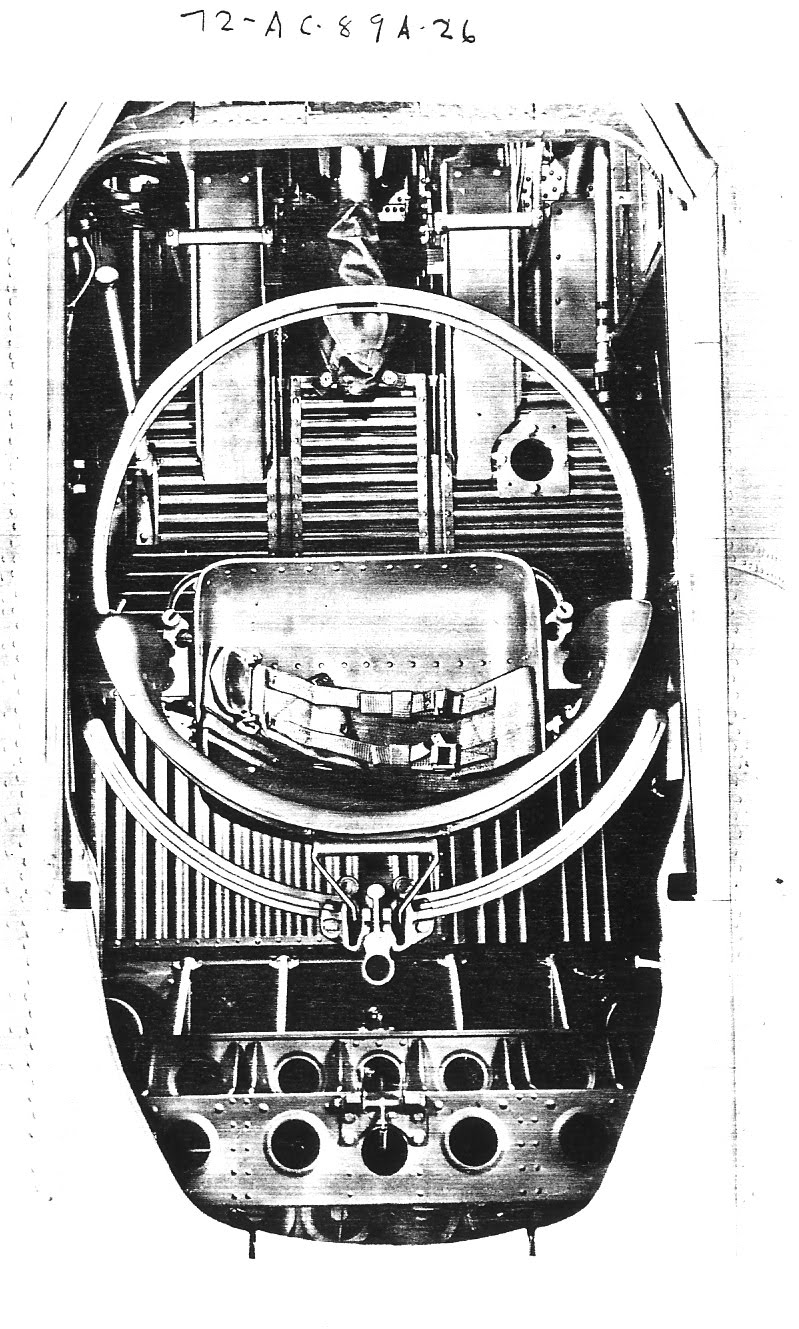
It's really simple. My friend Frank has started a Midway-based -2 using the Accurate Miniatures kit and I wanted to help out. What follows (after I finish talking, anyway) are some scans from a Douglas manual that will give a really good idea of what a wartime (as opposed to a contemporary restored warbird, which are, I can assure you, two dramatically different animals!) Dauntless radio operator's turret (and that's what both Douglas and the Navy called it; a turret, and the guy that sat back there was the radio operator) should look like. (Another highly convoluted sentence, that. It's probably a good thing I'm not in school anymore!)I've thrown in a couple of other goodies too just in case they might end up being of use. You would reasonably expect to see cockpit photos too, but they're deliberately conspicuous by their absence since every book you've ever seen on the SBD details that area pretty well and I'm pressed for time just now.

First, and pressed for time or not, here's some more talking! Frank builds primarily in 1/48th scale. So do I. That means we're going to take a half-minute or so and discuss the three kits that are contenders in that scale, even though two of the three are worthwhile with an enormous caveat attached to them. You can get a pretty good SBD model out of any one of these kits even though you're going to laugh at two of them, and maybe even exercise some of that Internet Expertise that can be so pervasive in our hobby and which may even cause you to say something Profound. Then again, maybe not.

The first kit that you can laugh at, or be snobby at, or whatever you might want to do at, is the now-ancient Monogram SBD-more-or-less-3. It truly is old (1960 or 61, I think), and it's got lots of working features such as retractable landing gear, working flaps, and a droppable bomb. It's also got poorly-detailed landing gear and no cockpit to speak of, and on top of all that it's covered in rivets. OK, so let's throw it away, right? No. Let's don't do that, but let's clarify why I'm saying what I'm saying. The basic kit is accurate dimensionally. The working features can be un-done (Modeling 101 rears its ugly head again; no Instant Gratification here, gang!) and missing details added. The landing gear can be fixed. And the rivets are ok, mostly, because the real SBD was covered with universal head rivets (those round-headed ones that stick up from the surface). The rivets are accurate and no other 1/48th (or 1/32nd) scale kit gets them right. In the rivet department it's Monogram's race, although it would be far easier and infinitely more practical to build your model off something a little more modern. It would be extremely labor intensive to construct a good model from this kit, although it can be done. The Monogram kit suffers from being the first one in the scale, and I would probably agree with you that it's best built box-stock, as a representative of days gone by. The pain ain't worth the gain anymore. You can, however, produce an outstanding model from it if you want to do that.

The next contender is from Hasegawa, which I think was issued as a -3 and a -4, and maybe (although I'm not certain about it) as a -5 or -6 too. It's a good kit dimensionally and is easy to build, but in many ways it's as tough a date as the old Monogram one. Simply put, it's not up to what anybody would consider to be The Normal Hasegawa Standards. It doesn't have raised rivet detail (not a deal-breaker), the cockpit is inaccurate in a number of areas, but the worst is in the diving flaps. Monogram didn't open up those holes (all 350+ of them) on their kit, but their kit is almost 50 years old so we can forgive the omission. Hasegawa didn't open them up either, and molded them so softly that centering a drill to correct the flaps is extremely difficult, thus forcing you to replace them with aftermarket, presuming that's still available, or fill them with black paint. It's a cryin' shame, too, because those holes are a major part of the Dauntless' personality. It might not seem so at first glance, but it would take almost as much work to correct the Hasegawa kit as it would the old Monogram one even though you do, in theory at least, have a better starting place. Me, I'd pass it right on by.

Fortunately, Accurate Miniatures also did an SBD for us, and have released it as all the Navy/Marine variants (at least I think they did, but it's no Big Deal if they didn't. If you've got a -2 then a -3 and -4 are a snap to build, while having a -5 means you can easily do a -6 too; most of the changes between SBD variants were internal, with cowling and free-gun installations being the significant external differences. (Yes, I know about the little spinner. It's no big deal.) The AM kit doesn't have rivets (wonder why not---they got everything else right!) but otherwise it's a thing of beauty. I personally stick Eduard PE in every kit I build, but you don't really need it for this one. It's the basis for an outstanding model right out of the box and is the kit of choice for most folks. It's a good 'un.

Now that we've got that out of the way, here are some illustrations and photos for you:


The radio operator's turret. The top of the photo faces forward on the actual aircraft. Note the rudder pedal troughs and radio operator's lap belt---the SBD could be flown from the back seat.   Douglas via Harry Gann


Sitting in the radio operator's position looking forward. The rudder pedals, stowed stick (at the left of the photo) and rudimentary flight instruments are all shown to advantage. Note the hoisting sling by the turnover pylon. While the SBD could certainly be flown aboard the boat, it was frequently hoisted aboard at pierside.  Douglas via Harry Gann


The upper view gives a better idea of how the stick was stowed. The throttle is at upper right. It was a simple cockpit.  The lower photo showes the canvas screen that was normally in place at the forward end of the radio operator's position; note the cutout allowing the back-seat instruments to be seen with the cover in place. Douglas via Harry Gann


The SBD-3 got twin .30 calibre free guns early in the production run, while all the -1s and -2s were outfitted with a single .30 in the radio operator's position. This illustration shows the single gun and its ammo can in the stowed position.  There's no armor visible here; that came later, after combat experience showed it to be a Really Good Idea.  Douglas via Harry Gann

And finally, some shots of operational SBD-2s and 3s. Please excuse the quality on a couple of them; the originals weren't very good...


Neutrality Gray. These SBD-3s wouldn't look like this for long; it's October of 1941 and war is barely a month away. Note that only the middle aircraft has a spinner fitted.  National Archives HG85-017C via Jim Sullivan


Remember that hoisting sling we talked about a few minutes ago? Here's what it was used for. Present-day safety officers would be seriously concerned about the goings-on in this photo, but it was business as usual for the WW2 Navy. The aircraft is an SBD-4.  National Archives

A classic shot of a classic aircraft. These Bombing Six SBD-3s are running up to launch aboard Enterprise; this photo was taken during the February/March 1942 time frame. Note the rudder stripes and oversized national insignia. The Air Group Commander's aircraft is immediately behind B4.  National Archives

End of the road at The 'Canal. This damaged Marine SBD-3 is in the process of being salvaged for parts at Henderson Field on Guadalcanal. The battle for the island extracted a heavy toll in both men and equipment.
Admiral Nimitz Museum via Bruce Smith

Is That All There Is?

Yep, for today, anyway. We were experiencing what some folks might call "technical issues" for the better part of the day and now I need to jump on the lawn tractor and go cut a whole lot of grass. Be good to your neighbor and we'll be back to normal tomorrow.
phil