Monday, August 24, 2020

Here's How You Do It, Bad to the Bone, Operation Thunderstorm, And Some Fruitflies


Dazzled By Brilliance?

We got our Triplane. The folks at Meng, who may or may not have produced other kits for Wingnut Wings, may or may not own some or all of the tooling, may or may not be faithful to the WNW's Dream and may or may not produce other kits of Great War airplanes in 1/32nd scale, have released this much anticipated kit of kits to the masses. See-What's-in-the-Box reviews have been hitting the electronic modeling press for a while now and there should be any number of How I Built It reviews out there by now as well. The kit is real, and it's available for purchase at this very minute. You can have your  own if you want one, which brings to mind a couple of thoughts.

First, one of those kits found its way out here to the wilds of rural Texas and is sitting by the work bench at this very moment. I've been able to examine it fairly closely, although I have to admit I haven't measured anything and probably won't. (That sort of thing can get you into trouble sometimes; just ask the highly respected folks who reviewed the initial release of the Eduard Me109-G family and claimed it to be dimensionally spot-on when it really wasn't if you don't believe me!)  No measurement equals no claims from me of dimensional accuracy, period, but in all honesty everything looks pretty good and the kit's fidelity to detail is excellent. Not breathtaking, not ground-breaking, and not the best ever seen in the entire history of plastic model airplanes, but definitely excellent. 

Not that it's a perfect kit by any means. So far it's been criticized for having a little bit of flash here and there and a set, because there are three of them after all, of slightly bowed wings that will require straightening prior to assembly. (That's all, he said?! Those are the only issues the kit has? Why tell me why are you complaining!) On the other hand, the complaints we've heard regarding the instructions are valid so you'll be wanting some decent reference materials at hand before starting the interior, if nothing else. The decals might or might not be ok but the "face" provided for Werner Voss' F.1 Triplane is incorrect and we don't much care for the instrument faces provided; Cartograf quality those decals ain't but they'll be mostly adequate for a lot of folks and can easily be replaced if that's desired. 

On the other hand, the kit provides a choice of ailerons, cowlings, and windscreens so you can build either an F.1, an early production Tripe, or a later one, out of what's already in the box. You actually have a choice because all the possible variants are catered for in that one kit, while most manufacturers (a grouping that could easily have included WNW themselves) would have released them as separate variants in order to increase their revenue stream. The kit decals make an attempt at covering the bases too. It's a great approach and we applaud it---way to go, Meng! Of course the kit doesn't include the option to up-engine the airplane with a captured Clerget rotary and maybe an English prop too, a practice that was followed on a limited basis by certain individual pilots within the Imperial Air Service, but there are aftermarket Clergets and propellers are available if you just can't live without doing that, and we think it would be going way too far to expect any kit manufacturer to cover that particular base anyway. 

So now we know it's a good kit and we think it's probably an accurate one as well, and as nicely detailed as we would expect from the boys from New Zealand. The instructions aren't as good as those that came in any Wingnut offering and the decals are barely adequate but hey; Meng tried, and they did a pretty darned good job of it too! They also released a kit that a great many of us wanted but thought we'd never see after the demise, maybe, of Wingnut Wings. (Let the rumor-mongering continue because it's already begun!)

On the other hand there's another 1/32nd scale Fokker Triplane kit out there as well, and it ain't half-bad. Yes, I'm talking about Roden's offering and yes, I actually meant to commit the heresy of saying it's a good kit, because it is. It's not as detailed as the new Meng kit, but once we get past the "valley" they put in the middle of the horizontal stab because they faithfully followed a set of drawings that erroneously included that particular non-existent feature, it's very nearly as good. Just remember that it's an older model and its not as well detailed as any WNW offering and therefore not as good as the new Meng Tripe either, but it's still a good kit and perfectly viable when married to a little aftermarket and some modest skill. 

Why do we mention the Roden kit at all, you may ask. The answer to that one is simple: There's a whole world of 1/32nd scale kits out there that Wingnut Wings had nothing whatsoever to do with and most of them are pretty darned good. Roden, for example, produce a number of very nice kits that do, admittedly, require a slightly higher skill level of the modeler than do the offerings from WNW, but the boys over at Copper State are issuing kits that are every bit as good as anything the folks down in the Southern Hemisphere ever produced and their instruction sheets and decals are top-notch as well. There are options to Wingnut Wings, albeit options that aren't nearly as prolific subject-wise, at least for the time being, but the point to be taken is that options are there if you want to explore them. 

That particular Adventure in Tangents aside, here's what I think we might learn from this adventure. First; nothing lasts forever, which means we might all want to try to obtain the kits we want to build while they're actually available at non-collector prices. Secondly; any kit that gets itself linked to anything WNW did will invariably be compared to that manufacturer, and perhaps/probably not entirely favorably. Finally, there are other manufactuers of large-scale Great War airplanes out there. There aren't many of them and their product lines are limited when we compare them with Wingnut, but they're there. 

My own personal Bottom Line is this: I have the Meng kit and will build it in the very near future, but I'm also going to build my Roden Tripe because it's a good kit as well, maybe not quite as good as that new Meng offering but good nonetheless, and I'm capable of making up for any perceived kit shortfalls if I choose to do that. Most serious scale modelers are capable of that sort of thing as well, while those who aren't will eventually acquire the necessary skills as they progress on their journey through the world of plastic scale airplanes. It's always helpful to start out with the best kit we can obtain but after it's all said and done it's the modeler, and his or her abilities and skills, that make the difference. The plastic is a starting place that we should probably call Opportunity because it all comes down to what we make of it at the end of the day. You might say it's all in our hands.

My story, etc etc...

A Fine Example of What We Just Said

Remember back about thirty seconds or so ago when we mentioned that it's mostly the modeler and not the kit? Here's a fine example of that sort of thing courtesy of Jim Sullivan, an AD-4Whiskey from VMC-1:

Those of our readership who have achieved a cerain seniority on Life may well recall the 1/48th scale polystyrene efforts of ESCI back in the 1980s and 90s. They offered the serious modeler a line of much needed and in many cases somewhat unique kit subjects, several of which were what we'll term "modestly flawed" and none of which could have been in any way described as an easy date. They weren't, and still aren't, a good choice for those with lesser skills but they can really be something for the modeler with a little bit of experience.

This particular variant of the Douglas AD Skyraider has never been produced by any other manufacturer, at least not in 1/48th, which means you're going to be using an ESCI kit (or its AMT sibling---it's all the same plastic no matter how you cut it) if you want to build one for your collection. Jim Sullivan wanted one and he had the AMT kit on hand, a collaboration which produced the results you see before you.

Here's The Real Thing; AD-4W BuNo126840 from VMC-1 taken in Korea on 15 May, 1953. That airplane hasn't been abused but it isn't exactly brand new and shiny either, and Jim's model captures the spirit of the thing pretty well, we think.   Sullivan Collection

And that, friends and neighbors, takes us to an old Rolling Stones tune, It's the Singer, Not the Song (Aftermath, December 1965). The kit isn't particularly easy but Jim has the skills and the need for a -4W in his collection, which leads to this sort of thing.  'Nuff said...

The Clock Was Ticking

But there was still plenty of time left on it when this photo was taken back in late 1966 or early 1967, and that particular Phantom was actively participating in the war in Southeast Asia.

Denny Smith was a C-130 driver who spent some time in-theater during the mid-60s, which is when he photographed 63-7590, an F-4C of the 480th TFS/366th TFW taxiing in from a strike on the Bad Guys. Friend and former F-4 driver Doug Barbier had this to say about the photo: That one really is a time machine, taxiing back in after a mission and after dropping the drag chute and going through de-arm. The paint and markings of those early "paint it in a hurry from this drawing, don't bother to prime it, use whatever we have on hand and make sure it's back on the schedule tomorrow morning" jets will drive you nuts. The T.O.s to paint them didn't show up until a long time after the fact and I have more than a suspicion that they were simply written to match what was commonly done in the field. Look at that early stab with no reenforcement plate and non-slotted leading edge too! Aftermarket, anyone?

 Unfortunately, the clock really was ticking on 7590; she was shot down two years later while flying with the 12th TFW. Both crew ejected safely, but it was a fate suffered by far too many airplanes during the conflict.   Denny Smith

The Right Airplane for the Job

Northrop's legendary P-61 Black Widow was one of those airplanes that made a career out of its mystique, size, and utility. It was big and it wasn't particularly fast or maneuverable, but that size meant it could carry significant armament and the heavy and bulky airborne radar of its day, which in turn meant it was well suited for use in its primary role as a night fighter. By the end of the Second World War its viability in that role was beginning to wane somewhat, although it remained in service with the 5th Air Force until 1950, but that's not what we're interested in today. It's size and soundness of structure made it a useful platform for other missions as well, and we'd like to show you a couple of photos of the airplane in one of its more significant, if less well-known, roles, that of weather ship. The mission was a direct result of a 1945 collaboration between the NACA, the Weather Bureau, the Army Air Forces, and the Navy. Headquartered out of the AAF's All Weather Flying Center in Clinton, Ohio, the type was tasked with flying through thunderstorms in an effort to gain meaningful knowledge that would relate to operating in all weathers.

The weather has always been a challenge for the aviation world to overcome, and the immediate post-War years began to see serious study of the various phemomena and conditions that could cause a threat to the aviator. The Thunderstorm Project's aircraft included a variety of types, one of which was Northrop's P-61---the Black Widow had been specifically selected due to its proven ability to cope with bad weather and severe turbulence. 43-8298 was a P-61B-20-NO assigned to the program and carrying the All Weather Flying Center's colorful red and yellow markings. The P-61 was a tough bird but the aircraft assigned to the Center took a beating all the same.   Mark Nankivil Collection

43-8327 was an early P-61C-1-NO and bore a variation of the markings found on 43-8298. At least nine Black Widows were active in the program from 1946 until 1949, and it seems that all of them differed somewhat in appearance as well; note the presentation of the serial number of 8327 under the port wing, for example. Instrumentation changed as well, and did so somewhat frequently as different aspects of the mission were addressed.   Mark Nankivil Collection

Finally, here's 43-8356, a different P-61C-1-NO, showing off yet another variation in markings. These airplanes suffered greatly while performing their mission, although no aircraft were lost during the course of the program.   Mark Nankivil Collection

Those of us who fly, even if only as commercial passengers, owe the crews of these aircraft an enormous debt for the job they performed so many years ago. Their courage and fortitude vastly improved our understanding of both thunderstorms and aviation weather in general, and paved the way for safer flying for everyone. It was difficult and dangerous work, and the crews of those P-61s excelled at it. At the risk of over-using a saying we quote fairly often around here: Let's raise a glass...

Gone But Not Forgotten

The LTV A-7 Corsair II family of attack aircraft have to rank among the most successful of the designs dedicated to the air-to-ground mission in the United States armed services. A result of the 1963 VAL competition to provide the Navy with a replacement for the long-lived Douglas A-4 Skyhawk, the first operational variant, the A-7A, began to reach the Fleet by 1966. The program eventually saw the type in use with both the Navy and the Air Force, as well as with several foreign operators. Today we're going to take a brief look at one specific variant, the A-7E, in use during a brief window in time; four aircraft spanning the years 1981 and 82.

Here's a fine place to start since VA-147 was the first Navy squadron to accept the A-7A into service, back in June of 1967, and was among the first to take it into combat. The squadron was active with the type during the Vietnam Conflict, and converted to the A-7E during 1969. This post-War Echo, 157479, was photographed on the ramp at NAS Chase Field on 06 June, 1981. Obviously well-used, 479 was the real thing, visiting a Tracom base after a recent cruise on the USS Constellation.   Phillip Friddell

May of 1981 saw a unique pair of "Fruitflies" from VA-193 on the ground at Ellington ANGB in Galveston. 159273 was nicknamed "Golden Dragon", a reference to 193's squadron nickname, and belonged to the unit's CO. She was a Clean Machine when I photographed her on the 22nd of May.   Phillip Friddell

Also found at Ellington that day was the squadron XO's aircraft, nicknamed "Executive Dragon". The Corsair II was a pugnacious-appearing little airplane as is well demonstrated by this photo.   Phillip Friddell

Finally, we have 156828 from VA-97 sitting on the ground at NAS Corpus Christi on 12 June, 1982. All four of these aicraft, photographed barely two years apart, were still wearing the Navy's classic Light Gull Grey over White scheme which would give way to the new TPS paintwork shortly after these images were taken. They were still pretty at the turn of the 80s, though!

The Corsair II lasted until 1991 in Navy service, with the last operational aircraft being retired after their return from Operation Desert Storm. The Air Force variant lasted a little longer, serving in the ANG until 1993, while several foreign users continued with the type until Portugal's retirement of their A-7Ps in 2007. 

From an operational standpoint the A-7 could carry an impressive load of ordnance for a considerable distance, but it suffered from low speed and limited ability to carry modern avionics. At the end of the day the airplane did its job and it did it well, but all things eventually must pass. It was quite a platform in its youth and it served well for over forty years, a testimony to its basic design. It was quite an airplane.

Happy Snaps

Yep; it's that time again! Here's an F/A-18A from the "Connie's" VFA-113 for your consideration today:

There are different reasons to like photographs of things. This image, taken by Rick Morgan over the Indian Ocean on 26 July, 1985, illustrates one of the more important ones. At first glance the image is a little frustrating since we can't make out the BuNo, nor can we really get a good look at the squadron markings on the vertical stab, but the composition---Lord-a-mighty; the composition! This, boys and girls, is how it's done! That's an A+++, Morgo, and thanks for sharing it with us!   Rick Morgan

And So It's Time to Go

Yep; it's that time. There's no Relief Tube today because nobody corrected us about anything, even though we almost certainly made some mistakes in the last issue. We're always interested in hearing from you, of course, and we'd love to see your photography if you've got anything you'd like to share with us. Comments, photos, or just Hi How Ya Doin', you can reach us for any of those things at replicainscaleatyahoodotcom although, as we always try to remind folks: You need to substitute the @ sign and a dot (.) in the appropriate places if you want the address to work. It's a pain in the wazoo to have to explain that, and we can thank those unscrupulous Picture Pirates for having to deal with it, but it's the way things are. (I know; whine whine whine...)

Anyway, that's it for today. Be good to your neighbor, stay safe in this year of the Covid, and we'll meet again soon!

phil


Monday, August 10, 2020

Not Really a Mystery, New Guinea Mitchells, A Havoc, Some Spiffy Decals, A Gift From Norm, and some DaNang Druts,


You Just Have to Try

Anyone who reads these pages on a regular basis knows the site is big on the 5th Air Force in the SWPAC during the Second World War. Our pages have been filled with Pacific B-17s, P-39s, P-40s, P-38s, A-20s, and on and on and on. It's an interest that gets a lot of attention around here. That interest bleeds over into the world of scale modeling as well with---you guessed it---lots of P-39s, P-40s, etc etc, being built.

One of our personal favorites in terms of modeling subjects is Bell's star-crossed P-39 Airacobra, a beautiful airplane to behold, albeit one cursed with relatively poor performance as employed in the SouthWest Pacific against the Japanese in the role of air-to-air combat aircraft and no; we aren't going to discuss the type's somewhat remarkable performance against Mr. Hitler's Luftwaffe on the Eastern Front or the fact that it held rough parity against the Japanese even during the Bad Old Days of the early war in the Pacific. Those are a whole different ball game and a first-class muddier of waters. We aren't, in point of fact, going to discuss the P-39/P-400's combat career at all, at least not today! What we are going to do is discuss one particular aspect of one particular kit and apply what we learn to our personal outlook and philosophy regarding the hobby. 

Let's start with a statement of fact: There are presently three mainstream kits of the Airacobra in 1/48th scale. Monogram started the ball rolling during the late 1960s with a kit that is still viable, if somewhat crude by today's Whiz-Bang Look At That standards, followed by Eduard's excellent offering from the  1990s and, finally, the "ultimate" Hasegawa kit that was produced around the turn of the present century. That Hasegawa kit is generally conceded to be the best of the available offerings, P-39-wise, but I have a personal fondness for the older Eduard kit and the point of today's diatribe lies within the polystyrene hull of that offering so it's going to be the only kit we discuss today.

Here's the deal, Lucille: The Eduard kit is sufficiently accurate but with a couple of caveats:

  • Detail is said to be lacking by contemporary standards, which is largely true.
  • The wing and wing trailing edges are described as being too thick, which is also true.
  • The cockpit doors, which are molded separately from the fuselage, fit poorly and can't be installed in the closed position, which is absolutely positively false.
  • The canopy doesn't fit properly, which is also false.
The thing is, a completed Eduard P-39 looks like a P-39, with the proper sit and featuring the pretty but in-your-face appearance of the real thing. I happen to like the kit a lot. That's one of those "your mileage may vary" sorts of things but there you go, besides which everything that's listed as a kit fault can be dealt with. You can easily address the allegedly dated details and the wing can be thinned down if you really want to go to that much trouble---I personally never do that, but you're certainly welcome to! 

What I absolutely do fix each and every time I build that kit are the canopy fit and the cockpit doors. Both subjects have been covered previously here, but every so often the internet crowd fall back to that old "the canopy and doors don't fit on the Eduard  Airacobra" song and dance which makes the discussion relevant again. Consider this:

The canopy doesn't fit right because the fuselage wants to be a little too wide in the area of the cockpit. If you build the kit and squeeze the fuselage sides in at the point where the aft cockpit bulkhead (the one just behind the seat) comes out of said fuselage and hit that junction point between said bulkhead and the fuselage with a little Tamiya Extra Thin or similar, and hold it together until the resulting joint has cured, the canopy problem will go away. Gone forever.

The greater problem, and the one that continually fuels that aforementioned internet crowd, is the fit of the doors. They're just fine if you want to model them open but horrible if you want to depict one or both of them in the closed position because those doors just can't be made to fit. That's what they say (the internet crowd, that is) but fortunately for us it's not true at all. 

The Eduard P-39/P-400 family is, in point of fact, very delicately and precisely tooled. The kit is a good one and all you have to do to make those doors fit properly is to lightly sand their perimeter with a fine grade of abrasive paper; we're talking something in the 1000-2000 grit range here. Just be careful when you clean up the sprue attach points and lightly employ that sandpaper around the perimeter of the part, taking special care to keep the door hinges intact shapewise (that means STRAIGHT!). Go slowly, fit as you go, and those doors can be made to fit perfectly. The notion that you can't successfully model them in the closed position is a polystyrene old-wive's tale, pure and simple, but that's not the point of this missive.

Let's take those P-39 doors as an example and a road to a greater truth, using my personal experience with the kit as the driver. I like the P-39 and have quite an interest in the type as used in New Guinea during those bad old days of 1942, and I prefer the Eduard kit of same for reasons we won't go into today. (Yes I just said that a minute ago, I know I did, but I'm feeling even more garrulous than normal today. Just humor me!) I've built several of them and have modeled them with one door open, both doors open, and no doors open, and those doors all fit on each one of the several models I've built of the airplane, as do the canopies. That's not because I'm any sort of superior scale modeler because I'm most assuredly not that. I wanted to build some Airacobras for the collection and I wanted them to look like they're supposed to so I took some time and figured out how to do it. I worked the problem and that, my friends, is the point of today's ramble. 

Let's hold this truth to be self-evident: If you want to do any given modeling thing, regardless of what it is, you probably can. Just think it through, figure out the best way to execute whatever action you determine, and DO IT. If you're new to the hobby try that sort of thing out on an inexpensive kit first because there is most assuredly a learning curve involved. Keep the mindset that it's a plastic model airplane kit and the fate of nations doesn't hinge on how well you build the thing; think it through and do it. Yes; you'll fail sometimes and you may even trash a couple of kits along the way but you'll also learn and you'll grow as a modeler. Remember this; if you don't try to stretch your boundaries and grow  you won't ever become truly proficient at the hobby, and in consequence you'll never ever get the doors on your Eduard P-39 to fit properly. You'll have problems with a lot of other things too. It's a universal truth: There ain't nothin' to it but to do it!

That's my story and I'm by-golly sticking with it!

It Never Was a Puzzle

There's a list of things that sometimes confuse and confound scale modelers, and one of them is that washed-out straw-colored coating sometimes seen on the face of pre-War US Navy aircraft propellers. You know the drill as well as I do; somebody will publish such a photo on an internet forum and the answers to what it actually is will come pouring in. Unfortunately, those answers are generally wrong so let's straighten this tiny mystery out once and for all!

We've all seen this image a thousand times before, but we're going to see it again today because of those prop blades. Notice the washed-out straw color that covers them? That's the result of a chromate conversion process, colloquially know as "Alodine", that aids in preventing or reducing corrosion on aluminum and it's neither a paint nor a lubricant that's gone astray. It's been used in the aviation industry for many decades and, in a somewhat less toxic variation than the original, is still around. It can be applied by dipping a part in a solution vat or by hand. This well-known and often-published photo of a Grumman F3F-3 at NAS Corpus Christi illustrates the point perfectly.   Possibly from the Life Archives but we aren't sure!

Here's a more contemporary illustration of the process, seen on the gas bag under this 419th TFTS CF-5D of the Canadian Armed Forces photographed on the transient ramp at Randolph in May of 1984. Alodine is most often used prior to priming or painting an aluminum surface so it's a little unusual to see that tank in it's "raw" state on an operational aircraft, but check out the way it looks and compare it to the photograph of those prop blades immediately above. Everything old is new again, eh?   Phillip Friddell

A Day Without B-25s is Like a Day Without Sunshine!

We think so, anyway, so here's a photo of an early B-25s sitting on the ground in New Guinea for your consideration. It is, is, as is so often the case around here, from the collection of Bobby Rocker, but you probably already knew that!

Almost ready to rumble, this 498th BS/345th BG B-25D nick-named "Little Nel" sits on what passes for a hardstand at 7-Mile. The photograph leaves a bit to be desired but it's of considerable value to us because it provides a good view of the tail structure where the plexiglas cap once lived. It was fairly standard practice for the B-25 groups in General George's Fifth Bomber Command to place a stinger gun back there, and this shot illustrates what the area that surrounds such an installation looks like. The internal structure would absolutely disappear on a model but that surrounding area would stick out like a neon sign, causing us to holler THANK YOU, BOBBY! for sharing this photo with us!   Rocker Collection

And While We're At It

Here's "Hawkins" (formerly "Runt's Roost") and "Here's Howe", B-25Ds of the 90th BS/3rd BG, returning from Wewak on 17 August 1943:

This photo is certainly evocative but it doesn't tell the story very well. The scene is almost placid, with all those Mitchells just cruising along in loose formation, almost as though they were out for an afternoon training hop. The excitement and, in all likelihood, the sheer terror of the mission just past can't be reflected in a photo like this one. For the guys in those airplanes it was in all probablity a very good day to be alive! Modelers take note of the different national insignia presentation on this pair of aircraft!   Gerry Kersey Collection

Then There's That Other One

The 3rd BG was well-known as an operator of the Douglas A-20 Havoc. We show a lot of B-25s on this site, with a great many of them being from the 3rd, but A-20s are a relatively scarce commodity here which leads us to an attempt at making amends:

Here's a magnificant view of A-20G 43-9422 "Bub's Brother" of the 13th BS/3rd BG posing for Bill Swain's camera in theater sometime during 1944. That airplane is probably in excellent mechanical condition but the paintwork is another story entirely; All Beat to Snot is a term that comes to mind in that regard. Take a look at those guys in the cockpit peering out at the photographer while you're at it---if that was a beat-up old jalopy they could pass for a couple of college kids out looking for fun, except they're not in an old jalopy and the fun they get to have in that airplane is heavily tainted by a dark side that can't be ignored. Let's raise a glass...   Bill Swain via Gerry Kersey Collection

Not What You Normally See Around Here

This project focusses very specifically on American military aviation, although we sometimes run photographs of models that don't fit that parameter. Here's one such example:

Sometimes you see an airplane that you just have to model, and this not-quite-finished Accurate Miniatures Yak-1B in 1/48th scale is an example of that very thing. Your humble (?) editor is presently off on a tangent building aircraft used by the former USSR during their Great Patriotic War against Nazi Germany; a lot of those airplanes are colorful beyond belief and the history is certainly there, providing ample reason to build up a collection of VVS fighters and bombers from that tragic period in our planet's past.

With that as a premise it's only natural to presume that a Yak-1 would have to join the collection at some point in time and in oddly enough one was actually in the planning stages when that particular mental exercise got moved up several notches while browsing Exito Decals' web site, where I discovered a sheet titled Yak Attack. One of the three airplanes featured on that decal sheet was so over the top and so well documented as to make it the Yak-1b of choice for the collection; an aircraft of the 31st GIAP/6th GIAD, 4th Ukrainian Front ca spring or summer of 1944. This model, which still requires weathering and an antenna suite to be called complete, is the end result of my acquisition of the sheet. Is this a colorful airplane or what?

I might also mention that these decals are among the best waterslide markings I've ever used. They went on flawlessly over the model's finish of Akan paint (yet another absolutely superior product!) without any glitches whatsoever. They conformed beautifully, even that dragon that's busily engaged in consuming the airplane's horizontal stabilizer, they laid down perfectly without any issues whatsoever, and they definitely make the model "pop". The documentation supporting the decals is superb as well and could be the poster child for how to do that sort of thing. We don't normally review much around here but we just can't say enough good about these decals. Like the model or don't like it at all, that's your choice, but those decals---holy cow! 

Ourah!!!

We Rarely Hear About Those Guys

Our readers know Norman Camou primarily through the aviation-oriented YouTube footage he finds and shares with us. There's no YouTube today, however. Instead, Norm has discovered a document we suspect anyone interested in the war in the Pacific will find fascinating. It's a study of the Netherland East Indies Army aviation arm in Australia and India during the Second World War. It fills in a significant gap in our knowledge of the participants in that theater and is well worth your time. The book is in PDF format and is free; all you have to do is click on the link below and download it. 


Many thanks to Norman for finding and sharing this work with us!

But wait! There's more! (Sorry, ya'll; I just had to do that!) 

Norm sends along quite a bit of material and here's a bonus he found on YouTube that we think you'll enjoy. It's and interview with a couple of SBD radio operators (known as "gunners" to most aviation enthusiasts). It provides an insight we rarely have into the crews of the mighty SBD. Take a look!


Thanks again, Norm, and keep it up!

Making the Best of Things

There was a time, back in the mid-1960s, when the Marine Corps' electronic warfare mission was performed by the venerable Douglas EF-10B Skyknight, an airplane that had begun its service career in an age of underpowered jet engines. That circumstance led to extremely poor performance in most service situations and was bad enough during peacetime deployments and the type's use during the Korean War. The hot air of Vietnam, coupled with the aircraft's gross combat weight, resulted in  performance that was marginal at best, leading in turn to its Marine Corps nickname of "Drut" which is, for those of our readership who might not know, the way the word "turd" appears when it's spelled backwards. 'Nuff said, eh?

Anyway, it's been a few issues since we've featured anything from Jim Sullivan's collection so it must surely be time to do it again! Let's take a look at a couple of "Druts" in Southeast Asia!

The Marine's VMCJ-1 were the sole operators of the EF-10B in theater, using them in combat during an iterim period prior to their replacement by the vastly improved Grumman EA-6A. This image shows us one of their airplanes, 125793, as it taxis in post-mission during August of 1966. the airplane is so clean as to be called spotless by operational standards. She was lost in-theater in an operational accident, with both crewmembers killed, on 17 July, 1968.    Fritz Gemeinhardt via Jim Sullivan

This image is a little soft but is well worth publishing as it depicts a somewhat shopworn EF-10B, 127051, on the busy DaNang ramp, also in August of 1966. Modelers may want to note the staining aft of the engine exhausts, which is substantial on this airframe and typical of the type when that area wasn't frequently cleaned. Keep reading because there's more to see on this bird!   Fritz Gemeinhardt via Jim Sullivan

Here's the other side of RM-3, taken on the same day as the other two photographs in this set. Remember that part where we mentioned the staining aft of the engine exhausts? Well, that's not the only place a "Drut" can get dirty! Note the staining under the intakes, the generally worn appearance of the airframe and, in particular, the staining forward of the 20mm muzzles, caused by firing the guns. Shooting at things wasn't the normal mission for the EF-10B during the SEA fracas; that more along the lines of providing threat warning and ECM support for Navy, Marine, and Air Force missions against North Vietnam's air defense radar network. In theory nothing in that mission would involve using guns. In theory, that is! Finally, those mission tallies behind the aircraft modex tell a story; there's no doubt that 127051 saw the elephant and did it more than once!   Fritz Gemeinhardt via Jim Sullivan

Jim Sullivan has been supporting this project, and all the others I've been involved in over the years, pretty much from the very beginning. Thanks, Jim, for all you do for this project!

Under the Radar

We don't often spotlight new books in this section, preferring instead to dedicate the space to older works our readers may have missed the first time around, but every once in a while something comes out that's just so special as to require mention. This is one of those books.

World Watchers, A Pictorial History of Electronc Countermeasure Squadron One; Romano, Angelo, Ginter Books 2020, 304pp, illustrated. 

This could be a truly brief review if we wanted to do things that way. This book is one of the very best unit histories we've ever seen, period, and the serious student of American naval aviation can't afford to be without it. It's honestly that good! 

That said, the volume begins with the unit's PBY Second World War predecessors and carries through all of the squadron's assignments, designations, and operations right up until the current year. Primarily a pictorial history (it even says so right on the cover), it is absolutely chock full of photographs, color illustrations, charts and indices covering every period (and designation) of the unit's history. The book is extremely well written and includes a great many anecdotal entries from former squadron members. It is well written and a joy to read.

References such as this one depend heavily on the contributions of knowledgeable and authoritative researchers and this book lists a veritable who's who of contemporary naval aviation photographers and historians in its credits. It's a book written by a heavy-hitter and supported by some of the best in their field. Finally, the production quality of the piece is well up to the standards normally maintained by this publisher, which is saying a lot.

In short, the author knocked this one right out of the park and we're looking forward to his next effort. Highly recommended.

The Relief Tube

There's not much to say here except that I've been exceptionally busy over the past couple of months and the schedule I'd made for myself---a new installment every 3 weeks or so---went right out the window in consequence. Nothing new there, right? Anyway, apologies to everyone for that, and thanks to those of you who emailed in to see if we were ok. Everything is fine here and I hope and pray it's that way for all of you as well. Stay safe, be good to your neighbor, and we'll meet again soon!

phil

Wednesday, April 22, 2020

Requiem for a Friend, The Triplane That Is, Gone But Not Forgotten, A Cobra, and Was It Really That Long Ago


The King is Dead?

In recent days the scale modeling portion of the internet has been awash with rumors, reports, and a whole lot of outright speculation regarding the apparent demise of Wingnut Wings. In point of fact some scale modeling sites have been quite literally going nuts over the whole thing, with comments ranging from "so what" to "it's the end of Great War scale modeling". Many comments have been constructive, in a sad sort of way, while a few have been outright nasty and a few others have bordered on absolute lunacy. Those comments run the gamut, there's no doubt.

The one thing that seems clear and actually true is that WNW have shut down. It might be temporary or it might be permanent but as I type this they're gone with staff laid off and, one might presume, doors tightly shuttered. I can't add anything to what's already been reported on all those electronic magazines and boards other than to comment that I was heavily involved in the procurement of aerospace tooling and fixtures for a great deal of my time in the industry and that it's normal for whomever pays for tooling to own said tooling unless some sort of circumstance precludes it, so I'll hazard one guess (and one guess only) and say that Sir Peter Jackson owns the tooling for all of those exquisite kits. I would, in fact, be amazed if he didn't own it, at least for the time being, but that's still a guess on my part and nothing more.

Of greater interest are those marvelous Great War kits that Wingnut have given us over the past ten or so years. Those models have been brilliantly engineered and superbly rendered, and have truly earned every accolade they've acquired over the decade or so of the company's existence. In my world there aren't enough superlatives to describe them. I didn't buy each and every one, although for the most part I've purchased the kits that have spoken to me, and I've even built several. I'm a fan, pure and simple.

On the other hand, I'm also a realist. As much as I've enjoyed, and continue to enjoy, those kits, there are other manufacturers out there who produce 1/32nd scale First World War subjects. Roden (yes; Roden!) is one, and their kits aren't half bad. They require more work than the offerings of that New Zealand-based company and their decals have a reputation for being extremely difficult to work with, but the actual kits themselves are perfectly buildable and look great when finished, even though they do lack the finesse and fine detail of Wingnut's offerings. Then there's Copper State, who's Nieuport 17s are absolutely gorgeous, rivaling the best work of WNW. Unfortunately their entire 1/32nd lineup, at least as of today, consists of just those Nieuports, but with any luck that's only a temporary situation.

We also can't give up the notion that someone will purchase Wingnut's tooling, or maybe the company will reopen at a later date. Either scenario is possible, even if that possibility appears distinctly remote at this juncture. Stranger things have happened.

Worst case, Wingnut's kits will remain available on the secondary market, albeit at greatly inflated prices, while Roden and Copper State will continue to produce their own kits of the aircraft of The Great War. It's easy to be maudlin about the whole thing and fall into a state of grieving for Wingnut's  passing and on a strictly personal level I do indeed grieve the loss of their company, but I'm also extremely grateful for the time they were with us. I've enjoyed the kits and am proud of the way they look on the shelf. I'm truly happy that my time as a scale modeler included that brief span of time when they were alive and well, and thrilling us with unexpected new release after release. It was a special time, and they were a special company.

With all of that said, tomorrow is a new day. Maybe those marvelous kits will be back, either in the guise of a reborn Wingnut Wings or maybe under someone else's logo. Maybe they're gone forever. The point is we had them for a while. As a company they did wonderful things and they raised the bar substantially by so doing. We all gained from their existence in our polystyrene world, and our hobby was a better place while they were with us.

The King is dead. For now...

We Were So Close

Yes we were. The guys over at WNW had said they would never do a Fokker Triplane because there was already a very good kit (Roden) out there. They were right about that one; the Roden Tripes (a Dr.I and an F.I, in case you've forgotten) were, and are, very good indeed. They're a little fussy to build, as are all of Roden's offerings, and in consequence probably not good kits for the beginner in spite of the Dr.I's almost total lack of rigging, but they're definitely on the high side of ok. Wingnut's kit, which is apparently tooled and pretty much ready to go, would have been a better detailed and far more builder-friendly kit, of course, but it would seem that we won't see it anytime soon, if at all.

Those two Ukrainian kits are pretty much it these days for Fokker Triplanes in 1/32nd scale (and yes; I know Andrea makes one too, but it's not in the same league as the others), but there's another Tripe out there that's well worth your time---it's just in a different scale:

And here it is: Eduard's 1/48th scale Dr.I, in Lothar von Richthofen's Jasta 11 markings and half-finished as usual, but boy what a kit! It's several years old now and has seen the usual Eduard boxings: Profipack, Weekend Edition, Dual Combo, and as a star component of at least two special offerings, Der Rote Flieger and Du Doch Nicht, so it's also easy to find. It's a superb little kit, rendered semi-difficult only by the extraordinarily petite detail parts that grace its contents, and it's probably not the Triplane for the absolute novice, but it goes together like a fine pre-digital watch and it's every inch a Dr.I once it's completed.

You may, of course, ask why we would discuss this kit when the Great War modeling world at large is drooling for the Wingnuts kit they may never get, but it's only fair to mention that there are a whole bunch of excellent offerings out there in 1/48th scale too and they're well worth your time. They're just a little smaller, that's all!

Then again, if I were a betting man, which I'm not, I'd be willing to wager that WNW Tripe will show up someday. Maybe not tomorrow or next week, and maybe not under the Wingnut Wings logo, but I'll bet we see it eventually. Fingers crossed, etc, etc...

The Bad Thing on the Block

That particular appelation could apply to any number of military airplanes but in today's context we're referring to Grumman's F-14 Tomcat. It was a marvel when first introduced, first and foremost by being a polymorph that actually worked, and secondly by proving itself to be a fleet defence interceptor, or may just a fighter, par excellance. It wasn't perfect, of course; nothing ever is. It was in truth a little underpowered, at least in its early versions, the AIM-54 Phoenix it was designed to carry was far from an optimal weapon when viewed in a real world sort of context, and it took a lot of maintenance to keep it operational. It was also a world-beater for several decades of its lifespan in Navy service and it looked good. Here are a few examples to remind you of what once was. Note that these images depict the F-14A during what many consider to be its finest decade, spanning the years from 1979 to 1989, but none of the schemes are the classic Light Gull Grey over White.

160671 was with VF-51 when photographed on the ramp at Randolph on 12 May, 1979. While not an Easter Egg in the truest sense of that word, since she's in overall Light Gull Grey, her full-color CAG markings make her stand out from the crowd. She spent a brief period of time on display in a museum but was eventually reclaimed by the Navy for reasons unknown to us and sent to AMARC for storage. She was pretty when she was young...   Phillip Friddell

04 April, 1982, saw VF-101's 161134 on the towbar at NAS Corpus Christi. She's relatively plain for this era, in overall Light Gull Grey with subdued squadron markings, but she's still every inch a fighter. One of a number of Tomcats modified for the TARPS pod, she's now on public display in Florida.   Phillip Friddell

VF-154 was operating 161612 when she was photographed at Corpus on 14 April, 1984. She's got some color to her but not much; overall Gull Grey isn't the most flattering of paint schemes, but she's still a looker in spite of it. She ended up in storage, a sad but necessary end to a fine career.   Phillip Friddell

There's just something about Felix on a Tomcat; that classic Navy squadron emblem just belongs there. In this case, the emblem is on Fighting Thirty-One's 161868, also photographed at Corpus but a few years later, on 07 May, 1989. This is one of the two paint schemes that says F-14 to us.   Phillip Friddell

And here's the other: An F-14A from VF-84 photographed taxiing out to launch at Bergstrom on 14 October, 1989. The shot was an accident; I was by the taxiway waiting for something else, but the opportunity was just too darned good to pass up!   Phillip Friddell

There was a time when I bemoaned the retirement of this classic airplane, but that came into perspective and focus one afternoon when I began mentally compairing the Tomcat to Boeing's immortal F4B-4. After all, they had similar careers; both built as fighters (yes, I know the F-14 was technically an interceptor, but stay with me here), both were the best there was when in their prime, and both, as time passed them by, were ultimately relegated to the bombing mission prior to their retirement. They were really something when they were young, though, and we definitely miss those days.

Those Other Cobras

Anyone who's been paying attention to these pages must surely have noticed that most of the photos we publish from the Pacific War are related to the 5th Air Force. There's a reason for that: The Fifth is a primary interest of mine. That said it was, unfortunately, a really big war with a lot of participants. Here's an example of one that wasn't from General Kenney's Air Force, courtesy of Bobby Rocker:

A sharkmouthed Bell P-400 Airacobra of the 67th FS, 347th FG, sits poised for another mission on Henderson Field some time in late 1942. We're showing this particular photograph today to illustrate a potential point of confusion for those confronted with P-39/P-400 photography from The Bad Old Days in the SWPAC. Note the sharkmouth: The 8th FG of the 5th AF used it too, while assigned to the Port Moresby area of New Guinea, and their version of that classic artwork was very much like the one used by the 67th FS on Guadalcanal. A practiced eye can usually tell the difference between the units but not always. Danger; Will Robinson! DANGER!   Rocker Collection

Thanks as always to Bobby for continually sourcing these images and sharing them with us.

It Seems Like It Was Yesterday

But Operation Desert Storm took place back in 1991, some 29 years ago! My own personal tie to the operation was a long-standing friendship with Prowler ECMO Rick Morgan, whom I'd known since he was in flight school in Texas. Last issue's publication of a TA-4 photo from Allen Epps triggered Rick to send in this photograph of his crew during taken aboard the Theodore Roosevelt while he was assigned to VAQ-141:

Rick provided us with the call signs for his crew, so that's how we'll identify them here, from left to right: Kurly, Tums, Boris (Rick Morgan), and our newest contributor Pugsley (Allen Epps) as they prepare for their first daylight war mission. We aren't going to publish the names of Kurly and Tums at this time because we don't have their permission to do that.   Rick Morgan

They don't look that old, and their faces don't reflect the years of training or the strain of combat, but these guys are The Real Deal; a highly skilled crew engaged in electronic warfare combat operations with the Grumman EA-6B Prowler. While serving in the Gulf they flew daily support missions for Alpha Strikes, they jammed communications and, on at least one occasion, they killed a SAM site. They're typical of the guys who stand up, and have always stood up, when their country needs them, and we're lucky they, and all their brothers and sisters, are there for us. Let's raise a glass!

Happy Snaps

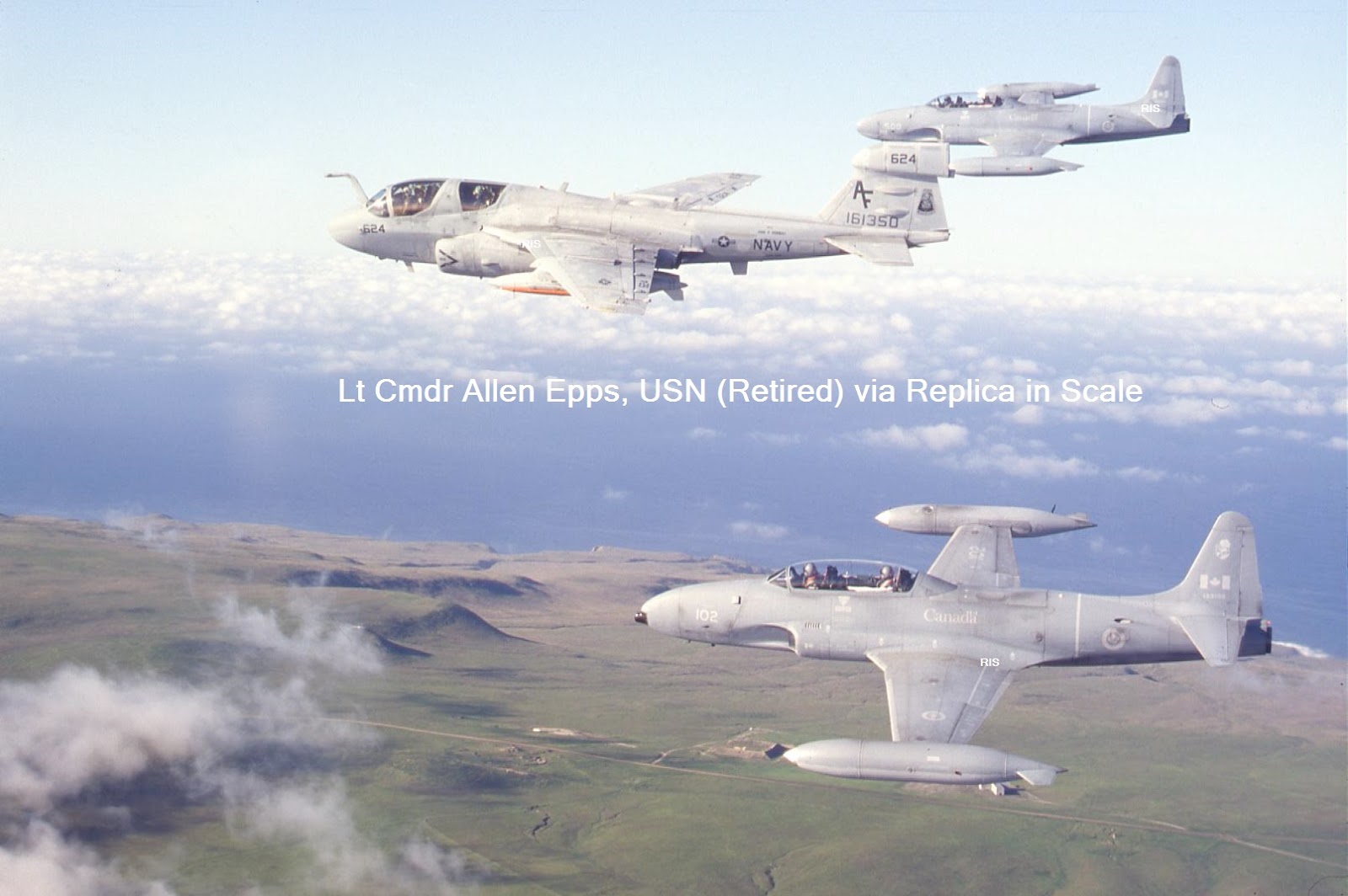
How about another air-to-air from Allen Epps to end this issue?

Over San Clemente Island with a pair of CT-33’s. We would run into the ship and “shoot” the CT-33’s as missile simulators then follow them as a third missile with an appropriate electronic signature.  Epps

Thanks, Pugs!

We're always looking for photography of American military aviation, by the way. If you'd like to contribute your images to this project, please drop us a line at replicainscaleatyahoodotcom using the appropriate symbology for the at and dot. We can't pay you but we'll make you famous, sortof, if you'd like to contribute your photos. How about it?

The Relief Tube

You may have noticed that we're actually publishing fairly frequently these days (a big YAY for that one), albeit with reduced content. We've been meaning to reduce the length of these things for quite a while because it's easier to do shorter issues than to put together the long ones that cause us to publish just a handful of entries per year. That's a particularly good thing to us and maybe for you as well, especially so since most of us are restricted to quarters at the present time. We'll try to get something out every couple or three weeks from now on, or at least until this Covid mess subsides and we all return to some semblance of normality. (Or maybe you could just keep to some sort of SCHEDULE, Phillip!)

In the meantime, stay safe, be careful, and be good to your neighbor. We'll meet again soon!

phil

Thursday, April 16, 2020

Knocking That Stash Down, Not So Tough, Iron Dogs in the Shop, Too Much to Ask?, and A Couple of Fantooms


A Trip to the Closet

Let's start this off by saying we're all a little short of a full load in the judgement department. We do goofy things, and we do them repetitively and with almost no thought. We spend money we don't need to spend, on things we don't actually need and may never do anything with. Ill-considered is a term that fits the phenomenon. Crazy is another.

I'm sure you've figured it out by now; I'm talking about The Monster in the Closet, the ruler of all scale modeling life, Moloch! Yes, I'm talking about...

YOUR STASH!

Before you get started with what can best be described as The Lame Excuses or, worse yet, define me as The Enemy, take a minute and consider that I'm one of you. I'm a member of the tribe. I am, in point of fact, a plankholder, one of the founders of the feast as it were. I counted the unbuilt 1/72nd scale airplane kits in my closet once upon a time, during a visit home from college way back in 1970. There were in excess of 1,200 boxed and unbuilt kits in there back then, a great many of which were still in shrink-wrap. The theory behind their purchase was fairly simple since I also worked part-time in a hobby shop: A new kit would come out and I would automatically buy three; one to build, one to convert to a different variant, and one to keep as a reference copy. OR, I would buy more than three. I've always liked P-40Es, for example, so there were 8 or 10 Revell kits of same in that closet, along with multiple F4Fs, LS Zeros, and on and on and on, ad infinitum/ad nauseum.

The maturation of our hobby, which in theory paralleled a similar phenomenon in myself, resulted in a change of scale, to 1/48th and 1/32nd (read bigger boxes here) and the onset of that boon/bane of the 21st Century scale modeler's life; aftermarket, to the mix, which ensured that we had lots and lots of stuff to acquire because a whole bunch of kits were of the short-run get-'em-while-you-can variety, and aftermarket (to include decals) has always belonged in the Here Today Gone Forever (except on eBay) category. The end result of all this seemingly inoccuous proliferation of Stuff is The Stash, which is sometimes manageable but often not. Another result is the monetary expense of that collection of unbuilt polystyrene, but that's drama for a different day!

It seems as though there's something new for us almost each and every day these days; a new kit, new decals, new resin or photo-etch, new something that we think we have to have. We buy all of it, or a lot of it, or at least some of it, and we put it in the stash because we aren't ready to build it or incorporate it into a model. No; we just want it, so we buy it and put it away. It's ours. We have it, and we're going to put it with all that other stuff.

I did some figuring a few months ago. I'm a Baby Boomer so I'm aging a bit, and I'm old enough that I've optimistically got 10, maybe 12 years of modeling time left before something happens to take me out of the hobby. A typical kit requires between two to six weeks of my time, so the honest truth is that I'm likely to run out of Phillip long before I run out of kits to build. The advent of the present global health crisis has only added fuel to that particular fire, and being on lockdown here at the Polystyrene Ranch has confirmed a concept for me: I really ought to get off my lazy rear end and start building some of those kits, and using up some of the decals and aftermarket too.

Tom Gaj, a long-time friend and fellow traveler in the world of scale plastic edifices, has recently begun building some of the older kits he's got hidden away. His current project is a Hawk F8F Bearcat, which I'm assured will be followed by a box-scale Revell X-3. Neither kit is new or even remotely state of the art, the F8F dating from the mid-60s and the Stilleto from the late 1950s. Both can be built into outstanding models but they require both a love of the subject and a liberal application of modeling skills to get to that particular end result. Tom has both, and I'm looking forward to seeing the end results of his efforts, but that isn't the point. No, the point is this: He's building from his stash rather than adding to it. On a more personal level, I'm finishing up a Special Hobby Wirraway I began some three years ago, after which I'm considering a Special Hobby Guardian, or maybe just finishing that still-born Monogram F-100.

My point is this: I've got enough unbuilt kits to last a very long time at my present build rate. I still buy them, but only those I know I'll build. I buy aftermarket when a project actually needs it, or if I want a special set of markings that I don't already have. I haven't completely stopped expending money on the hobby but I've certainly tapered off quite a bit, and I'm enjoying things as much if not more than I ever have. It's not such a bad way to do things.

My two cents...

Short Run That Ain't Half-Bad

There was a time, not all that long ago, when mention of the kits offered by Special Hobby would cause a great many scale modelers to look the other way and change the subject. It wasn't for lack of trying on Special Hobby's part; their kit list was (and is) both extensive and fascinating, but the kits weren't for everybody, or even for anybody who wasn't fairly good at their craft. "Some modeling skills required" was a caveat with meaning.

Everything changes, though. I recently almost completed (that's my modeling life; I ALMOST complete things these days!) a Special Hobby CA-9 Wirraway, and here's the proof:

See what I mean? It's sortof finished but not really, since it's missing a little cleanup and weathering, plus a radio antenna and some more clutter around the wireless operator's free gun, but that's where it is right now. The kit was relatively painless to build and went together easily, with none of the assembly pitfalls I'd read about on other sites. I question the canopy, which is kind of squashed, and I really wish they'd provided a free gun (almost anything would be better than what I scratched up for this model!) and I really really wish they'd done a CA-1 instead of a CA-9, but I wanted a Wirraway for the collection and it definitely looks like one, in this case from 4 Sqdn RAAF out of Port Moresby ca. 1943.

A couple of quick notes for those of you wanting to build this one:

The reviews I read said that SH omitted the landing lights from their kit. They didn't do that; those lights are molded on one of the main sprues but are not identified in any other way. Look for two little round doo-hickies that have no apparent application to the kit and there you are!

The interior is allegedly inaccurate and I have to agree with that one, but I didn't correct anything on this model. It will never see a contest or, given the Covid Lockdown, any other living human being, so it's ok with me the way it is. The biggest issue in there, if you're building any sort of CA-9 used in or near a combat zone, is the lack of a free gun with the kit, but that's easy enough to deal with.

The engine doesn't fit the cowling according to several sources, but I had no issues whatsoever with mine. I trimmed the backside of the crankcase per the instructions and attached it to the airframe, slid the completed cowling it place over it, and attached the carburettor intake to the fuselage and cowling. The intake locked the cowling in place perfectly. (That intake is inaccurate as well, for whatever that's worth.) In a similar vein, the resin exhaust pipes aren't supposed to fit either, but mine fit perfectly without any sort of trimming.

The propeller is incorrect according to most of the reviews out there, and I whole-heartedly agree with that, but I didn't do anything about it on my model.

None of the reviews mentioned it, or at least I don't think they did, but the landing gear seems to be molded fully compressed, which causes the completed model to take on a somewhat squatty stance. The tailwheel is off a bit too, and poorly detailed on top of that, but it's also useable if you're building a placeholder, which I was.

That's my story, and so on and so forth...

Rode Hard and Put Away Wet

That's an old description that could apply to almost anything flown by the Army Air Forces in the Pacific during World War 2, but it's especially applicable to the aircraft that fought there in the early Bad Old Days. Bobby Rocker has offered a couple of images of the Bell P-39 undergoing depot-level repair in late '42 or early '43 for our consideration today, so let's get right to it:

The 29th Air Service Group had this 13th AF P-39D under repair in less than stellar circumstances late in May of 1942. Note the early national insignia, replete with red centers. We're guessing most of the visible wear and tear on that Airacobra came from extensive training and routine operational use since the date places it far too early for combat in the 13th's area of operations, but the photo is of considerable value since it illustrates how the SW Pacific environment abused airplanes. Of further interest are the sophisticated maintenance aids in use---the 29th was a first-rate outfit and those were their working conditions early in the war!   Rocker Collection

The 4th ADG was active in Australia supporting AAF activities in New Guinea. In this photo we see a pair of 8th PG Airacobras, a P-400 and a P-39D, somewhere in the depot-level maintenance cycle. The photo was taken at Mareeba, in Northern Queensland, in December of 1942, and you can bet those airplanes are in need of some serious maintenance. The camouflaged hangar tells a story of its own, reminding us just how tenuous things were during those terrible times.   Rocker Collection

Thanks as always to Bobby Rocker for sharing these photos with us.

All I Want is a Decent Kit!

Some of us, myself included, grew up with the Revell, Hawk, Aurora, Lindberg, and Monogram kits of the mid and late-1950s, and a lot of us also had access to the Colby books that defined the US Navy and Air Force to a generation of wide-eyed kids. Those books, and at least three of those kit manufacturers, offered us kits of Lockheed's F-94C Starfire, an exposure that never left most of us. There have been kits of that airplane since the fifties, most recently an offering by the folks at KittyHawk, but none of them have truly done the airplane justice.

Is this a good-looking airplane or what? The F-94C just screams "1950s American Jet Interceptor" and it's very much a seminal part of the era. It's also a necessity for any collection of models depicting The Silver Air Force, but that KittyHawk kit isn't a particularly easy date, and the 1/72nd scale offerings currently available aren't all that hot either. Opportunity knocks, guys!   Ron Picciani

You'll note that the Starfire photo shown above is heavily watermarked by its photographer, Ron Picciani. That's because Ron, like so many of us, has had his photography ripped off and distributed all over the internet without either attribution or permission. That sort of thing is why we regularly deface the images shown on this site: Some of the kids don't play nice so we do what we have to do to try to keep them honest. For the record, Ron granted permission for the use of this image, and we're extremely grateful to him for that. He, and all those like him, were recording the real airplanes that inspired the models we make, and they were doing it when few others even cared. They were, and are, a truly special breed, and we all owe then a debt we can never truly repay. Thanks, Ron, for all you've done for us, and for our hobby!

A Fistful of Deltas 

McDonnell Douglas' immortal F-4 Phantom II was a fixture in America's arsenal for several decades, and the memory of their roar on launch and their shrieking howl when recovering lives strongly in what remains of my memory. Here are a couple of photos to remind you of those days of glory for the mighty Bent-Winged Bugsucker:

Oklahoma's 507th TFS, operating out of Tinker AFB, had the F-4D on strength for quite a while and John Dienst walked their ramp, camera in hand, back in June of 1983. Although an AFRES unit, the 507th adopted the same placement for "nose" art as the 182nd TFS of the TXANG; inside the nose gear doors. 760 has artwork there, along with the name "OUTLAW", a fitting description for the Mighty Phantom!    John Dienst

And here's 762 of the 507th, named "SMOKIN OKIE", a highly-descriptive moniker for the early F-4s. Neat airplanes on a beautiful day; we truly envy John that shoot. It just doesn't get any better!   John Dienst

Another D-model, this is 737 of the 301st TFW (Carswell) the morning before an airshow at Randolph in May of 1987. She's carrying an inert AIM-9, which makes her distinctly interesting and well worth shooting.    Friddell

And phinally (I'm truly sorry but I had to do that!), here's the 111th FIS' 65-0666 sitting on the ramp at Laughlin in March of 1987. The airplane is well-worn, which was unusual for any of the 111th's airplanes, but she still looked every inch a fighter. The F-4D's tenure with the Houston ANG was relatively brief, bridging the gap between their F-101Bs and their F-16s, but the Phantoms were every bit as impressive as any of the others!   Friddell

There are many F-4s to come on these pages but today just isn't The Day, so stay tuned!

Happy Snaps

It's been a while since we've run an air-to-air by one of our readers so we're definitely due for another one!

(An exceptional shot) of a VC-8 TA-4 in the Puerto Rican op areas operating as missile simulators. Once the Navy got rid of VAQ-33, 34 and 35 the job really fell to the Reserves and I flew with VAQ-209 from 95-07 so flew a lot of fleet support!   Allen Epps

What a neat image (and quite remarkable, in spite of Allen's modesty), and he promises more to come. How much better could things get?

The Relief Tube

It had to happen! Sooner or later I had to duplicate a photo in this blog---I've done it before, but with several years between the first and last times I did it. This time was different, with only two issues separating the times we ran a B-25D named "Mexican Spitfire". See if you can find them; you won't have to scroll back very far. Good grief!

Anyway, there's no excuse for it other than my ever-advancing seniority on life, coupled with the fact that my memory has never been especially good, so apologies are in order and I'll try really hard to make sure it doesn't happen again unless, of course, I forget...

Regardless of whatever it was we were talking about it's time to put this issue to bed, so be good to your neighbor and we'll meet again soon!

phil

Sunday, March 22, 2020

Slightly Before Fame, A Mitchell, One More Mitchell, And a Pair of SLUFs


My Very Own Personal Want List

Yep; you read that correctly! While I don't think I've actually succumbed to the annual wish lists that beguile such a large percentage of the folks engaged in our hobby each and every year, I do have a small bucket list of airplanes that I think deserve to be kitted in my preferred scale of 1/48th. Two of the kits that would have been right up there at the top of any such list originating from me have recently been kitted; an FJ-2 with an FJ-3 in the pipeline too, and a P-51H, so there's hope but we've still got a ways to go so, without further ado, here it is. The List! (Please note, yet again, that I want these in 1/48th scale. I'm not trying to be hateful towards anyone that builds those other scales but it's my list, remember, so 1/48th it is!)

An F-100D done to contemporary standards, and including most of the variations for that aircraft in the box---all the various tanks and stores, all the pylons, at least two styles of refueling booms, both speed brake configurations, and a vertical stab that caters to the pre-Vietnam War "PACAF Mod". I would like for the kit to be done without provision for opening panels too, thank you very much!

A state-of-the-art F-100F, done to the same standards as the F-100D cited immediately above and with all the appropriated mods as previously cited. Second verse/same as the first, as they say...

An accurate and state-of-the-art RF-101C. We've already got a decent one, you say? Well, take a look at the shape and size of the nose on the currently available kit and compare it to photographs of the actual airplane. We need an accurate recce Voodoo that's relatively easy to built and that existing new-ish kit isn't it.

A slatted F-86 Sabre. This one's a no-brainer and, in all likelihood, a license to print money for anyone who takes the plunge, but nobody has bothered to do it yet. There ought to be two separate kits featuring type-specific fuselages and windscreens for the aircraft as well; a kit for the A and another for Everything Else. Optional panels should be restricted to the ability to do a Project GunVal nose and nothing more and, much like our kit for the "Hun", it should include all the stuff we could legitimately put under the wings. (Maybe, just maybe, there's one on the way since we've just seen a mostly-decent FJ-2 get itself released, but I'm not holding my breath just yet!). Oh, and throw an F-86H in there while you're at it, please!

An F-80, both as an A and a C, which probably means two kits. Yes; I frequently say I like the existing Monogram kit of the Shooting Star and I mean it, but it's time for something a little bit better, a kit without opened panels and including all the pylons and underwing stores affiliated with the airplane. This one's another no-brainer, I think.

An accurate MiG-15, with all the applicable underwing stuff in one kit. While it's true that there are a handful of kits of this most important of first-generation jet fighters already out there, they're all flawed to one extent or another. Much like the slatted F-86, this one is truly needed and, in all likelihood, another one of those licenses to print money for whoever decides to accept that particular challenge.

An accurate MiG-17, preferably in its later iterations as applicable to use in SEA. Think about it for a minute: The "Fresco" was one of those seminal fighters that saw active service in every corner of the globe wearing the national insignia of numerous air forces and we still don't have a truly good kit of it. And yes, Virginia; I would like all the applicable pylons and stores for it as well. I'd also like a MiG-17PF as a separate kit, but not at the expense of a good model of the day fighter.

An accurate F8F Bearcat, buildable right out of the box with no aftermarket required to achieve an accurate model. Really, people!

An accurate and state-of-the-art F9F, both in its -2 and -5 iterations. This one's another seminal aircraft and Monogram's kit is ok but it's also 40 years old, give or take. It's way past time for an up-to-date and accurate kit of this one!

And now, while we're Living Large; here are the Big Guns on my list:

A B-45 Tornado, preferably with the option to do an RB-45 from the same kit. Yes, it would be really big and yes, it's somewhat lesser-known, but it's also a seminal jet bomber that was used heavily by the USAF in its recce versions during both the Korean nastiness and the Cold War.

An accurate and state-of-the-art B-57; a basic B-model with the different noses and all the underwing stuff, as well as wing-gun mods, and all in the same kit. Yes, there already are two existing kits and yes, you can get there from here with either one of them, but both fall somewhat short of the mark and could stand replacing. It's too much to ask for an RB-57F as well, since only a handful of people (including me) would actually want one, but maybe someday...

A B-66, or maybe an RB-66. I'm not picky about the variant on that one. It's another mainstay of the Cold War USAF and an active participant in the early and middle years of the conflict in SEA, a seminal if somewhat inadequate airplane. 'Nuff said.

There's my list, then. Some, like the F-86 and MiG-15, are must-haves and I truly can't understand why we don't already have the kits in hand for them. Others, such as the B-45, might be a stretch but, like I said in the beginning: This is my want list, and it may or may not coincide with yours. We could probably get some of those kits too, the single-engined ones anyway, if all the world's manufacturers of plastic model airplanes would lay off the Bf109s, P-51s, and Spitfires for a while and issue some things that aren't already on the market in vast quantities.

For what it's worth!

Before She Hit the Big Time

Nowadays Curtiss AT-9 41-12150 lives in its restored glory as an exhibit item at the NMUSAF, but there was a time when she was just old junk down in Texas.

Roger Freeman, he of Old Kingsbury Aerodrome fame, found 150's hulk abandoned in South Texas, beginning a chain of events that resulted in the restoration of the airframe followed by its addition to the collection of that edifice once known as The Air Force Museum. Your editor (me) was poking around a disused hangar at what used to be Kelly AFB back in January of 1983 and discovered her recently recovered fuselage and wings sitting on skids prior to removal for restoration. Nobody had to tell me to take her picture!   Friddell

Here's a slightly different view of her. The lighting in that hangar was typically awful and I was shooting K25 off a monopod. It was a bit of a challenge but one well worth accepting!   Friddell

And here's what she looks like today, gleaming in a presentation of the markings she once wore early in her AAF career! A restoration team at Kelly performed a great deal of the necessary restoration work prior to shipping her north. What a treasure!   NMUSAF Photo

Thanks to Bobby

Bobby, of course, being Bobby Rocker. Here's a shot of "Mexican Spitfire", a 345th BG B-25D from The Bad Old Days for our consideration today:

The "Spitfire' bought the farm in September of 1944; a sad end for a proud Mitchell. There were no easy days in the SWPAC...    Rocker Collection

And to Gerry!

Here's another bit of B-25 nose art for your consideration. This time it's the 3rd BG's "King Sol". The photo depicts a fairly early B-25 strafer and no; we don't have an overall view of her yet!

We're guessing "King Sol" to be painted in a fairly deep yellow and the airplane is wearing early B-25 gunpacks, but aside from that we don't know much! There's a tantalizing sharkmouth at the lower left side of the photo and somebody's having fun with some belted 50-cal draped across her over-painted nose, but that's about all we know at the moment.   Richard N Davis via Kersey

Let's remember those young boys of so long ago who risked and, in far too many cases, gave all they had in the name of our continued liberty. We know it's redundant to say it again, but let's raise a glass...

Many thanks to Gerry Kersey for this wonderful image.

A-7s On Short Final

I was talking with a friend of mine this morning who tactfully, if somewhat forcefully, reminded me that it's been a very long time since our last visit. (Again, Phillip? REALLY?)

This extremely abbreviated issue is a response to Frank's admonishment but it is, quite unfortunately well and truly abbreviated. We're going to end it today with a pair of 23rd TFW A-7Ds photographed on short final into Kelly back in December of 1979:

A pair of SLUFs from England AFB's 23rd TFW drift by just prior to recovering at Kelly on 09 December, 1979. They're a tiny bit of a world now long in the past, but a world we remember with great fondness. No; they aren't the greatly lamented Silver Air Force, but they're special nonetheless, at least to us.   Friddell

The present global health crisis has changed, and will continue to change, a great many things in our lives. With any luck we will all return to normalcy in a few weeks but until that day please stay safe, and do everything you can to stay healthy. In the meantime, I'll try to publish these things a little more frequently---maybe we can take our minds off the crisis for a while by looking at old airplanes.

In the meantime, and now more than ever; be good to your neighbor. We'll meet again soon!

phil