Tuesday, April 12, 2011

What Did We Know and When Did We Know It, A Korean War Player We Rarely See, Some South Carolina Deuces, It's Always a Good Day for Scooters, and Just to Prove We're Old

If It's a Secret, Why Would Anybody Talk About It?

Let's clear one thing up right off the bat---we're not talking about airplanes that we shouldn't be talking about (secret ones, that is) and, in point of fact, we're not even talking about real airplanes. Nope; we're talking about model airplanes, and in particular about new kits that haven't been released yet.

Rumors started showing up on several of the internet modeling boards about a new 1/32nd scale release from Tamiya a couple of weeks ago, but with no specific airplane identified; just mention that something new and exciting was on the way. It goes pretty much without saying that it was business as usual for that sort of thing once intial mention of the impending release was made, with everybody and his brother contributing a guess/wishful thought as to the subject of said Tamiya Treasure. Great fun was had by all and, if truth be known, is still being had, since our Brand New Most Amazing Model Airplane Ever Kitted still hasn't seen public release. Nope, it isn't even out yet, whatever is is, so why, you might reasonably ask, are we talking about this phenomenon on our Little Old Blog? Simple, sez we. We've been watching this exact same thing with some degree of amusement for the past forty years or so. Let us 'splain:

Frank Emmett caused me to join IPMS/USA back in 1968, and I've got (or would still have, if I'd kept that membership active) a low 4-digit IPMS number in consequence. That date, reaching back into the antiquity of Serious Scale Modeling, has allowed me to observe quite a few things, one of which has been the proliferation of "guess what they're doing next" rumors within the hobby. Sometimes the rumors have been spot on---witness the Hasegawa A3D rumor that first surfaced in 1969 (and it was true too, because we got a 1/72nd scale Hasegawa A3D, even if we did have to wait until the 1990s to get it)---and sometimes they've been way, way out there, claiming the imminent release of kits that nobody in their right mind would ever tool up for. The whole thing is almost a hobby within a hobby, as it were.

That notwithstanding, there apparently is something New and Wonderful heading our way from The Big T, and nobody knows what it is, which is going to make me, your Humble Correspondent, go out on a considerable limb and tell you, without any fear whatsoever of being contradicted by anybody, what it isn't. Are you ready? All keyed up and ready to hear our Very Own Replica in Scale Best Guess as to What the New Tamiya Kit Won't Be? Right then! Here it is:

The brand new, about-to-be-released Tamiya 1/32nd Scale Plastic Model Airplane will not be an FJ-3, nor will it be an FJ-4, not in that scale nor any other. Not today, not tomorrow, and probably not ever.

Phooey! I said Phooey and I meant Phooey! And now, back to what passes for regularly scheduled programming around here!

So What's a Tornado?

If you're of relatively tender years, a Tornado is, of course, a twin-engined strike fighter and interceptor employed by the remnants of the RAF. If your years are somewhat less tender, you might instead remember a bomber by North American Aviation that bore that particular name. (And, if you're really old you might also recall the Hawker Typhoon's immediate predesessor, the Hawker Tornado, but we aren't going back that far, ya'll! Not this time.) That particular North American product was, if I remember correctly, the United States' first operational jet bomber, and it was used with success in the photo recon role for a number of years, with several being shot down by Those Other Guys during the Cold War.

One of these days we ought to run a photo essay on that venerable platform, but for today we'll limit it to one tiny image. Don Gay was doing a little house cleaning and came across a pretty nifty B-45 shot.

Hi Phil. Today I have been battling the computer world and not winning. I am trying to ‘hook up’ a scanner and PC without too much success. Our mutual friend Jim Sullivan is well aware of what’s happening. Chalk it up to an ‘old phart’ trying to learn a new technology!!!!!!!! Anyway, I came across this in my musings-seeing how you like Korean War stuff-I sent this to you . RB-45 is one of those rare ac you don’t hear much about. This was taken at the end of the Korean war-May/June time frame-can only imagine it was trying to photograph the bases in N Korea prior to armistice.   Photographer unknown, exact date unknown but it was at Suwon. Cheers, dj

And, in my particular world (and limited expertise regarding the type), the unit is unknown too, which is a cue for our readers to chip in with the squadron. The RB-45 was an extremely useful airframe and served for a number of years although, as Don said, the type is virtually unknown today. It was a big airplane and would make a pretty large model in 1/48th scale, but I'd love to see a kit of it some day!  Don Jay Collection

Dixie "Deuces"

A whole bunch of Air National Guard units flew the F-102 at one time or another, and played a vital part in the air defense of the United States. One of those units was South Carolina's 157th FIS, as captured here by author and photographer Jim Sullivan:

A busy day at the field. 56-0993, an F-102A-55-CO, taxies in from a mission in August of 1971; note the opened speed brakes at the base of the vertical stab. 993 went to MASDC after her stint with the Guard, then on to conversion to QF-102A status, and finally to PQM-102B configuration. The F-102 was a useful airframe right up until the end. Jim Sullivan 

Here's what 56-0993 looked like when in her element. The gear's up and the fast-acting landing gear doors are snapping into the closed position. You can almost hear the thunder...  Jim Sullivan

57-0903, an F-102A-95-CO, reaches for the sky in this August 1968 portrait. The wing fences and tips of the gas bags are painted red, a treatment often seen on ANG F-102s. Note the lack of an IR sensor.  Jim Sullivan

And 903 comes home to roost. The F-102 was among the many 1950s USAF designs that routinely streamed a drogue chute upon landing, said chute sometimes (but not often) being deployed while airborne. The drogue chute was opened by a pilot chute, which is that little parachute hanging off the big one, just in case you didn't already know that.  Jim Sullivan

What the "Deuce" normally looked like when on final. It's our old friend 56-0993 again---what a neat photo! Jim Sullivan

Touchdown! The "Deuce" generally recovered nose-high, and did a fair portion of the rollout in a similar attitude in order to take advantage of aerodynamic braking, which was far easier on the brakes than bringing the nose down and tapping the binders early. 56-0995 ended her days up a pole in a city park in California. A sad end to a noble aircraft...  Jim Sullivan

Just Can't Get Enough of That Tinker Toy

Our last thrilling installment (or maybe it was the one before that; it all runs together sometimes) included an in-flight photograph of an extremely early A4D-1 Skyhawk. Here, right here on these very pages, is an even earlier one for your consideration, edification, and amazement. We've included a couple of shots of somewhat later "Scooters" too, because just can't stop at one! (We can't, anyway...)

Can you say "Prototype"? This is about as close as you can get to The Primieval "Scooter" and my, oh, my; what a seriously goofy-looking little airplane. It was a sound design, though, and paved the way for what was arguably the best light attack aircraft ever built. We won't dispute that claim! US Navy

Farther along. By the time this photo was taken, the A-4 was a standard fixture in the NAV and could be seen virtually anywhere the US Navy or Marine Corps was in residence. 152061 was an A-4E from VMA-131. The 20-mike-mikes have been removed and their ports faired over, but check out the MERs fitted to the inboard stations; it was the MER that turned the A-4 into the highly versatile attack aircraft it became. Talk about a force multiplier!  Mark Morgan

The NAV thought the A-4 possessed similar performance to the classic MiG-17, and used the type extensively in the adversary role throughout the 80s and early 90s because of that. 154172 was an A-4F used for the mission and was assigned to VFA-127 when photographed at an air show at NAS Corpus Christi in May of 1988. The paintwork was dark green over tan, a scheme that did abosolutely nothing for the "Scooter's" classic lines!  Phillip Friddell

It Seemed Like Such a Good Idea at the Time

In our last installment on the F-102 we related one of our many modeling-related disasters to you, and in the course of that discription made mention of the use of Letraset on that ill-fated project. There's Letraset and there's Letraset (both trademarked names, by the way); most of you probably thought we were discussing those sheets of thick rub-on letters and numbers that you can buy in any decent art supply store, but we weren't. Nope; we were talking about Letraset's brief foray into markings for model aircraft and armor, a noble effort somewhat ahead of its time.

They were called Letraset Scale Aircraft Markings, and were marketed by Alan Breeze in Canada, although every sheet in my collection was printed in England. They were available in 1/72nd and 1/48th scales, and were also available for 1/76th and 1/48th scale armor.

Here was what lived inside that Canadian sheet shown above. Letraset products were generally in register and super-easy to use, performing like any other rub-on dry transfer if the modeler was careful and followed the directions. And the subject matter wasn't run-of -the-mill either; there were some fairly esoteric topics covered on those sheets. (This was one of them!)

Their mainstream topics were well-done, and covered colorful airplanes. This sheet dates back to 1971 or so, pre-dating all of our contemporary dry-transfer decal sheets by some 35 years.

Once you got past MicroScale, virtually nobody was doing Japanese subjects Way Back When. Letraset did two sheets of them, plus a sheet of hinomarus. We never had it so good, and we didn't have a clue...

And here's the sheet, the Very Sheet, that provided some of the US AIR FORCE markings for that "Deuce". They should've been Insignia Blue instead of black, but I won't tell if you won't. I think I ran Dibble's Arts and Hobbies in San Antonio out of the Letraset Air Force Letters sheet when I built that "Deuce"!

Letraset decals died a natural death pretty early in the game, partly because their adhesive became disfunctional as they aged but mostly, I suspect, because most folks just weren't ready for them. Dry transfer decals for scale models are being made again, and may well be the Next Big Thing, but Letraset did it first. Me, I wish they were still making them!

A Ground-Bound Happy Snap

We're in a holding pattern waiting for our next batch of air-to-air photos taken by our readers to arrive, but to tide us over here's a really tasty photo from contributor Jim Sullivan. No, it's not an air-to-air, but it's pretty doggoned special, as I think you'll agree:

I've enjoyed seeing the action flight shots from Don Jay....some nice material. I've attached a candidate for your consideration for some future use. This is a brace of F-106's breaking over Blumenthal Field in Wilmington, NC on 4APR70. The 48th FIS had a detachment stationed in Wilmington for several years in the late 60's - early 70's. Hope you like it. Jim Sullivan

A classic shot of a beautiful airplane. Thanks, Jim!

The Relief Tube

It seems like almost yesterday when we ran those F-102A drawings, the origin of which I couldn't quite remember. Since then we've heard from Marty Isham, who reminds us that they were penned by Mike Druzilowski---apologies Mike! We've corrected the captions (and look forward to hearing more from Marty in the months ahead, so please stay tuned!) and will try to make sure that doesn't happen again!

Last issue we ran a few FJ-4 photos while we whined about the lack of a decent Fury kit, any variant, in any scale, from which we could build a decent model and, in captioning the piece, we made more than the usual number of errors, which Tommy Tomason caught and corrected for us. To wit:

That FJ-4 on the catapult in the first picture is an FJ-4B, it's not in chains but ready to launch with bridle and hold back in place, and that candy-striped weapon under the left wing is a Mk 7 nuclear bomb, much more attention getting (instant sunshine!) than four piddly 20mms. Other than that...
The pod on the FJ-4B in the second picture looks more like a four-shot rocket pod than the Bullpup guidance pod. The guidance pod was bigger all around and had a radome on the front.


The third FJ-4B has the retrofitted Martin-Baker seat, which doesn't appear in FJ-4s all that often. Nice catch on the lack of cannon. They were taken out of the ADs for a max performance nuclear strike. Same concept?


On the fourth FJ-4B (the Marine one), there are gun ports. They're just hard to see.
Best regards,
T
http://tommythomason.com/

Thanks Tommy and, just so our readers know, we've already corrected a couple of those captions in the original piece. One other thing: Just in case you were wondering why we're always so willing to own up to making a mistake; we pride ourselves on doing it right, but nobody's perfect and we understand that. We'd far rather own up to making an error than put out The Bad Word so please; if you catch us in a mistake, or would just like to add to something we've done, or maybe even just send in an original photo or information contribution, please contact us at replicainscale@yahoo.com . We welcome your comments and corrections!

And finally, here's a comment from long-time friend of Replica Frank Cuden:

Hi Phil,


Had a chance to view the "new to me" info on your site this morning - I confess to not having visited recently and that FJ-2/3 installment sure got my juices flowing all over again. I simply WANT a kit of that bird to build in my lifetime! Simple as that. I keep hoping Special Hobby will see the light and produce one or two variants for our modeling pleasure.


I really liked what I saw as I read through the verbage and viewed the photos - nice stuff and chock full of info - "same thing, only different" from the paper magazine days.


I did build the 1/48th Monogram Sabre ala XFJ-2 configuration, seemingly eons ago, and it didn’t come out too bad. Of course, I HAD to include that orange side elongated rectangle on the fuselage sides and that made the model. As I recall, I used the "Old-Fashioned, Real Floquil" at the time - think it was B & O Enchantment Blue and that seemed pretty close to the dark blue color - keep in mind, that was EONS ago! Today's Floquil, although workable, is a far-cry from the original formula but over the years, I have managed to keep a stock on hand - heck, I even have some (Pullman Green, I think it is), with a price tag of 95-cents on it. Still is good too.


Before this gets too long, again, thanks for turning out the periodic updates. I will make it a point to check in more often. Frank Cuden

Thanks to you for your kindness, Frank. And, thanks to the rest of our readers for all the great letters we've been getting. It's great to have all our friends, both old and new, back with us! And one more thing before we go; write to the folks at Special Hobby, or Hasegawa, or whoever-else-you'd-like-to-contact, and tell 'em we need a decent 1/48th FJ-3! Tell 'em enough times, ya'll, and maybe we'll get one before I get too old to build it!

Until then, be good to your neighbor. We'll meet again soon.
phil

Tuesday, April 5, 2011

Even More Bravos, An Oddball Fairchild, Some Deuce Data, and Kudos to Badger


Those Bravo Furies; Redux Reload

We've run quite a bit of material since beginning this project way back in February of last year, and a fair amount of what we've offered has been unique, unusual, and sometimes esoteric. A fair amount of it has also involved one version or another of North American Aviation's FJ Fury series, and today I'm going to explain why.

The blog server we use for this ongoing missive keeps all sorts of statistics for us, one of which is the popularity of particular articles. One of the big winners, time and time again, is that FJ series. We get positive feedback every single time we run photographs of the Fury, and we inevitably receive correspondence asking for more. It's a popular subject and, fortunately, we still have some photography you may not have seen, which allows us to fill those requests. So, howzabout a few more FJs today? Right? RIGHT!

In its element. This FJ-4 sits tensioned on the cat preparatory to launch, looking like it's going at Mach something or other just sitting there. We're starting out with this particular photo because we'd like to draw your attention to those gun ports. Four 20-mm cannon live in there; nominally standard fit on every FJ-3 and FJ-4 variant built. This is the way it's supposed to look. Remember that part.  Tailhook Association via Doug Siegfried

Here's an excellent study of an FJ-4B after a gunnery hop. It's a neat photo for any number of reasons, providing us with an excellent view of the pilot's flight gear, the interior of the gun bay (note the gun bay cover being used as a step, just like on every other F-86 or F-86 derivative ever built), and the rocket pod hanging off that inboard station. Oh yeah, and take a look at the gun ports. The staining is typical (modelers, please don't put long arcing streaks of nastiness behind those ports!), but there's more going on than just that. It looks like the gun panel of 307 has suffered the slings and arrows of outrageous fortune, to cop a phrase from that old British guy. There's a reason those airdales are grinning!  Tailhook Association via Doug Siegfried

Of course, you can avoid damaging your gun panels by the simple expedient of removing said guns and replacing the skin, as has been done to this VA-144 "Roadrunners" FJ-4B. The airplane is a relative Plain Jane, with minimal markings but is pretty nontheless. Note how scabbed-up that gasbag is, and also the "VA-144" stencil on the fin of same. Oh, and check out the Corvette in the right-hand background of the photo. What an evocative shot!  Tailhook Association via Doug Siegfried

The Corps made extensive use of the Fury too. There's not a lot of color on display here, but we get an excellent view of the white-painted flaperons and elevators, both done in conformance with BuAer instructions for the Gull Grey over Gloss White scheme. There aren't any gun ports on this one either.  Tailhook Association via Doug Siegfried

A two-ship from VMF-451 provides our parting look at the FJ-4 for today. There's not all that much to talk about here; just a couple of really pretty airplanes flown by your typical Sierra Hotel Marine aviators. It's just another day at the office...  Tailhook Association via Doug Siegfried

Just Exactly What Is That, Anyway?

Life isn't fair, ya'll, and to illustrate that point I'd like to offer up a picture of an airplane for your consideration. It's relatively obscure, as you're about to discover, and I'll bet one of the major kit manufacturers produces a super-detailed model of it in each and every one of the popular scales long before we ever see a decent FJ-Anything kit! (Whine, whine, whine...)

It's pretty, it's obscure, and it's just screaming for a kit from one of the Czech short-run companies (but not until after we get a decent FJ-3 or -4!). So, what is it, you might rightfully ask yourself. Check out the name on the hangar; it's a Great Big Clue as to the identity of this rare bird. Give up? OK then, allow us to introduce you to the Fairchild JK-1. In its most basic form it's a Fairchild 45, but the Navy bought one for VIP transport in 1936, then added two more to the collection during 1942 via acquisition of a couple of civilian-owned aircraft. It could carry up to 5 passengers not very far and not very fast, but it was pretty in that late-30s sort of way. It was evidently pretty versatile too; check out the tires and you'll discover that this example's apparently been off-roading! Those were the days...   Friddell Collection

Some Data on the Deuce, and Some Pictures Too!

In today's installment of our ongoing Convair F-102 Delta Dagger saga, we're going to get serious (out of character, I know, but sometimes we have to do it) and look at some data and drawings. First up are a couple of pages from the unclassified basic reference on the "Deuce", the Standard Aircraft Characteristics:

OK, it's crooked. I know it's crooked, and you know it's crooked too; that's the down-side of using photocopies of things given to you by People in a Hurry. We're running this view because you can just make out the launch tubes for the 2.75-in FFARs in the deployed weapons bay doors, and because it shows an old short-tail as the cover illustration.  Nice...  US Air Force

Still crooked, but it provides specified dimensions, fuel and oil tank placement, and a useful if sparsely detailed inboard profile. Bet you didn't think the engine sat that far aft, did you?  US Air Force
There's all sorts of useful stuff on this page, and it ought to give you a pretty good idea of where all those aviation writers get their basic information for their articles! Some folks have made a career out of regurgitating this sort of thing!  US Air Force
This page is kind of neat because it shows the sort of performer the F-102 actually was (and this time the copy's almost straight!). It's rare that a production aircraft actually meets its performance specs, much less exceeds them, making this a telling document. The "Deuce" was a hot rod in its day but its performance was quickly overtaken by other fighters and its direct replacement, the F-106A, could give it religion. In spite of that , the F-102 could do the job.  US Air Force

Finally, here's an idea of a typical mission profile. Those of you who enjoy computerized flight simulator air-to-air combat might be impressed by the lack of endurance evident here. You go up, you squirt the missiles at the Bad Guy, and you come back down. There wasn't much room for gas in the F-102.  US Air Force

Spiffy Drawings Department, Parts 1 and 2: If you read this part of the blog back when I first published it you may be a little confused right now, because this paragraph wasn't in it. What was there was a note that I'd found the following drawings, didn't know where I'd gotten them, and wanted somebody to please ID them for me. Marty Isham came through like the trooper he's always been, reminding me that he'd sent them on to me with a package of F-102 stuff Way Back When, and that Mike Druzilowski had penned the drawings. You might want to spend a little time here, because Mike defined some things nobody else has caught, making these the drawings to have if you're a "Deuce" kind of guy. Thanks to Mike for the drawings, and to Marty for keeping me honest!

Here's a really useful general arrangement drawing of the F-102A fitted with the Case 10 wing. Check out the varying details and the approximate date they were added to the airframe; that sort of thing could have significant bearing on the overall accuracy of your model. A great many of the "Deuce's" mods are catered to between the two Monogram/ProModeler kits, the biggest one being the wing, but some details will still require scratch-building. If you're building in 1/72nd scale, you're stuck with the Case 10 wing unless your modeling skills are of a superior nature. You might want to be aware of that so you can match your paint and markings accordingly.  Mike Druzilowski Drawing
This side-view gives us a great explanation of the details of an F-102A with the Case 20 Wing. (If that whole Case thing confuses you, just remember that the Case 10 wing is upturned at the tip, while the Case 20 wing looks very much like an F-106 wing with fences instead of a slat. You'll need to know the difference if you plan to model the F-102!  Mike Druzilowski Drawing

Now that you've got some more information on the "Deuce", how about a couple of photographs for inspiration?9
56-1150, an F-102A-65-CO, launches out of Udorn during 1969. She was from the 590th FIS at the time, and we can honestly say that the SEA camouflage doesn't do much for her lines. Don Jay
The ANG flew "Deuces" for a number of years. 56-1111 was an F-102A-60-CO assigned to South Carolina's 157th FIS. Contrast the dull paint of her SEA warpaint against the ADC Grey worn by 56-1193 behind her. Both aircraft ended up as QF-102A drones.  Jim Sullivan

56-1223 looks like any other Delta Dagger, but that 3-digit number on the nose, coupled with conspicuity markings, identifies her as a QF-102A. It was a sad end for a great interceptor.  Rick Morgan

Here's how that QF scheme looks in color. 56-1401 was built as an F-102A-75-CO and was a little battered when this photo was taken, but it really didn't matter given the mission.  Rick Morgan

Boy do I like this photo! Aside from showing a 157th FIS F-102A in the process of manning up, it provides us with excellent detail of the IR ball, and a great view of the FFAR tubes in the weapons bay doors too. That deployed  (and inert)  Falcon hanging off the centerline ain't bad either...  Jim Sullivan

Lord knows why, but I've got a fondness for the TF-102A. Must be that goofy-looking nose; I don't know. Anyway, Don Jay was passing through Hickam during 1969 or so and shot this ramp of the 199th FIS/Hawaii ANG. Check out the red-painted wing fences, a touch often found on the F-102. Pretty! Don Jay

And finally, here's yet another crooked document you might find useful; it's the SEA camouflage instructions for the F-102A as defined in the April 1967 edition of TO 1-1-4. This time it wasn't a bad photocopy that got us, but those Great Big Honking Staples the USAF assembled the thing with. And yes; I'm too lazy to de-staple it and make a proper copy, so you'll have to take what you can get. Look on it as a personal failing, I suppose, but the drawings might help you with that SEA "Deuce" model some day!

A Class Act

That phrase would adequately describe the Badger Airbrush Company, to say the least. There are a whole lot of other brands out there, and you'll hear a lot, both pro and con, about everybody's favorite brand. Me, I'm an Old Guy, and I like the stuff I've used most of my life. For the past 20 years or so the airbrush part of That Stuff has been made by Badger. I like the product.
That said, I'm not a technician and have, over the years, managed in consequence to accumulate a small pile of various airbrushes in need of a little TLC. A pair of Badgers and an Omni (formerly Thayer and Chandler, if you're old enough to remember them) were until recently the primary residents of that pile, and it was time to get them fixed, so A Plan was made and last January (the first week in January, to be exact) the first of the three, my much-loved Badger 150M, got itself boxed and delivered into the tender mercies of the USPS who, in the finest of USPS traditions, promptly turned around and lost the thing!

Jenny, my Far Better and Sometimes More Patient Half, is a girl who never gives up, and she set out to find my missing airbrush after it had been out for some three weeks with no acknowledgement of receipt from Badger. It took an honest 3-1/2 months for the thing to turn up, but turn up it did, somewhere in the wilds of Illinois. (That's where Badger is located, coincidentally, but the place it went to wasn't the place we sent it to. Go figure!) Badger finally got it a week and a half ago, turned it around in 3 days, and sent it back to me. And they didn't charge anything for the repair, either.

I tried it out for the first time yesterday, and can honestly say that it functions even better than it did when it was new. Am I impressed? You bet! And I'm getting a straight-up 150 ready to go out next, but I think I'll probably send this one up in a purple and white airplane instead of using the mail...

So why am I telling you this? Simple: Badger makes an airbrush that's as good as any and better than most, at least in my world, and they stand behind their product in a manner we just don't see in this modern age. They're a Class Act, and we thought you ought to know.

Happy Snaps

Today's entry is another photo from Don Jay's late-60s tour in sunny Thailand:

Hi Phil. Here's an F-105D of the 355TFW in ‘70. hanging on the wing of its pre-strike tanker-either Cherry or Peach track-in Thailand. By the loadout, he is heading for a ‘soft’ tgt in either Laos or MR 1 in SVN. Enjoy. dj (And I think those just might be red stars under the windscreen... pf)

Thanks as always, Don. And, lest we forget, Replica is continually looking for material, both for our "Happy Snaps" section and for articles. If you've got anything you'd like to share, please scan and forward to replicainscale@yahoo.com . You won't get rich or famous from doing it, but a lot of people will enjoy seeing your contribution.

The Relief Tube

We've got no corrections this week, not a single one, but we did receive a couple of really nice messages from our readership. One of them was an inquiry about a photograph, which I've passed on to the contributor---seems that a couple of our folks may have been in the same place at the same time. That one we don't need to share.

Another of the messages is from a reader who remembers us from those halcyon days of long ago, and who has also sent along photos of a model for us to enjoy. We get pictures of models from time to time but rarely publish them, primarily because of space. It's been a while since we've completed or published anything in that regard, so this is as good a time as any to show off someone else's work. The kit is a subject near and dear to our (read "my" here) heart; Hasegawa's excellent 1/48th Scale "Pete". We've done this sort of thing once before via an included link, but this time we're showing the photos. If you like the idea let us know and maybe we'll do it more often.

Phil, as a long time admirer of your late, lamented Replica in Scale I was PLEASED to find out you had a blog where I am happy to see you are carrying on the work of the magazine. I have just spent a happy week of spare tine reading all your blogs up to and including the most recent post. Great stuff mitt many fine memories, loved the post on Floquil with the letter from Mr. Solotar ( got that my self just can't bring myself to toss all those old, not so accurate color chips. Mix 1 oz. of Floquil Reefer White and 4 drops of Reefer Gray--indeed!). Really enjoyed your Monogram recollections, I wish they would have stayed around and fought it out with the Japanese competition. Japan has made millions of yen redoing the old Monogram kits. I still think their swept wing F-84 was the bees knees.....


Anyhoo between you and, Roy Sutherland and Tommy Thomson's blogs there is hardly any need to go anywhere else. I liked your Pete it is a nice kit enclosed are some pics of mine that I finished last year.


Thanks for all the good reading and yes as I have said before NO ONE gets to borrow my Replica in Scale mags! Best regards, Pat Donahue
 
Many thanks, Pat. It's always great to hear from the folks who remember us from The Old Days!


I'm not so sure about the fish, but I like the model. Then again those fish do provide a certain degree of whimsy; Whimsy is right up our alley, I think!
Anyway, all we've got left is one lonely little minute, as The Bear used to say. Be good to your neighbor, and we'll meet again soon.
phil

Monday, March 28, 2011

More Deuces, An Obscure Parachute, The Class of '38, and Some Nifty Post Cards

Doin' that Deuce Thing One More Time

Which isn't accurate, strictly speaking, because we're going to end up with several more installments before we're done with Convair's classic interceptor. I digress, however---last time around we looked at several of the "short tails", and frequent contributor Dave Menard has added a few more pictures to the mix, along with some comments. Let's jump right in and see what we've got:

It's an itty-bitty runway from the air, but that's where he's heading. This bird is from the Wright Air Development Center, a division of the ARDC, and was involved with cold-weather testing as a JF-102A. Those conspicuity markings really stand out!  Menard Collection

Here's a much better view of 802 in the air. The conspicuity-painted wingtips, which aren't very evident in our first shot, are shown to advantage in this photo. What a neat shot!  Menard Collection

Here's 802 touching down and showing off the tail markings. We don't have a good plan-view to define the wing markings but they were similar to the tail treatment. Note that the speed brakes are opened, although this editor can't see any sort of attachment for the drogue chute, indicating that it probably isn't deployed.  Menard Collection

Springtime in the Rockies it ain't. Here's 802 on the ground at Ladd AB in Alaska during the winter of 1955-56, doing cold-weather testing prior to service acceptance of the type. Sharp-eyed readers will note that once again we're playing the "Air Force, Air Force; Where'd They Put the U.S. Air Force?" game! It keeps us on our toes!  Menard Collection

Now that you've seen the Short Tail, here are a few Delta Daggers that might be more familiar to you:

In 1959 our friend Dave Menard was getting ready to deploy to France, but had time to shoot F-102A 56-1455 on the transient line at Peoria ANG Base in Illinois before he left. She's with the 18th FIS and is a relative Plain Jane by F-102 standards, but lack of markings don't hurt those classy lines one bit.  Dave Menard

The 496th at Hahn AB in Germany eventually ended up with some of USAFE's more colorful "Deuces", but 53-0810 wasn't among them when a young A1C David Menard photographed her in the spring of 1960. There's not one single non-standard marking on that airframe. Yet.  Dave Menard

We ran this shot several months ago, but Dave sent it along again and we're running it one more time, mostly because it shows a pair of F-102As from the 4th FIS at an air base in Northern Japan called Misawa. The checkerboards are red and black and these are some seriously pretty F-102s!  Menard Collection

The F-102 sired a two-seat trainer fairly early in the game; the TF-102A may well be the airplane that originated the use of the word "tub" to define the training variant of a tactical aircraft. The TF was ungainly and distinctly non-supersonic except in a dive, but proved a valuable tool for transition training. 56-2239 is with the 149th FIS/Texas ANG and was photographed at McEntire AFB in South Carolina. She's a pretty bird.  Jim Sullivan

You'd think an avionics update would be a relatively simple thing, with just a few changes to the airframe, but if you couple that upgrade with an overhaul you end up with airplanes that look something like the ones depicted in this photo taken at Greenville, SC, on 12 July 1968. It's a side of military aviation that few modelers ever get to see.  Jim Sullivan

We mentioned at the beginning of this installment that Dave Menard had some comments for us. We're guessing you'd probably like to read what he has to say, so without further ado:

31802 at time of photo was a JF-102A, assigned to Wright Air Development Center or Division of the old ARDC and looks like taken on the Patterson side of WP. She was also the Cold Weather Test airframe at Ladd AFB AK the winter of 1955/6 along with an F-101A. These were the last a/c to do CWT at Ladd, as the whole operation moved 26 miles down the Alcan Hiway to Eielson AFB AK. She has insignia red arctic markings on her outer wings as well as what you see in the photo, with an orange fluorescent band with white borders horizontal across the fin.


31806 the YF-102C was flown to Sheppard AFB TX to use as a Class 25 training airframe for newbie a/c mechanics to play with and it looks like that is where that photo was taken. (We also received a letter from reader Mike McMurtrey stating the same thing regarding the basing; good eye, Trey! pf)


31810 got the larger fin and speed boards, splitter plates and updates to wind up in the 496th FIS at Hahn AB Germany where I shot her nude in the spring of 1960. Will dig up a photo and scan it for your use if you desire. Yes! Please do that! pf


31812 the markings on this APGC bird(see badge on fin?)were the original ones put on at the factory. The curved over the wing U.S.AIR FORCE came later on but did not last long


41396 taken at George AFB CA where the 327th FIS was the first Deuce unit in the AF. In early July 1958, the whole sqdn moved to Thule AB Greenland to replace the F-89D equipped 74th FIS. Talk about some troops with tight jaws, wow! Can you imagine moving from George to Thule, hell, I'd be POed also.

Finally, for whatever it's worth, here are a couple of There I Was Stories that involve the F-102. Both come out of Misawa AB, Japan, ca. 1964-65:

Story the First: One of our neighbors in base housing at Misawa was a junior non-com who was assigned to the 4th FIS as an A and E type (that's Armament and Electronics, just in case you didn't know), and he came home with a pip of a story one morning. Seems he'd been working late and had witnessed the ground echelon changing out a pair of "Deuces" in the alert hangars. The replacement birds apparently got to their destination and backed into the alert barns with no undue drama, but the tug drivers must have been bored with things that night because the return to the squadron area with the airplanes that had until recently occupied said barns was a little bit sportier. A lot of Americans are hot rodders, at heart if not in fact, and the malady apparently afflicted the two young airmen driving the tugs; that's the only reason we can think of that would cause a pair of skilled and highly-trained young men to stop their tugs side by side on the taxiway, wait for the signal from a co-conspirator, and conduct an ad hoc drag race back to the 4th's hangar pulling their fully laden and armed F-102s behind them. There was fun, mirth, and, I'm told, an Article 15 for all of the active participants in the festivities. Nowadays the perps would most likely end up under the guardhouse, but this happened in the early 60s when things were, for better or for worse, somewhat looser.  How times have changed!

Story the Second: Misawa was in the process of losing its F-100s, which were being transferred to England AFB in Louisiana and then, a little later on, to Vietnam, Republic of. Losing the airplanes meant losing a lot of the personnel associated with them, which meant that some of my dependent friends were going back to the ZI with their parents. On the night in question, I was at base ops saying goodbye to one of my friends, who was prepairing to board the duty C-46 that made the Ass and Trash run between Misawa and Yokota, when an F-102 landed and made an extremely fast taxi towards the transient area. The pilot stopped the airplane at a fair distance from Transient, shut down the engine, opened the canopy, and slithered down the side of the aircraft. He was, not to put too fine a point on things, running when his boots hit the ground, passing the base fire trucks going the other way as he Beat Feet away from his apparently stricken airplane just as quickly as he could. We all stood there, waiting for Bad Things to Happen, but fortunately nothing did. Happen, that is. We watched for a while, then my friend had to board the C-46 so we all went home. It's been 45+ years since that event and I still don't know what I saw but it was great fun from a 16-year-old's perspective. I seriously doubt any of the Air Force guys involved in the drama shared my enthusiasm for it, however. Ah, memories...

Who Said the Japanese Didn't Have Parachutes?

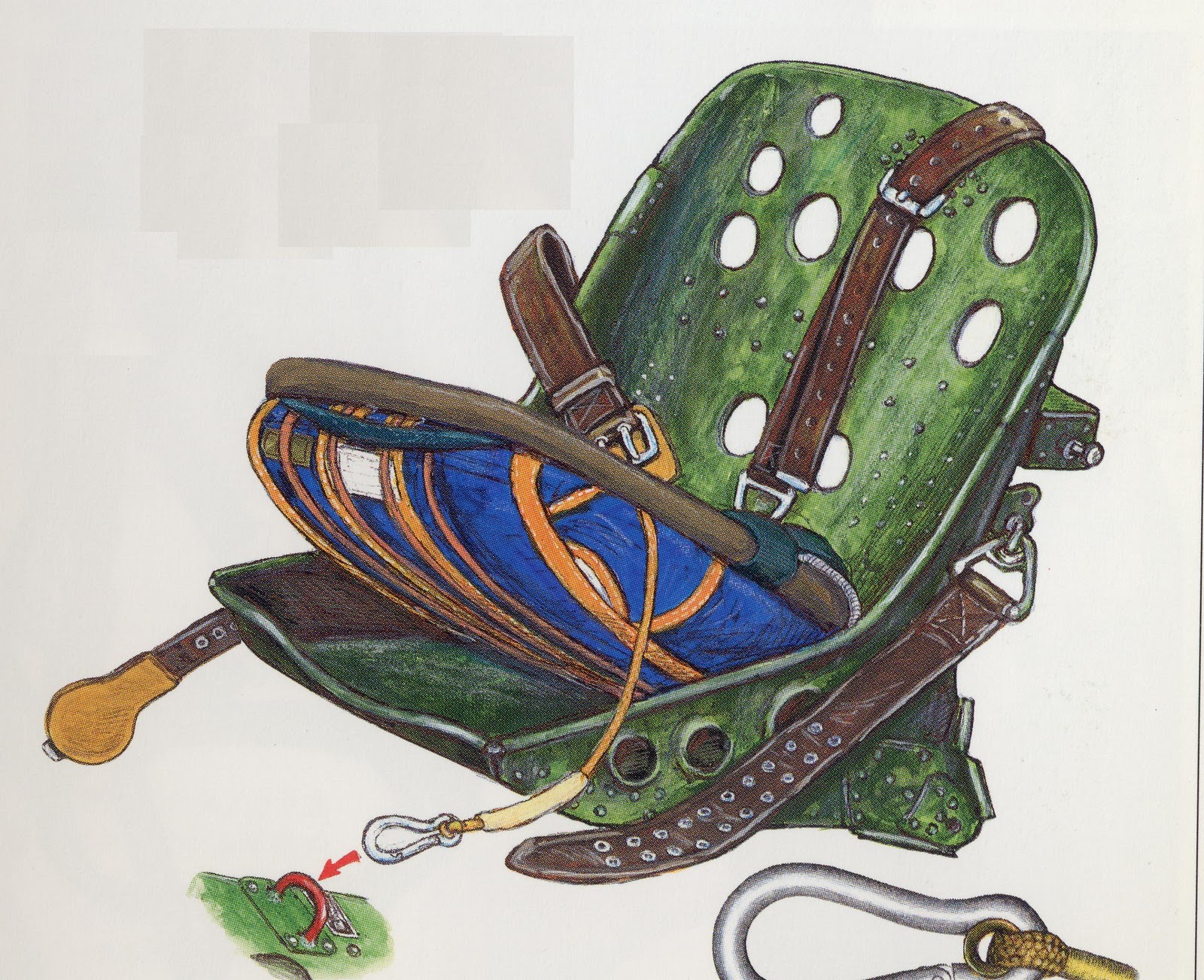
Well, some Old Guys used to say they didn't use them, even though they were standard issue in both the Japanese Army and Navy air forces during the war. There was apparently a question regarding one of the parachute rigs on one of the many scale modeling boards a few days back and David Aiken, aka "Captain Bonzai" (bet you didn't think I remembered that, did you, David?) submitted several photos of said harness. David was kind enough to copy me on some of the correspondence, which allows me to run a couple of shots of the harness for your enjoyement. I'll let David tell you about it.

Sensei H. Sugiyama Shi sent six scans to illustrate the IJN A6M seat and harness, the parachute pack (zabuton), the harness worn by the pilot, and the connections. As he gathered these items, he still seeks the IJN "D" ring...so used (in photo 2) a IJA "rip cord" red handle for the assembly.

Hope this may help with the MANY questions.


Cheers,
David Aiken, a Director: Pearl Harbor History Associates, Inc.  http://www.pearlharbor-history.org/


I don't know about you folks, but I often pose figures by my models, and these illustrations are of great value for that sort of thing. Many thanks to David Aiken and his Japanese mentors for allowing the use of the illustrations.  Aiken Collection

The Class of '38

About a hundred years ago, or at least it seems that way, Jim and I were hard at work on an SBD monograph that ultimately never got published. (I recently found and re-read the manuscript I'd written for said monograph and can honestly say that it's just as well; trust me on this one...) Somewhere in the evolution of the piece I'd loaned out a couple of photographs that were germaine to the SBD story. Jim found them a few weeks ago and sent them on to me---you've already seen one of them (the Northrop XFT-1), and there's really no place in our format for the other because of the way it's been tweaked by the USAAC. It's a neat shot, though, and well worth running. Here then is the Kelly Field Attack Section Class of 1938:

If you're an American you owe these guys, although it probably never crossed your mind to even remotely consider that. The photo was taken on 01 April, 1938. Within three years most of the people in this photo were hip-deep in a war, and I'm guessing a fair number of them died in it. That makes the photograph valuable to us all, I think, even though we can't see a whole lot of that A-17, although the gun fit and smoke tanks are of considerable interest to the modeler. Let's consider this one a tribute; thanks for your devotion and sacrifice, Class of '38.  Kelly Field 72861014 via Friddell Collection

You Meet The Coolest People on This Site

If you've spent much time exploring our modest offering, you've seen the links to the right of the page. One of those links is for a friend of ours named Jean Barbaud who, among other things, is one heck of an artist. You can see quite a bit of his work by clicking on his link, but I'd like to share a couple of his images with you here, because they're seriously cool. Please note that they're copyright, and that you can get a set of them (plus many others) by contacting Jean via the address given on his blog.

We really like P-40s around here, and we've had a soft spot for the 80th FG since that article on the unit way back in the original RIS. Here's Jean's take on all that.  Barbaud


And, of course, a P-51D! George Preddy would've liked this one, I think.  Barbaud

"Big Viv" was prominently featured in a classic USAF short film called "The Geiger Tigers". We presume the film was Jean's inspiration for this drawing---what a classic.  Barbaud

And finally, a "Fruitfly" from VA-93. Many thanks to Jean for sending these along.  Barbaud

And, as a reminder, you might want to check out our other links too. They're all favorites of ours and well worth your time!

Happy Snaps

This is rapidly becoming one of my favorite parts of the blog, and we've got a pretty spiffy entry for this week's edition from reader and contributor Don Jay:
Hi Phil, Here is another submission for your in-flight section. This is an F-4E out of Korat. It shows the capabilities of the F-4E and it just looks ‘tough’!! Shows how down & dirty it can get if you use these ac in the way they were meant. Here is a 34TFS F-4E with CBU-24 and Mk 82s both with fuse extenders and selectable fusing. This was taken from the Lemon anchor track in early 71 enroute to the Rt 9/tchepone area of Laos during support for LamSong 719. For the modelers in your group-note the irregular painting of ‘-228.’ dj


Many thanks, Don. We've got another of Don's air-to-airs in the works for a later edition so stay tuned (and please feel free to submit some of your own photography if you've taken any air-to-airs of military aircraft---we'd love to see them. As always, the address is replicainscale@yahoo.com .)

The Relief Tube

We're going to take a little different approach to this department today, by looking at some reader's models.

First off is an overdue look at an XFJ-2 Fury done by reader Brad Poling. He took an unconventional approach to building his replica and ended up with a really neat model. Here's what he had to say about it:

Phil,

The model was built using the Admiral toys 1/18 F-86 Sabre. As you know, the only Fury(s) one can build directly from the Sabre is/are the XFJ-2(s) and XFJ-2B Fury. It was no easy task as I had to totally dismantle the F-86. These "toys" weren't meant to be taken apart and much care (and patience) was required. I scratch built the nose gear using a wheel from a toy car for the tire rim and used the original Sabre tire on that "rim". The strut was made from a telescoping radio antenna. The gear door was modified and extended forward (though I should have extended it even more towards the nose). The gun ports were filled since the 755 wasn't armed. The tailhook, tail bumper, two barrier guards were all scratch built, as well as, their housings. The gunsight was removed. I borrowed the more appropriate wing tanks, seat harness, and navigational loop antenna from an Ultimate Soldiers F-86. The instrument panel was repainted (the original left a lot to be desired). I added a throttle control and landing gear up/down lever. All of the lettering (save for the small stencils) and insignia are painted (not decals). There are a few small errors (ie, the left wing insignia should have the very tip of the corner touching the wing slat), but overall I estimate it is at least 90-95% accurate. Not bad since I am not a model builder and this was only my second attempt as an adult. My only complaint with this model is the overall nose shape is just a little off. And the intake and exhaust had no detail (that is why I added the red covers). The Ultimate Soldier model was better detailed in this area, but lacked in others. I realize this isn't really the type of "model" you generally cover. However, since you've written on the Fury(s) so often, I thought you'd appreciate some info on the XFJ-2 program. BTW - 133755 was destroyed in a crash in 1953. While Bud Sickel was away with another squadron, a young Lt. took her up with instructions to fly no longer than 30 minutes due to a faulty fuel pressure gauge. Well, after 30 PLUS minutes of flying......he ran out of fuel and crashed. He barely escaped with his life. Brad

You can find Brad's photos at  https://picasaweb.google.com/bradnmel/XFJ2FJFury133755Model# . They're well worth a look.

One of the really neat things about this project is the fact that we get to meet people from all over the world. One of those readers is Anton Kochetkov, who writes to us from Russia. He's a dedicated (and seriously good) scale modeler, and has sent us a link to his latest project, a rework of the old 1/48th scale Lindberg X-3. The forum he's posted in is written in Russian, but the photos speak for themselves and the site itself is really neat too, and worth your time. Please give it a look:  http://scalemodels.ru/modules/forum/viewtopic_t_29406_start_0.html

Thanks for sharing with us, Anton, and please let us know when the X-3 is finished! (And send pictures!)

And that's what I know for now. Be good to your neighbor and we'll meet again soon.
phil