Coming and Going
Which is what I'm going to be doing for a little while. We talked about things being a little erratic while Jenny's mom & aunt are visiting and we're in the midst of that evolution even as this is written. Please bear with the lack of frequency and the probable brevity of my efforts during the coming month. Since we all have relatives someplace I'm sure everybody knows the drill and will understand.
A Photo Cat
How do you folks feel about the Grumman
Cougar? Me, I love it; it's gotta be the hottest thing since toasted bread as far as Good Looks are concerned. It's true that the sweptwing F9Fs were an interim design, but they were pretty capable and held the fort until better aircraft became available. Let's do a Quick and Dirty photo essay on the photo-recon variant of the airplane using official Grumman photography. (That means that you're on your own for color schemes this time. I'll try to dig some up to show you on another day but for now you'll just have to make do with these Grumman factory photos.)
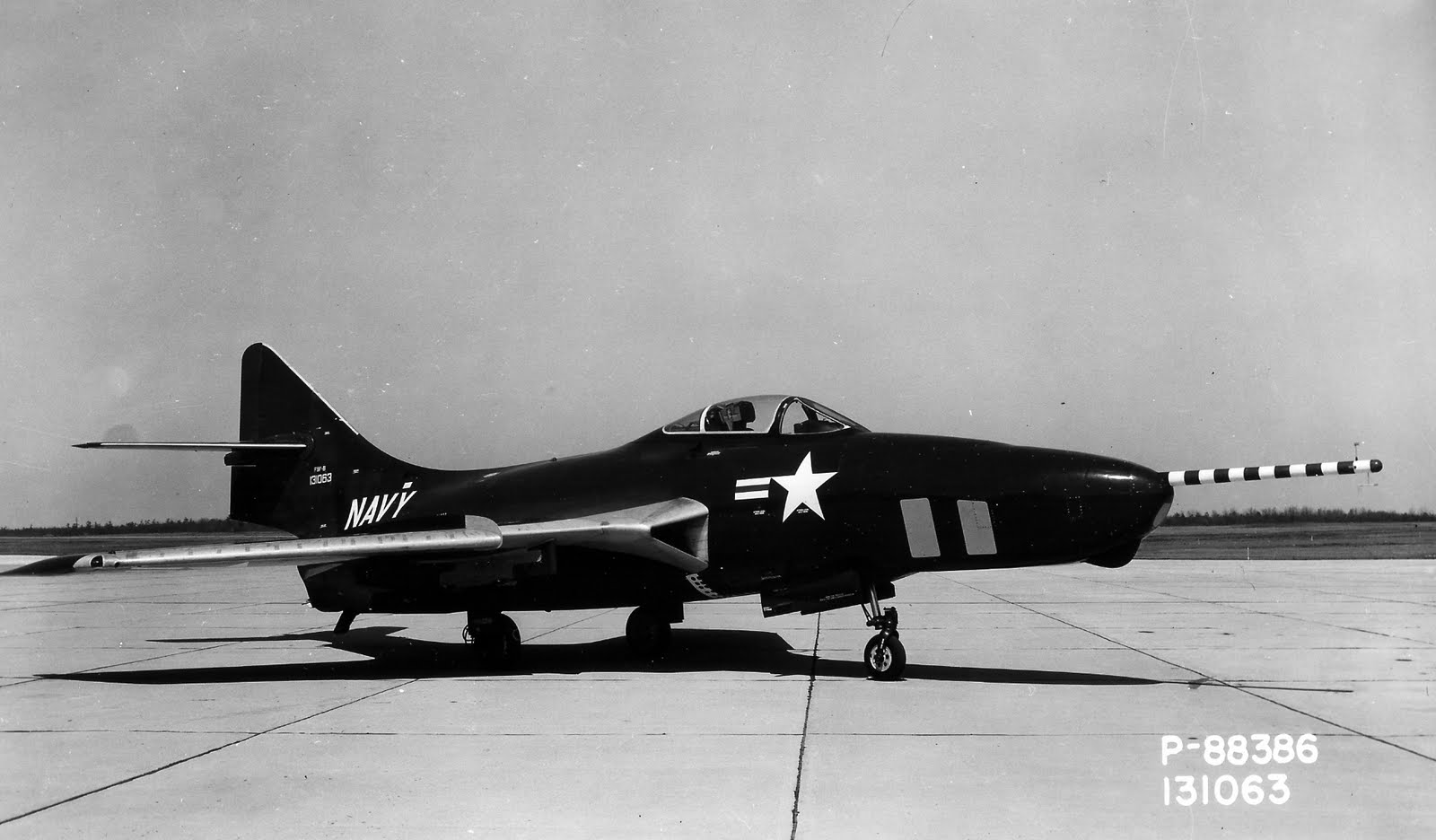
BuNo 131063 (the first F9F-8) as converted to F9F-8P configuration. The F9F-8P was developed just as the Nav changed over from Glossy Sea Blue to the Light Gull Gray and White camouflage scheme. Note the use of Corrogard on the leading edges; it's particularly noticeable here but is found on all
Cougars. The test boom doesn't do a whole lot for the looks of the airplane, does it? Grumman History Center P-88386
Here's the second production airframe, BuNo141669, posing with its camera suite. The aircraft is in test configuration (note the striped refueling probe) but is otherwise a "normal" production aircraft. Grumman History Center P-88852
And here's how it looks with the camera bay opened up. Grumman History Center P-88847
A closeup of the nose of 141669 with everything buttoned up. Most American military aircraft of the 50s had fairly extensive maintenance stencilling painted on the airframe. We don't normally think of the
Cougar as having much stencilling at all, but there's a fair amount of it evident here. Grumman History Office P-88851
This is the first production F9F-8P, BuNo141668, in flight. Of particular interest is the separation between the white undersurfaces and 36440 uppersurfaces on the nose. You can see quite a bit more of that stencilling in this shot too. Grumman History Office 558241
A 3/4 upper view of 141668 that shows to advantage the Navy's practice of painting all control surfaces white; note the all white horizontal stabilator and the white flaperons on the wings. Grumman History Office 55819
And the undersurfaces of 141668. Grumman History Office 55847
Substantially farther into the production build, here's a shot of BuNo144412 undergoing pre-delivery flight test. I've included this shot because the refueling probe is in place in this aircraft. There's an interesting markings anomaly on this bird as well; the last digit of the bureau number is substantially larger than the 5 numbers that precede it. Why is that, you might reasonably ask? I dunno; it's a mystery to me! Grumman History Center 56360
The Inside Scoop
You've probably noticed by now that I don't normally run photographs of aircraft interiors. These, however, are just too good to pass by; they're of the F9F-8P and should answer a lot of questions for the modelers amoung us.
Here's some ejection seat and canopy detail. Note the color of the seat, and that the back sides of the mirrors and the inside canopy framing are painted non-specular black. I'm not certain of the purpose of those brackets on either side of the headrest but suspect they may be camera mounts since they were photographed on the first production airframe (141668). The entire seat design is different from that normally found on the -8 series
Cougars and is also painted gray, while the normal production seat (the Martin-Baker Q7A) was painted black. Grumman History Office P-88761
The instrument panel and cockpit floor of 141668. Note that the inside of the windscreen framing is in non-specular black. A piece of plywood has been taped to the viewfinder of the photographic system. The cockpit is apparently "hot" if that placard stating that the emergency ignition igniter shells have been installed can be believed. Grumman History Office P-88762
The starboard cockpit side of 141669 (a typo by the folks at Grumman? The other photos in this sequence are of 141668) showing that funky early seat again. Those little buttons down near the cockpit floor are circuit breakers. Ergonomics? What ergonomics? Grumman History Office P-88764
The port side of 141668's cockpit. You now have enough photographic reference to build a pretty decent interior for a Photo
Cougar. Sure wish there was a 1/48th scale kit to work with! Grumman History Office P-88763
A schematic of the camera bay. This is from NavAer 01-85FGF-2-8 dated 1 February 1960, and was crooked when I got it; normally I'd straighten it out but before publication I'm pressed for time today so you'll have to go with what you've got. I think we'll all survive it... via Grumman History Office
Call It a Fruitfly or Call It a SLUF...
The LTV A-7
Corsair II series is arguably the most effective light attack aircraft ever built, and certainly one of the most capable. It was called the "Fruitfly" by the Navy, and the "SLUF" (an acronym for Slow Little Ugly F-----") by the Air Force, although their PR guys like to say "Fella" instead of what the type's drivers really called it. Go figure! Like most airplanes I cared about, this one's long-gone from service, but I've got quite a bit of photography on hand so let's look at a couple of snaps.
A-7D-14-CV, AF 73-1000, on the ground at Laughlin AFB in March of 1987. This green and gray example is from the Ohio Air National Guard's 166th TFS/121st TFW. Friddell
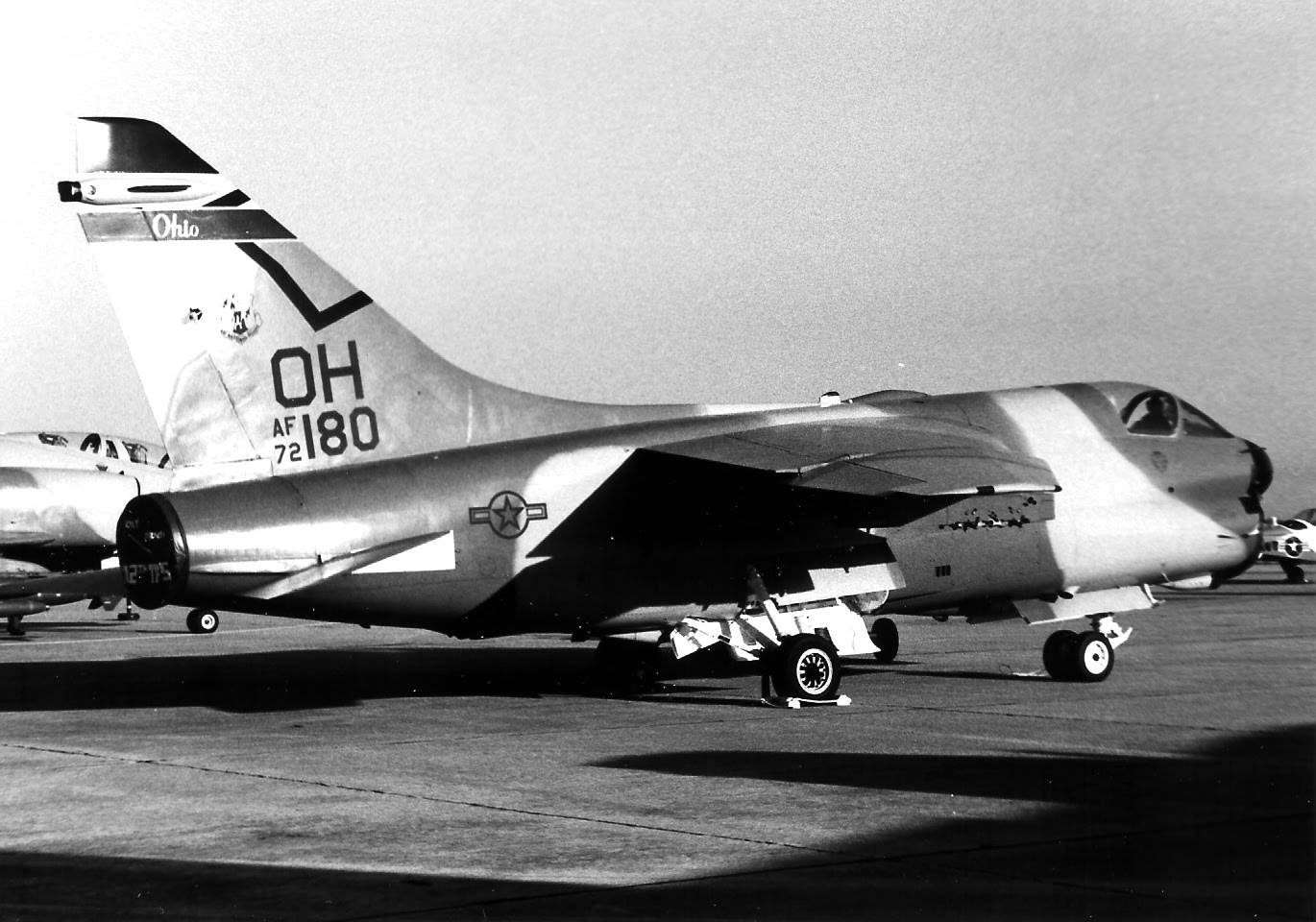
And here's 72-0180, an A-7D-12-CV, from Ohio's 112th TFS/180th TFG photographed at Bergstrom AFB in August of the same year. This ship was in two shades of gray. Friddell
A Turkey to End the Day
I read a lot of the modeling boards, usually on a daily basis. A couple of days ago there was an inquiry on one of them asking if TBFs were based out of Henderson Field at Guadalcanal. The answer is Yes, and here's a final shot for the day that shows one on the ground at Cactus in December of 1942.
Things are beginning to settle down on The 'Canal; note that this TBF-1 is parked in a hastily-constructed earthen revetment. Camouflage and markings are standard for the period. Sure wish we could see the side number! Admiral Nimitz Museum via Bruce Smith
And that's it for today! I'll be back again as time allows, but meantime, be good to your neighbor and we'll see you again as soon as we can!
phil