Everybody Seems to Have Liked It
Our 100th issue has come and gone, and the response from our readers has been great. We consider that to be a Very Good Thing since that issue was intended as a special thank-you to everybody for their support over the past year, and we're definitely happy that it made all of you happy! We managed to put in quite a bit of material (which means we'll have a busy Relief Tube this time around) and had something for almost everybody; good pookie all around.
So when's our next special issue coming out? In theory that will occur upon the publication of our 200th installment which means, if we stay on a weekly schedule, that you'll see it in about two years, although we may do a special birthday issue (it'll be our 2nd anniversary for this thing---how cool is that?!) in February. Time will tell. Meanwhile, thanks again for all your support. We'll do our best to be worthy of your continued interest!
A Hose Nose for Our 101st Edition
Everybody likes the Corsair, you know. The airplane looks neat, has a sterling history in both combat and peacetime, and we've got decent kits of most of its variants in nearly all of the popular scales. That conspires to make the airplane an excellent choice for the beginning of our Second Century, so without further ado:
Here we are, all dressed up with somewhere to go! F4U-4B 97428 from VF-114 is tensioned and getting ready to launch off the Philippine Sea during February of 1951, making this a probable combat sortie, or maybe a flight on the workup in route to theater. Operational conditions have flattened her Glossy Sea Blue paint job, but she's carrying a pilot's name and mission markers under the windscreen, which makes her a little bit special. A lot of the available kits of the "Hog" give a rectangular cutout in the inboard flap on the starboard side to simulate the F4U's foot step, but that step can be somewhat of an anomaly; it's always there, at least on the -4 and subsequent, but there's a little spring-loaded flap that covers it so you shouldn't normally be able to see it. V407 doesn't have that flap, just the cutout, which makes modeling it a little bit easier. Ron Gerdes via Sullivan
Early Days in SAC
We ran some really nifty shots of A-26s from the Jim Sullivan collection last week, and alluded that two of them may have belonged to an aircraft from the budding Strategic Air Command. That was in fact the case, as corroborated by contributor Dave Menard. Dave sent along a couple of shots that should interest us all.
Straight from the horse's mouth, as it were, is a copy of the Strategic Air Command's first insignia from the archives of the SAC museum. We're all used to the mailed fist but this one's classy too. (That mailed fist with the lightning flashes was designed by S/Sgt Robert T. Barnes in January of 1951; Sgt Barnes was awarded a $100 savings bond for his design.) This gives us something else to look for on those old photos! Menard Collection
And here's that insignia on an airplane, along with SAC's signature star-spangled blue band. It's doubtful that any B-17 ever operated in the bomber role with SAC, but there were still quite a few of them around when this photo was taken. 48936 was a VB-17G and was hauling staff officers for a living. That's Offutt's ops building in the background---long ago and far away. Menard Collection
An Invader Called "3-Ball"
We seem to have struck a nerve with our recent coverage of Douglas' immortal A-26. We're getting lots of comments and, thankfully, some new photos too, which means it's time to run some pictures. This time around we're going to look at a bird from the Michigan ANG's 107th BS:
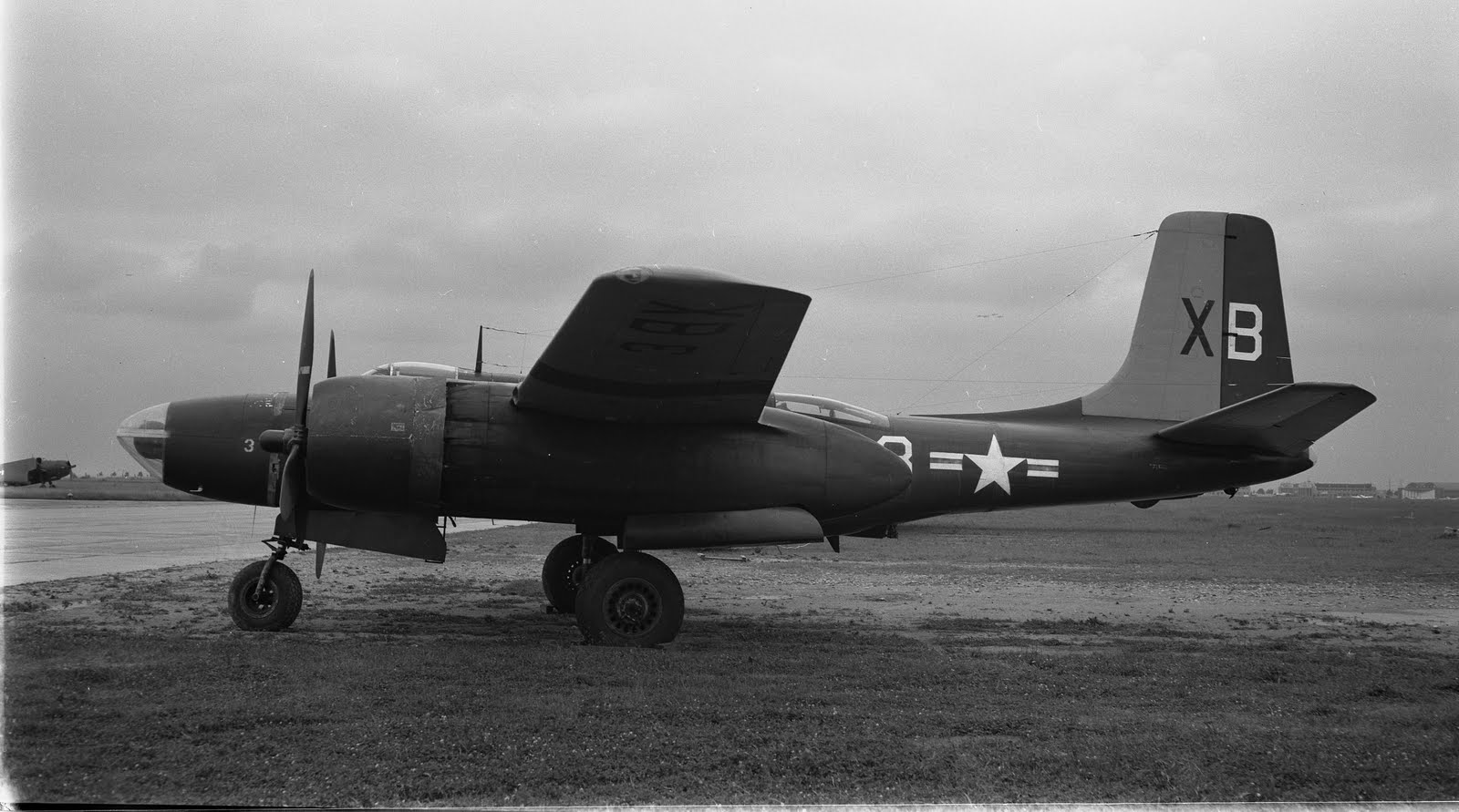
44-35522 was an A-26C-35-DT and is shown here during the 1947-48 time frame, complete with "NG" stencilled on her vertical tail. She's still got her turrets, and this view clarifies an earlier photograph for us. Note those gun ports on the starboard side of her nose---Doug Barbier, who provided these shots, tells us that all of the Michigan ANG's A-26Cs were so-modified. It must have been a fairly common addition to the aircraft, since one of the South Carolina birds we ran last time around had the same mod. Doug was kind enough to provide color details for us, something we don't always have. The tail stripes (top to bottom) were blue, yellow, and red, while the ball in the nose art is red with what appears to be yellow lettering, along with red prop spinners. W. Balogh via Menard Collection via Barbier
Here's "3-Ball" again, this time at Detroit's Wayne Airport ca. 1949. The wing tips and gear doors have been painted a dark color, probably blue, and the ball in the nose art has been repainted to match, as have the prop hubs (although the blue has weathered a bit on those hubs, exposing the red of the original markings). Note that the legend "NG" on our first photo has been changed and now reads "ANG". It's really neat to watch an airplane morph its markings this way! W. Balogh via Menard Collection via Barbier
Finally, here's a parting shot of "3-Ball" taxiing, probably during mid-1948. In one of our captions last issue we'd commented that normal ingress and egress was through the bomb bay, which is true of the hard-nosed Invaders. The Charlie models also had a boarding door forward of the nose gear bay which was often kept open to provide air while the airplane was taxiing; it provided a breeze in the cockpit and allowed the pilot an excellent view of the taxi stripe on the concrete. Note that those prop hubs now appear to be either white or yellow. Make up your minds, guys---make up your minds! W. Balogh via Menard Collection via Barbier
An F-4 You Rarely See
Reader Pat Donahue sent in a comment regarding one of the articles in our 100th issue, which you'll find in today's Relief Tube. He also sent in some photos of a model he built, and we'd like to share them with you today.
Here's a different sort of F-4 for your consideration---Pat's model of the Lockheed F-4 photo recon ship. P-38 models are a tough date no matter how you slice them, because the design of the real aircraft doesn't lend itself particularly well to easy reproduction in plastic. Couple that with the extremely-difficult-to-do-properly "haze" scheme and you've got yourself one impressive model. Great job, Pat! Pat Donahue
And here's a slightly different view of the airframe. The "haze" finish was apparently effective, but was also extremely difficult to maintain in the field. In consequence, the later F-5 photo Lightning was generally delivered in natural metal rather than "haze". The earlier scheme is really pretty, though, and the model is quite an attention-getter. What a treat! Pat Donahue
Those Navy Guys Flew the Invader Too
Tommy Thomason is one of the most knowledgeable people we know when it comes to American naval aviation, and it's always good to hear from him. Mostly you'll find his comments in the latter part of this blog, in our corrections and additions department, but every once in a while we'll sneak him into Prime Time, which is what we're doing today. Let's let Tommy tell you why:
In the interest of equal Navy time, attached are three pictures of JD-1s. The two good ones were taken by Pete Bulban (77209 appears to be at Pax and have a non-standard radar installation - also look closely at the background for a treat). The really crummy one was taken by yours truly, about 12 years old, at NAS Sangley Point, PI in 1956 or thereabouts. The camera may have been a classic Brownie Hawkeye. Note that the side number is 13. This may have been the JD that came back one day from towing targets for visiting fighter squadrons on one engine, having taking 20 mm hits from one of its customers. Since the hydraulics were out and there was some question about the brakes, the sailor in the aft compartment buckled his parachute harness to some structure and deployed the parachute on touchdown.
Look at this image closely and you can see the yellow wings and tail that were representative of certain of the NAV's utility aircraft, but there's not much else that's ordinary about 77209. Check out the radar installation that Tommy mentioned, and also the crew ladder deployed from the former location of the ventral turret. That test boom on the starboard wing tip is unusual too; this is definitely not your average JD-1! Bulban via Thomason
And the other side, which gives us better definition of the paint scheme. Of particular interest is the antenna array mounted to the airframe---that's definitely not a normal A-26 or JD-1 antenna suite! Check out the mud all over the wheels, and the aircraft's temporary parking place. You do what you have to do! Bulban via Thomason
Finally, here's the photo Tommy took of 77150 way back in 1956! The shot's a little soft, but absolutely fascinating nontheless. The gas bags and unidentified emblem on the nose would make this an extremely interesting model. Those of you who photograph airplanes with any degree of regularity will notice Tommy's sense of proportion and framing in this shot. Well done, Tommy! Thomason
Insider Humor
We don't normally run cartoons here, but there's definitely a place for them, as proven by this offering from Doug Barbier:
Lockheed's immortal T-33 was your typical late 1940s-early 1950s jet, typical in that it was somewhat underpowered and also tiny, at least by "modern" standards. Long flights in the airplane could be a challenge for the crew since it was so tight in that cockpit, as typified by this cartoon sent to us by Doug Barbier: (Here's) a humorous scan of the T-birdicus Subsonicus. With a poopy suit and all the rest of the gear you had to wear, you really WERE part of the airplane - and there certainly wasn't room to move in that cockpit - not side to side at least. Too funny! Thanks for sharing this with us, Doug!
Almost But Not Quite Happy Snaps
Doug Barbier's been getting quite a bit of space in this section of late, but that's because he's been sending in such really neat material! Today's submissions are also from Doug, but we're breaking the rules just a little bit because Doug didn't take these, and because they were shot as ground-to-air rather than air-to-air photos. The thing is, they don't really fit anywhere else on these pages but are just too darned good to pass up, so here they are---let's take a look:
Here are a couple of scans of photos shot by Baldur Sveinsson at that Reykjavik airshow in 1979 - the 6-ship pass would be absolutely forbidden in today's Air Force - dissimilar formation! EEK!! We did it all the time - without any formal prior briefings - you never knew who would have to lead you home in the clag. Flew formation with T-birds, F-4's, P-3's, C-130s, E-3's anything and everything that you could match speeds with and would agree to lead you in for practice. An E-3 had to drag one of our T-birds who'd had total electrical failure down to the runway in below minimums weather - missed on the first approach at 100' and didn't see anything - they cheated to about 50' on the second one and started in---Kevin had nothing to lose since he was going to die anyway, so he froze the stick and just kept the sink in. Saw a light at maybe 20' and planted it with less than 70 gallons of fuel left. At Kef back in those days, you either landed on the runway you took off from, died cold or died hot. No other options. Even if you ejected over the middle of the field, when the weather was 30-50 kts of wind and 1/16 mile visibility nobody was going to find you until it was way too late - and you'd get dragged to death out in the lava fields anyway - cost of doing business. Jumping out over the water in those conditions with 20 foot waves simply meant you were going to drown or freeze to death. Staying with the jet and trusting your skill was the preferred option. And there were no minimums when there were no alternatives - you did what you had to do. Hand flown ILS to touch down? Practiced them all the time since you never knew when you'd have to do it for real...... the guys who were out there in the field had very different ideas on what was "safe" vs. those sitting in comfy chairs at HQ. The HQ folks were always worried about their safety record and looking bad. We were always worried about survival. Baldur Sveinsson
Next one is the missed approach---note that Two's nose gear door is almost completely closed, gear is retracted already and they're maybe 6' in the air. Tommy was riding high on lead as his *sshole puckered up... YIKES---what a photo! We'd have given anything to have been a fly on the wall in the stag bar at the O Club that night! Baldur Sveinsson
And Now For the Real Happy Snap For Today
Our friend Doug Barbier used to fly with the Michigan ANG, and one of the types he flew was the Phantom. We happen to like F-4s around here, so it's fitting that today's Happy Snap entry is another of Doug's shots.
You have to love the F-4, and Doug's photography really makes the airplane stand out. Here are his comments regarding the photo, along with some advice for the budding air-to-air photographer: 266 is the F-4D Sq CC bird - crossing over I-94 northbound, headed for the MOA - I'll guess about March 1990. The camo works - that's the semi-gloss version. The flat got dirty way too fast and the crew chiefs hated it - they couldn't keep their jets clean.
A couple of thoughts on shooting air to air. It's pretty straight forward "IF" you brief it & give it some thought before hand. If I was flying, the rule was that the photo bird is always the leader. Doesn't matter where anyone else is flying - in front of, behind, above, below - the wingman's job was to be where you were briefed and never hit the leader. After that it's safe. I'd frequently drop the mask to be able to see the viewfinder better - and make a radio call telling guys where I wanted them to move for the shot. Really didn't do dedicated photo shoots---just grab shots to and from the area before doing some training .... You don't want the horizon in the picture. In the F-16, I'd set up about where I wanted to be vs. the sun & ground, then turn the autopilot on and tell everyone that they were about to get a turn into them - spin the heading selector on the autopilot and grab the camera while everyone was getting back into position from the roll-in. Snap while I could and then drop the camera, knock off the autopilot and set it up again. Worked like a champ. The lower you were the better - I liked about a thousand feet, unless you had some really good clouds to work with, but we're talking the mid west, so, if you had a nice blue sky vs. the typical midwest humidity, you could roll away from the wingman and get a nice blue background. The wingies had to work for it - you'll see in that shot that he's staring straight into the sun trying to hold position for me.
If I was not flying, we'd brief that the photo ship would be a "loose wingman" and it was our job to not hit anyone else, but we'd be talking on the radio to tell everyone where to be in the formation so the shot would turn out. Doug
The Relief Tube
First off, today's installment is a little bit earlier than we promised it would be. It's brief because we spent 3 hours last night with a Dental Emergency, and it's early because we've got jury duty this coming Monday. We will eventually get back to our regular schedule, but this is what we're doing today. Sometimes you have to improvise...
Anyway, last week's installment was a big one, and we expected to get a response or two. We weren't disappointed so let's jump right in, beginning with some comments from Dave Menard:
Hi Phil. Checked for your blog and glad it is early, here are some comments I'd like to add:
1. H-43s were never bare metal, as they had lots and lots of easily corroded magnesium for skin, so all had a coating of silver or aluminum paint, depending on your description (of that sort of thing).
2. H-43s were the last wooden winged aircraft in the AF, since their rotor blades were made of wood.
3. H-43s rescued more folks during the SEA war than all the rest of helos put together (AF, not Army helos).
4. Wayne Mutza has an outstanding book out on the Pedro from Schiffer.
5. Pedro was the radio call sign for H-43s, i.e., Pedro Zero Two, etc.
6. F-102A 56-1131 was one of the Deuces I worked on during my tour at Hahn from Dec 59 to May 62. Those two Deuces on the nose are not ZAPs, but places to paint the pilot's and crew chief's names.
7. Wing fences were orange day-glo which faded and flaked way too quickly.
8. 431 may have been photographed at the McClellan AFB museum, not at McChord, as there was no way a USAFE Deuce made it to the left coast in full markings.
9. B-26s were used by SAC as hacks, couriers, proficiency flying for desk bound pilots to get their four hours a month in, but none were in a combat role. SAC had VB-17s and one VB-29 also...
10. That insignia on top of 614s fin is the original SAC insignia, believe it or not! The infamous mailed fist with the lightning flashes and olive branches came along later on.
11. Bomb bay doors on the A-26 were left open when parked to keep the fuel fumes from accumulating too much inside the aircraft, not to provide access to the crew positions.
Cheers, dave
Thanks Dave, and thanks also for the head's-up on Wayne's "Pedro" book.
Tommy Thomason had some thoughts to offer us regarding a couple of those "Banjo" shots: Phil, congratulations (on your 100th issue), and now back to your regularly scheduled critique:
The VC-3 F2H-2 being loaded onto Philippine Sea is an F2H-3 (or maybe a -4) and is probably being off loaded as a dud not repairable on the ship.
One interesting element of the VF-41 F2H-3 pictured is that it has the pylon for a Mk 7 nuke. See http://tailspintopics.blogspot.com/2009/11/nuclear-banshees.html
Tommy had a couple of other comments as well, and this is as good a time as any to hear them. First: I was surprised to see that the wing-fold fairing was missing from the lead VAQ-129 EA-6B. Obviously not a flight critical part, like the IFR probe door on the F-14.
You printed the second page of the Approach article twice. I'd really like to see the scan of the first page. T
Thanks as always, Tommy, and here are those two pages from the Approach article on the TS-2A. Guess we got confused somewhere in Production!
Thanks again to Richard Adams for sending these to us for publication and, once again, please note that they originated with Approach magazine.
Finally, here are a couple of comments from readers regarding that B-25 story: Phil, a number of years ago I had the privilege of sitting behind the pilots (and in the upper turret and in the nose, etc) of a CAF B-25 while they were doing some training, mostly touch and goes with an extended pattern. The opportunity came up quick like so I hi-tailed it to the airport, not thinking about my wearing a white shirt. Well, after watching them taxi in and turn around/shut down, then flying then, walking around post flight my white shirt was now polka-dotted with the neatest splotches of R-2600 thrown oil. I kept the shirt till it fell apart; no way I was gonna let that one go to the bin before its time, it was too good a souvenir...
Congratulations of #100, and NICE 109! Winter finishes ain't that easy to pull off and you did it. Best, Pat Donahue
And:
Hi Phil, just returning to town and took some time to look at your latest issue. Nicely Done. Can’t say enough about those A-1 shots. To me the best one is A-1H 517---it has an abnormal load in that it is carrying a CBU-24/49 store. Just a great selection of a truly workhorse a/c. Then you follow up with the 57th FIS. Too much in one viewing!!
I’m sure we all have a good story/laugh about flightline photography and can’t believe you let that poor young guy get his whites oiled like that! I don’t know if you knew that Jim Sullivan and myself coordinated/orchestrated/escorted the tours at Oceana during the 80’s and 90’s-last one was 2001. Fun, fun and more fun! Cheers for now. dj
And another message from Don regarding that 100th edition:
Now that you are a CENTURION, I think it only appropriate that you have these photos! You can officially use the Century a/c in Replica as your pub is now as old as they are! PS: Don’t think many folks know that NASA used the ‘Hun’ as a research ac-proper ID is JC-100A. Best, Don
Thanks, Don!
And a Big Ol' Texas Thank You to all of our readers who have responded with kindness to our 100th issue, and who have sent photographs and comments. We've got some neat stuff still in the pipeline too, so stay with us! Meanwhile, be good to your neighbor and we'll meet again soon.
phil
Showing posts with label korean war. Show all posts
Friday, June 3, 2011
Sunday, November 21, 2010
More on the C-119 in Korea, Some Early Tankers, The Mighty Stoof, and A Neptune,
It Really IS a Big Ol' Box, You Know...
It's easy to forget when writing this stuff that a large proportion of our readership has never actually seen some of these airplanes for real, at least not outside of a museum. For that group in our audience, a quick explanation about the C-119 may be in order.
The type was an airlifter pure and simple, designed to haul stuff, people, and light vehicles to wherever such things might be needed and deposit them where they could be of use. It was an adequate performer when empty (or nearly so), and was a little bit of an ill-mannered slug when fully loaded. That whole Flying Boxcar thing was highly appropriate as names went, because aft of the flight deck the C-119 was nothing but a big empty box with a rail system (those thingies with all the rollers on them) bolted to the floor for cargo handling. You could fly the airplane with the clamshell doors in place, or with them removed; the airplane really didn't care. And you could get stuff to where it was needed.
There was a time when it seemed like every ANG or AFRes transport unit in the country either operated the type or had operated it at some point in its recent past. The type was everywhere, including Vietnam (where its primary role was often that of gunship, but that's a story for another day...), but it gained a lot of its fame during the Korean War and shortly afterwards, when a number of American C-119s were used to help the French in their attempt to put down a nationalistic movement in what was once known as French IndoChina.
With all that said, the C-119 was a unique airplane, and is one very much worth modeling. I can only think of two plastic (as opposed to resin) kits of the type; Aurora's old stager (in 1/77th, I think) and Italeri's excellent 1/72nd scale offering. (There are almost certainly other kits out there as well but this isn't an Old Kits site so we aren't going to mess with that sort of thing---apologies if that matters to you!)
Anyway, we ran a couple of C-119 shots last time around, which in turn caused Mark Morgan to send in a few more. Let's look:
There was a time when Air Force squadrons possessed more than a handful of airplanes, as this shot of the 314th Troop Carrier Wing in Korea attests. It's virtually impossible, at least without each aircraft's record card, to determine which squadron this is in a black and white photo since the only thing that varied was the color of the "standard" unit markings. Sure wish we could see the rest of that nose art!!! AMC Archives via Mark Morgan
Gettin' ready. Here's a C-119B from the 50th TCS/314th TCW preparing to drop members of the 187th Regimental Combat Team over Korea on January 15th, 1951. 48-0337 has her paratroop doors (a component of the clamshell cargo doors) opened and you can see the first trooper exiting the aircraft. Note the forward cargo doors are also deployed. I think there's nose art up there, but I sure can't make it out. AMC Archives via Mark Morgan
And away we go! Static lines are streaming behind the aircraft, and weapons packs are spilling out of those forward doors. This probably isn't the Very Best Way to get into a war, but it sure looks impressive! AMC Archives via Mark Morgan
Those clamshell cargo doors could be removed to allow big things such as jeeps and artillery pieces to be air-dropped. This photo shows 49-0106, among other 314th C-119Cs, lined up in preparation to launch with the clamshells removed. Kinda ugly that way, isn't it? AMC Archives via Mark Morgan
The C-119 carried some fairly ribald nose art during the course of its combat career. This isn't that, but it's still neat and, I think, worthy of modeling. "Oh Ged/Dilbert" sits on the ramp awaiting its next mission in this evocative shot. AMC Archives via Mark Morgan
A little bit bawdier, but still in good taste, "Jo-Jo" begins to taxi away from a dump of artillery rounds. Nowadays you almost expect the folks from OSHA to oversee combat operations, but there was a time when you simply did what you had to do... AMC Archives via Mark Morgan
A parting shot, as it were. It was a simpler time. AMC Archives via Mark Morgan
Passin' a Little More Gas
We run pictures of tankers every now and again, but a lot of folks don't really appreciate the job the they do (the tankers, not the pictures). They're a force multiplier all out of proportion to their numbers and, like many other military airplanes, are going away due to cost, budget cuts, etc. Here's a thought or two from Don Jay on the subject, along with a couple of really neat pictures.
With all the 'political wrangling' going on about the KC-135 replacement, many forget what a significant factor air-to-air refueling is to our air forces. It is truly a combat multiplier. The US has been fortunate in having a tremendous capability in this department since the mid '50s. Lets hope our politicians don't erode this capability past the 'point of no return'. Here are some early examples of in flight refueling. I bet not many remember that TAC had its own dedicated tanker fleet many years ago.
The first is a KB-29 refueling an F-86. This was out at Edwards during the proof of concept for the Flying Boom project. The second is a KB-50 refueling the Thud out over the Pacific in 64. Note the use of the probe and drogue with the Thud, while the last one is a PR shot showing Tac's world wide capabilities-KB-50 over the Gulf of Mexico in the 62/63 timeframe.
In the beginning... Not the real beginning, of course, since the AAC was trying out the air-to-air refuelling concept back in the 30s, but the Dawn of the Jet Age and Flying Boom beginning. Here a KB-29 tries out the boom concept on an F-86. Note the "Sabre" has both flaps and gear down, and is still pulling a moderate angle of attack, while the KB-29 is going downhill to keep airspeed. It ain't as easy as it looks! USAF via Don Jay
Over the Pacific in 1964. Another year would see KC-135As tanking the "Thud" both ways on missions to North Vietnam. Most PACAF fighter-bombers had a nuclear strike role in pre-Vietnam days, and the F-105 was quite possibly the ultimate expression of that mission as far as American tactical aircraft were concerned. USAF via Don Jay
TAC PR in action. You could actually tank three at a time of the KB-50, and it was done somewhat routinely, but not with dissimilar aircraft during actual operations. You can bet the throttles are firewalled on that tanker! USAF via Don Jay
The Mighty Stoof
One thing about the Navy; they've never been shy about giving their airplanes nicknames. The Grumman S2F/C-1A family were no exception, with the S2F pretty obviously offering itself up for transformation into "Stoof". We've never run a "Stoof" shot on these pages, so today's the day!
You are now looking at what may arguably be the loudest recipricating-engined aircraft ever built. The S2F was nothing if not LOUD! 136648 from VS-30 sits on the ramp awaiting deployment. The "Stoof" was a fairly small airplane, and wouldn't be big at all in 1/48th scale. That's a hint, model manufacturers! Mark Nankivil Collection
By the time this shot was taken off NAS Key West in August of 1973, the S2F-1 had become the S-2E. 151642 is from VX-1 and is stooging along with her MAD gear deployed. What a neat photo! Mark Nankivil Collection
The "Stoof" was a natural for conversion to COD duty, and was more capable in that role than you might imagine. Here's 146039, a C-1A from NAF Misawa, on final at an unknown airfield, date unknown. Mark Nankivil Collection
A Teaser to End the Day
It's just one lonely little photo, but what a photo! I've got some Vietnam-era Lockheed Neptunes in my collection that I keep thinking I'm going to publish one of these days, but I honestly like this one better. It's a colorful way to end the day:
The P-2 (nee P2V) Neptune got around. This colorful example is from VX-3 and is a DP-2E; note the missing tip-tanks and truncated aft fuselage. She's configured to haul Ryan Firebee drones and has apparently done a fair amount of it; note the wear on the red stripes over the wings and the extensive exhaust staining on the cowlings. The P-2 family led a long and exciting life. We'll run a few more photos one of these days... Bruce Trombecky via Mark Nankivil
The Relief Tube
We've run a few photos of the Douglas F4D-1 Skyray of late, and I must admit I've made some less than flattering remarks about her suitability as a carrier fighter. That, of course, led to a letter, which in turn has resulted in a response by two of our regulars, Tommy Thomason and Rick Morgan. As everybody knows by now, we don't run any sort of forum here, but it's neat to get differing thoughts on things all the same. Me; I still think the airplane was more of an exceptionally high-performance sport plane than anything else. As for Tommy and Rick, let's let them tell it for themselves.
First, some thoughts on the "Ford" from Tommy:
The main knock on the F4D was that it didn't have a useful weapons system for all-weather intercepts of jet bombers, which was its raison d'etre. The unguided rockets weren't accurate even when fired by radar. Guns had a low probability of kill as well, even in visual conditions against a jet bomber, because of lack of firing time in a head-on pass, accuracy in a beam attack, and difficulty of closing in a tail chase*. The Sidewinders couldn't home in cloud. Unlike the F3H, the F4D was never provided with a Sparrow capability. One CAG said he'd rather have F2H-4 Banshees than the F4D Skyrays assigned to his air group. There were always fewer F4D squadrons deployed than F3H squadrons. When the Phantoms arrived in the fleet, the Skyrays were all replaced first.
*Contrary to published reports, the F4D was not supersonic in level flight by the usual standard (you could dive it to supersonic speed and then level off, but the airplane would then slow and go subsonic) even when powered by the J57, with which the F8U was easily supersonic. Douglas spent an inordinate amount of flight test effort attempting to get the Ford supersonic in other than a dive, but was unable to according to no less an expert than Hal Andrews. The F5D configuration, with a better fuselage-fineness ratio and thinner wings like the F8U, was the answer. T
And from Rick, who also adds a note on the F3H Demon:
Phil: OK…. Comments on the latest blog. On the F4D; simply put, it was a show dog, not a war dog. Now don’t get me wrong, it was a beautiful aircraft- I love its looks, however even with its record flights it was not a great fleet aircraft. Designer Ed Heinemann said in his bio that he thought the follow-on F5D was the proper aircraft for the fleet. Capt Gerry O’Rourke (author of the great Night Fighters Over Korea) wrote a great piece for Naval Institute’s “Proceedings” that said it was a poor carrier aircraft, short on range and with a lousy instrument layout. His money quote was that it “…..came aboard looking like a drunken sailor off liberty”. The F4D was rapidly replaced by the F3H in the fleet, it was short-legged and not a great carrier aircraft.
As for the F3H; it wasn’t much better. It had longer range than the F4D and was a better ‘boat plane’ behind the CV but not much else. When you talk to Naval Aviators of that period, most seem to be happy they didn’t have to see combat in their aircraft, at least until the F8U and F4H showed up. Rick
And finally, unless I remember something else and add it later, here's a modeling comment from one of our readers. A few issues ago I ran some photos of a Hasegawa P-38G that I've been working on for, oh, the past two years or so. The purpose of said photos was to illustrate some weathering techniques, but therein lies the rub. The P-38 had handed propellers to counteract torque. The kit accurately depicts that and, if you happen to be in a hurry, you've got a 50% chance of getting it right. Unfortunately, that also provides a 50% opportunity to get it wrong. Wanna guess which way I went? Well, gang; there's no longer any need to guess. Let's let sharp-eyed reader Rob Rocker drop the dime:
Hello Replicia in Scale , the Props on the P-38G model are on the wrong side their rotation is not correct , the correct rotation on a P-38 both props turn in towards the fuselage from the bottom . Best regards, Bob Rocker I just can't get away with nothin'...
But I can say goodbye for today. We'll meet again soon. Meanwhile, be good to your neighbor.
phil
It's easy to forget when writing this stuff that a large proportion of our readership has never actually seen some of these airplanes for real, at least not outside of a museum. For that group in our audience, a quick explanation about the C-119 may be in order.
The type was an airlifter pure and simple, designed to haul stuff, people, and light vehicles to wherever such things might be needed and deposit them where they could be of use. It was an adequate performer when empty (or nearly so), and was a little bit of an ill-mannered slug when fully loaded. That whole Flying Boxcar thing was highly appropriate as names went, because aft of the flight deck the C-119 was nothing but a big empty box with a rail system (those thingies with all the rollers on them) bolted to the floor for cargo handling. You could fly the airplane with the clamshell doors in place, or with them removed; the airplane really didn't care. And you could get stuff to where it was needed.
There was a time when it seemed like every ANG or AFRes transport unit in the country either operated the type or had operated it at some point in its recent past. The type was everywhere, including Vietnam (where its primary role was often that of gunship, but that's a story for another day...), but it gained a lot of its fame during the Korean War and shortly afterwards, when a number of American C-119s were used to help the French in their attempt to put down a nationalistic movement in what was once known as French IndoChina.
With all that said, the C-119 was a unique airplane, and is one very much worth modeling. I can only think of two plastic (as opposed to resin) kits of the type; Aurora's old stager (in 1/77th, I think) and Italeri's excellent 1/72nd scale offering. (There are almost certainly other kits out there as well but this isn't an Old Kits site so we aren't going to mess with that sort of thing---apologies if that matters to you!)
Anyway, we ran a couple of C-119 shots last time around, which in turn caused Mark Morgan to send in a few more. Let's look:
There was a time when Air Force squadrons possessed more than a handful of airplanes, as this shot of the 314th Troop Carrier Wing in Korea attests. It's virtually impossible, at least without each aircraft's record card, to determine which squadron this is in a black and white photo since the only thing that varied was the color of the "standard" unit markings. Sure wish we could see the rest of that nose art!!! AMC Archives via Mark Morgan
Gettin' ready. Here's a C-119B from the 50th TCS/314th TCW preparing to drop members of the 187th Regimental Combat Team over Korea on January 15th, 1951. 48-0337 has her paratroop doors (a component of the clamshell cargo doors) opened and you can see the first trooper exiting the aircraft. Note the forward cargo doors are also deployed. I think there's nose art up there, but I sure can't make it out. AMC Archives via Mark Morgan
And away we go! Static lines are streaming behind the aircraft, and weapons packs are spilling out of those forward doors. This probably isn't the Very Best Way to get into a war, but it sure looks impressive! AMC Archives via Mark Morgan
Those clamshell cargo doors could be removed to allow big things such as jeeps and artillery pieces to be air-dropped. This photo shows 49-0106, among other 314th C-119Cs, lined up in preparation to launch with the clamshells removed. Kinda ugly that way, isn't it? AMC Archives via Mark Morgan
The C-119 carried some fairly ribald nose art during the course of its combat career. This isn't that, but it's still neat and, I think, worthy of modeling. "Oh Ged/Dilbert" sits on the ramp awaiting its next mission in this evocative shot. AMC Archives via Mark Morgan
A little bit bawdier, but still in good taste, "Jo-Jo" begins to taxi away from a dump of artillery rounds. Nowadays you almost expect the folks from OSHA to oversee combat operations, but there was a time when you simply did what you had to do... AMC Archives via Mark Morgan
A parting shot, as it were. It was a simpler time. AMC Archives via Mark Morgan
Passin' a Little More Gas
We run pictures of tankers every now and again, but a lot of folks don't really appreciate the job the they do (the tankers, not the pictures). They're a force multiplier all out of proportion to their numbers and, like many other military airplanes, are going away due to cost, budget cuts, etc. Here's a thought or two from Don Jay on the subject, along with a couple of really neat pictures.
With all the 'political wrangling' going on about the KC-135 replacement, many forget what a significant factor air-to-air refueling is to our air forces. It is truly a combat multiplier. The US has been fortunate in having a tremendous capability in this department since the mid '50s. Lets hope our politicians don't erode this capability past the 'point of no return'. Here are some early examples of in flight refueling. I bet not many remember that TAC had its own dedicated tanker fleet many years ago.
The first is a KB-29 refueling an F-86. This was out at Edwards during the proof of concept for the Flying Boom project. The second is a KB-50 refueling the Thud out over the Pacific in 64. Note the use of the probe and drogue with the Thud, while the last one is a PR shot showing Tac's world wide capabilities-KB-50 over the Gulf of Mexico in the 62/63 timeframe.
In the beginning... Not the real beginning, of course, since the AAC was trying out the air-to-air refuelling concept back in the 30s, but the Dawn of the Jet Age and Flying Boom beginning. Here a KB-29 tries out the boom concept on an F-86. Note the "Sabre" has both flaps and gear down, and is still pulling a moderate angle of attack, while the KB-29 is going downhill to keep airspeed. It ain't as easy as it looks! USAF via Don Jay
Over the Pacific in 1964. Another year would see KC-135As tanking the "Thud" both ways on missions to North Vietnam. Most PACAF fighter-bombers had a nuclear strike role in pre-Vietnam days, and the F-105 was quite possibly the ultimate expression of that mission as far as American tactical aircraft were concerned. USAF via Don Jay
TAC PR in action. You could actually tank three at a time of the KB-50, and it was done somewhat routinely, but not with dissimilar aircraft during actual operations. You can bet the throttles are firewalled on that tanker! USAF via Don Jay
The Mighty Stoof
One thing about the Navy; they've never been shy about giving their airplanes nicknames. The Grumman S2F/C-1A family were no exception, with the S2F pretty obviously offering itself up for transformation into "Stoof". We've never run a "Stoof" shot on these pages, so today's the day!
You are now looking at what may arguably be the loudest recipricating-engined aircraft ever built. The S2F was nothing if not LOUD! 136648 from VS-30 sits on the ramp awaiting deployment. The "Stoof" was a fairly small airplane, and wouldn't be big at all in 1/48th scale. That's a hint, model manufacturers! Mark Nankivil Collection
By the time this shot was taken off NAS Key West in August of 1973, the S2F-1 had become the S-2E. 151642 is from VX-1 and is stooging along with her MAD gear deployed. What a neat photo! Mark Nankivil Collection
The "Stoof" was a natural for conversion to COD duty, and was more capable in that role than you might imagine. Here's 146039, a C-1A from NAF Misawa, on final at an unknown airfield, date unknown. Mark Nankivil Collection
A Teaser to End the Day
It's just one lonely little photo, but what a photo! I've got some Vietnam-era Lockheed Neptunes in my collection that I keep thinking I'm going to publish one of these days, but I honestly like this one better. It's a colorful way to end the day:
The P-2 (nee P2V) Neptune got around. This colorful example is from VX-3 and is a DP-2E; note the missing tip-tanks and truncated aft fuselage. She's configured to haul Ryan Firebee drones and has apparently done a fair amount of it; note the wear on the red stripes over the wings and the extensive exhaust staining on the cowlings. The P-2 family led a long and exciting life. We'll run a few more photos one of these days... Bruce Trombecky via Mark Nankivil
The Relief Tube
We've run a few photos of the Douglas F4D-1 Skyray of late, and I must admit I've made some less than flattering remarks about her suitability as a carrier fighter. That, of course, led to a letter, which in turn has resulted in a response by two of our regulars, Tommy Thomason and Rick Morgan. As everybody knows by now, we don't run any sort of forum here, but it's neat to get differing thoughts on things all the same. Me; I still think the airplane was more of an exceptionally high-performance sport plane than anything else. As for Tommy and Rick, let's let them tell it for themselves.
First, some thoughts on the "Ford" from Tommy:
The main knock on the F4D was that it didn't have a useful weapons system for all-weather intercepts of jet bombers, which was its raison d'etre. The unguided rockets weren't accurate even when fired by radar. Guns had a low probability of kill as well, even in visual conditions against a jet bomber, because of lack of firing time in a head-on pass, accuracy in a beam attack, and difficulty of closing in a tail chase*. The Sidewinders couldn't home in cloud. Unlike the F3H, the F4D was never provided with a Sparrow capability. One CAG said he'd rather have F2H-4 Banshees than the F4D Skyrays assigned to his air group. There were always fewer F4D squadrons deployed than F3H squadrons. When the Phantoms arrived in the fleet, the Skyrays were all replaced first.
*Contrary to published reports, the F4D was not supersonic in level flight by the usual standard (you could dive it to supersonic speed and then level off, but the airplane would then slow and go subsonic) even when powered by the J57, with which the F8U was easily supersonic. Douglas spent an inordinate amount of flight test effort attempting to get the Ford supersonic in other than a dive, but was unable to according to no less an expert than Hal Andrews. The F5D configuration, with a better fuselage-fineness ratio and thinner wings like the F8U, was the answer. T
And from Rick, who also adds a note on the F3H Demon:
Phil: OK…. Comments on the latest blog. On the F4D; simply put, it was a show dog, not a war dog. Now don’t get me wrong, it was a beautiful aircraft- I love its looks, however even with its record flights it was not a great fleet aircraft. Designer Ed Heinemann said in his bio that he thought the follow-on F5D was the proper aircraft for the fleet. Capt Gerry O’Rourke (author of the great Night Fighters Over Korea) wrote a great piece for Naval Institute’s “Proceedings” that said it was a poor carrier aircraft, short on range and with a lousy instrument layout. His money quote was that it “…..came aboard looking like a drunken sailor off liberty”. The F4D was rapidly replaced by the F3H in the fleet, it was short-legged and not a great carrier aircraft.
As for the F3H; it wasn’t much better. It had longer range than the F4D and was a better ‘boat plane’ behind the CV but not much else. When you talk to Naval Aviators of that period, most seem to be happy they didn’t have to see combat in their aircraft, at least until the F8U and F4H showed up. Rick
And finally, unless I remember something else and add it later, here's a modeling comment from one of our readers. A few issues ago I ran some photos of a Hasegawa P-38G that I've been working on for, oh, the past two years or so. The purpose of said photos was to illustrate some weathering techniques, but therein lies the rub. The P-38 had handed propellers to counteract torque. The kit accurately depicts that and, if you happen to be in a hurry, you've got a 50% chance of getting it right. Unfortunately, that also provides a 50% opportunity to get it wrong. Wanna guess which way I went? Well, gang; there's no longer any need to guess. Let's let sharp-eyed reader Rob Rocker drop the dime:
Hello Replicia in Scale , the Props on the P-38G model are on the wrong side their rotation is not correct , the correct rotation on a P-38 both props turn in towards the fuselage from the bottom . Best regards, Bob Rocker I just can't get away with nothin'...
But I can say goodbye for today. We'll meet again soon. Meanwhile, be good to your neighbor.
phil
Subscribe to:
Posts (Atom)