Back to the North Country (Northern Japan, That Is)
Without further ado, or any ado at all for that matter, here are another couple of images from Misawa AB, Japan, taken during the late 1950s/early 1960s. Misawa was a humming sort of place back then, and seemingly a haven for all sorts of neat airplanes. Let's look.
A "Hun" on the ramp. Not too colorful, but a "Hun" nontheless. 56-3333 was an F-100D-90-NA, photographed shortly after her assignment to the 39th AD (most likely the 531st TFS) during the winter of 1964. Dave Menard was on the ramp trying not to get "detained" for taking this shot, while I was a sophomore at Misawa HS a half-mile away. 3333 was later converted to QF-100D status and expended. Long ago and far away... A1C David Menard
This "Hun's" a little more like we'd expect to see. F-100D-40-NA 55-2870 was also expended as a QF-100D drone at the end of her life, but she's in all her 531st TFS livery in this shot. Sharing the ramp with her is F-102A-50-CO 55-3463 of the 4th FIS. That's the base steam plant in the background. Misawa's ramp was usually well patrolled and closed to non-authorized personnel, which makes me wonder about the two Japanese civilians visible in front of the small building on the left. Menard Collection
I think we can safely say we've saved the best for last! SB-17G 43-39361 was built as a B-17G-110-BO, then converted to SB-17 configuration post-War. This shot was taken near base ops at Misawa in 1950, making it contemporary with some of the F-80s we looked at last time around. That must have been a fascinating ramp! M. Zelnak via Menard
We Don't Do Warbirds Around Here, Except for This Time
A lot of my friends like Warbirds, and I have a couple of friends who prefer them to almost any other form of aviation. Me, I could take 'em or leave 'em, mostly because I don't much care for the way they get restored. If you're wondering what that might mean, try thinking of your average Warbird as a Great Big Model Airplane, being painted and marked by the person building same. Sometimes the results are pretty good, but sometimes they aren't, and it honestly kills my soul to see a vintage airplane all tarted up looking like a badly-done model airplane.
You could counter, of course, by saying that each airplane is privately owned and the owner gets to do what they want. I'd certainly agree with that notion, but my personal preference is to do it Right if you're going to do it at all, and a lot of warbirds just look odd to me. The modern com gear and associated antennae don't help, and I don't much care for those "N" numbers either, even though they're both necessary and, generally, tiny. It's a personal preference and nothing more. (On the other hand, we do get to hear and see them fly, for which I say a great big THANK YOU to all the folks who take the time and spend the money to keep those treasures in the air!)
That said, today I'm going to offer up a photo of a Warbird for your consideration:
Hoo-hah! If you have to own a Warbird, this is the way to do it. This sort of thing could almost make me like Warbirds!
Don Jay
On the Ramp at Douglas Tulsa
The old Douglas facility in Tulsa was quite an operation while in its prime, although a lot of folks aren't all that familiar with the place. It may therefore come as a surprise that a fair number of Boeing B-47s were built there under contract, while a bunch of them were overhauld and modded there as well. MarkNankivil sent these shots in several months ago, and todays a good day to run them.
There may be one or two of you out there who don't know what a nose dock is. This shot explains the concept better than words could ever do; a ramp full of B-47s are undergoing what would amount to IRAN on the Douglas ramp. At least three different fiscal year's worth of production are represented here. Of interest is the B-47 recovering on the active runway in the background. Greater St Louis Air and Space Museum via Mark Nankivil
Pretty birds all in a row. These Stratojets are of interest because they show us yet another sort of nose dock---that's two different kinds to use in a diorama, ya'll. Note the legend "Mod Unit" painted over the numbers on the aft fuselage. These B-47s are being reworked. Greater St Louis Air and Space Museum via Mark Nankivil
Sometimes You Just Get Bored, Ya Know?
Which is what's happened to me with two different projects (three, actually; theres that still-not-finished A-4C that we started this whole thing with almost a year ago). I've just gotten bored. Not burned out, I don't think, but seriously, severely bored.
First up in the Boredom Sweepstakes is that big P-40N I've been working on. It's almost done, in point of fact it's so close to finished that you can almost smell it, but I've ground to a stop on the thing. It's probably the masking of that doggoned spinner---the bottom half came out just fine but I've re-done the tip twice now and I'm still not happy with it. I've also been balking on the canopy and windscreen, both of which are easy enough to mask because of the way Hasegawa designed the kit (all the frames are engraved). That one falls into the realm of the cosmically unexplained; I just don't feel like doing it.
Anyway, here's where we got to before the project ran out of steam:
It's on its gear, has most of its decals, and now sports twelve, count-'em; twelve, individual exhaust stacks up there on the nose. A lot of the weathering has been done and it's been squirted with DullCote. In this view you can't really see what a mess the spinner is, but it comes right off of there and will soon be repainted. Well, maybe not soon, but it will be repainted. Someday. Those Zotz decals were interesting to work with too; the nose are went on as good as any decals I've ever used, while the national insignia suffered from a little bit of silvering, an issue that was ultimately resolved with the application of full-strength SolvaSet. Go figure.
If you saw one side you have to see the other. That awful spinner demarcation is shown to advantage (?) here, but the view also shows us the nice tire/wheel ensemble provided with the kit. All P-40 wheels were spoked alloy, but the pre-N versions mostly seem to have worn wheel covers. The wheels, and therefore the tires as well, on the P-40N were of a smaller diameter than those that came before, this being because the N-model was a "lightweight" variant of the Warhawk. The Hase kit gives both early (big, as found on their P-40E and K offerings) and late wheels, a nice touch. I didn't manage to mess up the demarcation on the wheels, although in fairness that's mostly because the wheels themselves are separate components, not molded to the tires. Yay, Hasegawa!
The sharp-eyed among you may also notice that the images are a little soft this time. That's because Jenny just got me a Brand Spanking New Digital Camera and I don't have a clue how to use it yet. This is what happens when you close your eyes and jump right in. It'll get better...
And the Other One I Burned Out On
Everybody builds a P-38 sooner or later, and nobody builds more than one, or at least nobody I know does. I think that's because the airframe is a pain in the wazoo to model, with alignment issues abounding in most kits. This one got started over a year ago, and it's been sitting like this for the past six months. All it needs is some touch-up and its transparencies but, once again, it's stuck where it is.
This photograph has been deleted by the staff of RIS. ed.
Here's Hasegawa's P-38G marked as "Hold Everything" from the 431st FS/475th FG ca. 1943. The decals are AeroMaster (the decal company that some of the Internet Experts love to hate) and went on without a hitch. They're a lot more accurate than I could've done by hand, and gave me an opportunity to build a colorful mid-War SWPA Lightning from the Pacific's premier P-38 outfit. The kit doesn't quite have that characteristic P-38 "squat" and the mlg doors are a bear to align, but otherwise it wasn't a tough build at all. The Hase Lightning kits have a reputation for being difficult but I'm here to tell you it just ain't so! They do have too many pieces in some areas, but if you're the least bit careful you end up with something that sure looks like a P-38.
Here's the whole reason for this model getting built. Almost everything our side flew in the Pacific ended up looking beat to pieces after a short period of operating off dirt airfields in the tropical sun. This P-38 is actually an exercise in fading; there are at least four shades of OD, plus a little zinc chromate primer courtesy of a colored pencil (lightly sprayed-over with one of those afore-mentioned olive drabs so simulate paint worn down to primer) on that airframe. I think it looks ok but I'm not quite done with it yet. Time will tell. Time might also tell if the transparencies ever get painted...
Almost a Boring Airplane
Sometimes you come into a photo that's just plain boring until you start paying attention to what it is. Here's an example:
143562, an FJ-4B from VA-216, is about as Plain-Jane an airplane as you can get. This example is on the static line at an early-60s airshow and is nothing to write home about until you notice what's hanging underneath it. I'll guarantee you nobody at that airshow knew what it was! (PC? What's PC?) Tailhook Association via Doug Siegfried
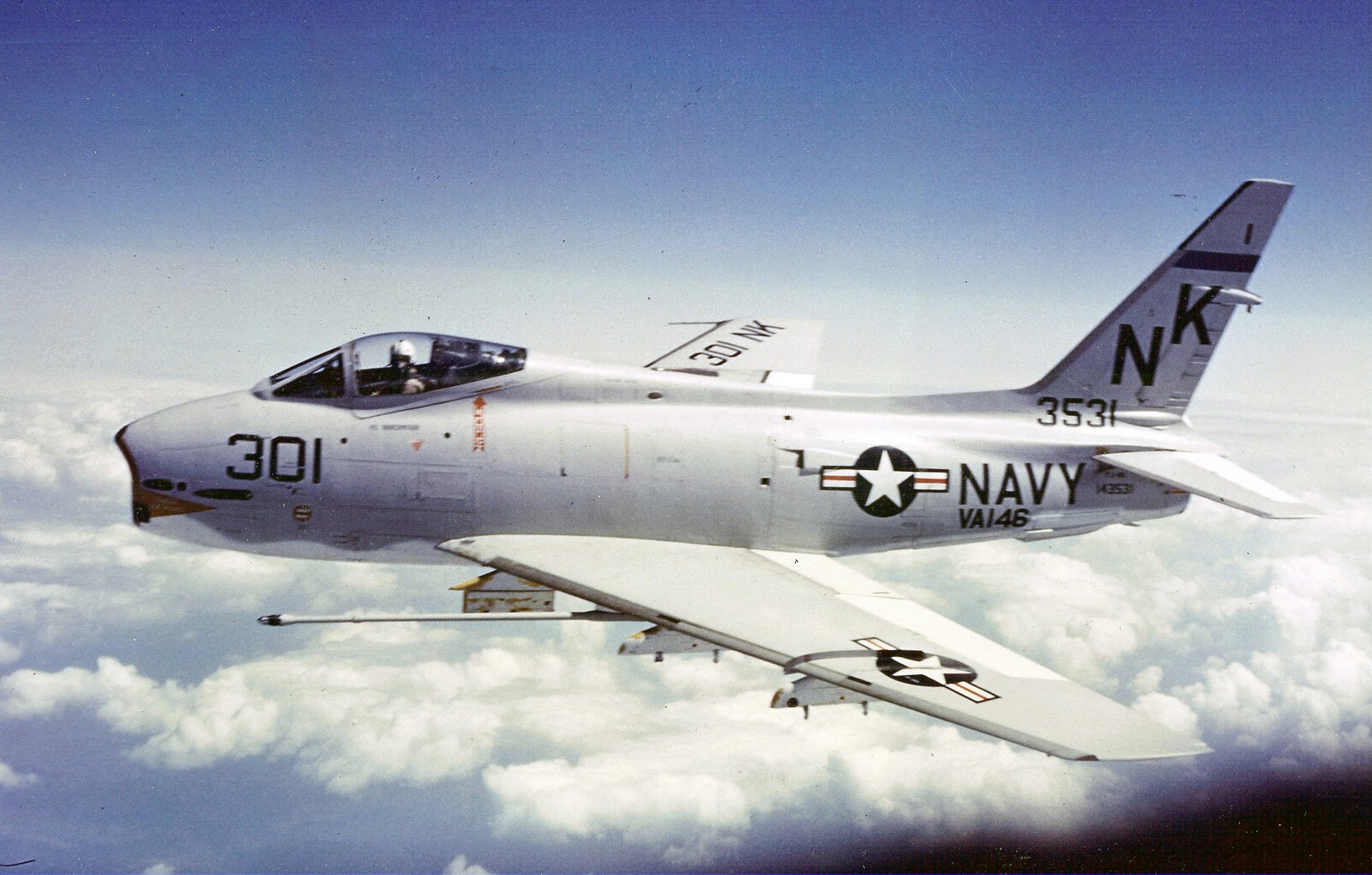
Here's another one that's pretty boring; this time it's an FJ-4B from VA-146 in flight. The shot's of interest to us because of the weathering on the pylons (note the Mil-P-8585 Zinc Chromate showing through) and the Corrogard on the leading edges. Although the shot's a little soft, it also gives us a fair idea of stencil placement, even though you can't actually read them. Tailhook Association via Doug Siegfried
VF-216 again, and still no squadron markings! There's a colored fin tip but that's just about it---143569 is just about as plain a fighter as you'll ever see. We've included it because it provides a lot of detail for the modeler. The sharp-eyed among you (and I'm presuming that to be just about everybody) will notice the lack of underwing stations. I'll bet the FJ was a joy to fly in this condition! Tailhook Association via Doug Siegfried
And one final FJ-4B shot, just to show we haven't given up on colorful airplanes. This VF-151 bird is sitting in the static line at yet another un-named airshow, but this time sans hardpoints and with a little bit of color. The squadron markings are subdued and tasteful and really work well with the Fury's lines. The tiny little stars around the tail of the big star are a nice touch. Tailhook Association via Doug Siegfried
The Relief Tube
We've got a couple of comments and corrections ( replicainscale@yahoo.com ) to share with you this week. Let's see what's going on:
First, from Don Jay: Hi Phil, Just looked at your latest edition of replica in scale. Some info for you:
The T-birds are not mine but I can help to pinpoint the time frame for you as between 10/78 and 4/79. In the background of -3679 is 53-5285 which arrived 10/78 and departed 4/79. I think (caution) that all the T-Birds belonged to the 21st Composite Wing. They were used for targets, ecm-spoofers, liaison, and to keep (the) HQ staff happy with some flying time. Thanks Don! Now, will the real owner of those T-Bird photos please stand up?!
And a kudo from a reader known only as Yeepie Jeepy:
I've always loved the FJ-4. I'm not sure why. they look pretty ungainly on the ground with that long nose wheel strut. On the other hand, they look really good in flight. Kinda like the Sabre Jet's brawny cousin. Thanks for sharing the pics.
Thanks Yeepie, and thanks for giving me a chance to define something for our readers. Although most blog sites allow reader comments with moderation (or sometimes without---how crazy is that?), we don't do that around here. I mention this so nobody takes offense if a comment doesn't show up on the blog---we'd love to hear from you but please send your comments to replicainscale@yahoo.com rather than to the comments part of the blog. It's easier for me to deal with it that way since this is still a one-person show. And I couldn't agree more with Yeepy about the FJ!
And that's what I know. Be good to your neighbors and we'll meet again real soon.
phil
Showing posts with label hasegawa p-40n. Show all posts
Sunday, October 3, 2010
Saturday, September 25, 2010
Misawa Memories, Mystery Meat, Stranger in a Strange Land, and That Big Warhawk
Long Ago and Far Away
Or at least it seems that way sometimes. My dad was career Air Force and was assigned to the 39th Air Division at Misawa AB, Japan, in October of 1962. Coincidentally, or maybe not, since the USAF of the 50s and 60s was pretty much a family affair where everybody's paths crossed everybody else's sooner or later, a young airman named Dave Menard had been assigned to that very same base just a few months earlier. I was in high school at the time and spent my leisure hours messing around with motorcycles, while Dave, even then, was photographing and collecting pictures of airplanes. The following images are from his collection and depict some of the aircraft from Misawa in the early and mid-50s. They give us a fascinating glimpse into how it was in The Silver Air Force, at least in PACAF, during those magical days.
A lot of folks don't know it, but the P-61 Black Widow lasted far longer in PACAF than in the other USAF commands. This tantalizing shot was taken on the ramp at Misawa in the early 1950s. The name "My Joan" appears to be in yellow, or possibly white, but the insignia red serial number of the aircraft is invisible against the overall Jet (that's what the Air Force called that gloss black) of the airframe. The unit is not known, and reader comments are invited! Menard Collection
Here's another shot of "My Joan". That tower and hangar were there when Dave arrived in early '62, and were still there when I left in late '65. As for the airplane; we just don't know much about it! Menard Collection
The 49th FG was associated with Misawa for a number of years, and operated several types of aircraft from that base during their tenure there. F-80C-10-LO 49-0557 sits on a typically snowy Misawa ramp prior to her assignment to Korea, where she crashed to destruction during a training flight in January, 1951. Although there are no markings to show it, she was assigned to the 7th FBS at the time. Menard Collection
"Lady Hades", another ship from the 7th FBS, poses for her portrait. That serial number can make you crazy if you don't know what you're looking at; 44-85262 was built as a P-80A-5-LO, then reconfigured to F-80C-11-LO standard prior to assignment to the 49th. Pretty confusing at first, huh? She's almost a Plain Jane except for that nose flash and the name. The 7th started out being called the "Bunyaps" (after a mythical Australian creature), later changed to the more familiar "Screaming Demons". Me, I prefer "Bunyap". It's a P-40 thing, I guess... Menard Collection
There was a time when you could paint a name on an airplane without it becoming the object of a congressional, or at least a command, investigation. Here's a really spiffy example of same: "Sassy Lass", another P-80A rebuilt to "C" standard sitting on the ramp at Misawa. Do you think that pilot's proud of his bird? Menard Collection
Sittin' on the ramp in Northern Honshu. This unidentified F-80C is probably from the 9th FBS but it's hard to tell from this angle, tail stripe notwithstanding. Those underwing tanks are a treat, and something that's infrequently modeled. Check out the paintwork on the generator sitting behind the starboard wing! Menard Collection
49-0550, a 9th FBS F-80C, sits on the ramp prior to preflight and launch. This may well be the same aircraft depicted in the shot immediately above, but it's hard to tell. The photo provides a far better view of the pylon tanks. This one went down at Pyongyang, Korea in May of 1951. Menard Collection
This red-trimmed "Flying Knights" F-80C is about ten kinds of pretty, although the name "Stinky" does make you wonder (it does fit in with the skunk's head nose art immediately below the name). We'll probably never know for certain, but it makes for a classy airplane all the same. This is yet another P-80A-5-LO upgraded to F-80C standard, in this case as an F-80C-11-LO. Menard Collection
"Ali-Baba II", 56-8315, a P-80A-5-LO rebuilt to F-80C standard, shows off its 7th FBS livery for the camera. Note the thin black cheat line on the blue nose flash and gear door. How about that Eisenhower jacket on the Amn 3C standing in front of the airplane? Menard Collection
Me, I could look at PACAF F-80s all day long, but it's just barely possible that some of you have had enough for one day. Just in case that's true, let's change the water a little bit and see what the 49th's straight-winged F-84s looked like during the Misawa period:
Given the paint job, I'd have to guess this to be the 49th FBW commanding officer's aircraft. 51-1327 was an F-84G-25-RE and was posed getting ready to launch when this shot was taken. Note the boarding ladder and APU by the nose, and the RATO bottles positioned aft. This was shot at Misawa, where the F-84s of the 49th performed an air-defense mission, but 1327 appears to be carrying a pair of 500-lb GP bombs. It must be time for a trip to the bombing range! Menard Collection
Getting there is half the fun! These Forty-niners from the 9th FBS are passing gas over the mountains of Northern Honshu during an excercise---note the 250-lb GP bomb on the pylon under 240. Of particular interest is the dark anodic finish to the aft fuselage of that airplane. Makes you wish for a color picture, doesn't it? Menard Collection
If it's color you want, it's color you'll get! Unfortunately, it's not a color shot of that 9th FBS bird above, but it's still interesting. Here's 52-3197, an F-84G-25-RE of the 8th FBS sitting on the ramp. Check out the refuelling probes on the wing tanks; the one on the port wing is in natural metal, while that on the starboard wing is yellow. The underwing pylons are yellow as well, and the name "Cynthia II" adds class to the shot. (That ramp full of 8th TFW "Huns" in the background ain't too shabby either!) Menard Collection
Let's go to the air show! Armed Forces Day in Japan used to be pretty much like Armed Forces Day any place else where the Air Force had a facility. In this shot we see a Japanese father and his young son in the process of checking out a "Blacksheep" F-84G. Those were the days! Menard Collection
Comin' home. An 8th FBS F-84G recovers at Misawa, date unknown. Gotta love those silver airplanes! Menard Collection
Now then, you've seen the Shooting Stars, and you've seen the Thunderjets. What more can there be? Well, since it's almost closing time for this particular segment, why don't we show a couple of 49th FG birds you probably didn't expect to see? Here then, without further ado:
Yep, it's fuzzy. Sometimes slides can be like that. Whatever this picture may lack in clarity, it certainly makes up for in interest. When's the last time you saw a 7th FS F-86 with a big honkin' name on the nose? "Fantasy" poses for the camera, a little bit the worse for wear but providing a tantalizing look at a really pretty airplane. Focus. FOCUS! Menard Collection
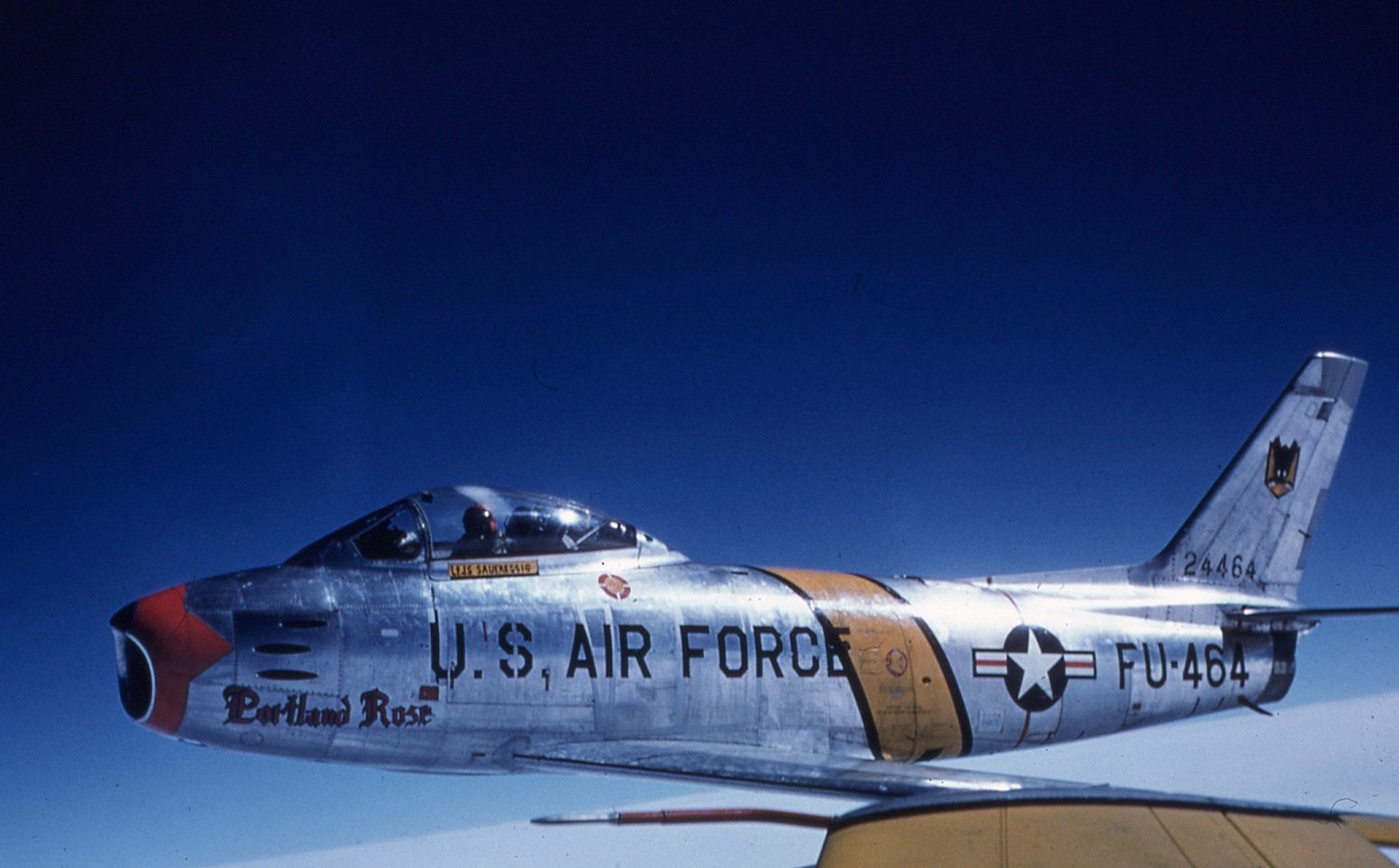
"Tuck it in, Two!" Formation shots are always neat, and this one's especially pretty. "Portland Rose", an F-86F-30-NA Sabre of the 7th FBS, lies alongside the photographer's ship in this gorgeous air-to-air shot. These aircraft are clean; no tanks or pylons. Oh, that silver Air Force! Menard Collection
So you want 7th FBS Sabres in close formation, eh? Far be it for me to deny you that simple pleasure. These guys are dragging along their gas bags, but it just don't get much prettier, does it? Menard Collection
Feet wet and they aren't even in the Navy! Here's a parting shot of the 49ers for you; "Maria", a 7th FBS F-86F, climbs out on a training hop. Do you think that pilot's enjoying his day? Menard Collection
OK, OK, that's enough of the post-War 49th for tonight. Thanks to Dave Menard for sharing these marvelous images with us. Wow!
Every Now and Then You Just Lose Track of Things
Which is exactly what happened here. I received these T-Bird shots way back when I first started this project, and I downloaded the pictures for use (thank goodness!). Then I accidentally deleted the original file, thus losing the original contributor's name. I think, and I stress think (not that I ever do very much of that) that the shots came from Don Jay, or maybe Mark Nankivil, but I'm honestly not sure which! They've been on my list of photos to run for months now but I never did because I couldn't credit them. It's finally time. If they're yours, please e-mail me at replicainscale@yahoo.com and I'll put a credit line on them. Please! (And a unit ID wouldn't hurt either!)
If it's gotta be a mystery, at least it's a pretty one! Here's 56-3679, an Alaskan Air Command T-33A, sitting on the ramp at Elmendorf in all her natural metal and Conspicuity Red splendor. That red panel on the nose gear doors is particularly tasty... Unknown, but hopefully not for long!
And a view of 56-3681 from the same unit. Note that this aircraft is in Aircraft Grey with the usual arctic conspicuity markings. The gas bags are a little the worse for wear, but otherwise it's a Clean Machine. Unknown, but hopefully not for long!
Remember those names on the 49th FG birds? Well, thing got a whole lot more subdued in that regard as the 50s passed into history. -3681 is carrying nose art, but you'd never know it without taking a really close look. Snoopy just shows up everywhere, doesn't he? I bet we'd know the story behind those kill markings if I hadn't dumped the original file! Unknown, but hopefully not for long!
And more kills! Repeat after me: Don't dump files. Don't dump files. Don't dump files... Unknown, but hopefully not for long!
Holy Cow, Ya'll; It's a Rooski!
Texas is a big place, and you just never know what you might find if you keep your eyes open. Here's an example of that:
In the town of Forney, Texas, east of Dallas on US Highway 80, is this MiG-17, parked just off the westbound frontage/service road in front of DeRidder Antiques. According to the employee on duty, the airplane was purchased from a museum in the Netherlands "about 15 years ago." The wings were removed and the disassembled aircraft was placed in a standard 40-foot container for shipment to the US. The owner is not really interested in selling it, according to the employee. These photos were shot on September 18, 2010 by yours truly... Note the stanchions placed to guard the starboard wingtip from further damage. Mike
Protecting a wing tip, Texas style. That lamp post provides a really nice touch! Mike McMurtrey
The view from the road. That "home furnishings" sign on the building in the background puts an interesting spin on things, don't you think? Mike McMurtrey
And here's where it lives. That "Southpark" school bus in the background is just about ten kinds of choice. Don't mess with Texas, ya'll! Mike McMurtrey
Bunyap From a Different Day
A few pictures ago we looked at some 7th FS F-80s, F-84s, and F-86s. Here's another 7th FS 49er to end the day with; the 1/32nd scale Hasegawa P-40N-5 that's on my work bench right now. We've made some progress:
"Daddy Please"/"Milk Wagon Express" is zipping right along, albeit far more slowly than I'd like. Here's the starboard side more-or-less showing how it'll look if it ever gets done. That spinner should, I repeat should, have been easy to paint, but once again I managed to snatch defeat straight from the jaws of Victory. That happens when you rush things, and I rushed things on that spinner. The situation is easy to salvage, though, and that'll be my next chore for this project. There's a little more canopy painting to do, and some seam-sealing (I use white glue for that sort of thing; on this model it'll mostly be done on the landing gear knuckles), then the airframe will be done. The big Hase Warhawks really look the part, don't they?
And the Other Side. The N-model had tell-tales sticking out of the wings to show that the mains were down and locked, and I need to drill a couple of holes so I can add those. There's the usual touch-up to be done, and weathering, and so on and so forth, and blah blah blah (as Jimi was wont to say in concert), but we're getting close. Remember last time around when I said this airplane had the usual 49th FG oddities about it? This is as good a time as any to talk about 'em. First, this was two different airplanes at two different times, Side Number 10 and then later on, Side Number 00. When it was #10 it had a white spinner; those blue areas were added when it became 00. And that blue around the intake lip is peculiar too; the pin stripe on the nose is definitely in all the photos of this ship, as either 10 or 00, and the area in front of it appears to be darker than the OD/Neutral Gray around it, which leads me to believe it was dark blue. I could be wrong, and this is most assuredly an Educated Guess on my part, but I'm sufficiently convinced of the notion to paint the airplane that way. Feel free to not do it on your model if you so desire. And if you can prove, not conjecturize but actually prove, that it was one way or another, please get in touch with me! Lordy, I like P-40s!
And that's what I know. Be good to your neighbor and we'll meet again soon!
phil
Or at least it seems that way sometimes. My dad was career Air Force and was assigned to the 39th Air Division at Misawa AB, Japan, in October of 1962. Coincidentally, or maybe not, since the USAF of the 50s and 60s was pretty much a family affair where everybody's paths crossed everybody else's sooner or later, a young airman named Dave Menard had been assigned to that very same base just a few months earlier. I was in high school at the time and spent my leisure hours messing around with motorcycles, while Dave, even then, was photographing and collecting pictures of airplanes. The following images are from his collection and depict some of the aircraft from Misawa in the early and mid-50s. They give us a fascinating glimpse into how it was in The Silver Air Force, at least in PACAF, during those magical days.
A lot of folks don't know it, but the P-61 Black Widow lasted far longer in PACAF than in the other USAF commands. This tantalizing shot was taken on the ramp at Misawa in the early 1950s. The name "My Joan" appears to be in yellow, or possibly white, but the insignia red serial number of the aircraft is invisible against the overall Jet (that's what the Air Force called that gloss black) of the airframe. The unit is not known, and reader comments are invited! Menard Collection
Here's another shot of "My Joan". That tower and hangar were there when Dave arrived in early '62, and were still there when I left in late '65. As for the airplane; we just don't know much about it! Menard Collection
The 49th FG was associated with Misawa for a number of years, and operated several types of aircraft from that base during their tenure there. F-80C-10-LO 49-0557 sits on a typically snowy Misawa ramp prior to her assignment to Korea, where she crashed to destruction during a training flight in January, 1951. Although there are no markings to show it, she was assigned to the 7th FBS at the time. Menard Collection
"Lady Hades", another ship from the 7th FBS, poses for her portrait. That serial number can make you crazy if you don't know what you're looking at; 44-85262 was built as a P-80A-5-LO, then reconfigured to F-80C-11-LO standard prior to assignment to the 49th. Pretty confusing at first, huh? She's almost a Plain Jane except for that nose flash and the name. The 7th started out being called the "Bunyaps" (after a mythical Australian creature), later changed to the more familiar "Screaming Demons". Me, I prefer "Bunyap". It's a P-40 thing, I guess... Menard Collection
There was a time when you could paint a name on an airplane without it becoming the object of a congressional, or at least a command, investigation. Here's a really spiffy example of same: "Sassy Lass", another P-80A rebuilt to "C" standard sitting on the ramp at Misawa. Do you think that pilot's proud of his bird? Menard Collection
Sittin' on the ramp in Northern Honshu. This unidentified F-80C is probably from the 9th FBS but it's hard to tell from this angle, tail stripe notwithstanding. Those underwing tanks are a treat, and something that's infrequently modeled. Check out the paintwork on the generator sitting behind the starboard wing! Menard Collection
49-0550, a 9th FBS F-80C, sits on the ramp prior to preflight and launch. This may well be the same aircraft depicted in the shot immediately above, but it's hard to tell. The photo provides a far better view of the pylon tanks. This one went down at Pyongyang, Korea in May of 1951. Menard Collection
This red-trimmed "Flying Knights" F-80C is about ten kinds of pretty, although the name "Stinky" does make you wonder (it does fit in with the skunk's head nose art immediately below the name). We'll probably never know for certain, but it makes for a classy airplane all the same. This is yet another P-80A-5-LO upgraded to F-80C standard, in this case as an F-80C-11-LO. Menard Collection
"Ali-Baba II", 56-8315, a P-80A-5-LO rebuilt to F-80C standard, shows off its 7th FBS livery for the camera. Note the thin black cheat line on the blue nose flash and gear door. How about that Eisenhower jacket on the Amn 3C standing in front of the airplane? Menard Collection
Me, I could look at PACAF F-80s all day long, but it's just barely possible that some of you have had enough for one day. Just in case that's true, let's change the water a little bit and see what the 49th's straight-winged F-84s looked like during the Misawa period:
Given the paint job, I'd have to guess this to be the 49th FBW commanding officer's aircraft. 51-1327 was an F-84G-25-RE and was posed getting ready to launch when this shot was taken. Note the boarding ladder and APU by the nose, and the RATO bottles positioned aft. This was shot at Misawa, where the F-84s of the 49th performed an air-defense mission, but 1327 appears to be carrying a pair of 500-lb GP bombs. It must be time for a trip to the bombing range! Menard Collection
Getting there is half the fun! These Forty-niners from the 9th FBS are passing gas over the mountains of Northern Honshu during an excercise---note the 250-lb GP bomb on the pylon under 240. Of particular interest is the dark anodic finish to the aft fuselage of that airplane. Makes you wish for a color picture, doesn't it? Menard Collection
If it's color you want, it's color you'll get! Unfortunately, it's not a color shot of that 9th FBS bird above, but it's still interesting. Here's 52-3197, an F-84G-25-RE of the 8th FBS sitting on the ramp. Check out the refuelling probes on the wing tanks; the one on the port wing is in natural metal, while that on the starboard wing is yellow. The underwing pylons are yellow as well, and the name "Cynthia II" adds class to the shot. (That ramp full of 8th TFW "Huns" in the background ain't too shabby either!) Menard Collection
Let's go to the air show! Armed Forces Day in Japan used to be pretty much like Armed Forces Day any place else where the Air Force had a facility. In this shot we see a Japanese father and his young son in the process of checking out a "Blacksheep" F-84G. Those were the days! Menard Collection
Comin' home. An 8th FBS F-84G recovers at Misawa, date unknown. Gotta love those silver airplanes! Menard Collection
Now then, you've seen the Shooting Stars, and you've seen the Thunderjets. What more can there be? Well, since it's almost closing time for this particular segment, why don't we show a couple of 49th FG birds you probably didn't expect to see? Here then, without further ado:
Yep, it's fuzzy. Sometimes slides can be like that. Whatever this picture may lack in clarity, it certainly makes up for in interest. When's the last time you saw a 7th FS F-86 with a big honkin' name on the nose? "Fantasy" poses for the camera, a little bit the worse for wear but providing a tantalizing look at a really pretty airplane. Focus. FOCUS! Menard Collection
"Tuck it in, Two!" Formation shots are always neat, and this one's especially pretty. "Portland Rose", an F-86F-30-NA Sabre of the 7th FBS, lies alongside the photographer's ship in this gorgeous air-to-air shot. These aircraft are clean; no tanks or pylons. Oh, that silver Air Force! Menard Collection
So you want 7th FBS Sabres in close formation, eh? Far be it for me to deny you that simple pleasure. These guys are dragging along their gas bags, but it just don't get much prettier, does it? Menard Collection
Feet wet and they aren't even in the Navy! Here's a parting shot of the 49ers for you; "Maria", a 7th FBS F-86F, climbs out on a training hop. Do you think that pilot's enjoying his day? Menard Collection
OK, OK, that's enough of the post-War 49th for tonight. Thanks to Dave Menard for sharing these marvelous images with us. Wow!
Every Now and Then You Just Lose Track of Things
Which is exactly what happened here. I received these T-Bird shots way back when I first started this project, and I downloaded the pictures for use (thank goodness!). Then I accidentally deleted the original file, thus losing the original contributor's name. I think, and I stress think (not that I ever do very much of that) that the shots came from Don Jay, or maybe Mark Nankivil, but I'm honestly not sure which! They've been on my list of photos to run for months now but I never did because I couldn't credit them. It's finally time. If they're yours, please e-mail me at replicainscale@yahoo.com and I'll put a credit line on them. Please! (And a unit ID wouldn't hurt either!)
If it's gotta be a mystery, at least it's a pretty one! Here's 56-3679, an Alaskan Air Command T-33A, sitting on the ramp at Elmendorf in all her natural metal and Conspicuity Red splendor. That red panel on the nose gear doors is particularly tasty... Unknown, but hopefully not for long!
And a view of 56-3681 from the same unit. Note that this aircraft is in Aircraft Grey with the usual arctic conspicuity markings. The gas bags are a little the worse for wear, but otherwise it's a Clean Machine. Unknown, but hopefully not for long!
Remember those names on the 49th FG birds? Well, thing got a whole lot more subdued in that regard as the 50s passed into history. -3681 is carrying nose art, but you'd never know it without taking a really close look. Snoopy just shows up everywhere, doesn't he? I bet we'd know the story behind those kill markings if I hadn't dumped the original file! Unknown, but hopefully not for long!
And more kills! Repeat after me: Don't dump files. Don't dump files. Don't dump files... Unknown, but hopefully not for long!
Holy Cow, Ya'll; It's a Rooski!
Texas is a big place, and you just never know what you might find if you keep your eyes open. Here's an example of that:
In the town of Forney, Texas, east of Dallas on US Highway 80, is this MiG-17, parked just off the westbound frontage/service road in front of DeRidder Antiques. According to the employee on duty, the airplane was purchased from a museum in the Netherlands "about 15 years ago." The wings were removed and the disassembled aircraft was placed in a standard 40-foot container for shipment to the US. The owner is not really interested in selling it, according to the employee. These photos were shot on September 18, 2010 by yours truly... Note the stanchions placed to guard the starboard wingtip from further damage. Mike
Protecting a wing tip, Texas style. That lamp post provides a really nice touch! Mike McMurtrey
The view from the road. That "home furnishings" sign on the building in the background puts an interesting spin on things, don't you think? Mike McMurtrey
And here's where it lives. That "Southpark" school bus in the background is just about ten kinds of choice. Don't mess with Texas, ya'll! Mike McMurtrey
Bunyap From a Different Day
A few pictures ago we looked at some 7th FS F-80s, F-84s, and F-86s. Here's another 7th FS 49er to end the day with; the 1/32nd scale Hasegawa P-40N-5 that's on my work bench right now. We've made some progress:
"Daddy Please"/"Milk Wagon Express" is zipping right along, albeit far more slowly than I'd like. Here's the starboard side more-or-less showing how it'll look if it ever gets done. That spinner should, I repeat should, have been easy to paint, but once again I managed to snatch defeat straight from the jaws of Victory. That happens when you rush things, and I rushed things on that spinner. The situation is easy to salvage, though, and that'll be my next chore for this project. There's a little more canopy painting to do, and some seam-sealing (I use white glue for that sort of thing; on this model it'll mostly be done on the landing gear knuckles), then the airframe will be done. The big Hase Warhawks really look the part, don't they?
And the Other Side. The N-model had tell-tales sticking out of the wings to show that the mains were down and locked, and I need to drill a couple of holes so I can add those. There's the usual touch-up to be done, and weathering, and so on and so forth, and blah blah blah (as Jimi was wont to say in concert), but we're getting close. Remember last time around when I said this airplane had the usual 49th FG oddities about it? This is as good a time as any to talk about 'em. First, this was two different airplanes at two different times, Side Number 10 and then later on, Side Number 00. When it was #10 it had a white spinner; those blue areas were added when it became 00. And that blue around the intake lip is peculiar too; the pin stripe on the nose is definitely in all the photos of this ship, as either 10 or 00, and the area in front of it appears to be darker than the OD/Neutral Gray around it, which leads me to believe it was dark blue. I could be wrong, and this is most assuredly an Educated Guess on my part, but I'm sufficiently convinced of the notion to paint the airplane that way. Feel free to not do it on your model if you so desire. And if you can prove, not conjecturize but actually prove, that it was one way or another, please get in touch with me! Lordy, I like P-40s!
And that's what I know. Be good to your neighbor and we'll meet again soon!
phil
Labels:
49th fg,
f-80,
f-86,
hasegawa p-40n,
mig-17,
misawa ab,
p-40n,
republic f-84g,
t-33
Sunday, September 19, 2010
Another Modular Hawk on the Bench, More Hogs, Some Mustangs, And a Couple of Spiffy Skyrays
Long Time Gone
Or, where I've been. It's New Job time again---what an odd little economy we've more or less got---and we missed last week due to the requirements thereof. Missing a week isn't my first choice, but if I don't pay the bills I can't do this blog; it's a classic case of priorities, as it were. Anyway, we're back again and, I think, with some really special stuff; let's us get started, whaddayathink?
Another Modular Hawk
There's something about the P-40 that has an appeal for most modelers, and I have to admit I'm hooked on the airplane too. For me it's mostly the early ones, most specifically the "E" models in use in the SWP back during The Bad Old Days of WW2, but I'll occasionally do an "N" to break things up a bit and, if I'm really in the mood to shake the tree, I'll build one in 1/32nd scale. That's what's happening today or, more specifically, for the past three weeks. Here's where I am as of today:
First, there was the simple act of getting the kit. I saw a release notice on one of those internet scale modeling sites and immediately put in a call to My Favorite Local Hobby Shop, the employees of which were convinced that such a marvel did not exist and that I was, in fact, chasing the 1/48th scale Hase offering of same. It took about 6 weeks before I was able to convince them that the 1/32nd scale kit really existed, and another two weeks after that to get it. Oh well, I'm stubborn, and I wanted the kit. I kept after it, and I eventually got it. There's a lesson therein.
Anyway, I got the thing, and now it's mostly together and partially painted and, as usual, it's going to be finished as an aircraft from the 49th FG; this time the 7th FS using some exceptionally nice decals made by the folks at Zotz. We're not going to to a blow-by-blow account of how to build the thing, because I figure you've already got some modeling skills to your credit, but there are a couple of things that could stand mention.
First, everything on this kit fits, which is in direct opposition to the ranting, raving, wailing, and general silliness you may have read on the internet about Hasegawa's 1/48th and 1/32nd scale Warhawks. All it takes is a little care when you're removing the parts from the sprues and cleaning them up, plus a little finesse when you're aligning things and Zip-Zap-Zoop; you've got an airframe! The Hasegawa P-40s are eminately buildable.
Second, there's not much of an aftermarket for the type. The cockpit can stand some Eduardizing, as it were, but that's mostly to get the various placards, etc, that you'll need to complete the interior. Those placards, plus a set of belts and harnesses, will finish off the almost-adequate kit cockpit very nicely. (I've only seen one release of the "N" model in 1/32nd, the Every-Schoolboy-Used-to-Have-the-Picture 1 of 15,000 bird. The only decals given with the kit are for that airplane, making the aforementioned Zotz sheet an essential.)
Third, and as to be expected with any airplane assigned to the 49th FG in the Pacific during the war, there are some questions about the markings. We'll get to those in modest detail later, but the bird I'm doing makes for the usual Interesting Study in Contradictions Regarding Airplanes of the 49th. If any of you hold original photography on the airplane, please wait until I've completely finished the model and couldn't possibly go back and un-do the damage, then scan and send those photos to replicainscale@yahoo.com . Right on!
Here's where we are so far. Sharp-eyed readers will notice that there's a lot of work to do on that spinner before we call it Done. Masking it most assuredly was not my finest hour! The transparencies have been faired into the fuselage but not yet masked and painted, and the major paintwork (sans those transparencies) has been done. I'm not certain about the cut line where the white conspicuity markings on the emennage meet the aft fus and may alter them later, or maybe not. Colors are Testor ModelMaster enamel, with RAF Azure Blue being used for the pale blue tail stripe; it seems to be an excellent match right out of the bottle. The poorly-masked spinner is done with USN True Blue, and I've used Insignia Blue forward of that little white trim stripe on the nose, because the photos I've got all seem to show a color that's slightly darker than the surrounding area up there. That may be because the white stripe makes it appear darker, but there's no way to know for certain without a color photo of the area and we already know that nobody's going to send in a photo until after the model is done, right?
The starboard side of the airplane, offered mainly because of those dark green splotches. They were the norm on AAF aircraft of the 1942-1943 era and seem to have been a standard feature on the P-40N. They also seem to have had a well-defined pattern rather than being just a random thing. The best explanation of them that I've seen, and the one that I'd recommend to you, is a drawing in Ian Baker's excellent Aviation History Coloring Book 44; Green Splotches, White Splotches; Another Look at USAAF Camouflage 1942-1943. As with all of Mr. Baker's offerings, this one is superb and well worth its modest price. The placement of the blotches on the model were taken directly from that monograph. Note the area under the canopy; it's OD to match the surrounding fuselage. You don't want to follow Hasegawa's painting instructions back there, gang!
We'll come back to this P-40 in a later installment, when it's a little bit farther along. Meanwhile, how about some Real Airplane Pictures for a Monday?
Props Are Good, and Hogs Have Props
You see a whole lot of Chance Vought F4Us on this site, and there are reasons for it. First, and most important to me; it's my site and I happen to like the airplane. Also, frequent contributors Jim Sullivan and Doug Siegfried like the U-Bird too, and they send in some neat stuff from time to time. Finally, there are really good kits of the Corsair out there in any scale you could think of, and of almost every variant ever produced. In my world that's motivation enough to do yet another photo essay on the type so here, without further ado, are some more F4U photos for your enjoyment:
A prime example of how to load one's britches on the flight deck. An SNJ takes the wire on the FDR while an F4U-5 gets stupid overhead. The adrenalin level in those cockpits, and on the boat, must've been something else---if you look carefully you can see the LSO coming out from behind his wind screen to marvel at the festivities. I'd love to see the plat camera footage on this one! Tailhook Association via Doug Siegfried
133843, a Marine AU-1 from an un-named unit, shows off its pylon suite; the AU could carry a lot of ordnance! Of interest is the frequently seen Non-Specular Sea Blue anti-glare treatment on the upper fuselage decking and cowling. Tailhook Association via Doug Siegfried
The AU-1 saw considerable service in Korea during the "police action". This VMF-212 bird, "Miss Penny", is one of the more famous AUs of the period. Note the natural metal main landing gear and tail wheels, and the pylon suite. There are some oddly-shaped areas on the forward mlg doors, which could be painted a light blue but which are more likely to be silver duct tape picking up a blue sheen from the airframe. A mystery, as it were! Gotta love that arrow on the forward fuselage! Tailhook Association via Doug Siegfried
A Korean War veteran friend of mine once called that particular place "a very cold corner of Hell". I suspect he was right. This photo shows 129362, an AU-1 of VMA-323, getting ready for a mission. The fuse extender on the 250lb GP bomb is remarkable, and could provide a neat touch to a model. The spAD in the background is probably an AD-2, although it's tough to tell from this view. The shot, most likely taken at Kimpo, portrays typical operations for the Corps during the Korean War. Tailhook Association via Doug Siegfried
Another AU-1, this time 129401 from VMA-323, sitting in a revetment. This shot reveals the exhaust pattern on a well-used Corsair, and may be of interest to modelers. Note that the squadron code ("WS") has been applied to the mlg doors as well as the usual vertical stab. Tailhook Association via Doug Siegfried
If it goes up it will come down sooner or later! This landing falls into the "any one you can walk away from" category, and depicts an F4U-5N from VMF(N)-513 after a slight misfortune. The Corsair was a tough airplane and could take a lot of abuse, although that twisted aft fuselage would indicate that this bird became a parts source shortly after the picture was taken. A lot of profile illustrations show the squadron's -5Ns in overall black; a few of them may have worn that color but this aircraft wears the regulation Glossy Sea Blue. Tailhook Association via Doug Siegfried
Some MO Birds for the Morgan Boys
It's been a long time since I first met the Morgan Brothers, Rick and Mark, but I think they're from Missouri, or at least they have an interest in airplanes from that State. That said, here's a selection of MO NG birds from the early 50s in honor of that interest (and for our mutual enjoyment as well):
There was a time, Way Back When, when almost every American military pilot learned his craft in North American's T-6 Texan. Here's a fine study of a 110th FS/71st FG AT-6D in flight to start the ball rolling. Of special interest is the lack of national insignia on the fuselage, although the star is evident under the starboard wing. Most ANG fighter units had at least one AT-6 (later T-6) on strength for proficiency training. Neat shot! G. Sommerich via Mark Nankivil
A pair of MONG Mustangs on the prowl. The large discs on the aft fuselage appear to be in black, although dark blue could be equally valid; your guess is as good as mine! Note that the second aircraft is carrying a nose number, while lead is not. Spinners appear to be white but may also be yellow. Fred Roos via Mark Ninkivil
Here's that disc again, this time on aircraft No. 5. The mystery deepens when you look closely at the image, because the spacing of the "MO" and "NG" would barely allow a conventional national insignia to fit between them, and there's no indication that one was ever there. Sounds like an opportunity for a Relief Tube entry to me! Fred Roos via Mark Nankivil
Taken on the ground at Lambert Field, this P-51D depicts a Missouri Guard bird early in its career. Note the pre-1947 national insignia (which appears to be greyed-out in finest WW2 ETO tradition) and the nose number. The early buzz number treatment is noteworthy; the P-51's "PF" became "FF" after the 1947 changeover to the USAF. It's really odd to see that greyed-out star on a post-War CONUS bird... G. Sommerich via Mark Nankivil
PF-105 flying a little form. There's nothing other than that nose number to indicate any sort of unit affiliation, although the aircraft does appear to have a red spinner. Of interest here is the oil streaking on the cowling, so typical of an operational Mustang. G. Sommerich via Mark Nankivil
And PF-106, bearing the nose number 16 and with an interesting spinner configuration; the aft portion is obviously in natural metal, while the forward part is apparently painted yellow (although it could just as easily be white). These guys were probably flying over Germany in the same kind of airplane just a few short years before! G. Sommerich via Mark Nankivil
Virginia Mayo was a popular actress of the day---here PF-650 (nose number 1) pays tribute to her. The photograph has obviously seen better days, but the airplane is pristine! Sure wish those guys had put a little more color on their birds---there's just not much there once you get past that red spinner. G. Sommerich via Mark Nankivil
Mustangs can crash too. This 116th FS P-51D exhibits all the classic signs of the results of a torque roll on takeoff. (A friend of mine once told me that his dad, who'd flown P-51s after the war, once informed him "you never straight arm a P-51!". Truer words were never spoken!) Then again, it may have landed long and flipped once it got to the over-run. Whatever happened, it provided a classic Bad Day for somebody! G. Sommerich via Mark Nankivil
A slightly later time frame, but once again torque roll seems to have been the culprit---look at the way the vertical stab is bent over. Everybody loves the P-51, but it's an airplane that can kill you in a heartbeat if you don't pay attention. Civil Mustang owners re-learn the lesson every year, it seems... G. Sommerich via Mark Nankivil.
Remember the Skyray?
Frequent contributor Mark Nankivil's dad was a naval aviator during the 50s and 60s. Mark's sent along a couple of really nice "FORD" images taken by his dad, and I think that offers a nice round-out for our day:
Here's an F4D-1 from VF-20 getting ready to take on a little gas. The Skyray was a tiny airplane, and a ferocious performer. It was also woefully underarmed and short-ranged to boot, making it relatively useless in anything other than the fleet defence or point-defense interceptor roll. It was also one of the most beautiful jet fighters ever designed. This photo really defines the type's good looks. Nankivil Collection
And THE F4D scheme, an F4D-1 from VF(AW)-3 out of North Island. This has got to be one of the prettiest fighter schemes of all time, even if those AIM-9Bs comprise the type's total armament! Thanks, Mark! Nankivil collection
The Relief Tube
Mark Morgan has sent along a comment or two on the F-94 photos we ran a few installments back:
Phil - WHOOPS, I goofed big time and left off a couple of items. The first shot with the 2nd FIS F-94As was taken at Nellis, the photo was marked by the Nellis photo lab on the back. I assume the event was oneof the early fighter gunnery meets.
The -94C shot is Burbank, my old plant (as distinguished from Plant B-1, which was further north near the railroad tracks). That hanger in the center background is where the Skunk Works was located while I worked there, 1/87-5/89, with the office building on the far side, out of sight. I fully expect that hanger had several U-2s under construction at the time this photo was taken; the aircraft in the foreground are pre-delivery F-94Cs and T-33As. Sad to say, this entire historic old complex is now gone, bulldozed in order for Lockheed Martin to get it off the California tax rolls. Sigh.. last time I rolled through there was May of '04 while I was doing the Noble Eagle road trips, was shocked to see everything removed..MK
A quick note from Tom Gaj regarding the Boeing T-43; the type flew its last operational mission last Friday, 16 September, out of Randolph AFB. The honors of that last GATOR flight fell to 73-1153. And another one bites the dust...
And please remember, I'm always looking for photographs and hard information on American military aviation of all eras, but in particular from 1919 to 1975 or so. If you've got anything of that nature that you'd like to share, please contact me at replicainscale@yahoo.com . I don't make money off this thing so you won't either, but full credit will be given for your contributions.
That's it 'til next time, so be good to your neighbor. We'll talk again soon.
phil
Or, where I've been. It's New Job time again---what an odd little economy we've more or less got---and we missed last week due to the requirements thereof. Missing a week isn't my first choice, but if I don't pay the bills I can't do this blog; it's a classic case of priorities, as it were. Anyway, we're back again and, I think, with some really special stuff; let's us get started, whaddayathink?
Another Modular Hawk
There's something about the P-40 that has an appeal for most modelers, and I have to admit I'm hooked on the airplane too. For me it's mostly the early ones, most specifically the "E" models in use in the SWP back during The Bad Old Days of WW2, but I'll occasionally do an "N" to break things up a bit and, if I'm really in the mood to shake the tree, I'll build one in 1/32nd scale. That's what's happening today or, more specifically, for the past three weeks. Here's where I am as of today:
First, there was the simple act of getting the kit. I saw a release notice on one of those internet scale modeling sites and immediately put in a call to My Favorite Local Hobby Shop, the employees of which were convinced that such a marvel did not exist and that I was, in fact, chasing the 1/48th scale Hase offering of same. It took about 6 weeks before I was able to convince them that the 1/32nd scale kit really existed, and another two weeks after that to get it. Oh well, I'm stubborn, and I wanted the kit. I kept after it, and I eventually got it. There's a lesson therein.
Anyway, I got the thing, and now it's mostly together and partially painted and, as usual, it's going to be finished as an aircraft from the 49th FG; this time the 7th FS using some exceptionally nice decals made by the folks at Zotz. We're not going to to a blow-by-blow account of how to build the thing, because I figure you've already got some modeling skills to your credit, but there are a couple of things that could stand mention.
First, everything on this kit fits, which is in direct opposition to the ranting, raving, wailing, and general silliness you may have read on the internet about Hasegawa's 1/48th and 1/32nd scale Warhawks. All it takes is a little care when you're removing the parts from the sprues and cleaning them up, plus a little finesse when you're aligning things and Zip-Zap-Zoop; you've got an airframe! The Hasegawa P-40s are eminately buildable.
Second, there's not much of an aftermarket for the type. The cockpit can stand some Eduardizing, as it were, but that's mostly to get the various placards, etc, that you'll need to complete the interior. Those placards, plus a set of belts and harnesses, will finish off the almost-adequate kit cockpit very nicely. (I've only seen one release of the "N" model in 1/32nd, the Every-Schoolboy-Used-to-Have-the-Picture 1 of 15,000 bird. The only decals given with the kit are for that airplane, making the aforementioned Zotz sheet an essential.)
Third, and as to be expected with any airplane assigned to the 49th FG in the Pacific during the war, there are some questions about the markings. We'll get to those in modest detail later, but the bird I'm doing makes for the usual Interesting Study in Contradictions Regarding Airplanes of the 49th. If any of you hold original photography on the airplane, please wait until I've completely finished the model and couldn't possibly go back and un-do the damage, then scan and send those photos to replicainscale@yahoo.com . Right on!
Here's where we are so far. Sharp-eyed readers will notice that there's a lot of work to do on that spinner before we call it Done. Masking it most assuredly was not my finest hour! The transparencies have been faired into the fuselage but not yet masked and painted, and the major paintwork (sans those transparencies) has been done. I'm not certain about the cut line where the white conspicuity markings on the emennage meet the aft fus and may alter them later, or maybe not. Colors are Testor ModelMaster enamel, with RAF Azure Blue being used for the pale blue tail stripe; it seems to be an excellent match right out of the bottle. The poorly-masked spinner is done with USN True Blue, and I've used Insignia Blue forward of that little white trim stripe on the nose, because the photos I've got all seem to show a color that's slightly darker than the surrounding area up there. That may be because the white stripe makes it appear darker, but there's no way to know for certain without a color photo of the area and we already know that nobody's going to send in a photo until after the model is done, right?
The starboard side of the airplane, offered mainly because of those dark green splotches. They were the norm on AAF aircraft of the 1942-1943 era and seem to have been a standard feature on the P-40N. They also seem to have had a well-defined pattern rather than being just a random thing. The best explanation of them that I've seen, and the one that I'd recommend to you, is a drawing in Ian Baker's excellent Aviation History Coloring Book 44; Green Splotches, White Splotches; Another Look at USAAF Camouflage 1942-1943. As with all of Mr. Baker's offerings, this one is superb and well worth its modest price. The placement of the blotches on the model were taken directly from that monograph. Note the area under the canopy; it's OD to match the surrounding fuselage. You don't want to follow Hasegawa's painting instructions back there, gang!
We'll come back to this P-40 in a later installment, when it's a little bit farther along. Meanwhile, how about some Real Airplane Pictures for a Monday?
Props Are Good, and Hogs Have Props
You see a whole lot of Chance Vought F4Us on this site, and there are reasons for it. First, and most important to me; it's my site and I happen to like the airplane. Also, frequent contributors Jim Sullivan and Doug Siegfried like the U-Bird too, and they send in some neat stuff from time to time. Finally, there are really good kits of the Corsair out there in any scale you could think of, and of almost every variant ever produced. In my world that's motivation enough to do yet another photo essay on the type so here, without further ado, are some more F4U photos for your enjoyment:
A prime example of how to load one's britches on the flight deck. An SNJ takes the wire on the FDR while an F4U-5 gets stupid overhead. The adrenalin level in those cockpits, and on the boat, must've been something else---if you look carefully you can see the LSO coming out from behind his wind screen to marvel at the festivities. I'd love to see the plat camera footage on this one! Tailhook Association via Doug Siegfried
133843, a Marine AU-1 from an un-named unit, shows off its pylon suite; the AU could carry a lot of ordnance! Of interest is the frequently seen Non-Specular Sea Blue anti-glare treatment on the upper fuselage decking and cowling. Tailhook Association via Doug Siegfried
A Korean War veteran friend of mine once called that particular place "a very cold corner of Hell". I suspect he was right. This photo shows 129362, an AU-1 of VMA-323, getting ready for a mission. The fuse extender on the 250lb GP bomb is remarkable, and could provide a neat touch to a model. The spAD in the background is probably an AD-2, although it's tough to tell from this view. The shot, most likely taken at Kimpo, portrays typical operations for the Corps during the Korean War. Tailhook Association via Doug Siegfried
If it goes up it will come down sooner or later! This landing falls into the "any one you can walk away from" category, and depicts an F4U-5N from VMF(N)-513 after a slight misfortune. The Corsair was a tough airplane and could take a lot of abuse, although that twisted aft fuselage would indicate that this bird became a parts source shortly after the picture was taken. A lot of profile illustrations show the squadron's -5Ns in overall black; a few of them may have worn that color but this aircraft wears the regulation Glossy Sea Blue. Tailhook Association via Doug Siegfried
Some MO Birds for the Morgan Boys
It's been a long time since I first met the Morgan Brothers, Rick and Mark, but I think they're from Missouri, or at least they have an interest in airplanes from that State. That said, here's a selection of MO NG birds from the early 50s in honor of that interest (and for our mutual enjoyment as well):
There was a time, Way Back When, when almost every American military pilot learned his craft in North American's T-6 Texan. Here's a fine study of a 110th FS/71st FG AT-6D in flight to start the ball rolling. Of special interest is the lack of national insignia on the fuselage, although the star is evident under the starboard wing. Most ANG fighter units had at least one AT-6 (later T-6) on strength for proficiency training. Neat shot! G. Sommerich via Mark Nankivil
A pair of MONG Mustangs on the prowl. The large discs on the aft fuselage appear to be in black, although dark blue could be equally valid; your guess is as good as mine! Note that the second aircraft is carrying a nose number, while lead is not. Spinners appear to be white but may also be yellow. Fred Roos via Mark Ninkivil
Here's that disc again, this time on aircraft No. 5. The mystery deepens when you look closely at the image, because the spacing of the "MO" and "NG" would barely allow a conventional national insignia to fit between them, and there's no indication that one was ever there. Sounds like an opportunity for a Relief Tube entry to me! Fred Roos via Mark Nankivil
Taken on the ground at Lambert Field, this P-51D depicts a Missouri Guard bird early in its career. Note the pre-1947 national insignia (which appears to be greyed-out in finest WW2 ETO tradition) and the nose number. The early buzz number treatment is noteworthy; the P-51's "PF" became "FF" after the 1947 changeover to the USAF. It's really odd to see that greyed-out star on a post-War CONUS bird... G. Sommerich via Mark Nankivil
PF-105 flying a little form. There's nothing other than that nose number to indicate any sort of unit affiliation, although the aircraft does appear to have a red spinner. Of interest here is the oil streaking on the cowling, so typical of an operational Mustang. G. Sommerich via Mark Nankivil
And PF-106, bearing the nose number 16 and with an interesting spinner configuration; the aft portion is obviously in natural metal, while the forward part is apparently painted yellow (although it could just as easily be white). These guys were probably flying over Germany in the same kind of airplane just a few short years before! G. Sommerich via Mark Nankivil
Virginia Mayo was a popular actress of the day---here PF-650 (nose number 1) pays tribute to her. The photograph has obviously seen better days, but the airplane is pristine! Sure wish those guys had put a little more color on their birds---there's just not much there once you get past that red spinner. G. Sommerich via Mark Nankivil
Mustangs can crash too. This 116th FS P-51D exhibits all the classic signs of the results of a torque roll on takeoff. (A friend of mine once told me that his dad, who'd flown P-51s after the war, once informed him "you never straight arm a P-51!". Truer words were never spoken!) Then again, it may have landed long and flipped once it got to the over-run. Whatever happened, it provided a classic Bad Day for somebody! G. Sommerich via Mark Nankivil
A slightly later time frame, but once again torque roll seems to have been the culprit---look at the way the vertical stab is bent over. Everybody loves the P-51, but it's an airplane that can kill you in a heartbeat if you don't pay attention. Civil Mustang owners re-learn the lesson every year, it seems... G. Sommerich via Mark Nankivil.
Remember the Skyray?
Frequent contributor Mark Nankivil's dad was a naval aviator during the 50s and 60s. Mark's sent along a couple of really nice "FORD" images taken by his dad, and I think that offers a nice round-out for our day:
Here's an F4D-1 from VF-20 getting ready to take on a little gas. The Skyray was a tiny airplane, and a ferocious performer. It was also woefully underarmed and short-ranged to boot, making it relatively useless in anything other than the fleet defence or point-defense interceptor roll. It was also one of the most beautiful jet fighters ever designed. This photo really defines the type's good looks. Nankivil Collection
And THE F4D scheme, an F4D-1 from VF(AW)-3 out of North Island. This has got to be one of the prettiest fighter schemes of all time, even if those AIM-9Bs comprise the type's total armament! Thanks, Mark! Nankivil collection
The Relief Tube
Mark Morgan has sent along a comment or two on the F-94 photos we ran a few installments back:
Phil - WHOOPS, I goofed big time and left off a couple of items. The first shot with the 2nd FIS F-94As was taken at Nellis, the photo was marked by the Nellis photo lab on the back. I assume the event was oneof the early fighter gunnery meets.
The -94C shot is Burbank, my old plant (as distinguished from Plant B-1, which was further north near the railroad tracks). That hanger in the center background is where the Skunk Works was located while I worked there, 1/87-5/89, with the office building on the far side, out of sight. I fully expect that hanger had several U-2s under construction at the time this photo was taken; the aircraft in the foreground are pre-delivery F-94Cs and T-33As. Sad to say, this entire historic old complex is now gone, bulldozed in order for Lockheed Martin to get it off the California tax rolls. Sigh.. last time I rolled through there was May of '04 while I was doing the Noble Eagle road trips, was shocked to see everything removed..MK
A quick note from Tom Gaj regarding the Boeing T-43; the type flew its last operational mission last Friday, 16 September, out of Randolph AFB. The honors of that last GATOR flight fell to 73-1153. And another one bites the dust...
And please remember, I'm always looking for photographs and hard information on American military aviation of all eras, but in particular from 1919 to 1975 or so. If you've got anything of that nature that you'd like to share, please contact me at replicainscale@yahoo.com . I don't make money off this thing so you won't either, but full credit will be given for your contributions.
That's it 'til next time, so be good to your neighbor. We'll talk again soon.
phil
Subscribe to:
Posts (Atom)


+Elmendorf+AFB,+Alaska+1977-1979+1.jpg)
+Elmendorf+AFB,+Alaska+1977-1979+2.jpg)
+Elmendorf+AFB,+Alaska+1977-1979+3.jpg)


-3+Nankivil.jpg)