Saturday, September 21, 2013

Some More 'Saders, A Sad Fort, What Followed the Jugs, and A Famous Visitor

Kind of a Drag

We've all had those days. You know the ones; the kind where you get the urge to go start something, get all the stuff out so you can do just that, and get to work, only to discover that you can't stay motivated. (We're talking about scale modeling here---if you're thinking cutting the grass or painting the house, you're on your own!) I've had a couple of those days lately and I thought I'd share the experience with you.

Aerial combat on the Eastern Front during the Second World War has held a fascination for me for a great many years, and those who know me well also know that there are a great many finished models of VVS and Luftwaffe aircraft sitting in the collection. That said, it should come as no surprise to anyone that there would currently be a project on the bench that would reflect that interest. There are, in point of fact, not one but two of them sitting there, and they're both dead as a duck at the moment, almost finished but interminably stalled. One of them has gone back into its box (it's a big box), and the other presently resides on The Shelf of Opportunity, where it may well live for quite a while to come. Allow me to 'splain, Lucy...

The first of the Great Stalled Projects of 2013 is an Eduard Fw190F-8, done in a set of truly unique colors worn by one of the aircraft assigned to SG11 and carrying a Panzerblitz installation under each wing. It's sitting there almost finished, requiring only a cowl and prop, plus all those tiny little rockets (twelve of them, to be exact), to be called Done. The problem with it, and it's a Big One, is that Eduard royally pooched the cowlings on all of their Fw190s and it's not an easy fix. The kit looks ok if you open everything up (the way we suspect it was intended to be built), but when you look at it in profile with everything buttoned up the upper line of the nose is straight as a board and parallel to the lower cowl line when it should, in point of fact, be slightly tapered downwards. It's no big deal if you don't know it's there, but it just screams out "Look at me---I'm WRONG!" if you do. QuickBoost makes a correction cowl for that very kit, presumably because so many people can't seem to cope with closing up the one that comes in the kit, but that correction cowl is missing the taper too. The Bottom Line: I can't bring myself to try to figure out how to fix the thing so it's sitting, completely assembled, painted, and decalled, inside its box sans clear parts and cowling. It's probably going to sit there a very long time.

The next GSP is yet another Fw190, this time a Hasegawa A-4 done up in one of those tasty JG54 winter schemes. It's completely done, painted, and decalled. It's weathered. All it needs is its transparencies and a seat to be called Finished, but the kit seat is too wide to fit in the cockpit tub with Eduard belts attached to it. I've thinned out the seat sides and it fits now; all that remains to be done is to paint it, install the belts, and drop the thing into the cockpit so the windscreen and canopy can be added. That's it, that's all there is to it, but I just can't work up the enthusiasm to finish it so it's sitting up there on the aforementioned Shelf of Opportunity, just waiting for the final few things to be done so it can go on the display shelf. (Hasegawa boxes are a lot smaller than Eduard boxes, so it can't go back in there.) I suspect that it too will sit there for a Very Long Time because, once again, I just can't find the inspiration to finish the darned thing.

So why is that, you might say? What deeply-rooted psychological issue stemming from my childhood is causing me to procrastinate and continually avoid finishing those models? What's the reason?
(Keep in mind that in this modern age of ours there's an underlying reason for just about everything.) What unsaid thing is it that's keeping me from finishing those two kits? There's only one answer: I don't know!

The point to be taken here is a simple one. Not everything we build gets finished. I know people who go a little bit nuts if they get a model almost finished and then can't find the inspiration to put it on the shelf. I also have a friend who's got an unfinished 1/48th scale Bell X-2 (not an easy date, that one) sitting on the shelf ready for paint and decals. It's been there since at least 2004, and from what I can tell it's likely to sit there a few more years before it's completed if, in fact, it ever is. The modeler in question thinks that's a fine state of affairs and so do I. At the end of the day this whole deal is a hobby, something we do for relaxation and fun. If some aspect of it becomes Less Than Fun and we choose to put it away for a while, or even forever, that's ok. Keep that in mind as you sit at your workbench and this wonderful hobby of ours will remain just that. Obsess on it because you don't finish a project and you'll likely end up playing video games, with plastic modeling becoming just a distant paint and solvent-soaked memory of the fun you used to have.

That's my story and, as usual, I'm sticking with it!

That Gorgeous F-8

Yep, that one. Chance-Vought's immortal F8U Crusader. The F-8 was a revolutionary aircraft in virtually every respect, and it was pretty, too. Mark Nankivil recently supplied us with a number of images that were bound for the Greater St Louis Air and Space Museum Collection (a facility we highly endorse), and we'd like to share them with you today.

If ever an aircraft required a transition trainer the F8U was it, so Chance-Vought piddled with the notion of a two-seater for a while. The aircraft you see before you is the result of that piddling. Initially designated the F8U-1T and becoming the TF-8A during the McNamara-inspired I Don't Know What All Those Letters and Numbers Mean So I'm Going to Change Them So I Can Understand Them redesignation of American military aircraft during 1962, the aircraft got an extra seat and accompanying set of controls and lost two of its 20mm cannon. The result (in this case designated as an NTF-8A to avoid designation confusion with the existing single-seat TF-8A) is the aircraft you see before you.  BuNo 143710 was originally built as a straight-up single-seater and later converted to TF standard. It's seen here in August of 1974 when assigned to the Navy Test Pilot School. What a pretty airplane!  D Ostrowski via Greater St Louis Air and Space Museum via Mark Nankivil

And here's the other side, showing how graceful the aircraft looked with the canopy closed. Very few people actually flew 143710 before it crashed to destruction in August of 1978 (both crew members escaped that particular encounter with Grave Misfortune). You might want to check out the radome treatment; although the aircraft was converted from an Alpha model it received the later, substantially larger radome treatment of subsequent F-8 variants. Modelers might want to check out the way that speedboard is sitting on the ground too; it was a characteristic of the entire F-8 family!   D Ostrowski via Greater St Louis Air and Space Museum via Mark Nankivil

The RF-8 branch of the Crusader family ironically ended up being the last of the type in US service. As with all the photo 'Saders, 146856 was originally built as an F8U-1P and converted into RF-8G configuration late in life. This particular airframe is apparently about to head to the NARF(photographed at Scott AFB in 1975) but still looks every inch the thoroughbred even though she's apparently all used up. We could be mistaken (and will most assuredly hear about it if we are!) but we're pretty certain the RF-8 series was the last purpose-built photo-recon aircraft used by the NAV, subsequent aircraft types making do with dedicated pods instead of built-in cameras. It was a different era.  LH Reynolds via Greater St Louis Air and Space Museum via Mark Nankivil

VF-124 was the West Coast F-8 Rag, and F-8E 149222 was assigned to the unit when this photo was taken in May of 1971. She spent a number of years in the role of transition trainer before going to the MASDC facility in 1987. The name on the vertical stab tip is "Snuffy" and there's surely a story there; do any of you know what it is? That address is replicainscale@yahoo.com !  R Burgess via Greater St Louis Air and Space Museum via Mark Nankivil

If you get through the RAG you'll eventually end up on a boat. F-8E 150855 was assigned to the Ticonderoga when this photo was taken in September of 1968. The war in Southeast Asia virtually guaranteed she wouldn't stay this way for very long, but she was absolutely pristine when Rick Burgess shot her portrait in 1968. Note the red paint inside the gun ports, a colorful if somewhat impractical way to show the squadron colors.  R Burgess via Greater St Louis Air and Space Museum via Mark Nankivil

Can anybody say "Show us the Pretty"? 150898, an F-8J of VF-24, was caught on the ground at Miramar in November of 1969. She ended up in MASDC but was wearing one of the more colorful Crusader schemes when this photo was taken. She was a Fleet bird, assigned to the Hancock, and almost certainly had seen the elephant over North Vietnam. Sharp-eyed modelers will note that the inside of that speedboard is painted Insignia Red.  T Gibson via Greater St Louis Air and Space Museum via Mark Nankivil

The F-8 was a hotrod if ever there was one, and a fair number of them ended up with the NAV's test and evaluation squadrons. 150898, an F-8J, was performing exactly that function with VX-4 when Fred Roos shot here in January of 1975. She's beautifully painted but obviously very well worn. She was eventually retired and sent to MASDC, but was still blowin' and goin' when this evocative photo was taken.  F Roos via Greater St Louis Air and Space Museum via Mark Nankivil

The Marines made extensive use of the F-8 too.146963 was an F-8K, re-built from an F-8C and assigned to VMF-351 when this photo was taken in October of 1963. Note the staining all over her airframe and, in particular, streaming back from the control surfaces on her wings. The sit of tailplanes is entirely characteristic of the F-8 when the aircraft is shut down.  F Roos via Greater St Louis Air and Space Museum via Mark Nankivil

145419 was an F-8L assigned to the NATF when this shot was taken in June of 1972. You've probably already noticed (and equally-probably already knew) that the NAV rarely operated the type with any sort of stores hanging under the wings. 419 could be the Poster Child for that configuration. Anybody out there know what this airframe was doing in '72?  D Ostrowski via Greater St Louis Air and Space Museum via Mark Nankivil

We'll run a few more Crusaders another day. Meanwhile, many thanks as always to Mark Nankivil for sharing images from his remarkable collection with us!

No Easy Days in the SWPAC

I think we can safely say we've all seen to many movies and read way too many books about the combat aircraft of the Second World War. Our next photo shows just how dangerous it could be even for the guys who weren't flying combat:

This uniquely-camouflaged B-17E was assigned to the 29th Air Service Squadron but had been reduced to a hulk when our photo was taken. She's uniquely-painted and carries the name "Buzz-Flies" on her nose, but we don't know a whole lot more about her than that. We do know that the sea of mud she's resting in was all too typical of operational conditions in the Southwest Pacific. Imagine, if you will, the heat and humidity, the mud, and the mosquitos all present in that photo. There were no easy days for anyone in the SWPAC.  Rocker Collection

Neel Would've Been Proud

When we think of the 348th Fighter Group during World War II we inevitably think of the P-47D Thunderbolt, and with good reason. The group, led by Neel Kearby, took a fighter that was, at least on the face of things, totally unsuited to combat in the Pacific and turned it into a finely-honed killing machine through the simple tactic of playing the game in a manner that favored the P-47 instead of simply reacting to the way the Japanese wanted to do things. As a direct result of their tactical doctrine the 348th quickly became the highest scoring (and by a considerable margin) P-47 group in the theater. Still, the immortal "Jug" really wasn't the best fighter for flying the not-inconsiderable distances required to take the war to the enemy in that oceanic theater of operations, and by the time the 348th reached the Philippines they had acquired a more suitable aircraft for the long-distance war they were waging; the P-51D Mustang. Through the kindness of Johnathan Watson we're going to take a look at some of those P-51s today. Enjoy!

This aircraft summarizes the popular view of the 1945 edition of the air war in the Pacific; a clean airplane basking in the sunshine of a tropical island. The actual situation couldn't have been further from the truth. This aircraft, from the 340th FS/348th FG (note the red-on-white spiral treatment to the spinner), was relatively clean when this photo was taken, but all you have to do is look at the paintwork on her fuselage stripes or the staining on her fuselage to know she's been worked pretty hard. Still, the Philippines basked in sunshine a good portion of the time.  Watson Collection

Of course, sometimes that sunshine was what happened when it stopped raining. The 341st's"Jenny" is sitting on a nice, sunny ramp, and there's even dust on the runway, but she's parked in front of a bog. Field conditions were a whole lot better than they had been in New Guinea, but a tropical island is a tropical island and mud is mud, no matter where you are. Speaking of primitive conditions, check out the pump attached to the drop tank that's sitting in that trailer. Those guys worked hard for each and every mission.  Watson Collection

Captain Sam Denmark flew with the 460th FS, and "Six Shooter" was his bird. The squadron insignia and kill markings, along with the spinner treatment, make his aircraft a natural for a scale model should you be so inclined. Check out her battered paintwork and the mud all over her mains---she's a pretty airplane but she could sure use a bath.  Watson Collection

"Minute Men" of the 460th FS was another well-worn ship from the 348th---note the paint missing from the tip of her spinner and her generally weary appearance. You might also take note of the condition of her tires; they're well worn and probably substantially past their service life due to that wear, but they're still on the airplane. Sometimes you just had to go with what you had...  Watson Collection

If you're familiar with any of the 348th's Mustangs this is the one---Bill "Dingy" Dunham's "Mrs. Bonnie". She's sitting on the ground at Ie Shima in this view, and at first glance she's well cared for. A closer look at her paintwork will prove that's not really the case; she was worked just as hard as any of the group's other aircraft were, and it showed. There were no easy days.  Watson Collection

And here's "The Rollicking Rouge" from the 341st in all her glory, a fitting aircraft with which to end this piece. She's airborne and ready to rumble, bad news for the Japanese fighters that might encounter her in the air. Still, the Japanese were possessed of some extremely capable aircraft and pilots right up to the last day of the war, and it was as easy to die in a P-51 in 1945 as it was in a P-39 or P-40 during 1942 or 43. Let's raise a glass!  Watson Collection

Kearby and The Duke

Everybody did what they could back in the Bad Old Days of the Second World War, and a number of Hollywood celebrities visited the combat zones as members of various USO troupes. This next photo illustrates one of those visits.


Neel Kearby was, by all indications, a 100% professional and a man with a serious demeanor. This photo, taken during a USO tour that had stopped over at Saidor, shows him in a happy mood as John Wayne tries out the cockpit of one of the 348th's "Jugs". Although Wayne never served in the military he performed an invaluable service to the war effort by touring the combat zones in support of the guys on the sharp end of things. Kearby's smiling in this shot, but he looks spent and all used up. The war took a toll on everybody who fought in it, and Neel Kearby would eventually pay the price.   National Archives via Bobby Rocker Collection

Under the Radar

Top Cover for America, John Haile Cloe and Michael F Monaghan, Anchorage Chapter, Air Force Association with Pictorial Histories Publishing Co., Missoula, MT, 1984, 262pp, illustrated.

When we think of the USAF during almost any phase of its existence we tend to think of airplanes flying over the Pacific, or over Europe or maybe Korea, or even the CONUS. It rarely occurs to anyone that the Air Force and Air National Guard have had a substantial, if sometimes small, presence in Alaska for virtually their entire history. Beginning with the pioneering flights of the 1920s and extending until the present day, the USAF and its associated ANG units have quite literally flown "top cover for America". This volume covers the history of that effort from inception until its publication date of 1984 and does so in a highly readable and detailed style. Photo reproduction isn't the best, and the book comes across as distinctly low-budget in many respects, but the information contained within is of the highest order. It's one of those volumes that is well worth seeking out and it belongs on the shelves of any enthusiast who has an interest in the United States Air Force. Long out of print, it's still available if you look for it, and is worth the effort when you find it. Recommended.

The Relief Tube

Today we're going to start out with a comment from Rick Morgan. It's not a correction this time, although we do appreciate that sort of thing if you're so inclined, and it points out some interesting information on that last batch of A-7Es we ran.

Phil: I was impressed by your selection of A-7E shots in the last installment. Three of them were truly rare shots of squadrons in short-lived (about a year or less) Air Wing markings. While most AirPac VAL units stayed with their air wings over several deployments. The VA-195 bird (NL413) was in CVW-15 markings (NL) for only a few months, Jan to Oct 1982, and never cruised with them. The Blue Diamonds (in this case NE312) made only one deployment with CVW-2 in 1984 between 14+ trips with CVW-9 (NG). The ‘Golden Worm” of VA-192 (NG300) is shown in CVW-9 code; and they only did one trip with NINE after many years with CVW-11 (NH). I’m CCing two of the only guys I know who seem to think stuff like this is important (!). As you say- Neat Stuff !  Rick

Thanks, Morgo!

A blog member known to us only as Space Ranger has left this comment regarding the clanger we dropped last issue when we were attempting (with pathetic success, as things turned out) to describe the Douglas successor to the F4D:

Re: "Douglas F6D Skylancer." I think you mean Douglas F5D Skylancer. The F6D was that clunky ol' "Missileer" proposal.

Thanks, Space Ranger and no; we're not going to do an F-6D piece, just in case any of you were wondering!

About a hundred years ago (or at least it seems that way) we ran a piece that included some TBMs wearing a ZA tailcode. Periodically one of our newer readers will have a comment on one of those older pieces as in this instance, thanks to Marc Frattasio and Peter Jardim:

A while back ago you asked about the "ZA" tail code and the small circular insignia under the cockpit of the TBM shown on http://replicainscale.blogspot.com/2011_07_01_archive.html. The "ZA" stands for attack aircraft assigned to NAS Squantum and the insignia is the Squantum witch insignia. Prior to 1970 the individual naval air reserve squadrons did not actually "own" the aircraft that they flew. All the reserve aircraft on a reserve base were maintained in a pool from which the various reserve units on that base drew on their drill weekends or annual training periods. The base identification code letter assigned to NAS Squantum was the letter Z. During the period between 1947 and 1950 reserve aircraft in these pools also had a code letter that identified the type of aircraft. For example, A for attack, P for patrol, F for fighter, T for trainer, R for transport, etc. So "ZA" in the case of that TBM stood for an attack aircraft assigned to NAS Squantum. There were probably three or four naval air reserve attack or composite ASW squadrons at NAS Squantum at that time that flew this exact same aircraft. In 1950 the type code was dropped and all aircraft assigned to NAS Squantum just carried the Z on their wings and tails. To see what the Squantum witch insignia looked like go to www.anapatriotsquadron.org. Take care.   Marc J. Frattasio

I just came across the page doing a search on Squantum and saw the TBM-3E Avenger. The "Z" is the Squantum station code and the "A" was designated for attach. Squantum had plenty of aircraft types and for a period of time before they switched to just having the "Z" on the tail they carried the type designator. I can't say for sure about the badge but chances are it was the Squantum Witch that some aircraft carried. At the bottom of this page where the patches are is an image of the witch. hope this helps, Peter Jardim

Thanks very much, Marc and Peter, and thanks for that link.

We got a number of comments from a group of folks that we choose to call The Usual Suspects regarding that appendage hanging off the "Ford" last time, but we also received the same information from another of our readers whom we don't hear from often enough. Here's a description of our former Mystery Structure from Rex, the Accidental CAG:

Hi, Phil. In regards to " That's quite an apparatus she's got strapped to her aft section but, as usual, we're clueless as to its purpose. (Tommy?)". Well, I'm not Tommy, but I nitpick every word he types online",(just kidding). That device is not attached to the aft section, you can see that it is mounted to the outer pylon. It is the Red gear for a towed target system, in this case the Del Mar target. Your pic is a neat companion to a color shot that Mr Olson must have taken at the same time, from a slightly different angle and then had published in the Ginter book. (we see less of the BuNo in the Ginter photo). One thing I don't see in either photo is any sort of Motor Unit, but, I don't know at what point the RMU would be installed on an aircraft---maybe they were installed the same time as a target? Hope this is of help.  Rex

Thanks Rex, and I'm certain that Tommy extends his thanks as well! (And it goes without saying that we'd also like to thank Tommy Thomason and Rick Morgan for writing us with the correct description of that goofy-looking rig!)

And that's it for this time. Many thanks to all of your for your patience while we got our heads straight on that Picture Pirate thing, and special thanks to John Mollison for kick-starting us by way of his current "Hun" project. And, while we're thanking people, a special vote of appreciation needs to go out to Jenny, who repeatedly told us to stop 'cessing on the Picture Cretins and get back into the game!

Until next time, be good to your neighbor. We'll meet again soon!

phil

Sunday, September 8, 2013

That Bat-Winged Douglas, Hooked on Zeke, Tojo Completed, Courage, and Those TPS Fruitflies


What a Summer It Turned Out to Be

And why, you might logically ask, is that? The answer is an easy one---we've just seen the release of a 1/32nd scale Tempest V, with another one (from a different manufacturer) in the pipeline. We've got a new 1/32nd scale F4U-1 Corsair, the first "birdcage" Corsair ever released in this scale. One of the Chinese manufacturers has announced a T-6 in the scale, and there's actually a sku number to order against so the announcement is more of an "is" than a "might be someday". Academy has that PBM we've talked about over the past couple of issues, and there are other kits in the pipeline as well.

New books seem to just keep appearing, as do new decals. By now there must surely be a resin update set for every kit of any airplane ever issued by anybody, and the PE industry is right in there too. We've got turned brass pitot tubes and gun barrels in wide profusion in the three most popular scales, and engines, and landing gear, and the list goes on and on, not to mention the magic of stereo lithography, which is just beginning to raise its somewhat miraculous head in the hobby.

On the down side we've lost Testor's version of our old friend Floquil, and it's not certain that somebody else will pick up the brand although, in all honesty, Floquil  paint hasn't really been the same since that nasty old brain-cell-eating DioSol was removed from the formulation back in the 90s. One of the Chinese manufacturers, who surely should have known better, royally pooched a much awaited 1/48th scale kit of the Lockheed F-80, and we still don't have a kit of the FJ-3/-3M in any scale.

When you think about it, though, the down side isn't all that down, and as modelers we've gained a lot more than we've lost. We could be trite and say that we're living in a New Golden Age of plastic modeling and we'd be right, but we've said that before a couple of times so there's no point in repeating it. What we will say is that we've never had it better as modelers; never in the history of the hobby. The only time we've even come close was back in the halcyon days of the mid-and-late 60s, when Revell GB, Airfix, and Frog were releasing new kits almost monthly, Hasegawa and Tamiya were first beginning to make themselves felt in the hobby, and a new decal company named MicroScale was issuing decals to compete with the handful of sticker manufacturers already in place. Nowadays it seems as though all we have to do is mention that we want a new kit of something and we'll see it (except of course for that FJ-3!) sooner rather than later. Such is the power of the internet.

So why is this worth writing about? It's a simple thing, and one that we've touched on a time or two in the past. All you folks who wanted Tamiya to kit a 1/32nd scale F4U-1, or Pacific Coast to do a Tempest, or whatever else that "I've got to have one because I really want one and somebody ought to kit one" model may have been in your particular world, need to go buy one. We personally didn't purchase the F4U, although we probably will sooner or later. We did get a Tempest, and we would've bought an F-80 if that kit was worth having. The point is this: It costs money for all those model companies to research a kit even if they're relying on hobbyists and amateur historians to do the research for them, and it costs money to make the tools from which said kits will be produced. It costs money to research and print a kit's decal sheet and instructions, and it costs money to put the thing in a box and get it on the shelves so the modeler can actually buy that kit of their dreams. Every one of those new kits requires a great deal of money to bring it from somebody's dream to a real, honest-to-goodness hold-it-in-your-hand-and-build-it model. The companies that go out on a limb to create those objects of our affection need to sell kits in order to make some money to recover their costs and, hopefully, make enough of a profit to stay in business and give us yet another kit that we claim we just can't live without. It's a cycle, and we (that would be you and me, in case you hadn't figured it out yet), need to do our part and actually buy a kit or two instead of whining about how expensive everything has become and leaving that brand-new just-released Whatever-It-Is Mk III to sit and rot unsold on the shelves. If you asked for it and, in particular, if you whined about wanting one on one of those internet modeling boards and thereby influenced someone's decision to manufacture it, you need to spend the money to actually buy one. If you put your money where your mouth is you'll probably see that dream kit you really want one of these days. If you don't, and those manufacturers lose money making the dream kits you're not buying, you probably won't.

Just sayin'...

It Must Have Seemed Like a Great Idea at the Time

An Addendum at the Beginning

Usually we put corrections in place in the Relief Tube section an issue or two after we receive additional information from our readers (or, in certain extremely rare circumstances, actually manage to stumble onto the problem ourselves!), but sometimes we get them quickly enough to make it worth doing immediately after we publish an issue. Today is one of those times. It's the same old deal; if you haven't read this issue yet then you didn't miss anything, so you can ignore this entire correction. If you have already read it then you'll want to read the corrections, but we'll make it easy on you. To wit:

The caption on the final photo in this piece (139130) made mention of an airplane called the F6D Skylancer. It should have read F5D Skylancer, but we didn't catch the typo before hitting the "publish" button. Long-time friend Mike McMurtrey did catch it and promptly informed us of the fact (I'll bet he was grinning when he did it, too!). Thanks as always, Trey!

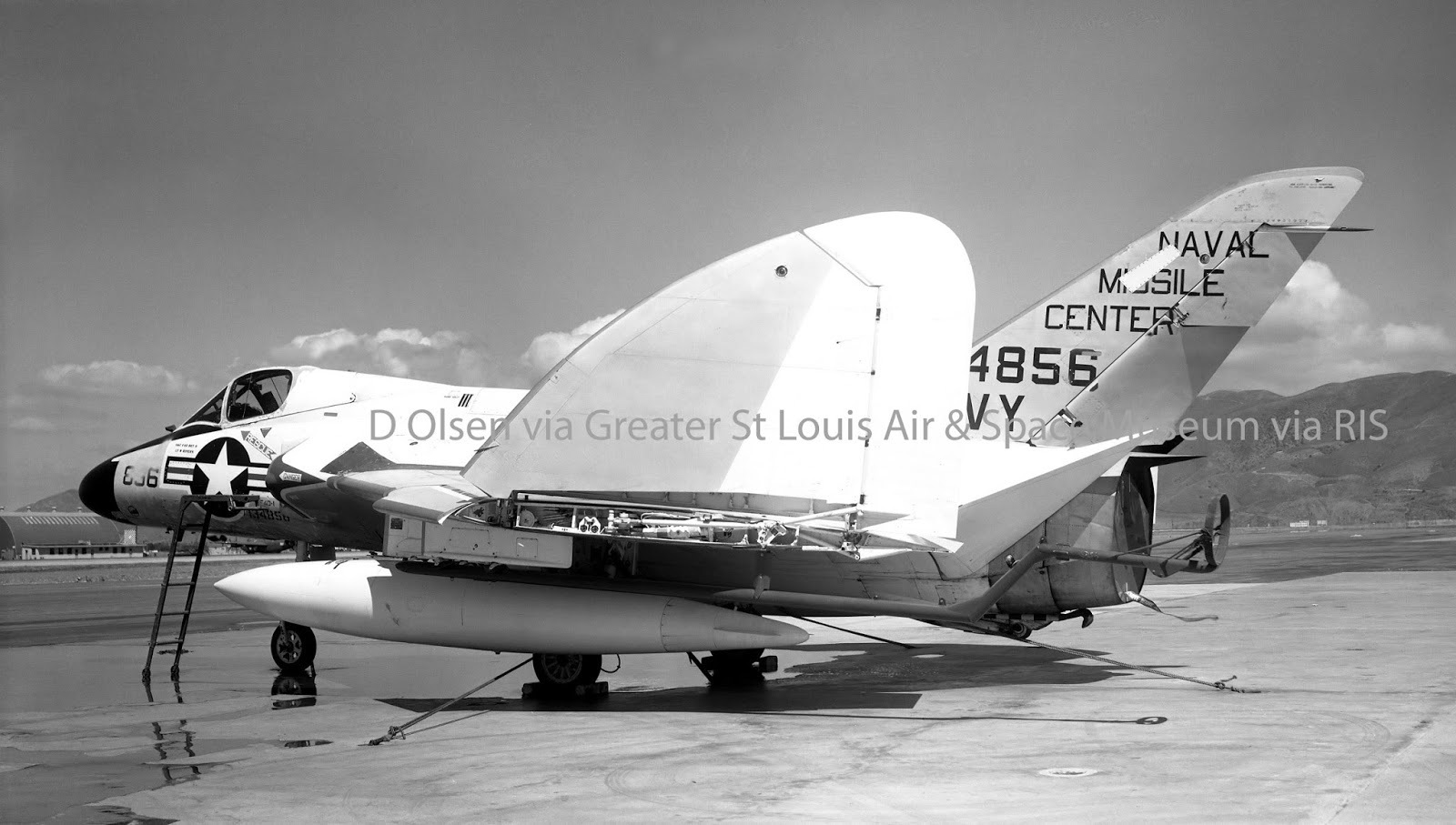
That takes care of the correction on the last photo in this piece. There's also one on the lead photo, so let's get down to it. In the caption we refer to a mystery structure hanging off the airplane and admit we don't have a clue as to what it might be. A reader named Rex came to our rescue with this explanation:

Hi Phil. In regards to " That's quite an apparatus she's got strapped to her aft section but, as usual, we're clueless as to its purpose." That device is not attached to the aft section, you can see that it is mounted to the outer pylon. It is the reel gear for a towed target system, in this case the Del Mar target. Your pic is a neat companion to a color shot that Mr Olson must have taken at the same time, from a slightly different angle and then had published in the Ginter book. (we see less of the BuNo in the Ginter photo) One thing I don't see in either photo is any sort of Motor Unit, but, I don't know at what point the RMU would be installed on an aircraft---maybe they were installed the same time as a target? I hope this is of help. Rex

Thanks, Rex; it's helpful indeed!

And now back to the original photo essay!

The Douglas F4D-1 Skyray was a looker and no two ways about it. If you happen to be my age (a condition I wouldn't deliberately impose on anyone) you might remember building either the Hawk, Comet, Aurora, or Lindberg kits of the airplane back in the 50s, or maybe even a little bit later than that. We got a kit from Airfix in the 70s, and what will probably be the definitive kit of the type from Tamiya in the 90s. We got references too, and decals. As modelers we can actually create a really good replica of what was arguably one of the prettiest jet fighters ever to grace the deck of an aircraft carrier. It was quite an airplane; a marvel of engineering. It was also, not to put too fine a point on things, pretty close to being a total failure as a military aircraft.

Yep; that gorgeous-beyond-words "Ford" was fast, and could climb like the legendary violated simian, but it couldn't do much else. It was a handful around the boat. It was woefully under-armed. It was a dense airframe with little room for growth as far as radars and avionics were concerned, and it was right up there with the early MiG-21 variants in terms of combat radius and useful range. It was really pretty, though.

Mark Nankivil shared a few "Ford" images with us a couple of weeks ago and, now that we've suitably defaced them to better deter The Picture Pirates we're ready to share them with you. We're sorry, folks; we truly are. The photos are really neat anyway, and we hope you enjoy them in spite of the watermarks.

The "Ford" was armed with 20mm cannon, but the guns weren't very useful thanks to an extremely limited ammunition load. The primary weapons were primordial early versions of the AIM-9 family and pods of unguided 2.75-in FFRs. The fact that the aircraft could be armed with guided missiles guaranteed that the type would show up at the Naval Missile Center at Point Mugu, which is where this photo was taken in April of 1961. That's a towed target rig she's got hanging off her structure (thanks, Rex!), although the motor is missing. There appears to be a scab patch on her vertical stab as well, but we have to admit that we don't know if it's a repair or has some other purpose.   Doug Olsen via Greater St Louis Air and Space Museum via Mark Nankivil
The Marines have frequently received the Navy's hand-me-downs, and that was sort-of the case with the F4D-1. The type didn't work out particularly well in the NAV and didn't do much better with the Corps, but it did provide experience with what was, for a very brief period of time, a state-of-the-art interceptor. 139151 from VMF-542 was photographed on her home ramp in September of 1961, looking to be ready to rumble with her pylon-mounted AIM-9s. She was a relative Plain Jane as far as her paint job went, but she still looked like she was going a million miles an hour just sitting there.   Doug Olsen via Greater St Louis Air and Space Museum via Mark Nankivil

Remember that part where we said the "Ford" was a beautiful airplane? Well, folks, they just never got any prettier than the NAV's VF(AW)-3's scheme for the bird---if there was a prize for good looks there's little doubt that Gene Valencia's "Fords" would win it, each time, every time. This scheme has probably inspired more people to build a model of the F4D than all the other units put together. Both of the Tamiya kits offer these markings right out of the box (as did MicroScale's old Allyn reissue back in the 70s), and most after-market sheets devoted to the type will get around to covering the unit sooner or later, presuming they haven't already done it. It's what we might call a popular squadron, even though its service life with the type was brief.  Doug Olsen via Greater St Louis Air and Space Museum via Mark Nankivil

139162 was another Skyray from VF(AW)-3 that posed for her portrait that day. There's not much about her to set her apart from her sister shown just above, but it provides a variation if you'd like to model a "Ford" ramp some day. The F4D-1 climbed out at a pretty impressive angle of attack; an interception launch must have been a sight to behold!  Doug Olsen via Greater St Louis Air and Space Museum via Mark Nankivil

Let's go to an air show! Paul Stevens caught 139130 on the ground at an Armed Forces Day back in 1961. She was looking a little bit rough around the edges the day this photo was taken, but was still as capable an interceptor as the type ever was. The "Ford" wasn't particularly large, which was a big part of the problem since there just wasn't any room for growth. The Douglas F5D Skylancer would have been the answer, but the appearance of Vought's F8U and McDonnell's F4H-1 pretty much sounded the death-knell for the bat-winged Douglas interceptors. A couple of the naval aviators who frequent these pages have opined that it was a very good thing that the Navy never had to go to war with the F4D-1, but then that could have also been said about any of the type's contemporaries as well. She was a place holder at best, but she sure looked like a star!  Paul Stevens via Greater St Louis Air and Space Museum via Mark Nankivil.

Hook 'Em

If I had to guess, or even if I didn't, I'd be of the opinion that most of our readership has built a model of Mitsubishi's immortal A6M Zero-Sen at one time or another in their modeling careers. It's one of those airplanes that's both iconic and, for the scale modeler at least, a rite of passage. I've built more than a few of them myself, and out of that grouping (there are 10 or 11 of them, I forget which, sitting on the shelf as I type this) at least a couple are from the Tainan Ku and its successor 251st Ku. There are, in point of fact, no carrier-based Zero-Sen whatsoever in my personal collection. Every one of them is shore-based, but therein lies the rub, which brings us to the point of this missive.

 It's been conventional wisdom for a number of years that the Tainan and 251st Kus removed the radios from their fighters and cut off the antenna masts as well (mostly true) and removed the tailhooks from their aircraft, those actions being taken in order to lighten the airplanes by removing unnecessary equipment and therefore weight. Taking out the radios made sense, sort-of, since they weren't all that good in the first place. Removing those hooks was another matter entirely, and was one of those deals that made sense except for when it didn't make any sense at all sense most of the airplanes in question were delivered to their land bases off an aircraft carrier. It's confused me over the years and might've confused you as well but, lo and behold, Bobby Rocker has come through once again, this time with a photo that offers indisputable proof regarding at least one A6M variant and that pesky tailhook.

The place is Buna, and the GI is from the 32nd Infantry Division. The aircraft is (or was until recently) an A6M3 Type 32 Zero-Sen From the Tainan Ku and, in keeping with the whole point of this piece, its tail-hook is deployed, proving beyond doubt that at least one of the Tainan's "Zeros" had its tailhook in place after delivery to a land base. It's my guess that most, if not all, of the others did, and I'm guessing their Type 21s and 22s probably still had them too. The hook seems to be painted black, which is entirely in keeping with all of those Hasegawa and Tamiya instruction sheets, and it's definitely deployable. Many thanks to Bobby for the photograph and the confirmation of a long-held theory.   Rocker Collection

Another Big 'Un on the Shelf

That Hasegawa Ki-44 I've been piddling with for the past couple of issues is done, and we're going to take a look at it today. It proved to be an easy date, taking approximately 12 hours from start to finish---that's the sort of thing that happens when you get yourself a kit where everything fits flawlessly! In point of fact, this particular model pretty much out-Tamiyas Tamiya for ease of assembly and darned near manages to build itself. Let's take a look:

Hey everybody, look at the big silver airplane! Well, maybe it's not so big; the Ki-44 was a tiny aircraft even by Japanese standards, and looks absolutely diminutive when it's sitting on a shelf next to just about any other 1/32nd scale JAAF fighter, but it's big enough. This is one of those rare kits where everything fits almost perfectly---we sanded the seams on the fuse, the wing halves (or more properly wing thirds), and the horizontal stabs, then polished them out without using a spot of putty anywhere. None. Nada. Zip. All the markings were masked and painted except for the unit insignia and the number 32 on the rudder (which is repeated on the lower mlg doors), which are kit decals. There's an Eduard interior in there, and the antenna's from stretched sprue, but everything else came directly from the kit.

Here's what the other side looks like. If you recall, the fuselage was done as a completed subassembly which was in turn attached to the wing, which was done that way too. Read that sentence again if you missed what I'm saying here---the fuselage was built, painted, and decaled, and then attached to a wing that had received the same treatment. The horizontal stabs and cowling were done the same way, and it really simplified the assembly of the model. You can't do that sort of thing with a model that doesn't possess superior fit, but this kit could be the poster child for one that's easy to stick together. Somewhere back there when this project was first started I mentioned my unerring ability to snatch defeat straight from the jaws of victory, mostly because I always mess up something and have to go back and do a few repairs. This kit was different in that there were no issues with any part of the assembly or finishing. That big Hasegawa "Tojo" is an amazing assemblage of plastic, ya'll!

And here's a not-particularly-good 3/4 frontal view to end this essay with. (One of these days I'll get a decent digital camera; I promise!) As a reminder, all of the silver was done with a Tamiya spray can, although I can't remember which one of their many shades of silver I used. That really doesn't matter, since the whole point is that I was able to easily paint the thing as subassemblies. Anything that isn't silver was done with masking and an airbrush, of course, but the point is that a quality aerosol paint can be a real time saver and a joy to use. I'm liking the way the model came out and am truly hoping my next project will be as easy as this one was (it probably won't be, though...)! That's my story and I'm sticking with it!

Some Really Special Guys

Some seventy-one years ago, give or take, The United States made the decision to strike the Japanese homeland by means of a carrier-based attack against assorted Japanese naval targets in the Tokyo area. An attack force of USAAF B-25Bs, to be led by Col. Jimmy Doolittle, was chosen to conduct the raid and the rest, as they say, is history.

You may remember a scene very similar to this image from the classic movie Thirty Seconds Over Tokyo, where the filmatic Doolittle Raiders were shown practicing doing carrier launches from what was then Eglin Field. In this photo from the National Archives, 40-2281, a B-25B assigned to the 17th BG (but not used on the actual raid) runs up her engines prior to launch. If any modern air force were to do this nowadays the aircraft would be surrounded by all sorts of telemetry and data-recording devices, and there would be safety devices galore, as well as a fair number of people watching. There's probably a fire bottle around there somewhere, and almost assuredly a meat wagon and crash truck or two are parked out of camera view, but the setup was pretty basic. Can I hear anybody say "it was a simpler time"?  Rocker Collection


The launch! No, it's not off a boat, but it's every bit as hairy. This shot is a still from a movie so the quality's not all that good, but it gives a graphic sense of the drama associated with every aspect of the project. 40-3366 was another aircraft assigned to the 17th but not used on the actual raid itself. The modelers among us may want to note the distinct difference in color between the rudder fabric and the sheet metal of the vertical stab. Bet the adrenaline was pumping in that cockpit!  Rocker Collection

A Few More Fruitflies

If you've been paying any sort of attention at all to what we've been doing around here, you've noticed an ongoing almost-a-series group of articles on the LTV A-7 Corsair II. We're going to continue that trend today with a look at the "Fruitfly" in TPS.


It's May of 1982, and this uniquely-camouflaged Echo model (158823, from VA-195) is posing for its picture at an airshow. Of particular interest is the demarcation of the light grey beneath the wings and horizontal stabs---to say this scheme is atypical is an understatement of the greatest magnitude! She was an A-7E-12-CV and was absolutely pristine when Mark Morgan took this shot. She's also carrying all of her weapons stations, a practice that was generally discontinued not long after this photo was taken.  Mark Morgan

The various Navy test squadrons made extensive use of the A-7 family, as illustrated by this shot of VX-5's 160724, taken at Selfridge in November of 1983. The Tactical Paint Scheme (bet you always wondered what TPS stood for, didn't you?) had a way of looking all beat-up and worn-out even when relatively new; this airplane is in far better shape than her paintwork would indicate. She's a survivor, ending up on public display in Louisiana.  Ron Kowalczyk

May of 1983 saw this  A-7E (157501, an A-7E-7-CE) on public display at NAS Lemoore. She's a bit shopworn but her markings are extremely well-done and she'd make a fascinating subject for a model. This shot gives us an excellent view of the Corrogard applied to the leading edges of all of her flying surfaces, which was not typical for the type when in TPS. She's only carrying 4 of her original 6 underwing stores stations; the increasing use of smart weapons decreased the need for lots of room for ordnance.  Mark Morgan

October of 1983 saw this gorgeous bird from VA-146 on the ground at Lemoore. She was an interesting aircraft in that she was assigned to a boat (the KittyHawk) and still carrying all 6 of her weapons stations when this photo was taken. That's a FLIR pod hanging off her inboard pylon. There are no racks hanging off those stations, but in every other respect 155273 is ready to rumble.  Mick Roth

159647 is another survivor, ending up outside a Chevrolet dealership in Fallon, Nevada, of all places! She was still the Real Deal when Rick Morgan took this shot at NAS Whidbey Island in August of 1984, and is somewhat special in that she's wearing CAG markings. She's relatively clean as TPS-painted aircraft go, and is carrying TERs on her outboard stations. Contrast this shot with that of 157501 a couple of images back; all of 647's Corrogard surfaces have been painted over. It's the little things that make this hobby so interesting!  Rick Morgan

VA-97 was a prime user of the type and used their aircraft hard, as illustrated by this shot of 158021 taken at an air show at NAS Corpus Christi in April of 1986. She's entirely combat-capable but really looks awful in this portrait. Check out those stains on the upper surfaces of her flaps---do that on a model and your typical "knowledgeable" scale modeler will tell you you've pooched the paintwork, thus further widening the gap between all the Instant Experts out there and reality. Just goes to show...   Phillip Friddell

The various greys used within the TPS range of paints were (and still are) notorious for changing their appearance depending on ambient lighting, as illustrated by this photo of VA-27's 159281, taken at Whidbey Island by Rick Morgan in August of 1987. Her paintwork is patched and extremely well-worn and, once again, we have a graphic example of the streaking and staining often found on the upper surfaces of the A-7's flaps when the aircraft was painted in TPS. The A-7 family did yeoman service in the Fleet and reserves, a fact not always appreciated by enthusiasts.  Rick Morgan

VA-122 was the West Coast RAG for the Fruitfly and frequently sent dets to the boat for carrier qualification. 160542 is seen here on the Ranger in October of 1988, and she's in relatively good shape overall in this shot. Note the stainless steel APU exhaust peeking out above her starboard nose gear door---it's pointless to paint anything that gets that hot since the paintwork will just blister off the surface of the duct. It's a note worth remembering if you're planning on building a model of the A-7.  Rick Morgan

This "Fruitfly" from VA-37 (158842) was cleaner than most when Rick Morgan took her picture in May of 1989. She was transient at NAS Whidbey Island when the shot was taken, and was in the 4-station configuration so typical of late-80s A-7s. The intake warning treatment looks a little goofy to our eyes, but we're pretty highly opinionated about such things. 842 ended up in Chicago as a museum bird, adding to the roster of "Fruitflys" that finished their days on public display.  Rick Morgan

Our final A-7 for the day is a little bit of a ringer. She's recently off the boat and served in Operation Desert Storm while with VA-72. Her wrap-around tan and brown camouflage is in distinct contrast to any sort of TPS, but was probably useful at low altitude over the Middle East. The photo was taken at an Armed Forces Day display at Eglin in 1991. Note that she's carrying all six of her wing stations---we're guessing she probably dropped a whole bunch of iron bombs while on station and needed the rack space. She was eventually transferred to the Royal Hellenic Air Force, but was very much a Navy bird when this photo was taken.  Bill Thomas

And that wraps up our A-7 coverage for today. We'll probably run a few shots in the days ahead since we've got so many of them in the collection, but we're going to take a break for a while and look at some other airframes in the next few issues. It seems fair to us!

Under the Radar

Today's Under the Radar entry is an older book that was largely ignored by the aviation community when it was originally published. It's achieved a new relevance due to recent progress in the field of aviation, and is well-worth looking at.

With unmanned vehicles being The Hot Topic these days (it seems as though you can't go more than a day or so without something about "drones" appearing in the popular press), it's probably worth while to look back a bit into their history.

Lightning Bugs and Other Reconnaissance Drones; The Can-Do Story of Ryan's Unmanned Spy Planes, William Wagner, Armed Forces Journal International and Aero Books, 1981, 222pp, illustrated, is a highly readable, non-technical overview of the Ryan Firebee program for inception though its service in the Vietnam War. The volume begins with the requirement for an unmanned surveillance and target drone and details the development of the aircraft's development and its substantial (and largely unknown) combat career during the Southeast Asia War Games. It's well-written and explains the AQM-34 program in considerable detail. Most folks don't have it in their libraries (we doubt most folks are even aware of its existence!) but we consider it to be essential reading if your interests run towards American involvement in that unfortunate conflict. You'll probably have to search to find a copy but the result is well worth the effort. Recommended.

Happy Snaps

It's been a while (far too long, in point of fact!) since we've run anything in this section of the blog, so today must surely be the day to correct that! 

OK, so it's not actually in the air, but it's getting ready to fly so we're going to consider it a viable entry into our Happy Snaps department anyway. The time is September of 1987, and the place is the USS Constellation. Long-time friend and fellow aerospace traveler Rick Morgan is up in Vulture's Row, camera in hand, photographing the goings-on down on the flight deck. The aircraft is one of VA-122's A-7Es, recently arrived and taxiing to its parking slot. That deck looks peaceful and somewhat serene, but it isn't. Every day on the boat is a day that's just waiting for disaster---that's something worth remembering when you look at all those carrier ops shots we run around here.  Rick Morgan

The Relief Tube

Letters, we get letters; we get stacks and stacks of letters (with apologies to Perry Como). Well, maybe we don't get that many letters, but we do get a bunch of them. Here are a couple of comments we've recently received regarding various and sundry things that have appeared on this site:

Let's start off with a clarification from Tommy Thomason regarding that desert-bound PBM we ran last time. It's in the form of scans from a 1944 issue of Naval Aviation News that explain what was going on when that photo was taken---Tommy didn't comment beyond sending the images so we're not going to either, but they're worth a look.


Thanks as always, Tommy, for your help!


In the Keeping Us Honest department, here's a comment from Pablo Ziegler regarding that model of the Brewster Bermuda we ran a while back:

Just a note about the SB2A: as far as I know, the Special Hobby kit is 1/72nd scale. The firm released both the SB2A and the British Bermuda Mk.I to date. In 1/48th scale, as far as I can remember, the only game in town for the Buccaneer is the old VacWings48 kit.

Apologies to Frank Cuden for that particular clanger; Frank most assuredly knew the difference and supplied us with all the pertinent information when he sent the photos. Some days we just aren't very smart...


And we've got quite a few other comments as well, but they're mostly about that Picture Pirate thing and, frankly, we're as sick of all that as you are so we aren't going to run any of them. We definitely are interested in your comments, though, so please feel free to write us at replicainscale@yahoo.com if you've got something to say, or if you've got photos or information you'd like to share.

Finally, here's an unadulterated shot of a 17th PG Curtiss P-6E in flight for your enjoyment. Consider it a gift from the Greater St Louis Air and Space Museum courtesy of Mark Nankivil. It's a positive way to end our day---a beautiful photograph of a beautiful airplane.

Finally, there's a LOT of material waiting in the wings for us to show you, so stand by. We'll meet again real soon, but until then, thanks for your patience with our recent lack of a schedule, and be good to your neighbor.

phil

Sunday, July 28, 2013

Progress With Tojo, A Special Photo, Mariner, and A Nifty Buccaneer


Why Don't He Write?

OK, it's been well over a month. What's going on this time? Well, folks; to put it in a nutshell, we discovered another Picture Pirate and it really put us in a Why Are We Doing This kind of mood for a while. Here's what happened.

We were messing around on the internet a while back and decided to put 4th FIS into Google Images
to see what might pop up, 4th FIS "Deuces" always being a topic of interest around these parts. A whole bunch of photos showed up and right there, in front of The Deity and everybody, were the F-86Ds from the 4th, the exact ones we'd run right here at RIS a year or so back through the courtesy of Dave Menard. The problem was, they were credited to the photo service account of somebody named "K...". That wasn't the end of it, either---there were hundreds of images on the site, and a few of them were very familiar to us since they'd come from the collections of Dave, Marty Isham, and the like, and a great many of those images had seen the light of day as exclusives, having not been provided to anybody else before they were offered to us.

The kicker here is that we didn't personally take the images, and neither did the folks who collected them, making the whole copyright issue a difficult thing to negotiate at best. We couldn't find anything that we'd personally shot (there would most assuredly be repercussions had we discovered that!) but it was discouraging in the extreme to see so many images lifted without mention of the collections from which they'd come. (We give credit lines on our photos, remember!)

To be perfectly honest with you, things like this tend to make us want to fold the tent. On the other hand, the person who'd loaded those photos had loaded a whole bunch more from other sites as well---our images only constituted a small percentage of what was there, so we weren't alone in the victimization department. We thought about the whole deal for quite a while (a little over a month, to be exact), and decided to continue with the project, but with an unfortunate side effect for you, our readers.

We'd gone to smaller watermarks on our photos a while back, in order not to compromise the quality of our images, but the guys on the various internet user groups, coupled with a couple of folks on that particular photo storage site, just won't let it go. That's forcing us to put large watermarks on the photography again. We hate to do that but those guys have pretty much left us no choice. To our regular readers, as well as those folks just discovering our site, please accept our profound apologies for those big honkin' watermarks. It's a classic case of a few ruining something for the many, but it is what it is and, at the end of the day, we fully intend that the folks who contribute to this site and make it what it is receive the credit they deserve. Most of the images have a huge sweat equity connected to them because of the sheer effort it takes for the collector to locate them and obtain copies. It's an integrity issue pure and simple. We think we have integrity, and we know our contributors do. We're pretty sure there are other folks out there who don't.

One more thing, ya'll: If you're looking at somebody else's site and see one of our photos run without provenance you can be pretty certain the person who's site it was took those photos without permission, since we only grant permission to use our photography to the folks who give credit to the photographer or collector who provided the images in the first place. We're proud of what we do around here---we run a straight-up publication and we intend on keeping it that way---so would you Picture Pirates please cease and desist? Our stats tell us that we're pretty popular and we'd hate to shut the project down because you can't keep your hands to yourselves, but that's certainly becoming an option so cut the crap, ok? Ok.

Movin' Right Along

The last time we convened I'd made pretty significant progress on that 1/32nd scale Hasegawa Ki-44, and promised an update the next time we met. Well, it's that time, so here's the update as promised!

And here we are---The Incredible Modular "Tojo"! The kit is one of those that fits like the proverbial glove, so the path taken in construction was somewhat different than my norm, which you all saw last issue. (In case you missed that one and are too lazy to scroll down to the installment immediately previous to this one, the wings and fuselage were built and, as you can see from this photo, finished, prior to assembly.) That big honkin' unit insignia is a kit decal, as are the numbers on the rudder. The home defense bands, Hinomarus, red tail, yellow ID panels on the wings, and anti-glare panels were all masked and painted and are now ready for assembly. The approach wouldn't work with a lot of models but it's a great way to do things if all the big pieces fit properly; this particular kit is about as shake-and-bake as it gets!

That silver paint is also a departure from the norm around here (that's two departures in one blog, by Golly!) in that it's Tamiya lacquer sprayed from a rattle can. They make several variations of the stuff and I honestly can't tell you which one I used here but it looks ok, whatever color it was. The kit's instructions tell you to paint the fabric-covered control surfaces with JAAF Grey-Green, which I did, but photographic evidence seems to indicate that the Ki-44's control surfaces were most often finished with silver dope. It would be easy enough to go back and fix them, but it would be equally easy to just leave them as they are, and today's a Day of Least Resistance---grey-green they are and grey-green they stay! I don't think I mentioned it when we were talking about all the things that were pre-painted on the model, but the anti-skid wing walkway was masked and painted as well. Better safe than sorry...

Here's a 3/4 rear view of the same side of the airplane, which honestly doesn't show us anything significantly different from the photos above. On the other hand, it does show us how effective an un-black can be---in this case it's Floquil Grimy Black, and it looks a whole lot better than if I'd used an intense, "pure" black in its stead. There's some touch-up to do before the project moves any further along, but we like where it is at this point. There's still plenty of opportunity to mess things up, though, so stay tuned for the next thrilling installment.
Dick and Marge

Richard Ira Bong was America's ace of aces during the Second World War with 40 confirmed aerial victories against the Japanese scored while flying with first the 49th and, later, with the 475th fighter groups. Bobby Rocker sent us a photo that we place in the "sentimental journey" category, for obvious reasons.

Dick Bong and Marge Vattendahl, who was to become Mrs. Bong. Yes, that's her picture that Bong used to paste on the nose of his P-38s. The marriage was short-lived, unfortunately; Bong died test-flying a Lockheed P-80 in 1945---they'd only been married a few months when he was killed. Marge lived until 2003 and passed away at the age of 79. She remarried (twice), and apparently didn't speak often of her time spent with Dick, but her ashes were interred next to his. We often talk about the price paid by those who fought in that terrible war, but it's something worth remembering. Take a close look at Dick Bong's face, look at his eyes. He's young, he's in love, and he's so very, very old, aged before his time. It was a lousy war...

Thanks as always to Bobby Rocker for this image, and for the continued contributions from his collection.

That Martin P-Boat, A Slight Return

The impending arrival of the new Academy Martin PBM Mariner has a whole lot of folks excited, and rightfully so. Never the glamor girl the far more mundane PBY turned out to be, the PBM plugged along in journeyman fashion, ending her days as a Cold Warrior. Jim Sullivan's unique collection includes a fair number of Mariners, several of which we'd like to share with you today.

Let's start off with a good day gone bad. This PBM-3, assigned to VP-208, has apparently suffered a rough landing in the British West Indies during May of 1943; sharp-eyed readers will notice that both wing floats are missing. The aircraft is in Blue Grey over Light Grey, with all codes in black. The airplane doesn't appear to be in imminent danger of either capsizing or sinking, which may indicate that her starboard wingtip is dug into the bottom. Every picture tells a story, and we'd sure like to know the story behind this shot!  Jim Sullivan Collection

Here's an early PBM-3 sitting off the seaplane ramp at NAS Pensacola in 1944. She would have been a trainer when this photo was taken but was, in all likelihood, an operational aircraft in her early days. That blue-grey upper surface color has driven modelers to distraction for a number of years, leading me to think that close enough is good enough. That's just an opinion, though.   Bill Derby via Jim Sullivan

1942 was the killing time for U-Boats off the east coast of North America, but the threat was still viable right up until the end of the war. This section of PBM-3s belonged to VP-209, and were posing for their portrait off NAS Norfolk when this photo was taken in August of 1943. The paintwork has changed over to Tri-Scheme, and the national insignia are the briefly-employed red-outlined star and bars of mid '43. The colors really suit the Mariner's unique lines, don't they?   Jim Sullivan Collection

This PBM-3D is an enigma to us. She's got beaching gear attached and is on the ground at Wilcox Dry Lake in Arizona during June of 1944. She doesn't appear to be damaged in any way but is festooned with guide lines and there's quite a bit of ground echelon activity going on around her. She's in Tri-Scheme, she's unarmed, and she seems to be in what some people might call an embarrassing situation. If only that picture could talk!  Jim Sullivan Collection

This is a little more like it! It's March of 1945, and "Umbriago II" is about to be winched aboard the tender off Karma Rette. The apparent discoloration above her fuselage chine is due to water staining and will disappear once she's on deck and has had a chance to dry. Her side number is repeated on the aft fuselage, and both numbers are underscored by a thin "V". A PBM-5, she'd make for a fine model.  Jim Sullivan Collection

Here's another PBM-5 for your consideration. This time it's "Belle of the Pacific" nested on the tender deck during August of 1945. It's rare, although not unusual, to find Mariners with nose art; the "Belle" is a fine example of the practice. Aftermarket decal guys, here's your chance. Too bad we don't have a full side view of her!  Jim Sullivan Collection

But wait! Maybe we do have a side view of her, or most of one at any rate. Here she is again, being winched aboard the tender. We're missing the BuNo on her vertical stab, but otherwise we have enough information to allow her to be modeled. Note that her bow guns are unshipped, but she still carries her dorsal armament and, we presume, her tail guns as well. This shot was taken on the same day as the one directly above, presenting us with a fine opportunity to define her paintwork and markings.  Jim Sullivan Collection

Quite a few PBMs operated out of Norfolk during the War. Here's a ramp full of them, taken in late 1945. The aircraft are all -5s, and their paintwork is a mixture of Tri-Scheme and Atlantic ASW. Of particular interest is the side number presentation on the aircraft painted in the ASW scheme; a grey number surrounded by a grey rectangle. It's something a little bit different if you happen to be planning a model.  Jim Sullivan Collection

The date is November, 1949, and this Glossy Sea Blue PBM-5 is sitting on the ramp at NAS Pax River assigned to the NATC. Her markings are nothing to write home about, but her external equipage is worth a second look. Notice that her national insignia follow the lead established by the F4U in that the Insignia Blue has been omitted from that marking, being replaced by the GSB of the aircraft's paintwork.  Jim Sullivan Collection

Almost the end of the line. This Coco-Solo based VP-45 PBM-5 is photographed in flight off Panama during 1954. She's wearing both a side number and tail codes but is otherwise a Plain Jane. She's still armed, though, and is presumably assigned to ASW duty. Note the "tape" on the radome on her dorsal forward fuselage. If only we knew...  Bob Searles via Jim Sullivan

It's used to be the norm for used-up patrol bombers to end their days with the Coasties. That's the case with 59114, a PBM-5G working out of North Island during 1959. The Mariner was on her twilight cruise by then, soon to be replaced by Martin's P5M Marlin, but a handful were still around to close out the decade. This bird was well-maintained, and was going out in style.   Peter Bowers via Jim Sullivan.

And that's it for That Other P-Boat, at least for now. We aren't quite done with American seaplanes yet, though, so stay tuned!

One That Didn't Make It

There are airplanes and then there are airplanes. Brewster, an old-line American coachbuilder (first with wagons and later with automobiles) had a somewhat disastrous shot at designing and building aircraft for the US Navy, first with the F2A fighter and, later, with their SB2A Buccaneer, a dive bomber that never quite lived up to its intentions. A couple of hundred were built before production was terminated, and most of those lived out their limited service lives with foreign air forces and naval arms.

Still, the aircraft possessed enough appeal to cause a 1/48th kit to be released by our friends at Special Hobby. Frank Cuden, who knows a thing or two about plastic modeling, recently tackled the kit for an article in Fine Scale Modeler and he, plus the staff at FSM, were kind enough to allow us to run a couple of images of the end result. For further details we heartily recommend that you acquire the appropriate issue of that publication!

From this perspective the aircraft looks very much like an SB2C variant, doesn't it? The model shows the aircraft in mid-1943 camouflage and markings, with the appropriate FT (for Flight Test) lettering on the cowling.

Here's a 3/4 nose view to show off Frank's cockpit work. I don't have the kit but have more than a passing familiarity with other offerings from SH; there's a whole lot of Frank's skill apparent in this model.

And a 3/4 rear view to end the set with. It's probably for the best that the aircraft never achieved active service with either the Navy or Marine Corps, but this model makes us want to go get a copy of the kit for ourselves!

Thanks to Frank Cuden and the folks at FSM for the images.

The Relief Tube

Of which there isn't one today. We've been extremely busy with non-Replica doings of late, and have come to the conclusion that it will take at least another week or two to finish up the issue we had planned for this go-round. Since it's already been well over a month since our last installment we've decided to go ahead and publish what we've got. The next issue is already in work and, hopefully, won't take as long to get here.

Thanks for your patience and be good to your neighbor 'til we meet again.
phil