Sunday, May 26, 2013

A Pugnacious Little Fighter, That Other Patrol Bomber, An Invader, Some Photo Birds, and A Great Big Boat


READ THIS FIRST

Which is a somewhat bossy way of saying that we received some supplemental information on two of our feature articles that caused us to go back and make some significant corrections. If you read this when it was first published you'll want to go back and re-read it. If you're just now getting around to reading it don't be concerned; what you didn't know surely won't hurt you!

When It Rains, It Pours

It seems like only yesterday that we were discussing the eminent arrival of the new 1/32nd scale Tamiya F4U-1, and those of you who actually remember what's written here may recall that we were suggesting there were other airplanes we'd rather have seen kitted in its stead. One of those airplanes was the Hawker Tempest V, a significant aircraft that's been extremely poorly kitted in every available scale since the beginning of time, plastic-wise. We weren't the only people who wanted one, either; countless contributors to the various electronic modeling magazines and boards have been lamenting for the past several years that a decent Tempest was not to be had.

That takes us to John de la Garza, a mentor of ours from days gone by and a man who had a knack for causing large mainstream model companies to produce kits of previously unavailable aircraft. Del worked up a viable 1/72nd scale P-40C back in the late 60s, after which Frog promptly issued a kit of same. He scratch-built a Kawanishi "George 21" from a pile of parts and some sheet plastic, and we promptly saw a kit of same within months of its completion. The list went on and on.

We mention this because we bemoaned the lack of a Tempest in lieu of that big "Hog", after which several of our readers wrote in to remind us that Special Hobby was about to release a war-time Tempest kit (a Mk V) in 1/32nd scale. We wiped that particular dollop of egg off our face, only to discover that the good folks at Pacific Coast Models had secretly developed their own kit of same, molded by Sword and assisted in the project by Roy Sutherland. Life had just become very good indeed! It was de la Garza Syndrome on steroids!

Why, you may well ask, is this such a big deal to us? That answer is simple; when we were 12 or so we discovered Pierre Clostermann's The Big Show. Yes; we know there are a great many people who think a lot of his book was what contemporary politicians call "spin", but the fact remains was that he was there, and he scored enough kills to qualify as an ace regardless of the accounting system used. He also inspired an entire generation of aviation-minded kids, of which we were one, to go digging into books to find out exactly what a Hawker Tempest was. You can like his book or hate it; we really don't care. The simple truth of the matter is that it was a seminal work for us, and our well-worn Ballantine paperback edition of same is a treasured memory of both his inspiration and "that big brute of a fighter" he wrote about with such passion. And now we've got not one, but two 1/32nd scale kits on the way. How lucky can we be?

That takes us to the point of this whole thing (and Yes, Virginia; there actually is one for once). We bemoaned the fact that we were getting yet another Corsair (I'm sorry I said that, Mr. Sullivan!) and asked for a Tempest V, at which point we got not one but two of them in our preferred scale. They're real. They exist. They're not the horse poot we so often hear from overly enthusiastic pie-in-the-sky model manufacturers. Both Sword and Special Hobby did The Deed, and they did it without endlessly promising it---kudos to both!

As for The Point---we've got some mojo working, brothers and sisters, so how about we try it again? We want a 1/32nd scale FJ-3. We want a 1/32nd scale T-6/SNJ. And when do we want 'em? We want 'em NOW! Right freaking NOW!

Hey Del; can you scratch-build a 1/32nd scale FJ-3 for me?

Shoki

As long as we're discussing airplanes we've liked a lot over the years, let's throw in one of our Japanese favorites; Nakajima's Ki-44 Shoki, better known to the West as the "Tojo". Our first kit of that particular fighter was built in 1969 when we tackled Tamiya's 1/72nd scale (more or less) version of same. Quite a bit has changed since then and we've now got exceptional kits of the aircraft in all of the conventional scales, which makes it that much easier to construct a decent replica of one. Today our interest falls into the box of Hasegawa's recent 1/32nd scale offering of the Ki-44 or, more specifically, their special edition (Nakajima KI44-II Shoki, Shinten Seikutai, Kit # 08208) that caters to the handful of special attack modified aircraft of the 47th Sentai (specifically intended to cope---by ramming---the ever-increasing appearance of the B-29 over the mainland) that had their wing guns removed in favor of increased performance. That particular kit is far too expensive in our opinion, since it's a "special edition" with the "changes" seemingly restricted to a specialized set of decals, but at the end of the day it was the kit we had available to us so there you go!

As plastic models go there's not much bad to say about the kit; it's recent Hasegawa, which means it's reasonably accurate and nicely detailed right out of the box. We picked up the ubiquitous Eduard interior set (#32 652 Ki-44 Shoki Interior SA) for the type but that's it for aftermarket. Everything else is kit stock. We're actually making some progress on the thing too, so let's take a look and see where we are today.

The Big Picture, so to speak. The interior is completed (although the gun sight has yet to be added) and the fuselage has been sanded and partially polished out. The wings and horizontal stabs are together and sanded but haven't been permanently attached to the airframe yet, and the cowling is assembled---the truth of the matter is that we stuck it together to get a feel for its final appearance. So far we like it, but we aren't very far into the project yet and there's still plenty of time for us to snatch defeat straight from the jaws of victory!

Hasegawa likes to make the wings an honest-to-goodness structural component on their 1/32nd scale kits, and that big honkin' spar assembly you see here could support the bridge of your choice. There are a couple of large tabs on the fuselage that fit into the space between the "spars", effectively locking the wing where it's supposed to be, clever engineering; that! The two holes you see in the wing fairing are for the fuselage step but Hasegawa doesn't open up the well so it won't look very good if you turn the airplane upside-down. We're probably going to fix that but we haven't done it yet. Finally, most Japanese airplanes of the era used a transparent color coating called aotake, generally a blue or green color, as a corrosion inhibitor on bare metal interior surfaces, but not every part received the coating. We've hit the interior of the center section of the wing with Testor ModelMaster Aluminum and don't intend to paint it further, but very little of this area will be visible on the completed model so it really doesn't matter to us. If it does matter to you, feel free to paint it appropriately.

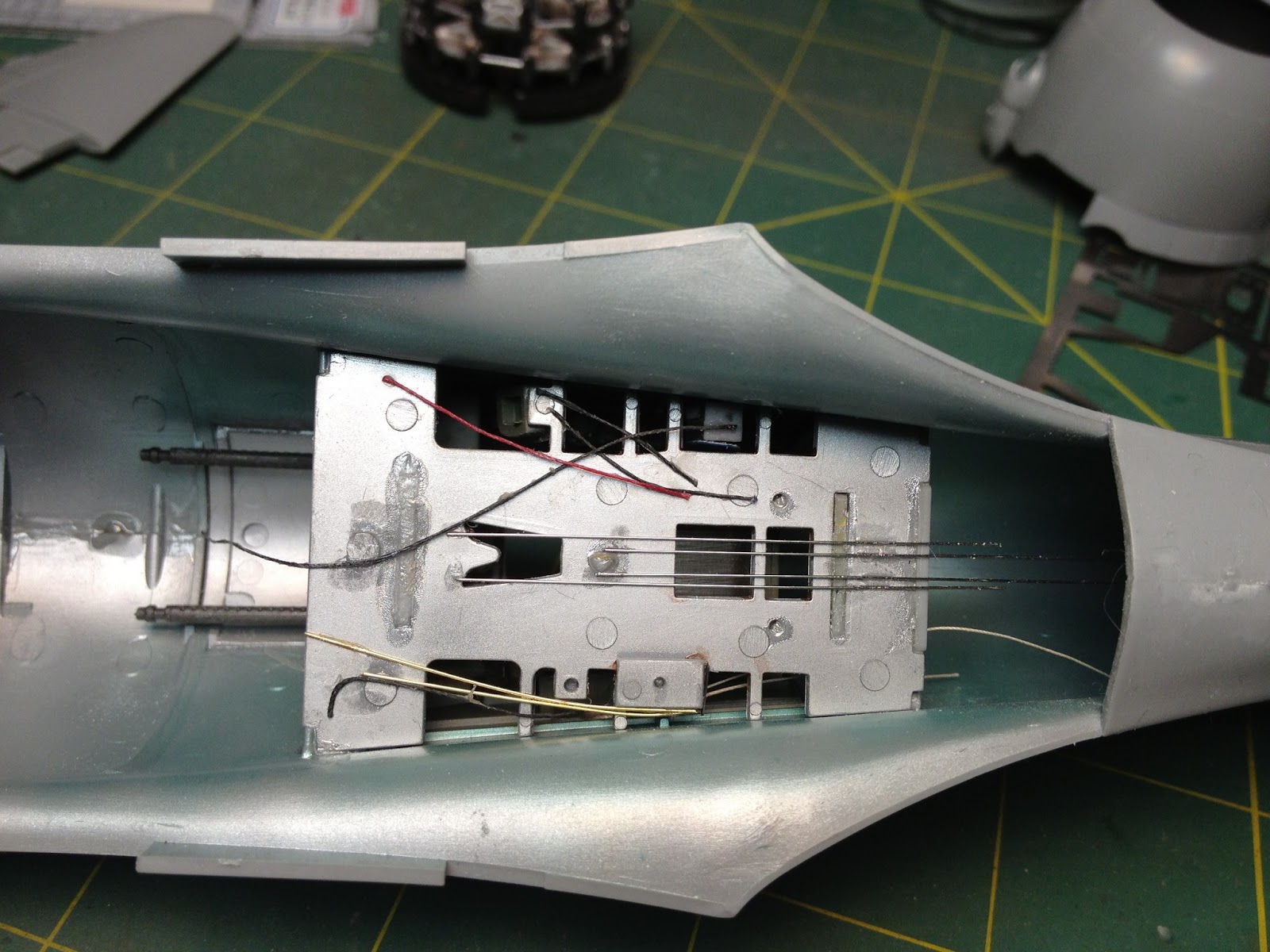
Here's something that's really easy to do and can add substantial life to your models if that sort of thing interests you. We've added the aileron and rudder control cables by cutting .010 stainless steel wire and attaching it to the bottom of the fuselage floor with superglue, and added a handful of electrical cables from sewing thread that's been coated with white glue to remove the fuzzies that are inevitably found on thread. There are no surviving Ki-44s around, although a center section of fuselage does still exist in China (we think), which means the routing of those aforementioned electrical cables are a best-guess sort of thing. The interior, which you can't see in this view, has been painted in the green color most often found in Ki-43 and Ki-84 interiors, while the "bare aluminum" areas of the interior structure have been airbrushed with a transparent dark green, with no attempt made at a consistent finish. We think it looks good but your mileage may well vary.

Here's the interior of the starboard fuselage after the liberal application of the appropriate Eduard pieces. They look ok, but keep in mind that they're also made up---it's that no-surviving-airframes-or- manuals bugaboo rearing its ugly head again. That Eduard set is a good one, but we had to trim the radio panel, which is substantially bigger than the kit part for some reason beyond our understanding, and we've installed minimal wiring as well. There's still a little bit of work yet, but it's nearly done. Oh, and the guns don't have a whole lot of detailing on them, and never will---all you can see of them are the butts once the forward fuselage decking is installed. No; we don't know why Hasegawa did it that way either.

And the port side of the interior, mostly. There's still a little bit to go in there, and we really liked the Eduard photo-etch (except for that overly large radio panel), but you could easily build a decent model without it. You pays your money...

This view kinda-sorta shows the Eduard instrument panel which is, along with the seat belts and harnesses, which are about the only reason we still buy photo-etch interiors. There are days we can paint that good, but there are a whole lot more days when we can't even get close. It's important to understand your limitations, we think.

Finally, here's a shot that shows the seat, belts and harness, and turnover pylon detail, all of which came from Eduard. That seat is a thing of absolute beauty and really looks great in there. The aforementioned belts and shoulder harness will get dirtied up a little bit with some pastels, and the lovely Eduard detail on the turnover pylon will end up the same faded black as the rest of the area under the canopy. So far we're liking it.

And that's where the project is for now. We'll try to remember to keep taking photos as we go along so you can see what we're doing (and hopefully avoid the bone-headed mistakes we'll inevitably make in the process). Banzai, ya'll!

A Mariner at Last!

Some kits are a rite of passage for the plastic modeler, and every generation has its own special ones. For those of us who passed our elementary school days in the 1950s the Revell PBM Mariner was one such kit. We all built at least one of them, mostly poorly, and we all were amazed at how different it was from that other Navy patrol bomber, the Monogram PBY-5A. The PBY was the PBY, but the PBM was different and therefore way cool. Or maybe not.

Obscure kits have a way of coming out of the woodwork, and we'll be the very first to admit that our knowledge of every single plastic model ever issued is limited at best---we say that to forestall the torrent of letters that are certain to follow after we tell you that the PBM has been extremely poorly kitted over the years. The type was never as popular or famous as its Consolidated stablemate, and to date very few companies have seen fit to invest in the tooling necessary to kit one. That makes the Academy announcement of the impending release of a Mariner all the more special to flying boat aficionados---just ask Brian over at Seawings about that one!

We haven't actually seen the kit ourselves (and probably never will since it's in 1/72nd scale; a little too small for our preference) but the fact is that, good, bad, or indifferent, it's a kit of a Mariner in a popular scale. We hope it sells like hotcakes.

Bobby Rocker has provided us with several really neat images of the type, which we thought we'd share with you today. Call it "inspiration" if you will. (We only hope the kit will do the type justice; Academy has had a somewhat checkered past regarding the accuracy of their offerings. We're looking forward to seeing what they come up with on this one!)

What we presume to be a PBM-5 undergoing preflight prior to launch. The aircraft is identified as being from VPMS-2 and provides us with a classic view of this largely unsung aircraft. Make special note of the aircraft's size; the PBM was somewhat smaller than its companion PBY.  Rocker Collection

The place is Okinawa, and this particular Mariner has fallen on bad times. It's been placed on pontoons by an unidentified Seabee unit and is in the process of being moved to a repair facility---this would make a really neat diorama, ya'll!
Rocker Collection

And a whole bunch of P5Ms in the same place at the same time. There are a couple of Catalinas hiding in that shot too, and it's interesting to compare the relative sizes of the two aircraft. It would be a pretty big model but we'd love to see a Mariner kitted in 1/48th scale!  Rocker Collection


Some Books You Might Want

Last issue we discussed the brand new (and highly desirable) reference on the Tainan Kokutai in New Guinea. Coincidentally, frequent contributor Rick Morgan spends a fair amount of his professional time in Australia these days and has come up with a couple of books we think are worth mentioning, although they aren't generally available here in the United States. The comments are Rick's and, unfortunately, he didn't mention how to obtain a copy of the titles for your own library, although a quick trip to the internet ought to get that fixed in short order.

Storm Over Kokoda: Australia’s epic  battle for the skies of New Guinea, 1942:  (2011, Peter Ewer):   Covers the period from the start of the war with Japan through the end of 1942 and the realization that, with the best of their men and units fighting for “Mother England” in Europe and Africa, they’d have to scrape together new squadrons to defend their own homeland.  This book starts with the loss of Rabaul (and its defense by Wirraways),  deals with early combat by Hudsons and Catalinas and really ends up with the formation and training of 75 Squadron and its epic defense of Port Moresby before the US arrived.

Darwin Spitfires; The Real Battle for Australia (2011 Anthony Cooper):  Another fascinating book; covers ‘warts and all’ deployment of three squadrons of Spitfires to protect the Northern Territories in 1942-43. Although great things were expected, doctrine and command dynamics led to their initial work being less successful against the Japanese then the US’ 49th FG flying P-40Es.  The Brit/Aussie 1st Fighter Wing initially tried to fight Japanese raiders with tactics that had been proven in the Battle of Britain but didn’t work over Darwin for a variety of reasons. In the end they achieved a roughly 1:1 kill ration and many acts of individual heroism were obscured by losses and inability to meet the expectations of higher command.
 
Rick has always been somewhat particular when it comes to reference works so we anticipate the books to be well worth having. Many thanks to him for making us aware of their existence!
 
Honey Bunch III
 
We've been running a series of photographs from the Johnathan Watson Collection over the past couple of issues and have another set to share with you today. This time the aircraft in question is a  Douglas A-26B-50-DL named "Honey Bunch III" and taken when she was assigned to the 319th BG, probably at Yokota AB in Japan, during 1947.
 
Here's a great ramp shot to start things off. Note the early gun nose with the .50s displaced horizontally, as well as the wing guns, all of which have muzzle protectors in place. Most of the aircraft shown here still have both ventral and dorsal turrets complete with guns. The exhaust streaking is typical of the A-26 family, and these natural metal aircraft from the 319th have anti-glare panels on the insides of the cowlings, although you can't tell that from this angle. The OD over Neutral Gray aircraft visible in this image are from the 3rd BG.  Johnathan Watson Collection

Here's another view of "Honey Bunch III", this time parked in front of "Arabella", another A-26B from the 319th. This view shows the attachment of the gun covers to good advantage; they appear to be made from a dark OD-colored canvas. Note the canvas covers over the main landing gear tire/wheel assemblies only---the nose wheels are not covered in any of the shots in this series. Times were tough in the Air Force during the 40s, and these aircraft are pretty beat up even though they were barely four years old when the photos were taken.  Johnathan Watson Collection

This photo shows us virtually nothing in the way of markings, but it provides a great view of the dorsal fuselage on an early production A-26 and defines a typical antenna fit. It's detail like this that makes or breaks a model...  Johnathan Watson Collection

The photographer apparently had a flair for the dramatic, and we're grateful to him for possessing it. Check out the nose guns; there should be six of them running horizontally across the nose of this aircraft, but it only has four in place. There's a lot of chipping on the anti-glare panels on the inboard sides of the cowlings and on the face of the propeller blade on the number 2 engine as well. (The prop on number 1 has been removed and may well have been undergoing overhaul; if the condition of the starboard prop is any indication it probably needed it!)  Johnathan Watson Collection

Our final shot in this series provides us with the color of the name on the nose of "Honey Bunch III", as well as the placement of the prop warning stripe. The pilot standing under the nose is probably George Rasmussen, her nominal pilot.  John Watson Collection

"Honey Bunch III" bought the farm in a landing accident in 1947. These photos are a unique record of her final days, and we're grateful to Johnathan for sharing them with us.

SPECIAL ADDENDUM TO "HONEY BUNCH III"

Just when you thought it was safe to come out (approximately 8 hours after we posted this issued of the blog) we heard from Gerry Kersey over at 3rd Attack.org. He provided us with some insight that may be of interest to our readers:

According to all the info I have the 319th BG never made it to Yokota. They returned to the States at Fort Lewis in Washington in December 1945. The approximately 57 A-26B and C models they flew from Okinawa went to Clark and Dulag. An undesignated number went to Japan where they were dispersed to the 3rd BG as well as the 89th Squadron which was detached from the 3rd and attached to the 38th BG in approximately April 1946.

If you look on the
A-26/B-26 page at the bottom, you will see official documents concerning the 319th BG. The pilot who flew the 44-34226 to Dulag is listed F/O Theodore E. Leete. Whether this is him in the photo I don't know.

One final note of The Mystery Deepens variety: Whoever the young pilot is who's standing in front of "Honey Bunch", he's wearing a wool shirt, jacket, and gloves, scarcely the attire for anywhere in the Philippines. We don't know exactly where the photo was taken but guess it was Japan since that's where the object of our affections crashed in 1947 (plus that's how the originals were identified to our contributor, Jonathan Watson). Further comments are invited!

The Photo Crusader

At the time of its service introduction the Chance Vought Crusader was the highest performing carrier aircraft in the world, legitimately supersonic in most conventional flight regimes and adequately armed, albeit with relatively poor avionics in its early versions. The type's overall performance offered a quantum leap not only to the NAV's fighter squadrons, but also allowed for a significant advance in that service's photo recon capabilities in the guise of the F8U-1P. That variant became the RF-8A during the 1962 standardization of military aircraft designators within the US armed forces (followed eventually by a modification of the airframe into the RF-8G) and soldiered on for several years after the last fighter variant had disappeared from both Fleet and Reserve squadrons. Most of the RF-8As and Gs ultimately ended their days with the NavRes, providing a viable reconnaissance platform that was ultimately replaced by a podded F-14A TARPS mod. Quite some time ago Mark Nankivil provided several images to us that had been gleaned from the William Peake collection, and we'd like to share those photos with you today. (Note that all of the aircraft we're featuring were RF-8Gs when photographed.)

144614 was an F8U-1P with a relatively boring life. It was redesignated an RF-8A in 1962, and saw squadron service until 1987 when it was sent to the boneyard. This shot was taken in her declining years, when she was assigned to VFP-206. The "Hawkeyes" of 206 had the distinction of flying the last F-8s in Navy service, giving up the type in 1987. This aircraft is in overall light grey, one of several paint variations to be found on the RF-8s during their TPS period.  William Peake via Greater St Louis Air and Space Museum via Mark Nankivil

BuNo 144617 was another bird from 206. Part of her career was spent as a chase plane, and ended up her days on a pole in the Flying Leathernecks museum in California. In this view her cameras have been removed and she's light on fuel and is sitting all tippy-toed in consequence, but she's every inch a thoroughbred nonetheless.  William Peake via Greater St Louis Air and Space Museum via Mark Nankivil

Here's the other side of 617. Most of the photo Crusaders were Plain Janes as far as markings went, and 144617 was no exception. The ones that ended up in the Reserves were generally very well maintained, making colorful examples of the type a rarity.  William Peake via Greater St Louis Air and Space Museum via Mark Nankivil.

Or maybe that lack of color just applied to the pre-TPS birds?  144618 is sitting at an airshow in this undated photo, resplendent in her Light Gull Grey over Insignia White paintwork and proudly displaying her active duty VFP-63 Det 4 markings at a Stateside airshow during the 70s. She ended up at MASDC in 1982.  William Peake via Greater St Louis Air and Space Museum via Mark Nankivil

BuNo 144860 was yet another aircraft assigned to VFP-206 (although that particular BuNo was assigned to an A3D-2T; anyone holding the correct identification of this aircraft is invited to contact us at replicainscale@yahoo.com ). Once again we're looking at a 1980's Plain Jane in a lightened condition. Paint jobs like this would drive a lot of scale modelers crazy, but the aircraft is strictly regulation.   William Peake via Greater St Louis Air and Space Museum via Mark Nankivil

VFP-306 was one of the more colorful RF-8Gunits, as illustrated by 145607. Modelers may want to note the paint color on her deployed in-flight refueling probe. The aircraft went to Castle AFB for restoration but, sad to say, we don't keep up with the comings and goings of most museum aircraft so her ultimate disposition is unknown to us. You're encouraged to write us if you know where she's hanging out these days...  William Peake via Greater St Louis Air and Space Museum via Mark Nankivil

145623 is another TPS bird from VFP-306. She ended up at DM in 1984, but was ready to rumble when this photo was taken. Her speed brake is dragging the ground, providing us with an excellent example of why such things are generally deployed only in flight. Her paintwork is somewhat the worse for wear as well---growing old is never easy.  William Peake via Greater St Louis Air and Space Museum via Mark Nankivil

VFP-206 had colorful airplanes back in their Easter Egg days of the early 1970s. 145633 was apparently at an air show when this photo was taken, and is resplendent in her finest paintwork. Yes; that's a deployed speed board hanging off her belly and no; it isn't touching the ground. One must have one's dignity.  William Peake via Greater St Louis Air and Space Museum via Mark Nankivil

Now THIS is a little more to our liking. 146895 is a Fleet bird from VFP-63 Det 4, and is minimally but beautifully painted. If we were inclined to build an RF-8 of any flavor this aircraft would be a prime candidate Unfortunately, she crashed to destruction in 1977. William Peake via Greater St Louis Air and Space Museum via Mark Nankivil

And here's 146827, also from VFP-63's Det 4. She never got to old age, being destroyed in a fire immediately after the conclusion of her 1977 cruise on the "Connie". Note the color of the cloverleafs on rudder and compare them to the ones on the tail of 146895 immediately above. Standardization? We don't need no stinkin' Standardization!  William Peake via Greater St Louis Air and Space Museum via Mark Nankivil

And now we're back to VFP-306, but with a slightly different wrinkle. 146845 is wearing a full color squadron badge under her fuselage national insignia. She served longer than most, being chosen for conversion to an RF-8G prior to her final flight to MASDC.  We think she's a pretty airplane.  William Peake via Greater St Louis Air and Space Museum via Mark Nankivil

Let's close out today's RF-8 photo essay with a shot of VFP-206's 146860 and an unidentified companion flying some really tasty form. It's a beautiful shot and a fitting way to end the day.  William Peake via Greater St Louis Air and Space Museum via Mark Nankivil

And while we're adding things to our pre-existing blog, a clever ploy designed to confuse and confound those of you who read the post when it was first published, here's a note from Rex regarding our RF-8G piece.

Hi Phil:

I have some quick notes for you concerning the RF-8 photos you posted. First off, all of them are RF-8Gs, the ventral fins are the give-away. All of the aircraft with the afterburner scoops are RF-8G
SLEP, that is to say, RF-8G after a second rebuild when they received an engine upgrade; the RF-8A and initial rebuilt RF-8G had the same engines as the F-8A had and used an oval hole on each side to let in afterburner air, the scoops coming in later models with different engines.

This info places the photo of AA-602 BuNo 144618 as being after the 1978 SLEP program, even though she kept her hi-viz paint scheme, which is a pretty cool photo to show to us.

As for the Accidental CAG nickname, my Uncle (a Gunny, Ret) pinned that on me when he saw that I was building enough models to cover approximately 5 Air Wings, while covering every Air Wing at least once.

I thoroughly enjoy your coverage, even if it is not Navair
related---I didn't stop being interested in other aircraft when I
decided to specialize in one group!

Rex, the Accidental CAG

Hey, What's That Doing Here?

"That" being the USS Massachusetts, BB-59, taking a little fuel from the USS Saugatuck, AO-75, somewhere in the Pacific during the Second World War. It's true that we don't do much with warships around here but some folks do build models of them, which earns these photographs a place on our site. That fact, combined with the composition of the photos, makes them well worth reproduction here. Enjoy!

Those deployed triple-a guns would make us think the ships were in a combat zone and ready for trouble (and they could well be), but the large numbers of crew standing around on deck without battle attire make us think otherwise. Note how cluttered both ships are; most models never quite manage to capture that sort of thing, no matter how well they were constructed. Building either ship is a challenge we'd think twice about accepting, but we sure like that photo.  Rocker Collection

And here's an equally dramatic view taken from the starboard side. This would make a really neat diorama, but we'll guarantee you we won't be the ones to build it.  Rocker Collection

Thanks once again to the generosity of Bobby Rocker for these amazing images.

The Relief Tube

It's been a while since we've published, so we've got quite a few comments that require mention.

First, let's see some observations regarding those F-80 shots we published an issue or two back. To start things off, here's one from a reader known only as Marc regarding that radio sitting on the wing of one of the F-80s:

The test equipment or a 1950s version of the Boom Box" is a Zenith Transoceanic portable shortwave radio, very popular during the 40s and 50s...

Then from Marty Isham:

Hey Phil....I'm pretty sure this is a Zenith Transoceanic Radio and the Knuckle Busters are listening to perhaps AFRN out of Japan to have help with adjusting the A/C and to see if Mac has crossed the Yalu yet.....Marty

Finally, here's a comment about several aspects of the piece from Gerry Asher:

I was elated see Jonathan Watson's "Flying Fiends" 36th FBS F-80 contributions- the 8th FBG and in particular the 80th FBS "Headhunters" have been a primary interest to me for some time. The 80th flew the Shooting Star in combat longer than any other unit in the USAF, not converting to F-86Fs until the last couple months of the war. As a matter of fact, by that point the squadron's yellow-trimmed tails had been 'muddied' with blue and yellow as they received hand-offs from the 35th and 36th when they transitioned to Sabres. It wasn't uncommon by April of '53 to see 80th drivers flying former 36th ships (red-trimmed fuselage buzz numbers) with a 35th tail section (blue sunburst) grafted on. Korea was every bit the "meatgrinder" for F-80s that Vietnam was for F-105s... Regarding a couple of images in the batch about which you posed questions: The shirtless soon-to-be-smoking mechanic definitely has an early "boom box" on the wing - I can't readily discern a manufacturer, but I'd bet a dollar to a doughnut hole that the big dial on the main face is a twin-pointer for AM-FM bands. The "BAFFLING INSTALLED" stencil visible at right on the wing tiptank was probably part of a TCTO (Time Compliance Technical Order). When the "Misawa" tank was first designed, stretching the F-80's standard 165 gallon tiptank to 255 gallon capacity (by splicing in two additional center sections), I think the baffles - perforated plates to moderate the fuel from sloshing - were sometimes discarded. This was fine until it came time for any violent maneuvering with any fuel still remaining in the tank - an aggressive pullup after bomb release would send fuel sloshing from one end of the tank to the other, and the twisting moment on the shackle sometimes ripped the tank (and some of the wingtip) from the bird. As a result, I believe a TCTO was issued to ensure tanks - both the 165s and larger 255s - were properly baffled. As a side note, the 255 "Misawas" were developed to extend loiter time over Korea while the F-80 was still operating from Japan; once they were firmly established in the south (by the spring of '51), their use began to decline. Thanks for this one - it's the first time I've ever seen this stencil! A second image which requires comment is an "F-80C" somebody else may have already hammered you about - because it's not an F-80. It's one of the 36th's T-33s (note the hinged canopy), serial 49-994. Being an early production T-bird, she has no "bang seats" - just the plain old P-80A-style buckets. Ejection seats didn't happen on Lockheed's production line until the '51 model serials, although many earlier birds were eventually retrofitted. Ship 994 did have "teeth" however, with '48-'49-'50 models still fitted with twin .50 caliber machine guns. I guess that's all I have to nitpick here today - thanks for keeping "Replica In Scale" rolling! All my best, Gerry Asher

Thanks to all of you for those comments!

Next, Doug Barbier has a thought on that New Hampshire ANG F-86L that just won't lie down:

Phil, Another great issue. With no references handy and simply off the top of my head, with regards to that NH F-86L I can come up with 2 possibilities: 1. It's just the film / lighting and they're the same colors. 2. Assuming they actually are different, then I'd guess that the jets had flight colors painted on them. As an example, the Huns with the 107th TFS, Mich ANG had diagonal bands in their flight colors painted on the forward nose gear doors and on the tips of the external fuel tanks for a while. I've seen Red, Blue, Green and Brown. The squadron color was red of course, and that was painted in a band on the tail. Call it a coin toss... Doug

Next up is a comment on that VA-45 "Scooter" shot we ran a couple of issues back:

Phillip another way to check the unit that a Skyhawk was assigned to , and  the dates, is to go to Skyhawk.org , then you look into each USN unit (for example), and somewhere down the page for each USN and USMC squadron there is a heading that says "aircraft assigned to this squadron" (the wording varies a bit by page) that opens a page where someone has broken down the BuNo cards for every Skyhawk assigned to a given unit, and where it went to when it left there those pages state that A-4E 152004 was never with VF-43, but, was at VF-45 in the 1987 and later time period if you get "tricky" enough with interpreting GoNavy, plus Fleet Allocations, and then the Skyhawk.org site, it is possible most of the time to assign a valid date to an undated photo and that blue Lightning flash A-4B was definitely the "Blue Bolts" of VA-172,,,,,,long time Navair students can spot those as surely as seeing a Red Ripper hog on a Crusader, hope that helps Rex, the Accidental Cag

Thanks, Rex. It sounds as though there's a sea story associated with your title of Accidental CAG. Would you like to share it with us?

We've been lamenting the lack of 1/32nd scale T-6 and Tempest kits for so long it's almost become a standing joke around here, but we seem to be getting closer to kits of both, as pointed out by Australian reader Jamie from Oz:

G'day guys, love the blog! Hobbycraft are supposed to be releasing a 1/32 T-6/Harvard at some stage, and Special Hobby are shortly releasing a Tempest.  http://www.modelforum.cz/viewtopic.php?f=97&t=71717&start=0&st=0&sk=t&sd=a
HTH, Jamie in Oz


Thanks, Jamie!

We've got a number of new readers judging from the comments we've received of late regarding some of our older posts---here's one from Steve Birdsall regarding those Pacific B-17 shots we ran a while ago:

Hi - I have a bit more information about 41-24548, one of the B-17s featured in your November 2011 post. The name of that B-17 was HARRY The HORSE . . . I’ve seen a slightly over-exposed print of the Tadji crash shot that reveals the full name. It’s the same aircraft in the shot of the B-17 taking off from Momote. The number 167 behind the cockpit identifies the 57th Troop Carrier Squadron of the 375th Troop Carrier Group. I enjoy your blog, always something interesting.
Regards - Steve Birdsall

Many thanks, Steve, both for the correction and the compliment!

And this from Captain Paul David of the Canadian Armed Forces regarding that VA-196 retirement ceremony shot sent to us by Mark Morgan a few issues ago:

Good day Phillip, I can shed some light on the photo of the VA-196 bird on your blog as I was there when that pic was taken. 28 Feb 1997 was the decommissioning ceremony for VA-196, the last A-6 Intruder squadron. Author Stephen Coonts was in attendance and was gracious enough to have his photo snapped with me. As you can see, the weather was low and overcast - Intruder weather as they'd say. Cheers! Paul A. David

Thanks, Paul!

Now for a comment from one of our Belgian readers, Bob Verheggen.

Hi Philip. For sure a T-6 as Belgium had beautiful ones and it’s the first military plane I saw when I was 5 in former Belgian Congo ;I have a lot of T.O so if one comes out , I will super-detail it; I remember Replica in Scale mag, lot of souvenirs of a time when modelers didn’t complain to much when a new kit was released but were happy that it was issued . I still have some copies I look at regularly . Those were good times and such documentation was welcome. Now aren’t modelers reacting as spoiled children? Kind regards,
Bob “glidingbob” Verhegghen (61 years –modeler since my 6 – first model Spad XIII Aurora I think ). Chastre –Belgium

Bob definitely makes a point regarding spoiled children. Food for thought, as it were---thanks, Bob!

Finally, we have a comment from a reader known as Slacker, who offers us a really nifty link to some old Freeman Field photography:

Hi Phillip....do you do Facebook? If you do have you seen this page; https://www.facebook.com/pages/Freeman-Field-Recovery-Team/100776559984890
They have some really cool stuff and the comments are priceless....chuck

Thanks, Chuck. Unfortunately, We're not a Facebook Guy---most days it's all I can do to figure out how to do this blog without making too big a mess of things. Social networking is entirely beyond me!

You've probably all noticed by now that our last couple of issues have taken a long time to get into print. We apologize for that and can only say it's the nature of the beast. Hang with us, please; we have to get better at this schedule thing sooner or later!

And that's it for this time around. Be good to your neighbor, and we'll meet again soon.
phil

Sunday, April 14, 2013

Thoughts on That New Hog, Echo Fruitflies, Everything Old is New Again, A Book You Might Want, And a Pretty P-51

The Ever-Inscrutable Tamiya

It's official. Tamiya just released a 1/32nd scale kit of the Chance Vought F4U-1 Corsair. As usual, they (Tamiya, that is) snuck up on everybody, although there are those saying they knew it all along and, as usual, the internet modeling crowd are already crying for replacement parts and detail sets for a kit that hasn't shipped to anybody yet. Better yet, it's only a matter of time before a group of folks we'll call The Usual Suspects begin criticizing certain parts of said "U-Bird" based on screen shots of parts and the rumor mill, complaining about things they couldn't possibly have any knowledge of since nobody actually has a kit in their hands. To paraphrase that great American philosopher Yogi Berra; Let merriment reign unconfirmed!

Anyway, it seems as though 1/32nd has become the new gold standard for plastic modelers, with unexpected releases showing up every week, or so it seems. They're neat releases too; not just another of Herr Willy's creations, but some of the big stuff as well---B-17s, B-25s, He-219s, and it goes on and on. Mostly we need those kits; in the case of the Corsair, for example, the Trumpeter F4U is, unfortunately, none too accurate, and the old Revell kit, well; it's the old (early 1970s vintage) Revell kit, isn't it? We need a state-of-the-art "Hog" pretty badly in this scale, and there's little doubt Tamiya will release a modest-sized family of Corsairs before it's all said and done. Life is good.

Then again, let's play a little Devil's Advocate here. That F4U would appear to be a Thing of Beauty, and there's no doubt we'll have to get one for our personal collection sooner or later. Then again, we already had at least two 32nd scale kits of the airplane, didn't we? Let's think about all of the important aircraft that are poorly represented in any scale that would lend themselves beautifully to 1/32nd in place of that "U-Bird". Like what, you may ask?

OK, we'll bite! How about a PT-13/-17, or a T-6? Both types are iconic, and we need contemporary kits of both, and not just in 1/32nd scale but in any scale. Maybe you don't like trainers---some folks don't. How about a Hawker Tempest then, or an FJ-Anything, or a P-6E? Or maybe a Ki-10, or a Yak or Lavochkin of virtually any flavor? Or a decent C-45? And the beat goes on...

The point is, that new Tamiya F4U-1 is a pretty big deal, and it'll sell like hotcakes. Since making money is the name of the game if you're a manufacturer, all is well. The planets are in alignment and The Big T will make a whole lot of money on this one. We needed that big "Hog" and we got it. Kitting it is a no-brainer---the only surprising thing about it is that it didn't happen before now. Then again, all those guys that flew the thing in combat learned how to fly in a series of trainers, one of which could have been a PT-Something-Or-Other, and one of which most assuredly was an SNJ (a T-6 variant). Our logic is somewhat perverse, but it seems to hold water.

That's what we think. What about you? That address is replicainscale@yahoo.com . We're waiting...

A well-known shot of a pair of F4U-1s from VMF-215 shortly after their arrival at Munda in 1943. The mud was pervasive, and traces of it even appear on the underwing national insignia of "Spirit of 76". Some of our airmen in the Pacific actually did operate from halfway decent airfields, but very rarely did those folks have a globe and anchor on their utility caps. When you folks get your very own Tamiya "Hog" all built and weathered, give a thought to the guys who actually flew the airplane in combat. There were no easy days in the SWPAC.  Rocker Collection

A Few More A-7s.

We began one of our ongoing and admittedly rambling photo essays on the LTV A-7 Corsair II family a while back and today's the day for another installment of it, with the variant at hand being the penultimate Navy variant of same; the A-7E.

The "Echo" was a logical development of the basic airframe, getting a performance boost from the installation of a TF-41 powerplant as well as improved avionics and an M-61 rotary cannon. The end result of those improvements was a much improved attack aircraft that soldiered on to fly combat until the early 1990s. Time, technology, and budget overtook it, though, and it was among the first Navy types to be replaced by the now-ubiquitous F/A-18. It was a highly capable attack aircraft right up until the end, and it wore some extremely colorful markings during the course of its service life. Let's take a look.

VA-25 was called "The Fist of the Fleet" and it became famous when one of its A-1s downed a MiG-17 back in the Southeast Asia War Games. Their markings were fairly tame by Navy standards, but there was no mistaking who they were---that green fist holding the lightning bolt saw to that. BuNo 157441 was photographed on the ramp at NAS Chase by David Balcer back in 1979, and she survived in the Fleet until the late 1980s before finally heading for the desert. When this shot was taken most A-7Es still carried six underwing pylons; the outboard pair were later removed to enhance performance since the laser-guided munitions of the 80s and 90s made it possible to literally get more bang for the buck using fewer air-launched weapons. Progress, as it were...  David Balcer

VA-22 has always been one of our favorite A-7 units, simply because the squadron markings were so well done. 157445 is shown here wearing their colors, parked on the transient ramp in 1980 but still carrying full Easter Egg paint work. She ended up in the desert in the late 80s and was beginning to show her age when this photo was taken. There's nothing so wrong with her that it couldn't be fixed by a visit to the NARF, but her paint and markings have definitely seen better days.  Bob Mignard

157510 was on the Nimitz in August of 1980 when she was photographed by Rick Morgan. Much like 157445 she's fairly beat up, but appearances can be deceiving. Life on the boat is hard on airplanes, but the NAV knows how to take care of them in that environment. Still, 510 didn't manage to survive to a ripe old age, but crashed to destruction Ocala National Forest in Florida in 1985. We've said it before but it's worth repeating: There's nothing easy about military aviation.  Rick Morgan

VA-37's "Fruitflies" carried one of the more famous squadron emblems during the 1980s, as illustrated here by 158820. She was written off for unknown reasons (to us, anyway) in March of 1983, but was looking good when this photo was taken in May of 1979.  John Dienst

In contrast to the photo of 157445, 159273, also from VA-22, looked shiny as a new penny when we photographed her on the transient ramp at Randolph in 1980. She came to a sad end in 1983, dumped over the side (and also for reasons unknown) as a write-off. The modelers among our readership might want to take a close look at the shape of that air intake---it's been the Waterloo of more than one plastic model company trying to kit the A-7!  Phillip Friddell

159285 was assigned to VA-66 and was transient at Myrtle Beach when Norm Taylor caught her there in June of 1978. She ultimately ended up with the Greek Air Force but was in her glory here. Her outboard pylons have been removed but she looks brand new (and, truth be known, she wasn't far from it when this photo was taken). A lot of people think very highly of Norm Taylor's abilities with a camera---this photo shows why!  Norm Taylor

Some of the photographers we know shoot only what they're interested in, which makes this VA-22 CAG bird unique---she was photographed by Marty Isham, known to his friends as "Mr. ADC". Ask Marty about it and he'll tell you flat out that he doesn't shoot Navy airplanes. Here's proof positive that he does, at least every once in a while. 159980 was another A-7E that ended up with the Greek AF, but she was still flying with the NAV when Marty took this shot of her back in the 80s. Like the rest of the "Fighting Redcocks" markings her CAG paintwork is subdued but pretty. We like it, anyway...   Marty Isham

We should probably all keep in mind that the adjective "dirty" is a relative thing. VA-46's 160567 wasn't dirty when Ted Paskowski photographed her at Grissom AFB in 1981; she was filthy, but beauty's only skin deep. She survived her stint with the NAV and ended up with the Thai Navy where, we presume, her paintwork was somewhat better maintained than it was when Ted snapped this photo!  Ted Paskowski

In stark contrast to that VA-46 bird we just looked at, there's nothing dirty or out of place on this NTPS aircraft photographed at PAX River in 1988. 160565 was what you would have to call a Clean Machine, but then most Test Pilot School aircraft are extremely well-maintained. 565 went into storage at AMARC in 1992 and was, in all likelihood, spotless when she made that last trip.  Bob Burns

160715 illustrates the paint scheme that bridged the gap between the "Easter Eggs" of the 50s, 60s, and most of the 70s, and the TPS greys of the 1980s. She's still in Light Gull Grey over Insignia White, but now her control surfaces have been over-painted in grey and most of her lettering has changed from black to white, although she still carries full-sized national insignia. She was assigned to VA-81 when photographed in 1981. A survivor, she ended up on a pole in Jacksonville.  Tom Ring

VA-15 carried some of the A-7's more colorful markings while operating the type, but we're running this shot to show you that opened equipment bay. The "Fruitfly" was easy to maintain, with a great many essential components within easy reach without having to resort to maintenance stands or an undue amount of specialized equipment. 160736 was another bird that ended up in Greece once her career with the American Navy was finished.  David Balcer

Today's final A-7 shot was taken at Andrews in September of 1981 and shows VA-15's 160869 being readied for flight, offering us a look at the port-side equipment panels in an opened-up condition. 869 is also carrying TERs on her outboard stations, and is looking every inch a warplane in this photo.  Ted Paskowski

We aren't done with the A-7E yet, even though we are finished for now. Stay tuned for more!

Scary Stuff on the Peninsula

The Korean Peninsula, that is. It seems as though that nasty little war that never really ended is on everybody's minds these days as things in The Land of the Morning Calm deteriorate daily. This site doesn't have anything to do with contemporary goings-on, of course, but the current round of Korean unpleasantness provides us with a lead-in to a time some 60 or so years ago when the United States was hip-deep in conflict there. Jonathan Watson has provided us with some remarkable images from his collection which we'd like to share with you today.

The Korean War began on 25 June, 1950, with North Korea's invasion of the South. The 8th FBW was stationed at Itazuke AB in Japan at the time, and its 36th FBS was among the first United States aircraft to respond to the crisis. Our first shot in this series depicts part of the squadron sitting on the ramp---note the unfortunately illegible name on the fuselage of FT-700. That position on the fuselage was a common location for artwork and names with the 36th throughout this early period of the war.  Johnathan Watson Collection
FT-603 is in the chocks armed up in this view. The positioning of the boarding ladder on the starboard side of the aircraft (rather than the port) is noteworthy, as are the practice rockets attached below the wings. We would guess this shot to have been taken immediately pre-War, but there's no way to know for sure.  Johnathan Watson Collection

This shot provides an excellent view of the nose of the F-80C as operated by the 36th during the early stages of the war. The .50 caliber nose gun ports are all capped except for one, and that gun bay appears to be empty. The "tab" visible inside the starboard intake is the mount for the gun camera. Check out the rank insignia on the master sergeant in the foreground---it took a while for all the Army insignia and uniform items to disappear from the Air Force, and a mixture of same could still be found throughout the Korean War.  Johnathan Watson Collection

This port-side view of a pre-War 8th FBW F-80C illustrates the clean lines of the aircraft and provides us with an excellent view of the structural detail to be found on the interior of the intake splitter plate. The F-80 was an extremely simple airplane and was easy to fly. It was also, as events were to prove, totally unable to fight on equal terms (or even close to them) with its primary adversary in the conflict, the MiG-15, even though several air-to-air victories were scored with the type. It's real forte was air-to-ground work, but that was yet to be determined in those Bad Old Days of June, 1950.  Johnathan Watson Collection

We're including this view for a couple of reasons, even though it's not from the 36th (it does, however, belong to the 8th FBW), and are encouraging reader comments regarding a couple of things that are visible in the photo. Let's start with that object sitting on the wing---is it a piece of test equipment or a 1950s version of the Boom Box? We're not certain, although it seems to have way too many buttons and knobs to be a commercial radio. Anybody out there have any insight on this one? Also, note the "BAFFLING INSTALLED" stenciling beneath the horizontal stab, and both the attire and the cigarette of the ground crewman. "Out of uniform" is a phrase that comes to mind, and smoking around an airplane was considered A Very Bad Thing even in 1950. It was a simpler time.  Johnathan Watson Collection

"Spam Can II" provides us with an excellent view of the way the 36th presented their aircraft art. The lettering of the name is in the same red color the squadron used for their painted trim, and the art itself is a pretty fair representation of a period can of Spam. We'd love to have these markings for an F-80 model (and, for that matter, would love to have a new kit of the Shooting Star to put them on!) but we doubt that'll happen any time soon.  Johnathan Watson Collection

Here's another example of fuselage art on a 36th FBS aircraft. "Mr Completely" provides us with a classic USAF play on words and really sets off the aircraft. The command stripes on the nose are also of interest, as are the "rails" for the practice rockets that we can see beneath the wings. The boarding ladder is on the starboard side of this aircraft too, which makes us wonder if it wasn't a fairly standard practice within the unit.  Johnathan Watson Collection

Gearing up before a mission. This photo provides us with a classic view of the mixture of uniforms and flight gear to be found within the 5th AF during the Korean conflict. Note the gas bags lying on the ground behind the ground echelon---that particular method of storage, plus the ubiquitous (for the time) cigarette in the mouth of one of the mechs, would put a contemporary USAF safety officer into convulsions, but it was the norm for the time and the place illustrated by this shot.  Johnathan Watson Collection

Taxiing out. This photo of "Mr Completely" was apparently taken at a slightly later date than that first shot of her and shows artwork of some sort sitting just above the "y" in the name. It's interesting to note that this sort of thing has caused countless arguments among amateur historians and scale modelers, who can become extremely pedantic regarding markings and paintwork applied to military aircraft. This photo provides us with a classic example of why it's good to be somewhat open-minded about such things. Johnathan Watson Collection

Gettin' ready for the Boogie. This shot may be pre-War, or it may have been taken prior to a straight-up fighter sweep. Whatever the circumstances, the photographer had an eye for composition and has provided us with a gorgeous image of flight line operations at Itazuke during 1950. And No, Virginia; those guys aren't wearing ear protection. Did we mention that it was a simpler time?  Johnathan Watson Collection

And another taxi shot. In 1950 you could still pretty much do a simple pre-flight, strap in, light the fire, and go. Unfortunately, the accident rate of the day reflected the approach to flight safety and a great many aircraft were lost to operational accidents. The ensuing years would see a dramatic change in operational procedures for all of the world's air forces, but things were still pretty simple during the Korean War, as this photo (showing a cover on the head of the ground director, just waiting to be sucked up an intake) attests. Simpler isn't always better...  Johnathan Watson Collection

Heading out. This photo provides us with a fine perspective of the F-80's diminutive size. You don't realize just how tiny some of those early jets were until you stand beside one, and the  Shooting Star definitely reflects its 1944 design. Have we mentioned that we'd really like to have a state-of-the-art F-80 kit?  Johnathan Watson Collection

Off we go! These birds appear to be launching on an air superiority sweep. The Air Force wasn't encountering MiG-15s in June of 1950, and the F-80 was entirely capable of winning a knife fight against a piston-engine Yak or Lavochkin. The MiG would prove to be another story entirely.  Johnathan Watson Collection

Thanks to Johnathan Watson for sharing these images with us. This is as good a time as any to note that we receive most of our photography from our readership, and we actively encourage contributions. If you have anything you'd like to share from your own personal collection we strongly encourage you to do it. The address is replicainscale@yahoo.com .

It's About Time!

If we had to guess, we'd guess that almost every one of you has read Samurai at one time or another. It's a seminal work on the air war in the Pacific and it's been mandatory reading for students of that portion of the Second World War since its first publication back in the mid-1950s. As a history it's somewhat flawed, and it raises more questions than it answers, but for a great many years it's been one of the two or three things available to us in English regarding the Tainan Kokutai, which was one of Japan's most elite and successful fighter units during the first 18 months or so of the Pacific War. We've been sadly lacking in any sort of definitive history of the unit, at least until now.

Eagles of the Southern Sky; the Tainan Air Group in WWII Volume I: New Guinea, Luca Ruffato and Michael J. Claringbould, Tainan Research and Publishing, 2012, 352 pp, Illustrated, is the history we've all been waiting for regarding the Tainan Ku, lengthy title notwithstanding. It covers the "classic" period of the Tainan's pre-Guadalcanal days at length, and details the unit from its inception until the beginning of the end for the group over the Solomon Islands.

Taken as a reference the book is somewhat amazing; it covers not only Japanese operations but, to a great extent, those of the various Allied units opposing the Tainan Ku as well and, for perhaps the first time in the United States, discusses the significant contributions of the RAAF's 75 and 76 squadrons in their hand-me-down P-40Es. The book is well illustrated with period photography and includes a great many images not previously seen in the West. It also includes a large number of full-color profiles as well as several indices. It's well-researched and will probably be the definitive resource on this unit for a number of years to come.

We did find one somewhat irritating issue with the book, although we honestly put it in the realm of nitpicking. The basic presentation of the publication is softcover and printed on a fairly poor grade of paper, which allows print and images from the opposite side of the pages to occasionally bleed through to the side the reader is looking at. We suspect this is the unfortunate result of economics and, quite frankly, are delight to have the resource available to us in any format. Our personal preference would have been for hard covers and heavier, coated stock, simply because we suspect the book will be heavily used by most of the people who purchase it. That said, we hope the book receives the success it so soundly deserves and that the publishers will someday do a 2nd edition in a more permanent presentation.

Still, few people will purchase this book to criticize its current presentation, and the documentation that has gone into its creation is very nearly beyond reproach. The simple fact that the authors were able to obtain the services of Steve Birdsall, Lawrence Hickey, Ed Dekiep, and Gordon Birkett, speaks volumes for the credibility of Ruffato and Claringbould, who are to be commended for creating what is obviously a labor of love for them. This book is an absolute must-have if your interests run towards the war in the Pacific, and we anxiously await the publication of the second volume of the set.

Just a Pretty Airplane; That's All

An issue of Replica isn't complete without at least one example of photography from the amazing collection of Bobby Rocker, and today's shot is a pip!

Most of us are familiar with the 348th fighter group's use of the P-47D Thunderbolt, and the type is the one that is most indisputably linked to the unit's history. That said, the classic early "Jug" variant (the D-model) operated by the 348th was short-legged and not particularly well-suited to combat in the SWPAC; the first Thunderbolt suitable to the theater would be the last one; P-47N late that appeared in the conflict (but not with the 348th). The 348th was almost unique within the 5th AF, who's primary aircraft were the P-39, P-40, and P-38, in that they not only flew combat successfully with the P-47 but also transitioned to the North American P-51D Mustang and flew combat in it prior to the cessation of hostilities. This photo provides us with an excellent view of one of their command ships. Beauty!   Bobby Rocker Collection

The Relief Tube

An issue or two ago we ran a couple of A4D photos from the collection of Frank Garcia, and commented that we weren't entirely certain of the unit identification for one of them. We asked our resident experts of Things Navy, Tommy Thomason and Rick Morgan, for clarification and possible correction and received these responses. First, we'll hear from Tommy:

Phil, according to gonavy.jp, FDR had two squadrons of A4D-2s, not A4D-2Ns, on board in 1960. 303AB is for sure an A4D-2 from VA-172, the Blue Bolts, as you thought. 505AK is an A4D-2N. However, strictly speaking, there is no difference between radome paint because the A4D-2 didn't have a radome. With respect to the radome, you may be thinking of the difference between the early and late A4D-2N/A-4C noses that were different in appearance. See http://tailspintopics.blogspot.com/2010/07/a4d-skyhawk.html

More trivia: the original gray/white scheme had gray rudders. Subsequent evaluation of the thermal effect on the aircraft of a nuclear explosion resulted in the rudders being white along with the upward facing elevators/stabilators and ailerons/spoilers. This change was not official until 27 December 1961, well after this cruise, although my understanding is that some rudders were already white by that time.
Best regards, T

Then from Rick:

Phil: I'm in Canberra for one more night, return home Tues/Weds. Love the JG5 BF109- one of my favorite Luftwaffe units and you even got Carganico's Mickey Mouse on there. I concur with Jan's assessment on last issue's A-4E;  it's probably VF-45 out of Key West; VF-43 had most (if not all) of their Scoots in a standardized gray camo late in their day and typically put the squadron logo on the tail and not a red star.
As for Frank's shots, the CVG-1 bird is an A4D-2 from VA-172 Blue Bolts. The other guys are VA-46 (A4D-2), VA-15 (AD-6), VF-14 (F3H), VAH-11 (A3D-2) and VF-11 (F8U-1).
The one marked AK505 is indeed a Clansman from VA-46; the tail markings and sash are a reproduction of the Clan McDougal tartan, that being the unit's first CO.  Other squadrons in CVG-10 at that point were VF-13 (F4D-1), VF-62 (F8U-1), VA-106 (A4D-2), VA-176 (AD-6).
Rick

Every once in a while we publish a photo that just won't lie down, to use a Southernism. A while back we ran a photo of an F-86L, then ran a couple of corrections regarding the shot. Today we've received another comment regarding that photo, and it raises an interesting question:

Mr. Friddell,
It's interesting to note that the NH ANG F-86L ("3593")you posted on 3/21/11 appears to have green trim on the tanks and tail. The NH ANG F-86L (0150)in this post appears to have medium blue trim. Any thoughts on whether they're really different or is it a color repro issue. BTW, the drawings of 0150 on p. 112 of Replica in Scale Vol 2, #'s 3 & 4 (I was a subscriber!) says it's trimmed in green. or, to summarize, blue or green for 0150?? What do you think?
Thanks,
Jim Q.

PS I really like this blog
.

Thanks, Jim. We've gone back and re-examined the photos in question and can honestly say that they do indeed appear to show green trim but also seems to show a blue-ish tint, depending on the slide you're looking at, which wouldn't be out of place in a group or wing setting but is somewhat unusual when we're discussing an individual squadron. Anybody out there have any ideas on this one?

Finally, here's a comment from reader Peter Schupp regarding one of the 43rd BG B-17s we ran a while back:

Phil,
 
You've got a great site. I particularly like you comments about preserving the history. I know accuracy is important to you.
 
On Tuesday, 8 Nov 2011, you posted a picture from the Rocker Collection of B-17F 41-24457. In your post you identify the aircraft as 'Aztec's Chief' and the filename of the image is   'Aztecs Chief buzzing Gizo Island Solomons.jpg' .
 
This aircraft was named 'The AZTEC'S CURSE', most likely a reference to the less than comfortable conditions endured by the men who fought in the Solomon Islands campaign. I didn't see any other comments on your site, so thought you'd like to know.
 
This the largest and nicest copy of this image I've ever found, and I'm very happy to add it to my collection. 
Thanks.

Peter Schupp
Junior Woodchuck Historian

And that's it for today's thrilling installment of our blog. Thanks for looking in, and stay tuned: We've got some really neat stuff in store for you! Until then, be good to your neighbor, and we'll meet again soon.

phil