Sunday, July 15, 2012

Paint It White, More Hotel Mustangs, A New Department, T-Stick 2, and Gasbags for the F-51

It Just Ain't That Tough, Ya'll
Painting things white, that is. Or yellow, or red, or any of the other bugaboo colors that give so many modelers fits when they try to apply paint to a new project. We've personally never had much of a problem with any of those colors, so with that as a point of reference, let's talk technical for a minute.

First, let's define the sort of paint we're going to be using. Your humble modeling editor (as opposed to your humble photographic editor) has been around the modeling world for a while and has developed a distinct preference for enamels and lacquers as opposed to the acrylics more and more people are using nowadays. It's not that we haven't used acrylics before; Floquil Poly S (the original formulation, thank you), Tamiya, and Gunze have all passed through our airbrushes, along with a home-brewed concoction of artist's acrylics thinned with tap water and a little isopropyl alchohol. All of the above worked just fine, but certain colors just never behaved the way we wanted them to.


We've also worked with the hobby-based lacquers and enamels; Humbrol, Pactra, Frontier HQ, Imrie-Risley, Floquil, Official, Testor, et al, and have found most of them to be far more user-friendly and easy to use, particularly for a novice. That statement sets the tone. We're going to be talking about enamels in this missive. Why don't you get your ventilation going, put on your respirator, and let's play with paint for a few minutes.

White is one of the Big Three in terms of the colors most novice and intermediate modelers have difficulty with, so let's start with that one. The challenge presented by white is simple; how do you get decent coverage without a huge build-up of paint, or runs, or that gritty sandpaper-ish finish we've all experienced at one time or another? The answer is simple, although it may not seem so at first glance.

One answer is so blatantly obvious that everybody ought to blush with embarassment if they haven't already thought of it: Use a good grade of paint. Floquil is great; lots of coverage even when thinned, fast-drying, and easy to manipulate. Testor is right behind it and that's Testor in any flavor of enamel, either the classic Little Square Bottle or the ModelMaster line. In stark contrast Humbrol, which used to be one of the best hobby paints you could buy, is presently made in China (or at least the last tin we personally bought was) and is, in a word, useless crap. That said, we're going to presume you're using something from either the current (modern) Floquil line or ModelMaster. You're on your own for anything else.


The second component is also simple, although it runs counter to what a newby's conventional wisdom might suggest: Thin your paint! We normally thin everything we use a minimum of 30%, and 40 to 50% is more the norm. We use multiple thin passes (just like you'd do if you were painting a real airplane or car) and we let the color build up---the color is thin so you aren't building up a thick, hide-every-detail layer of paint. The beauty of doing things this way is that you can allow your base coat to show through in places if that's what you need to do, for instance if you were replicating the white leading-edges of a mid-to late-War PTO aircraft and wanted to show a little weathering and fade.

Here's an example of painting with a really thin white. In this particular case the paint (Testor ModelMaster enamel) was thinned some 45% and the paint was applied in multiple thin coats. Coverage was just fine, thank you, and it only took 3 or 4 light passes with an airbrush to achieve this effect. The upper surfaces were done the same way, which allowed a little bit of the original grey and green camouflage to show through in places. The end result was a replica of a well-used but not overly beaten-up RAAF Spitfire Mk VIII.


That takes care of painting with white, so here's what we've learned: use good-quality paint and thin it. Learn how to paint with it, which means practising with an airbrush, not just squirting paint everywhere with it hoping things will work out for you. In short, learn how to master your material!

So how about painting with yellow? If you're moderately bright you've already figured that one out for yourself---painting with yellow is just like painting with white only using a different color, and a decent quality of paint is essential to your success. You can brighten things up a bit by applying a coat of white to your model first, but that really isn't necessary; we routinely paint FS13538 prop tips by masking and painting directly over the black prop blades.

They call it Mellow Yellow (Quite Rightly!). The under-cowl Gelb 04 ID panel on this FockeWulf has been painted with Floquil's Reefer Yellow directly over the model's tan plastic, with no undercoating of any kind. If memory serves we used some 4 or 5 light passes to achieve this effect. This is how we do our fuselage stripes and cowlings too; it's really easy to show traces of the original camouflage on a given model, if that's the effect you're going for, by appling light colors and manipulating the paint with technique. Practice is your New Best Friend!

That leaves us with everybody's favorite modeling color; red. By now you should have the drill down pat, and already have it in your head that you're going to be using multiple passes of paint to achieve the effect you want. There's one big difference to red, though---if you want a really bright red that just pops out at you (a tonal variation that's pretty much too much for most scale models, by the way), then undercoat with white first. The thing most folks don't understand about red is that it's just another paint and it'll behave that way if you don't let it spook you.


Red over dark green. We always try to do this sort of thing the way it was done on the real airplane, which in this case meant Testor ModelMaster Gloss Insignia Red directly over the camouflage color, with no undercoating of any sort. It took 4 or 5 light coats of that red, thinned some 40%, to get this effect---we originally gave thought to undercoating with light grey (as opposed to white) but that proved to be unnecessary. We like how it came out, but you don't have to do it that way if you happen to think it isn't very good. You pays your nickle...

So where does that leave us? With any luck at all, you can now go straight out to your modeling desk, prep some paint, and apply a contest-winning coat of white, yellow, or red, to the model of your choice. Just remember that practice does indeed make perfect and you'll be ok. Once again, that's our story and we're sticking with it.

A Few More Shots of The Fastest Mustang
We ran a few shots of the fastest and most capable of all the Mustangs, the under-dog F-51H, a few issues back, but we had others we didn't run in that essay; time and The Great Move of 2012 got in the way and we just didn't accomplish what we'd set out to do. Old and valued friend Marty Isham had loaned us a great many color shots (which we ran) and a batch of black and whites (which we didn't, because we didn't have time to scan them before everything got boxed up); thanks to Marty here's our feature photo essay for the day.

Most F-51Hs ended up with the Guard, but a few made it to the regulars too. 44-64256 was built as an F-51H-5-NA, and was assigned to the 1100th ABG when this snapshot was taken in the early 50s. The H-model differed substantially from the more-familiar Ds and Ks, and the airplane lost most of its classic lines in the process. The Hotel was, however, the most capable member of the Mustang family. The dawn of the Jet Age did her in.  Isham Collection

Here's 44-64290, another H-5-NA from the 1100th. The airframe appears to be painted silver, while the spinner is in natural metal and the fabric-covered control surfaces are in silver dope. If you look closely you can detect an antenna wire running from the tip of the vertical stab to a pointon the right side of the fuselage just behind the opened canopy (and not to those antenna masts!). The devil's in the details!  Isham Collection

Taxiing out. 44-64633 is yet another 111th bird, and this shot illustrates that antenna wire placement to what some folks might call good advantage. Note that all of these aircraft have operating tailwheel doors; by this time most D and K models had had their tailwheels permanantly locked down, based on the USAF's experience with muddy airfields in Korea. Most of the H-models had retractable tailwheels right up until the end of their careers.   Ron Picciani

The 56th FG operated F-51Hs for a short while, an irony of considerable proportion considering their wartime success with the rival P-47 Thunderbolt. "Ah'm Available" (from the 62nd FS) is one of the very few H-models to carry any sort of nose art; the airplane was never spectacularly marked while in service with either the regulars or the Guard. Those wing stripes are kind of tasty, though... (And the tailwheel on this bird is, but of course, LOCKED DOWN! There just ain't no justice!  McLaren Collection via Isham

This is what we might call a classic shot, were we inclined to do that sort of thing. 44-64319 was from the 56th and was photographed sitting on the ramp at Selfridge in 1948. Note the missing tailwheel doors and absence of antenna wire. Zero-length rocket stubs are visible under the wings.  Isham Collection

44-64572 was built as an F-51H-10-NA and was pulling duty as a target tug when this photo was taken at Selfridge in August of 1949. This study offers a tremendous amount of detail to the modeler, although there's no worth-while kit to use it on---the configuration of the rocket stubs is of particular interest.  William Balogh via Menard via Isham Collection

New Jersey's 119th FS was one of the many ANG units that operated the F-51H for a short period of tiem. 44-64322 was another H-5-NA and was captured while participating in a public air show in the late 40s. Like most F-51Hs, she's a Plain Jane as markings go, but this shot provides some useful details of the area under her canopy decking.  L Paul via Isham Collection

A great number of F-51Hs ended up in New England, as typified by this gorgeous example from Massachusett's 101st FS. 44-64478 was photographed in 1951 sporting a pair of command stripes. The H-model would've torn 'em up in the skies over Germany or Japan, but was too late for the war and never saw combat.  John Antaloci via Pack via Isham Collection

In 1953 Vermont's 134th FG was a prime user of the F-51H. This evocative shot illustrates a small part of their ramp. Note the missing tailwheel doors.  Bill Green via Isham Collection

This remarkable photo simply screams Air Guard! 44-64496, an F-51H-5-NA, was captured amidst a pack of T-6Gs during August of 1953. Note how the antenna wire runs to the right side of the fuselage, a modeling detail not to be overlooked if we ever see a decent kit of this aircraft!  Bill Green via Isham Collection

One of our first memories is of being a small boy during the early '50s while our dad was stationed at Limestone (later Loring) AFB and seeing rows of Mustangs parked along airport fences when we drove around New England on weekends. Here's a fine example of that particular childhood memory; Vermont's 134thlight up preparing for flight on a sunny day in 1953. Times were simpler back then!  Bill Green via Isham Collection

The shape of things to come! Vermont's 44-64377 sits on the ramp next to T-33A-1-LO 52-9458. The nation's hottest piston-engined fighter's performance had just been eclipsed by that of a jet trainer. The end was in sight.  Bill Green via Isham Collection

New York's 139th operated the Hotel for several years. The paintwork on these aircraft is somewhat unusual; notice the treatment of the leading edge of the vertical stabilizer and its accompanying strake. The F-51H could never have been called an Easter Egg (with the exception of a couple of target tugs we ran in our last installment) but these come close to fitting that bill.  Francillon Collection via Isham

Our final shot of the day is a real doozey; Illinois' 169th FG all lined up and sitting pretty. No, they weren't the most attractive of their breed, and they didn't wear classic paint jobs. They never fought in a war or fired a gun in anger, but they were there, ready if needed. Your collection of 1950s American aircraft is not complete without an example of the fastest Mustang. If only we had a kit!  Menard via Isham Collection

Under the Radar


We haven't added any sort of new department since the installation of "Happy Snaps" some months ago, so it must surely be time to do it again. Our Brand Spanking New section is going to be called "Under the Radar" and will be an infrequent review or announcement of things new, either plastic or published, that seems to have been ignored by the rest of the modeling world. There are a ton of people doing homegrown publishing on the internet so duplication of effort may well (and probably will) exist, but with any luck most of what runs in this space will be new to you.


With that as a premise, let's go right to our Very First Edition of "Under the Radar":
Glory Days; The Untold Story of the Men Who Flew the B-66 Destroyer Into the Face of Fear, Wolfgang W.E. Samuel, Schiffer Military History, 2008, Hardbound, 429pp, illustrated.


It's been some 40 years since the conclusion of festivities in The Southeast Asia War Games, and you'd think that by now every airplane and every unit involved in said activity would have been covered extensively in print. In some instances that's the truth of the matter; just go looking for books dedicated to F-105 or F-4 ops in that unfortunate conflict and the point will be well-proven. If, however, you have an interest in the "lesser" players in the air campaign of that struggle, you'll be hard-pressed to find much of anything that's worthwhile.


The B-66 Destroyer family falls handily into the latter category. It's electronic warfare variants were a constant in SEA air ops from the beginning of combat missions over the North until the last unit left the theater in March of 1974. Jay Miller's AeroFax title has long been the standard reference on the airplane (albeit a nearly unreadable one because of the tiny size of the type face employed) but it's long on technical description and short on operational history, which is where Glory Days comes into the picture.


Wolfgang Samuel was a B-66 pilot, a retired colonel, and his personal history of life with the B-66 is both engaging and highly informative. It's a personal narrative with the history of the aircraft interwoven into the story, so the reader shouldn't expect the abundance of technical information that makes Miller's effort so valuable to the historian, but the narrative fleshes out the operational side of the B-66 story much as Jack Broughton's books perform that function for the F-105. The airplane's strengths and weaknesses are explored in considerable depth, as well as its developmental and operational history, all in sufficient detail to enable the reader to understand just why so many of those photos of USAF strike missions over the North included an EB-66 in the shot. The B-66 was critical to the mission; not the optimal platform but what was available, and its combat crews performed superbly in a high-threat environment. It's not just a history of the type's service in Vietnam, but provides a fascinating look into the world of one of the Air Force's most underappreciated combat aircraft.


Originally published in 2008, the book has gone largely unheralded in the aviation community. That's a shame, because it's definitely worth acquiring; it belongs on the bookshelf of any historian or enthusiast with an interest in the Cold War or the air war over SEA. We recomend it highly.

After the War Was Over

Republic Aviation's F-105 Thunderchief won its spurs in a combat environment it was never intended to fight in, and a large percentage of the combat force was lost as a direct result of the fact that it was the best tactical fighter-bomber the USAF had at the time. Everybody knows the story, but a lot of folks don't seem to remember that the "Thud" saw squadron service after the conclusion of hostilities.
The Powers That Be recognized the F-105's failings and an attempt was made to upgrade the airframe into a more survivable combat platform, which in turn gave birth to a mod known as "Thunder-Stick Two". A total of 30 F-105Ds (or 31, depending upon the source used) were modified into this configuration in a program that began in 1966, although few of the aircraft so modified (the distinguishing external feature of which was an enlarged dorsal spine or "hump" added to house the new LORAN gear) saw combat past the assignment of a handful of aircraft to the theater to provide proof of concept. Although some aircraft did see service with regular units of the USAF, most ended up with Carswell's 457th TFS/301st TFW, an AFRes unit stationed in Central Texas.

While we'd love to show you photography of the handful of T-Stick Two birds that were evaluated in SEA, we don't have any (which is a big hint for anyone who might have such images to offer to share them!). What follows is a small collection of aircraft from the 457th. We hope you'll enjoy them.

The tell-tale hump of the T-Stick 2 mod is extremely evident in this shot of 61-0110, a modified F-105D-20-RE of the 457th. Maddog John Kerr photographed her at Bergstrom on 4 August 1979 when she was nearing the end of her life. A rare survivor of her breed, she ended up on public display at Roswell Industrial Air Center in Roswell, New Mexico.  John Kerr

This profile view by John Dienst provides an excellent view of the change in profile to the "Thud's" airframe as a result of the T-Stick 2 mod. There proved to be minimal degradation of performance due to the modification, and directional stability was actually improved as a direct result of the increased side area. 60-0464, an F-105D-10-RE, ended up at MASDC in 1982 but was in her prime when photographed in May of 1979. Note that the port-side gas bag has been converted into a travel pod and features a bright green upper fin.  John Dienst

Lee Bracken was one of the handful of aviation photographers who taught us how to do it, and we hold him in high regard. This gorgeous study of 60-0455 shows why we feel that way. The airplane went to MASDC in 1981 and ended up on public display, first at an American Legion post in Mississippi, then finally in the veteran's memorial park in Dixon, Illinois. She was in her graceful middle age when Lee shot her at Bergstrom in 1979. Beauty!  L Bracken

61-0110 was a well-used example of the breed when photographed by your editor at Kelly AFB on 27 Jan, 1982. She carries a travel pod on her left inboard station and proudly wears the name "Texas Humpbacks" under her port intake. This view is of the same aircraft that introduced this piece, and shows how dramatically a change in lighting can alter the perception of color on a camouflaged airplane---modelers beware!  Friddell

And here's the artwork, presented in the finest tradition of the F-105s who's remains litter the karsts and valleys of the northern half of Vietnam. Of particular interest is the insignia red tip to the interior of that gear door, a paint modification added in an attempt to prevent injury to maintenance personnel. A small painted zap from the F-105 depot at Hill AFB provides additional interest to this shot. "Texas Humpbacks" would make for a great model, but neither the conversion kit nor the markings exist. Dream on...  Friddell

The end of the road. This unidentified specimen sits semi-derelect in June of 1984 awaiting her fate. A handful of "Thuds" ended up on public display and more than a few ended up as BDR hulks. We aren't certain about this one but we do know it was a sad end for a noble airplane. Long ago and far away...  Kerr

Where You Gonna Put That Extra Gas, Mister?

By the end of the Second World War most of the planet's air forces had learned the value of range extension via use of external fuel tanks. North American's P-51/F-51 family had a far better-than-average unrefuelled range to begin with, but the addition of auxilliary tanks allowed her to fly virtually anywhere in western Europe, and to perform butt-killing missions to Japan with the 20th AF. Since the Mustang family survived well into the post-War era, and since so many kits are available of the aircraft, we figured our readership would enjoy having a little bit of additional information regarding this often-overlooked aircraft component.

The Sargent Fletcher company was a major player in US military aviation for a number of years, producing a great number of aircraft-specific external tanks and pods for all sorts of airplanes. The following images are from their one of their 1970s-vintage catalogs and provide dimensions and specifications of two different tanks with application to the P-51D/K/H.

This page depicts the 110-gallon jettisonable fuel tank built by Sargent Fletcher. The tank could be used by the P-38, P-47, P-51, and P-61, and was found well into the post-War period. Modelers will have to do a little math but the distance between suspension lugs is well-defined in this view.  Sargent Fletcher Corp.

This tank is most often associated with the post-war F-51D/K/H family, but could also be employed by the F-47N. We've often seen the tank in photos of ANG F-51Ds and Ks; it's a natural for modelers of the post-War era and provides a classic example of one of the earliest Fletcher aux tanks.  Sargent Fletcher Corp.

Happy Snaps

When last we met we told you we'd be back with another Happy Snaps entry this time around. A promise is a promise, so here you go!

Most folks tend to think of the Middle East when they think of Grumman's EA-6 family in a combat situation, but the earliest member of that tribe, the EA-6A, saw combat use in SEA at the hands of the Marine Corps. This study of an otherwise-unidentified EA-6A of VMCJ-1 was taken by retired Marine Lt Col Ted Herman and provided to us by frequent contributor and retired Naval Aviator Rick "Boris" Morgan. The aircraft are carrying ALE-32 jamming pods on stations A and B and are apparently en route to work on a typical day in The Nam. The paintwork is a well-worn example of the Navy's classic Easter Egg Light Gull Grey over Gloss White---modelers take note!  Herman via R Morgan

The Relief Tube

We don't know how you feel about things, but it's a definite relief to us to have a "real" issue in print again! That said, here's a small accumulation of comments we've piled up over the past several months. We did some significant picking and choosing here in the interest of keeping things brief because we've had a LOT of comments. Here's a sampling of them:

About a hundred years ago we ran some photos taken by Rick Morgan depicting a nose art contest held aboard the Theodore Roosevelt while she was en route back to the CONUS in the wake of Desert Storm. Matt Norton was one of the folks responsible for the application of that nose art, and he had this to say about it:

Mr. Friddell,

I am the guy in the green shirt. To fill you in a bit, headgear (cranial) is not required on the flight deck when NOT under flight operations. The artist has his cranial on because he was working on a ladder much of the time. Yes, during flight ops, headgear is mandatory.

I was there to assist the artist by mixing the paints and look after the paint guns and air brushes. We had a lot of fun applying it and a sense of pride when done. VAQ-141 was one of the few squadrons on board that took advantage of the opportunity to apply nose art.

Unfortunately, I do not remember the artists name and there is not a good shot of his face here. My memory would be sparked if I could see his face. May have a better clue packed away with my Navy things.

Matthew S. Norton
formally
AMS2
VAQ-141
Night shift Corrosion Control supervisor


Thanks for the clarification, Matt, and apologies for taking so long to publish your comments!


And from Dave Menard regarding our first F-51H installment:

Loved the H Mustang stuff and well recall them overhead in the early fifties and getting into fur balls with Navy reserve Corsairs and Bearcats out west of Chicago! Now, straight and level only.
Here is a civvy H taken in East St Louis in the spring of 1971. When she cranked up, sounded like a sewing machine. Use if you desire and I took it! cheers, dave
Beauty, and a type rarely seen on the Warbird circuit.  Thanks, Dave!  Menard

And here's one on that wooden B-26 Marauder model we showed so many months ago, from Tom Sanders:

The B-26C is a Strombecker Recognition Model originally manuactured in 1942. It is interesting that Strombecker used the dimensions of the "prototype" (first constructed) for the dimesions yet marketed it as a B-26C (Omaha, NE Martin Plant). It is in 1/72 scale that was originated as a standard in the UK. The landing gear, doors and package guns are add-ons and should be kept (in my opinion) as they are vintage to that particular model. Steve Remington at Collectair.com just posted one of my Strombecker B-26 models under the "Strombecker Story" about 3/4 down the page.


Thanks, Tom! It's great to have that information available.

And there's more; so much more, but we've quite frankly run out of steam for today. Here are a couple of further comments from the editors (us/me) to wrap things up:

We've recently heard from several of our UK-based readers informing us that the screen formatting of RIS over there has been an issue of late. We've asked some of our friends around the US to see if they've been having problems too; so far it seems to be confined to our friends in Britain. We'd like very much to hear if any of the rest of you have experienced any issues with the site.

In that vein, we frequently do that copy-and-paste thing when we run the Relief Tube, an action that seems to wreak havoc with Blogger's software in terms of font and type size. That's why these Relief Tube entries tend to wander all over the place in terms of different sizes and font presentation---we are, as we've said so many times in the past, dumb as the proverbial post when it comes to computers, so bear with us. We just may get this all figured out someday (although nobody here is holding their breath on that one!). Patience is a virtue.

Finally, and in the best tradition of not letting a thing go until we've worked it to death, we've been informed by people we trust of the identities of a couple of the folks who have been playing fast and loose with our photography. That means, in simplest terms, that we now KNOW WHO YOU ARE, so cut it out! For those of you of an honest nature (which would be most of our readership), please feel free to right-click and save to your heart's content; just give provenance if you reproduce the images anywhere.

That's it for now, so be good to your neighbor. We'll meet again soon.
phil

Tuesday, July 3, 2012

A Day to Remember

That day, of course, being the 4th of July. If you happen to be an American it's a pretty special day; the day a rag-tag group of somewhat disorganized colonies became a fledgling nation. If you aren't an American, well, it's still a pretty special day for us, so humor us, ok? (And speaking of humor, a co-worker in a place we were once employed asked our Token Englishman (all aviation companies have at least one of those and most have several, aviation engineering being right behind professional rock & roll musician as the job occupation most often exported by our friends in the UK) if the British celebrated the 4th of July. We were somewhat bemused and anxiously anticipating said Brit's response, which wasn't long in coming: "Of course we celebrate the 4th of July in Britain. We call it Thanksgiving!" It's all in perspective, right? Right!)

Anyway, we're still stumbling along trying to get reorganized and up and running with the "real" RIS, but today's going to have to be yet another half measure. It is the 4th, though, and it's special to us, so we're going to run some photos you might not normally see on these pages. Yes, it's a tribute of sorts and yes; it caters to our own particular interests. We think you'll find something to enjoy today but if not, thanks for stopping by and we'll see you next time around.

People and Places

We show mostly airplanes around here, and sometimes we show a few of the people who maintain and fly them. We almost never show the other guys, the ones who slogged through the stinking mud waiting for Serious Bad News to rain down on them. Today's their day, along with some airmen, courtesy once again of militaria collector extraordinaire Bobby Rocker. How many times can we say you owe these guys if you're an American? Our answer to that one is "not nearly enough".

December 7th, 1941, was a seriously bad day for the United States. These guys were there and fighting back, duking it out with the pilots of Kido Butai in outdated P-36s and P-40s and holding their own in the process. It was a long way back, but the valor of these pilots, and others like them, put us on that road. We owe them.  Bobby Rocker Collection

Ever been to O'Hare Airport in Chicago? Here's the guy it was named after; "Butch" O'Hare. He was in the war from the Bad Old Early Days and made it almost all the way to the end. He was a fighter pilot's fighter pilot and, by all accounts, an inspirational leader. Like so many others he's still out there, waiting to come home. We owe them.  Bobby Rocker Collection

Big John Landers saw it all. He was an early 49er, flying with the 9th FS in the rough early days over Darwin. He ended up in Europe in P-51s, and was a highly successful fighter pilot. He survived the war as a decorated ace, but that smile belies the truth behind flying combat no matter when or where you served. We suspect that smile masks a lot of pain. We owe them.  Bobby Rocker Collection

Sometimes you could actually manage to look dapper, even in New Guinea. The year is 1942 and a young Hoyt Eason is standing on the ramp at 14-Mile Strip near Port Moresby---he could be standing on the flightline at Kelly Field, or Selfridge, or Langley, but he's not. He's young and he's proud, and he's old before his time.  We owe them.  Bobby Rocker Collection

MF Kirby in his P-38 at Dobodura. He's just a kid, ya'll; a tired, worn-out kid. Modelers like to weather their airplanes to make them look like they've been around the block, but sometimes they forget the people who flew them. Those pilots, and the ground crews, got worn out too. We owe them.  Bobby Rocker Collection

Neel Kirby took a fighter nobody wanted to fly and led the 348th Fighter Group in a theater the P-47 was manifestly unsuited for, and made it all work. Other 5th AF fighter groups struggled with the P-47 in the air-to-air mode, fighting against the far more nimble Japanese Army and Navy fighters that were arrayed against them, while the 348th made the airplane into a first-class killing machine. Kirby wore himself in in the process and died in aerial combat, exhausted and all used up. We owe them.  Bobby Rocker Collection

Dick Bong was quiet and unassuming, and was America's ace of aces during World War II with a total of 40 confirmed victories, all against the Japanese. He was by all accounts a quiet and unassuming man who was an absolute master of his craft. He survived combat only to die, as so many other veteran pilots did, testing new equipment back in the States. We owe them.  Bobby Rocker Collection

Gene Valencia was a Sierra Hotel naval aviator and fighter pilot par excellence. He racked up a commendable score in the Pacific War, and spent a great part of his post-war years as a naval aviator, devoting his life to service to the country. We owe them.  Bobby Rocker Collection

Jerry Johnson was one of the best, and one of the lucky ones who survived the war. His luck ran out during a post-War flight in foul weather and he died trying to save the other men in his aircraft. He's one of the many who are still out there somewhere. We owe them.  Bobby Rocker Collection

You can call Greg Boyington a boozer, and he was. You could call him a brawler and you'd be telling the truth, because he was that too. He was also a superb fighter pilot, an inspirational leader who led. By all accounts he was completely exhausted and all used up when he was shot down and captured by the Japanese in 1944. He survived the war, but the war never left him. It never really left any of those guys; it never does. We owe them.  Bobby Rocker Collection

Bloody Buna Redux

This is an aviation site and that's why most of you are here; because you're aviation modelers and enthusiasts. We're that way too, but we have a personal interest in the ground-pounding side of things, and in particular an interest in the goings-on in the Southwest Pacific during the Second World War.

That said, have any of you ever been to The Everglades? We mean in the Everglades, as in out of your car and walking through them? If you have, then you can identify with this next group of photos; those guys are hot, sweaty, filthy dirty, and eaten alive by insects of every variety known to man. They're in a totally unfamiliar environment, fighting an implacable and courageous enemy who know their business and fight to the death. The things they see and experience will brand most of them for life but few of them complain to anyone who wasn't there with them, because that's their way. These pictures were taken in and around Buna Mission in 1943 but they could have been taken any time and any place where American GIs have ever fought.

The 32nd Division had it tough at Buna and paid dearly for their victory there. They hated the job, most of them, but they did what they had to do.  Signal Corps via Bobby Rocker Collection

It's always tough fighting an entrenched enemy, and particularly difficult when that enemy is as skilled as the Japanese were at Buna. Those grunts have just finished slogging through a swamp to get to that bunker, and then on to the next one. It was a lousy way to make a living. Signal Corps via Bobby Rocker Collection

Here's a view of a different, and slightly more elaborate, bunker. The size didn't matter; it was all the same to the Japanese soldiers who defended them, and to the GIs who had to take them one at a time. This company officer has been through the ringer; there were no special cases at Buna.  Signal Corps via Bobby Rocker Collection

Kids. Just kids, but not for long. They'd all grow up too fast, and become old beyond their years. They were heros and they despised it---all they wanted was what every soldier has wanted since the beginning of time; to leave the war and go home. Most of them did, but far too many didn't. Signal Corps via Bobby Rocker Collection

The 127th takes a break at Buna, examining the spoils of war. They're kidding around, probably joking and telling stories about their recent combat and little knowing that they would never leave that stinking place, whether they died there after this photo was taken (as several of them inevitably did) or survived the war to go home. They'd carry Bloody Buna with them to their graves. Signal Corps via Bobby Rocker Collection

There's nothing good about War. There never has been and there never will be---it's a plague and a destroyer of lives. Everyone who comes in contact with War suffers from it, no matter which side they're on. Think about that for a minute, and think about the guys in the pictures you've just seen. We owe the guys who wore the uniform then, and who wear it today. To a lot of Americans the 4th of July means fireworks, and beer, and a day off from work. To us and, we suspect, to a great many of our readers, it's a reminder of the sacrifice of others. Thanks, GI, and Gyrene, and Sailor, and Airman. Happy 4th of July!


                                         Happy Birthday, America!               MJ Delgado

A couple of final notes for today:

First, to all of our readers overseas who don't celebrate the 4th of July, we ask your indulgence. This is a special day for us here in The States and we hope you understand.

Next, we're going to try to set up the scanner tomorrow, which means we'll get back in action in terms of photos (and yes; you've seen that Phantom and the shot of John Landers in these pages before, but they're a fitting way to end the day with) and maybe even get back to a halfway decent schedule again---we sure haven't had one lately so it's about time!

Finally, we've been building again, albeit not to the extent we'd like to, so we'll have some new modeling features for you too. In theory that's something to look forward too, but then again maybe not---you just never know, do you?

Happy Snaps

Nope, not this time around! We've got to scan some stuff first, so please be patient with us!

The Relief Tube

We've been out of action for so long that we've built up quite an accumulation of entries for this part of our blog. There are so many, in fact, that we're still going through them to prepare them for publication; please forgive us if you wrote in and haven't had your comments published yet. We'll get to them in a bit; honest!

Finally, let's remember that the photos above came from the collections of others. We'd like for you to do that right-click-and-save thing but if you plan on publishing them please remember where they came from and give credit for the images.

Be good to your neighbor and we'll meet again soon.
phil

Wednesday, May 23, 2012

One Darned Thing After Another, Is It Hap or Is It Hamp?, Some Furies, A Stormovik, And Sandy

It Probably Seemed Like a Good Idea at the Time

It being the software that Google is kind enough to provide, free of charge, to anybody who wants to put a blog on the internet. It is, by and large, a pretty good service considering the price, and it's given us over a hundred blog entries during the course of the past year or so. Like pretty much everything else in life, though, there's a fly in the buttermilk.

When we started this thing a year or so ago it was with a different version of Blogger (that's what they call the software, just in case you couldn't figure that one out for yourself!). We got comfortable with that version of the thing, so it was to be expected that they'd change it, which they did. Then they changed the way they present our photography, and promptly changed it back again to the old way, which lasted for a month or so before the photos changed yet again to the filmstrip presentation that most of us so soundly dislike. Then they changed the editorial format again, to the New, Improved Blogger. We don't think we like it very much (which isn't true---since we're revising this issue as we go along we can honestly say it's actually better than the old one we thought we preferred), which is why you haven't seen a post in a while. We're still whizzed off at The Picture Pirates too, but mostly we're annoyed by yet another unrequested change in the software.

That said, the software is extremely affordable (free, that is) and seems to be working ok; in point of fact we may even grow to like it, although we aren't going to tell that to Google. Once again, thanks for your patience and no; we aren't in the final stages of an untimely demise---far from it. Why, we're in our prime! For those of you who have just joined the site (we're up to 100 members now), a hearty welcome. To everyone, New Guys and Old Timers alike, thanks once again for your patience.

A Zeke By Any Other Name

Let's talk a little personal history for a minute. Our dad was a lifer; career military in the US armed forces. He was at Milne Bay and Port Moresby for a brief period of time. He was a grunt, and he walked over part of the Owen Stanley Mountains in order to take part on the assaults on Lae and Buna. He walked through Lae after it had been rendered relatively helpless, but he fought at Buna with the 32nd Division, slogging through the dismal swampland that characterized the place and fighting dugout by dugout and bunker by bunker until a hard-won victory was achieved. We asked him about it once or twice---what was it like to be there---and we never got an answer, just silence and a faraway look, as if he was back there for a while. It was a horrible place to fight, but it had to be done and the 32nd did it.

There was a Japanese airfield at Buna too, which was captured during the course of the fighting. The once-invincible Tainan Ku had aircraft there, several of which have become modeling icons because they were photographed in considerable detail when those fields were occupied. The remarkable collection of Bobby Rocker includes several images of A6M3 "Zeke 32s", colloquially known as "Hap" or "Hamp" depending on the time period under discussion. We'd like to share those photos with you today. Yes, you've seen most of them before, but probably not in this degree of resolution. Thanks, Bobby!

It's the norm nowadays to discuss the color the Zero-Sen was painted in, but we're going to side-step that thorny issue and just say that the Tainan Ku abandoned quite a few aircraft at Buna. V-187 was one of the more famous ones, and this shot has appeared in a multitude of publications over the years. It's a pretty neat photo because it illustrates the prop and spinner treatment (and yes; we know the front of that spinner is missing!) The balance of the aircraft is that still-illusive Mitsubishi airframe color, and the cowling is dark blue-black.  Rocker Collection

And here's a side view of the same aircraft. The command stripe was probably a cobalt blue, and the presentation inscription is a particularly nice touch. If we remember correctly this aircraft was featured on the decal sheet of the prehistoric (early 1960s) Tamiya 1/72nd scale kit of the "Hamp". It's colorful and would make for an exceptional model today.  Rocker Collection

Another presentation bird, V-190 has been shown in a great many publications too. In this view the cowling's blue-black is beginning to fade---the surviving aircraft at Buna ended up with cowlings that look to be the same color of the rest of the airframe due to sun fading. We can tell you from the personal recollections of a family member (what few recollections he shared of that terrible place) that New Guinea was hot, snake and insect-infested, and generally miserable. It was a crummy war for our guys, but it wasn't any better for the Japanese.  Rocker Collection

They called it Bloody Buna. The place was a swamp, a stinking, fetid swamp. It was hellishly hot, and ridden with disease. The staff guys in McArthur's high command badly underestimated the Japanese defender's strength and fortifications, and the 32nd Division paid dearly for their mistake. It's popular nowadays to call those guys The Greatest Generation. That title doesn't begin to pay them back for what they did at Buna, or what they endured. If you ever get to meet one of the survivors of that battle shake his hand and thank him. You owe him.  Rocker Collection

A special note: We expect folks to do the right-click and save thing with our photography so they can have it for their personal collections. We endorse that, and we encourage it. Please remember, though, if you're going to put them in Flickr or some other photo-sharing site, you need to credit them to Bobby's collection. Yes, they're offical US Army photos, but Bobby Rocker collected them; you didn't. Let's give some credit where credit's due, ya'll!

Those Fighting Furies

As you've probably noticed, we've got a love affair with North American's FJ-3 and -3M Fury. It is, to our way of thinking, the prettiest of the Sabre variants, even if its service in the Fleet was brief. Here, thanks once again to Doug Siegfried of The Tailhook Association, are some tantalizing FJ images for your perusal. Yes, you can save them. No, you can't publish them without giving The Tailhook Association credit for them.

Swept wings and limited power meant that the Fury was a handful around the boat, but it held the line until more capable fighters were available. This prime example of the type belongs to VF-51 and  shows just how colorful the 50s Navy could be. It also illustrates the FJ's "sit" to great advantage, just in case we ever see a decent kit of the -3!  Tailhook Association

Taxing in. The FJ had a really goofy-looking wingfold, but it worked just fine in practice. Check out the pilot's flight suit and helmet---almost makes you want to start putting pilots in your Navy jets, don't they?  Tailhook Association

Pretty maids all in a row. These aircraft belong to VF-53 and were aboard the Kearsarge during its 1957-58 WesPac deployment. Talk about an evocative photo!  Tailhook Collection

Also from Fighting Fifty-Three, this shot provides us with a fine image of the Navy's cold weather flight gear during the late 50s and early 60s. It was a simpler time.  Tailhook Association

Some things never change. The Ordies are loading an early AIM-9 to this FJ-3M, while assorted open fuselage panels give us a look at one of the gun charging system's oxygen bottles and the port-side gun's 20mm ammunition cans. If you just have to open up the panels on your model, this is the way to do it. Just ask that Officer (possibily the pilot; check out the name under the canopy rail)leaning on the refuelling probe!  Tailhook Association
OK, you aren't having a Bad Day or experiencing an internet-induced excursion into a less-than-sane condition; we published the blog by accident last night, well before it was complete and, in point of fact, before it had even gone through a rough edit. There were a couple of substantial mistakes in the captioning of the FJ shots as a result, but thanks to quick e-mails from a couple of our readers (thanks, Rex and Morgo), those glitches are now fixed. We'll get this edition of the blog finished up tonight, but we wanted you to know why you're getting all the revised postings for this one---we never were very bright where 'puters were concerned!  Ed.

Is It Really Better Just Because It's New?

You've probably got us figured out by now---iconoclastic is a term that could well apply to our outlook on life, and that outlook is frequently defined in this blog. That said, let's talk for just a minute about the Brand Shiny New Tamiya Il-2 kit (or, more properly, the OLD Accurate Miniatures kit) that all the internet guys are expending all those electrons on.

First things first---we have an abiding interest in things Soviet as applied to The Great Patriotic War, so we'll probably buy the new kit sooner or later and, judging from the sprue shots that have cropped up all over the internet, we'll probably build it as soon as we get it. Still, and we'll maintain this until Hades freezes over if necessary, the old Accurate Miniatures kit isn't bad at all, so you ought not go throwing yours away just yet. (Send them to us if you don't want them!) Here's an example:

Here it is in all its black-and-green glory; the newly "obsolete" A-M 1/48th scale kit of the single-seat Il-2. We've read several places that the nose on this kit is a bear (no pun intended) to properly install on the model---this is, in our opinion, patently untrue. Those of you who have built kits by this manufacturer probably remember their admonition to follow their instructions to the letter. If you do that you won't have any trouble with the installation of that nose, or any other part of the model. If you don't, you probably will. Pay attention, ya'll!

A-M kitted the single seat version of the Il-2, as seen here, and the late-War cranked-wing two-seat variant while Eduard, who once sold a special edition of the kit under their name, issued a limited release of the aircraft in its far more common straight-winged two-seat variation. The Il-2 was a great big honking airplane, and the Accurate Minatures kits do it full justice. They have most assuredly not been rendered Instantly Obsolete by the admittedly better-detailed Tamiya offering.

Like a lot of folks, we replaced A-M's wing guns with brass rod, and we used QuickBoost exhausts because it seemed to be the thing to do at the time. The rest of the model is straight out of the kit. This view shows the inboard bomb installation and yes; that bright blue is correct if the experts in such matters are to be believed.

So there you have it---the "old" A-M Il-2 is a decent and perfectly adequate kit that's not quite as good as the brand-spanking new Tamiya offering. It's well worth building and can be found on the trade tables at model shows for next to nothing these days. Don't count the old girl out just because she's got a couple of miles on her, ya'll!

Hey Joe, Where You Goin' With That Gun In Your Hand?

In this particular case it's highly doubtful anybody's going out to shoot their old lady, but the guys driving these "Sandys" are going out to do some serious hurt to The Bad Guys. It's possible, just barely possible, that we've run these photos before, but we're too lazy to go back through the files to check so here you go---they're either new to you or they aren't! Either way, we hope you enjoy them!

The 56th Special Ops Wing spent the late 1960s in Southeast Asia operating one of the two best stepchildren ever adopted by the United States Air Force, the Douglas A-1 Skyraider. Quite a few of the 56th's birds flew with nose art, but 517 didn't. We're running the shot because it defines an era, and because it provides an excellent depiction of one of many typical ordnance loads used by the aircraft in SEA. Oh, and pay attention to the antenna suite too, because none of the available kits of the A-1 depict them properly.  G. Merritt via Replica in Scale

Bad News on the wing. Go read virtually any history of the air war over Southeast Asia and you'll read account after account of rescues of downed American aviators in the face of horrendous opposition from the guys on the ground who didn't want said aviatiors to go home that day. When you read those accounts, think of the helo drivers and the PJs who went in there to pick those guys up, and think of the pilots of that 30-year-old clunk of an attack aircraft, borrowed from another service, who went in with the rescap assets to provide suppressive fire. "Sandy" was a radio call sign used for the A-1s involved in those operations. "Sandy" is spelled G U T S.  G. Merritt via Replica in Scale

Leaving the Home Drome to go look for Bad Guys. By the end of the war the A-1 had become vulnerable to enemy defenses and was worn out to boot, but it was definitely the right airplane, in the right place, and at the right time.  G. Merritt via Replica in Scale

A final word on these photos; they were taken by G. Merritt and are from our collection and need to be properly credited if they're lifted and run on any site other than this one. You guys need to man up and do the right thing about provenance, ok? OK.

And that's it for today; no Happy Snaps and no Relief Tube, because we've got some other things we need to do. With any luck this will be the last of the abbreviated installments, and will signal the return to some sort of viable schedule. We'll meet again real soon, but until then be good to your neighbor!

phil

Sunday, April 15, 2012

We're Back, Thoughts on a Strange Hobby, The Fighting 39th, An A-26 Office, and The Last Thing You'd Expect to See Here

Hey, Ho; Let's Go!

OK, so Joey and the boys aren't here to count it off for us, but the spirit's there, and it's time to get back in the game. The Great Move of 2012 is complete, and no airplanes were harmed in the making of it. All the books, photos, kits, decals, paint, and on and on and on; all the stuff that needed to get here, got here. We are, to steal yet another phrase, cocked and locked and ready to rock. Hey, Ho; Let's GO!

How Silly Can We Get?

Even though a considerable percentage of our readers are far more interested in the photography we've managed to dig up than the plastic models that caused us to run those photos in the first place, we are, at the end of the day, a publication devoted to plastic modeling. That fact leads us to follow the various ins and outs of the scale modeling industry with considerable interest, which means we also look in on several of the better-known internet modeling sites for new releases. We also, for whatever it may be worth, read the various forums featured on most of those sites; oft times we learn, but we also end up scratching our heads quite a bit at what we read there. For a case (or two) in point, let's look at the hoopla around two recent releases, both in 1/48th scale; Revell's PV-1 and Tamiya's apparently impending Il-2.

When the PV-1 was announced, the boards started buzzing with the usual silliness devoted to plastic models that haven't been released yet. When the kit finally was released, people started buying it in droves, or so it would seem, and also began criticizing it which, in turn, set off a feeding frenzy in the camps of all the folks who manufacture aftermarket resin correction and detail sets for our hobby. As a result we saw an onslaught of replacement parts, precious few of which were actually required in order to build an accurate PV-1, and we saw what would have been, way back in The Good Old Days, reams and reams of criticism in said boards regarding the need for those parts, the practical use of those parts, and almost anything else you might think of that would have anything at all to do with those parts. A few wise souls brought up the fact that the kit was pretty darned good right out of the box and really only needed improved props, but they were essentially trampled underfoot by the crowd that wanted to spend extra money on resin aftermarket. It's a strange little hobby.

Then there's that apparently impending Tamiya Il-2, which we're assured is an entirely new kit and not just a revised Accurate Miniatures kit to be sold primarily in  the Japanese market. The boards couldn't go after that particular kit regarding detail or accuracy, since nobody actually has one yet, but they could and did go after it from the standpoint of need, which begs a question---do we really need another Il-2? That depends. Tamiya has a long-standing track record of issuing kits of subjects they want to do rather than what a relatively small group of modestly opinionated scale modelers believe they should do.

To cut to the chase, is the old A-M/Eduard Il-2 good enough? Yep---it sure is. Does it need replacement with a newer kit using 2012 technology? Nope---not really. Think about it, though; the Hasegawa family of Mitsubishi A6M kits were first released in the 1990s and are still pretty darned good right now this minute. Tamiya have released state-of-the-art kits of two of the Zero variants over the past couple of years, and they're a genuine improvement over those older Hasegawa offerings, albeit not by much. There certainly isn't enough difference between the two kits to cause us to surplus out the Hase kits sitting in our closet in favor of replacement by newer and more costly Tamiya issues, the point to be taken being that we feel we'd be equally well-served by building either. It's probably going to be that way with the Il-2 as well. We've got a couple of A-M/Eduard kits in the pile and will build them some day---they're good, solid representations of that classic warplane, but we'll eventually buy the new Tamiya kit (if, in fact, it is new) as well. It is, like we said, a strange little hobby.

Our very own personal bottom line is that we'll probably buy the new Tamiya kit if there really is one, and we'll build it sooner or later. If the kit turns out to be an A-M re-pop we'll probably opt to keep what we've already got in the collection, but we won't criticize the folks at Tamiya for doing it. Yes, we'd rather have a decent F-86H kit (which probably wouldn't sell worth a tinker's damn, if the truth be known) but it ain't gonna happen, at least not from Tamiya.

At the end of the day we've seen a new and badly-needed kit of the classic Ventura, and we might be seeing a new and not necessarily-required kit of the Il-2 as well. As plastic modelers we applaud them both, and suggest that the myriad of internet critics stop talking about them and go build something instead.

The Turning Tide

The world is going though a period of massive and significant change at the moment, and virtually everything those of us with some seniority on life have held to be self-evident truths are up for grabs. It wasn't always so. There was a time, barely half a century ago, when things were very well-defined indeed, and resolute purpose was not questioned. Here's a glimpse into that not-so-distant past courtesy of Bobby Rocker.

The 39th Fighter Squadron, a part of the 35th Fighter Group, was a Sierra Hotel sort of outfit during World War 2 and was in things pretty much from the beginning, although their rise to fame really didn't get started until after their assignment to New Guinea. Here's a flight of their P-38s buzzing the strip at 14-Mile; note the gas bags hanging off the port wing stations only. Those aux tanks, along with everything else in the Southwest Pacific, were in short supply and were only used as required to support each particular mission.  Rocker Collection

The 39th did a stint at Milne Bay prior to moving to Port Moresby. This Lightning appears to be poised and ready to go, but the severe tail-down attitude indicates that she's lacking ammunition for her guns, rendering her harmless for the time being. The laundry line in the right-hand background of this shot provides a telling indication of the conditions the 39th had to endure while in New Guinea. Pretty much everything was make do and they, along with all the other 5th AF fighter units, made things work with what they had.  Rocker Collection

This P-38 had the luxury of a revetment made from logs, which protected it from bomb blast and splinters. Of course, that revetment wasn't much use against heat, rain, insects, or poisonous snakes, all of which were present in great abundance. It was, as we've said so many times in the past, a nasty little war.  Rocker Collection

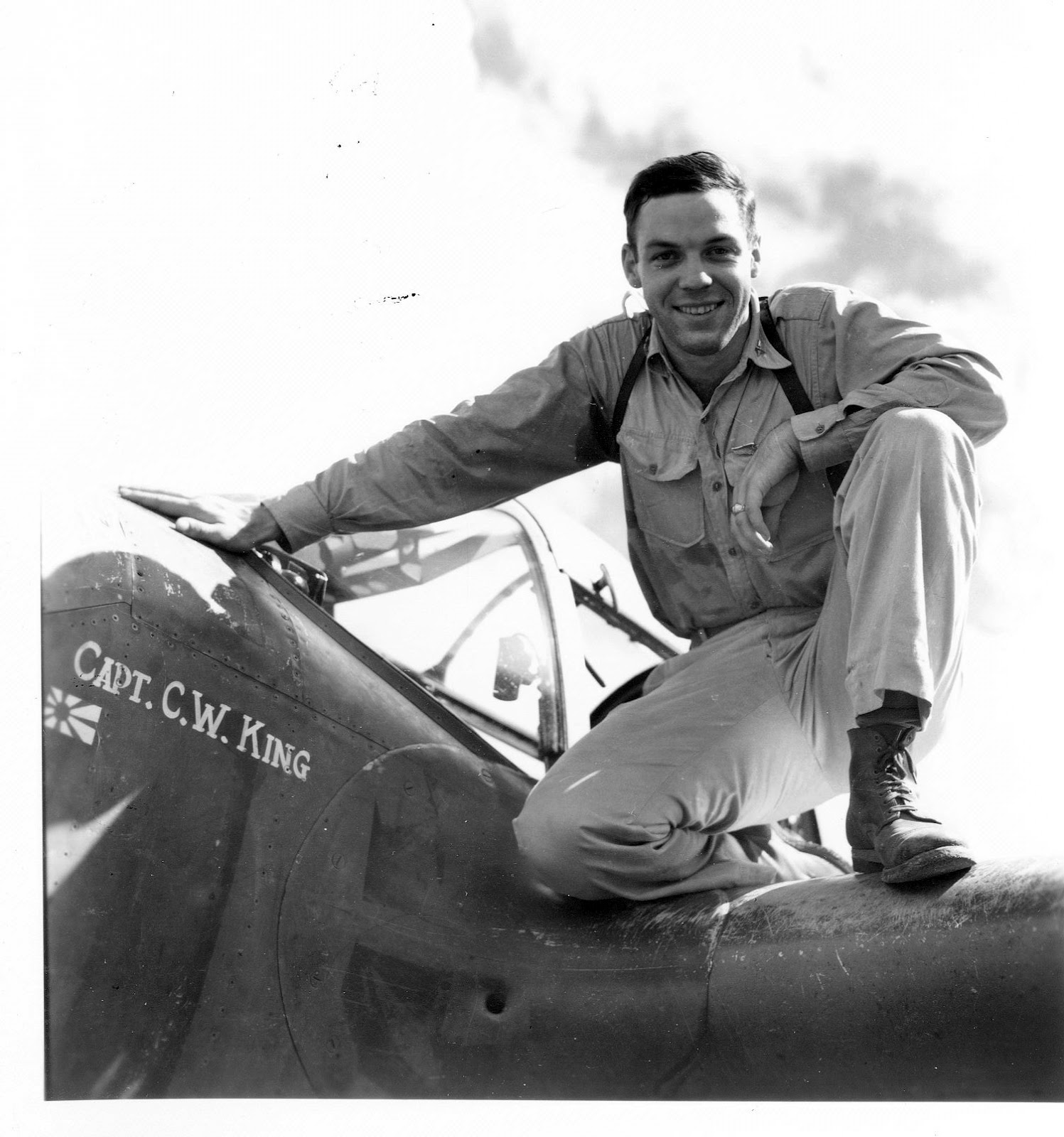
When aviation historians mention Charles King everyone immediately thinks of his P-39, but he flew P-38s as well. Here's his Number 27 parked in the mud at Port Moresby. We can't say it enough; this environment wasn't the exception, it was the rule. Those guys were hot, dirty, dead tired, and sometimes sick, and they got in the airplane day after day and flew the missions in spite of it all. They got the job done, and sometimes they died in the process. We owe every one of them. Rocker Collection

 Here's "Japanese Sandman II" at 14-Mile Strip. She's a fairly famous airplane and this is the way we're used to seeing her, relatively clean and ready to go get The Bad Guys.  Rocker Collection

Even famous airplanes step in it once in a while. Here's another shot of "Sandman", but this time she's off the taxiway and partially mired in the ever-present New Guinea mud, and with a badly-mangled port wing to boot. The Japanese were a skilled and aggressive enemy, determined in their opposition, but you could get away from them once you were out of the immediate combat area. There was no way to avoid the lousy weather, or the mud. Everybody paid the price.  Rocker Collection

You could call it courage, or guts, or anything else you wanted to, but the guys who flew in the Pacific, particularly in the rough days of 1942 and 1943, were a pretty special bunch of aviators. Here's Curran Jones from the 39th looking ready for parade beside his Lightning.  Rocker Collection

And Paul Stanch. The uniform's fairly clean but those boondockers tell the story.  Rocker Collection

Here's Walter Beane with part of his ground crew at 14-Mile. The P-38 has proven itself to be a bear to keep flying in the comtemporary warbird circuit. Keeping them in the air was business as usual in 1943. Rocker Collection

Charlie King poses for the camera at 14-Mile, looking like he just stepped out of the shower. They say the camera doesn't lie, but sometimes it fibs a little bit.  Rocker Collection

This shot's a little bit closer to the truth. We'll leave today's essay with this shot of Ken Sparks posing with his damaged P-38. Look at his face; you can see the exhaustion. Have we ever mentioned that it was a crummy war?  Rocker Collection

One for the Modelers

We're always after detail, us modelers, and we're manic about it, detailing our models in places where nobody can ever see what we've done. The photo you're about to enjoy comes to us from Mark Nankivil (we think!) and provides us with some detail you can see:

Just another day at the office. This remarkable shot provides an excellent look at the instrument panel and cockpit area of a WW2-vintage A-26. This one ought to keep you guys busy detailing for a while!  Greater St Louis Air and Space Museum via Mark Nankivil

Off On a Tangent

OK, admit it. Most of you guys started out your modeling career building cars, or at least you did that if you're as old as we are. Whatever else you build now or have ever built, there was a car model in there someplace. We did it too, and we still do it every once in a while, up to and including right now. The Great Move of 2012 has kept us from finishing anything in the way of model airplanes lately, and we're presently hip-deep in assisting our spouse with a model car display in the community we just moved from, so today's model shot is of the automotive variety. It might or might not be what you wanted to see, but it's what we've got. We'll return to what might be deemed our regularly scheduled programming next time.

No, they aren't airplanes, but they are models and this is, in theory at least, a modeling blog, so there you go. The hot rod is an old Monogram 1932 Ford roadster and is mostly built straight from the kit, with only the substitution of a set of Halibrandt wheels from a 427 Cobra to set it appart from all the other "Deuce" roadster models out there. The orange car is, by golly, the very Monogram 427 Cobra that we stole those wheels from (although it has same kind of wheels on it too, so not to worry). The Cobra is a straight-up competion car and has a scratch-built roll bar and 5-point harness, along with a few other minor modifications to the kit. The Deuce was built in the late 1980s, while the Cobra is newer, having been constructed during the '90s. Some of us just never grow up.

Happy Snaps

Today's entry is another shot from the camera of Rick "Boris" Morgan:

Phil, I was scanning shots today for the A-6 Osprey book I’m doing and had this one at hand- it shows a division of Swordsmen (VA-145) A-6Es over Puget Sound on 4 Aug 1988. The guy closest to us is 162197, an A-6E SWIP. Rick   Rick Morgan    Classic! Thanks, Morgo!

The Relief Tube
We've received a tremendous amount of correspondence over the past month and a half (closer to two months, actually, but we won't count if you won't) and there's a fair amount of it that deserves publication, which we promise we'll get to next issue. That said, here's one to provide some food for thought. We're probably as sick of those low-life photo thieves as you are, so we're going to figure they're just not worth talking about anymore once we get past this one last comment from our friend Doug Siegfried over at The Tailhook Association:

Phil, photo credits are a big bugaboo with all of us. We, at The Hook, always strive to give credit to who every took or provided the image. On the internet, being free and open to all presents a great problem. I confess I have taken pictures off your site and put them in our archives server but always with the photographers name via Replica in Scale. Don't know the answer but I would sure hate to see some of the great shots, especially of Navy/Marine disappear. Thanks again for posting all the great shots you have on your site and keep the model shots coming.
Cheers,
Doug Siegfried


OK, Bottom Feeding Purloiners of Other People's Photography, read what Doug wrote. That's how the Real World does it. And Doug, thanks as always for your encouragement and support!

We have some other comments as well, reams of them, in fact, but it's been a long day so we're going to cut things off here for now. Thanks for your patience while we've been off on our self-inflicted sabbatical, and be good to your neighbor. We'll meet again real soon.
phil