Showing posts with label sbd. Show all posts

Tuesday, April 13, 2010

Banshee Addendum, A Demon or Two, A Wrinkly Bomb, and a Bipe

A-24 Paint; A Slight Return

Or in other words, go back to yesterday's blog and take a second look at the part about painting the very first A-24s. I don't have a clue why I didn't do it when I should have done it, but I left out the BuAer letter that goes with the spec. I've appended that letter and cleaned up a couple of dates which should, with any luck, make the piece easier to read and understand. Another thing I failed to mention is that I anticipate some folks will disagree with the conclusion I've reached regarding those nonexistant blue/gray A-24s. Feel free to drop me a line at replicainscale@yahoo.com if you'd like to offer up your thoughts on the topic, or if you'd like to discuss anything else, for that matter. I enjoy hearing from you.

Photos of the Phantom's Phather

I know, I know; even I can hardly bear to read that title, but it seemed to fit the mood of the moment. I won't do it again until the next time I get the chance. Meanwhile: After years of waiting there are finally a couple of pretty decent kits of the McDonnell F3H Demon for us to work with, even though the mainstream manufacturers still haven't snapped to the notion that a good injection-molded, state of the art 1/48th scale F3H, FJ, F2H, F7U, swept-wing F9F, or F11F kit (or even 1/32nd scale; these airplanes aren't that big) would sell like the proverbial hotcakes. The short-run guys aren't really doing much for us in that regard either, come to think of it, but these are mainstream airplanes, for cryin' out loud, and they deserve more attention than they've been given thus far. Somebody please hold off on that "new tool" (I had to say it!) Me109 or A6M-Anything and give us some decent 50s Navy jets instead. Go boldly forth, etc, etc.

And on and on he rambles, never stopping and barely coming up for air, but the point should've been made by now so let's look at a couple of pictures:

An F3H-2 on the Franklin D Roosevelt during one of her early-60s Med deployments. The aircraft is being spotted on deck; note the towbar extending from the NLG. It's interesting to observe the people in these old photos; there's no doubt who the Chief is in this picture! No BDUs or Zumwalt uniforms here, by Jingo!  (Minimal use of cranials too---it was a simpler time, and a far more dangerous one if duty put you on the flight deck during ops.)  Frank Garcia

Home again. This Demon has just recovered; the cross-deck pendant (that would be the "arresting wire" if you don't speak Navy) has just disengaged and is beginning to retract. Flaps and slats haven't been retracted yet, but that's about to happen. Note the position of the horizontal stabilator.  Frank Garcia

Our official Gee What's Going On Here shot of the day. These Tophatter F3H-2s appear to be on either a pier or a lighter, but I can't figure out which although the line running from the tug to the upper left of the shot would suggest the latter. I'm guessing the airplanes are being transferred , either from the boat to shore or vice versa, but I don't know which. Flaps and slats are deployed and the horizontal stab is in the full "down" position. The photo provides a legitimate reason to model a Demon with everything hanging, although that would only be relevant in a diorama of this sort. There's never a dull day on The Boat.  Frank Garcia

Let's Get Bombed

Remember back several installments when we were discussing Vietnam-era Navy ordnance? Somewhere in one of those discourses I mention that the Nav's bombs began receiving coatings to the exterior of their casings to make them less likely to cook off in a fire aboard ship. Here's a fine example of that very thing:

This Mk 82 is hanging of an FA-18A during a mid-1980s WesPac deployment on the Constellation and illustrates that nasty coating to advantage. Paint your bombs like this and they'll probably throw you right out of the old model airplane club, but this was/is a fairly normal appearance for Navy bombs. Note how rough the surface texture is, how wide those yellow stripes are, and how the entire weapon contrasts with that light gray tail assembly. This Bad Boy is fused and ready to rock!  Rick Morgan

And Speaking of Weapons, and Maybe of Druts

OK, who knows the history of the Douglas F3D Skyknight? More specifically, what was it designed for? If you answered Fleet defense, you hit the nail on the head, although in all honesty the F3D was woefully underpowered throughout its service career and probably wouldn't have posed much of a threat to any serious intruder bent on sinking the boat. (During the Late Southeast Asia War Games it was given the nickname of "Drut". Spell "drut" backwards and you'll gain a better understanding of that whole power-to-weight thing with this particular airplane... ) Interception duties fell by the wayside pretty quickly for the F3D and the type ended up being used for limited electronic warfare (Vietnam), utility, and test duties. Let's take a look at a Skyknight that falls into the latter category.

Our last Navy photo for the day shows an F-10B (Mr. McNamara's designation for the F3D after the 1962 designation realignment), BuNo 124630, preparing to take off from China Lake during 1964.

 The aforementioned F-10B preparing to launch during AGM-45 Shrike testing at China Lake on 7 February, 1964. The airplane is an old stager and her skin tells the story; she's been around the block a time or two! The second seat is occupied by a civilian engineer---what a job!  US Navy KN-8883

A Blue and Red Airplane Because We Haven't Had a Model in a While

So how about a bipe to end our day with? The model is the Eduard Pfalz DIIIa done up to represent Rudolph Berthold's bird. It's the Eduard kit and is 100% bone stock, but that's usually not a bad thing with Eduard's Great War offerings; none of them are perfect and most have errors that require correcting, but they sure look the part when they're done!

Boy, does that paint just jump right out at you or what?  This exceptionally striking scheme was used on a number of aircraft assigned to Jagdgeschwader II during April of 1918 and makes for a really pretty model. The Eduard Pfalz is a great kit to build if you've never done a biplane before; it looks daunting in the box but the Pfalz DIII family were robustly designed and that simplicity extends itself to the model as well. Caution is required during construction but it's not as tough a date as you might imagine. What you see here took approximately two weeks of part-time work to accomplish.

Here's a 3/4 nose shot that graphically illustrates why you should always pay attention to what you're doing. On my model the entire nose is red, but there's extremely strong evidence that the bottom of it was silver on the real thing. Phooey! It looks ok anyway, though. (The phrase "don't turn it upside-down" comes to mind here.) Rigging is stretched sprue (this is me talking; could it possibly be anything else?) and could stand to have turnbuckles added, which I may go back and do some day. Unless I don't...

And a photo of the Pfalz being plucked from the modeling desk by a Giant Hand. Run away! No, wait---don't run away--- let me tell you about a couple of other things first! The rubber available to just about anybody during The Great War rarely had carbon black added to it when it was processed and was almost never black in consequence. Aircraft tires of the day ran the color gamut from light gray to a dark grayish-brown, and some had a distinctly pinkish cast to them. The "rubber" color here is a mix of my own and is of the pinkish-gray variety. The red and blue are Testor paint out of those little bitty square bottles that used to cost ten cents when some of us were kids (they most assuredly don't cost that anymore!), thinned about 75% with ModelMaster thinner and squirted on with a Badger 150, after which a thinned topcoat of new-formula Floquil Clear Flat was applied to knock off some of that super high gloss that comes from using Testor paint that comes in those little square bottles! Stickies are straight out of the kit as is the photoetch that you mostly can't see unless you look into the cockpit. The dust is one of those things that just happens sometimes. ("Dust Happens." What a slogan!)

And We're Done!

At least for a while. For now, why don't you go write a letter to all the major, mainstream manufacturers and tell them we need good 1/48th scale kits of 1950s Navy fighters, then build yourself a Pfalz? Either one, or both, of those things will keep you occupied for at least a minute or two! Oh, and be good to your neighbor too. We'll see you again real soon.

phil

Monday, March 29, 2010

Helping a Friend With Some Photos

Helpin' When I Can, Or Thoughts On a Speedy-Dee

We all have favorite airplanes, and I've made no bones about the fact that mine is the Lockheed F-104. This isn't about that, though, so don't go looking for pictures of pointy little airplanes here. There won't be any of those, not this time anyway. (Probably later, though...)

What there will be is the Douglas SBD, or A-24 if you prefer, although it won't really be an A-24 deal at all because I've got some really tasty photos of 3rd Attack Banshees at Port Moresby to share with you, and that's going to be a whole separate thing on another day. Today's just going to be the SBD, and more specifically, the SBD-2 and -3. So why is that, you might reasonably ask?

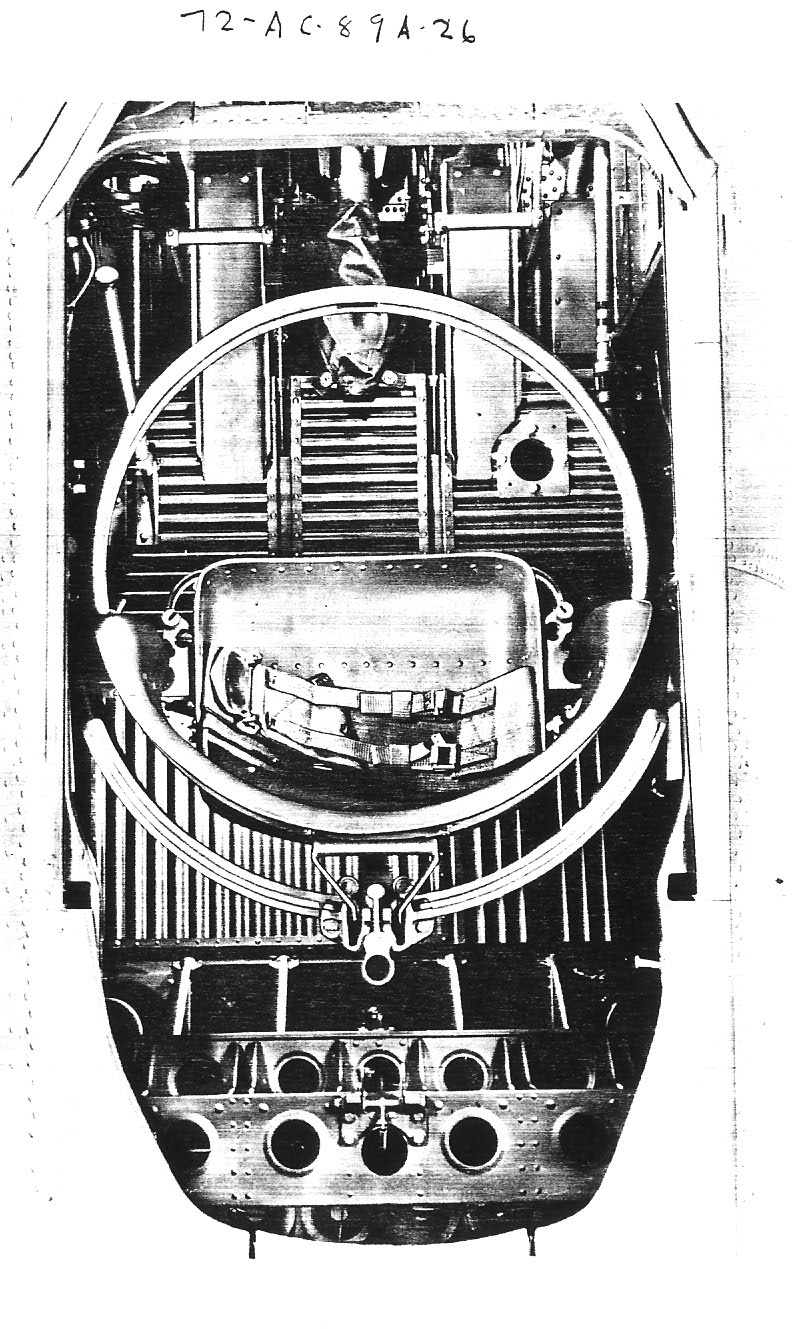
It's really simple. My friend Frank has started a Midway-based -2 using the Accurate Miniatures kit and I wanted to help out. What follows (after I finish talking, anyway) are some scans from a Douglas manual that will give a really good idea of what a wartime (as opposed to a contemporary restored warbird, which are, I can assure you, two dramatically different animals!) Dauntless radio operator's turret (and that's what both Douglas and the Navy called it; a turret, and the guy that sat back there was the radio operator) should look like. (Another highly convoluted sentence, that. It's probably a good thing I'm not in school anymore!)I've thrown in a couple of other goodies too just in case they might end up being of use. You would reasonably expect to see cockpit photos too, but they're deliberately conspicuous by their absence since every book you've ever seen on the SBD details that area pretty well and I'm pressed for time just now.

First, and pressed for time or not, here's some more talking! Frank builds primarily in 1/48th scale. So do I. That means we're going to take a half-minute or so and discuss the three kits that are contenders in that scale, even though two of the three are worthwhile with an enormous caveat attached to them. You can get a pretty good SBD model out of any one of these kits even though you're going to laugh at two of them, and maybe even exercise some of that Internet Expertise that can be so pervasive in our hobby and which may even cause you to say something Profound. Then again, maybe not.

The first kit that you can laugh at, or be snobby at, or whatever you might want to do at, is the now-ancient Monogram SBD-more-or-less-3. It truly is old (1960 or 61, I think), and it's got lots of working features such as retractable landing gear, working flaps, and a droppable bomb. It's also got poorly-detailed landing gear and no cockpit to speak of, and on top of all that it's covered in rivets. OK, so let's throw it away, right? No. Let's don't do that, but let's clarify why I'm saying what I'm saying. The basic kit is accurate dimensionally. The working features can be un-done (Modeling 101 rears its ugly head again; no Instant Gratification here, gang!) and missing details added. The landing gear can be fixed. And the rivets are ok, mostly, because the real SBD was covered with universal head rivets (those round-headed ones that stick up from the surface). The rivets are accurate and no other 1/48th (or 1/32nd) scale kit gets them right. In the rivet department it's Monogram's race, although it would be far easier and infinitely more practical to build your model off something a little more modern. It would be extremely labor intensive to construct a good model from this kit, although it can be done. The Monogram kit suffers from being the first one in the scale, and I would probably agree with you that it's best built box-stock, as a representative of days gone by. The pain ain't worth the gain anymore. You can, however, produce an outstanding model from it if you want to do that.

The next contender is from Hasegawa, which I think was issued as a -3 and a -4, and maybe (although I'm not certain about it) as a -5 or -6 too. It's a good kit dimensionally and is easy to build, but in many ways it's as tough a date as the old Monogram one. Simply put, it's not up to what anybody would consider to be The Normal Hasegawa Standards. It doesn't have raised rivet detail (not a deal-breaker), the cockpit is inaccurate in a number of areas, but the worst is in the diving flaps. Monogram didn't open up those holes (all 350+ of them) on their kit, but their kit is almost 50 years old so we can forgive the omission. Hasegawa didn't open them up either, and molded them so softly that centering a drill to correct the flaps is extremely difficult, thus forcing you to replace them with aftermarket, presuming that's still available, or fill them with black paint. It's a cryin' shame, too, because those holes are a major part of the Dauntless' personality. It might not seem so at first glance, but it would take almost as much work to correct the Hasegawa kit as it would the old Monogram one even though you do, in theory at least, have a better starting place. Me, I'd pass it right on by.

Fortunately, Accurate Miniatures also did an SBD for us, and have released it as all the Navy/Marine variants (at least I think they did, but it's no Big Deal if they didn't. If you've got a -2 then a -3 and -4 are a snap to build, while having a -5 means you can easily do a -6 too; most of the changes between SBD variants were internal, with cowling and free-gun installations being the significant external differences. (Yes, I know about the little spinner. It's no big deal.) The AM kit doesn't have rivets (wonder why not---they got everything else right!) but otherwise it's a thing of beauty. I personally stick Eduard PE in every kit I build, but you don't really need it for this one. It's the basis for an outstanding model right out of the box and is the kit of choice for most folks. It's a good 'un.

Now that we've got that out of the way, here are some illustrations and photos for you:


The radio operator's turret. The top of the photo faces forward on the actual aircraft. Note the rudder pedal troughs and radio operator's lap belt---the SBD could be flown from the back seat.   Douglas via Harry Gann


Sitting in the radio operator's position looking forward. The rudder pedals, stowed stick (at the left of the photo) and rudimentary flight instruments are all shown to advantage. Note the hoisting sling by the turnover pylon. While the SBD could certainly be flown aboard the boat, it was frequently hoisted aboard at pierside.  Douglas via Harry Gann


The upper view gives a better idea of how the stick was stowed. The throttle is at upper right. It was a simple cockpit.  The lower photo showes the canvas screen that was normally in place at the forward end of the radio operator's position; note the cutout allowing the back-seat instruments to be seen with the cover in place. Douglas via Harry Gann


The SBD-3 got twin .30 calibre free guns early in the production run, while all the -1s and -2s were outfitted with a single .30 in the radio operator's position. This illustration shows the single gun and its ammo can in the stowed position.  There's no armor visible here; that came later, after combat experience showed it to be a Really Good Idea.  Douglas via Harry Gann

And finally, some shots of operational SBD-2s and 3s. Please excuse the quality on a couple of them; the originals weren't very good...


Neutrality Gray. These SBD-3s wouldn't look like this for long; it's October of 1941 and war is barely a month away. Note that only the middle aircraft has a spinner fitted.  National Archives HG85-017C via Jim Sullivan


Remember that hoisting sling we talked about a few minutes ago? Here's what it was used for. Present-day safety officers would be seriously concerned about the goings-on in this photo, but it was business as usual for the WW2 Navy. The aircraft is an SBD-4.  National Archives

A classic shot of a classic aircraft. These Bombing Six SBD-3s are running up to launch aboard Enterprise; this photo was taken during the February/March 1942 time frame. Note the rudder stripes and oversized national insignia. The Air Group Commander's aircraft is immediately behind B4.  National Archives

End of the road at The 'Canal. This damaged Marine SBD-3 is in the process of being salvaged for parts at Henderson Field on Guadalcanal. The battle for the island extracted a heavy toll in both men and equipment.
Admiral Nimitz Museum via Bruce Smith

Is That All There Is?

Yep, for today, anyway. We were experiencing what some folks might call "technical issues" for the better part of the day and now I need to jump on the lawn tractor and go cut a whole lot of grass. Be good to your neighbor and we'll be back to normal tomorrow.
phil