Tuesday, July 25, 2023

Over and Over, U-Birds from Jim, Some Arachnids, A Different Time, and A Present From Norm


A Continual Rebirth

The year was 1961, and Monogram had just released their 1/48th scale F4F-4 (more or less) Wildcat to the modeling world and, perhaps more importantly, to 12-year-old Phillip. It was beautifully detailed---just look at all those rivets---and had working features too, what with its folding wings and rolling wheels. In later years we came to understand that a few things had been omitted here and there, such as the fuselage windows, the entire accessory section of the engine, and there was no cockpit to speak of. Fine detail, while good for its time, was on the sparse side as well (those universal head rivets were entirely accurate for the Wildcat's airframe, for instance, but were somewhat overstated) and it was, out of the box, a simplified replica of the F4F. To a skilled modeler it was an opportunity. To the aforementioned 12-year-old Phillip it was a gift from the gods.

Many years passed and that Monogram Wildcat remained the only readily available 1/48th scale kit of the type before the deities of the polystyrene world smiled once more and, in 1994, we were gifted with Tamiya's 1/48th F4F-4, a kit vastly improved over the one from Morton Grove. That Japanese kit still had a bunch of universal head rivets on its airframe but they were supposed to be there, and it was a revelation, for a while anyway. There was, of course, that little matter of a missing intercooler (a somewhat large and conspicuous item living in the engine's accessory section), and the sparse cockpit and simplified interior. There were some other things wrong with it as well but it was a quantum leap above the old Monogram kit and besides, the handful of errors could be easily corrected with aftermarket and the application of a bit of Modeling 101. The modeling gods had smiled again!

Times had changed between the release of that seminal Monogram kit and Tamiya's, however, and expectations were higher from those of us who actually built our kits rather than buying and hoarding them. It wasn't that the Tamiya kit was all that bad, mind you, but they only released it as the -4 variant, which left us all in the lurch for the other significant Wildcat variants. We could fix the minor issues with the kit, of course, and we did just that, while the somewhat skilled among our ranks could easily convert the kit to an early-War F4F-3 and the truly gifted could modify the kit into a passable FM-2 but, like we said, times had changed. The Monogram F4F-4 was now a dinosaur, suitable for entry-level modelers and small children on Christmas, and Tamiya's wunderkit had, through no fault of its own, entered into the realm of the has-been. We wanted something better in 1/48th and we were soon to get it, or so we thought.

2007 saw a relatively new company, Hobby Boss, release an entire family of Wildcats into our waiting hands. There, in one fell swoop, was an early F4F-3, a late F4F-3, an F4F-4, and, wonder of wonders, an FM-2! Life was Good and then, thanks to the realization that the company's research had been lacking, it wasn't good after all. None of the kits had those rivets that were so essential to the Wildcat's character and a great deal of detail had either been simplified or omitted entirely while the FM-2, that ultimate member of the F4F family that had never been previously kitted by a mainstream manufacturer (we call that opportunity), had a nose that was entirely inaccurate for the type. We began cross-kitting, the aftermarket guys began making aftermarket, and it became obvious that you could indeed get there from here, but only with a bit of struggle. It was time for another kit!

We got that kit too, boy did we ever get it! In fact we're now in the process of getting the entire Wildcat family, one variation at a time, from our friends at Eduard, and we finally have a decent shot at an accurate F4F-Anything or an FM-2 mostly out of the box. There are problems, of course. There always are; the short list includes ribbed tires which weren't used on carriers (at least not early in the War) and a missing main fuel tank, and those New and Wonderful Eduard decals which work really well except for when they don't. Still, the Wildcat that can be produced out of the box is little short of amazing. It's a wonder, a true revelation for the modestly experienced modeler. It's as good as it's going to get, until it isn't. 

There are a couple of lessons we can learn from this 60+ years of 1/48th scale Wildcat kits. Each and every one of them, and that includes the now prehistoric Monogram kit, were considered state of the art when they were originally released and all of them, even the Hobby Boss offerings, raised the bar a bit higher. We seemingly have reached the pinnacle as far as that airplane is concerned, but even the new Eduard kit has issues, albeit minor and largely insignificant ones. Someday somebody will release yet  another F4F or FM-2 that will push that truly amazing Czech offering to second place and we'll welcome that new kid on the block with open arms, after which the cycle will start over. It's the nature of our game, and it's a good thing. 

Amazing things have been done with that 1961-vintage Monogram kit. I've seen the results that can be achieved with it and the thing can be done, if only by a special few who possess the abilities required. Everything that's happened since that year has been gravy for the scale modeler as the kits and all that goes with them has improved, almost exponentially, with the passage of time. What was once exclusively the province of the top tier of modelers is now within reach of almost anyone. 

Here's our takeaway: The kits now available to us just keep getting better and better, and all of the older kits begin their fade into obscurity. It's the nature of things. The new whiz-bang kits age out and are replaced by something newer and astounding. The new kits are replaced in turn, and the cycle repeats itself. It's natural and normal. It's the way things are. 

And it's good. 

What Goes Up Must Come Down

And it doesn't always do it gracefully. Come down, that is. The military aircraft of the World War 2 era were particularly prone to being crashed, not because of any intrinsic flaw in the aircraft (usually!) but because so many were flying and, more importantly, being flown by pilots with varying skill levels. Even the most benign of airplanes could bite you, and the high-performance cutting-edge fighters of that era were often a handful for their frequently inexperienced pilots. The conclusion of hostilities reduced the number of airplanes in use and a larger percentage of the people flying them were possessed of a skill level vastly improved from that of many wartime aviators, but it was still a dangerous game. Here, from the collection of the late and greatly missed Jim Sullivan, are a few examples of times an airplane bit an aviator featuring Jim's favorite aircraft, the FG-1D Corsair.

This FG-1D (BuNo 87087) was assigned to the Reserve Unit at Grosse Isle and suffered a belly landing on 28 March 1948. Its untimely arrival in a muddy corn field resulted in little trauma to the airplane and none that we're aware of to the pilot. Not all crashes were so benign but this one was a walkaway with little damage. Note the V- that appears in front of the Bureau Number presentation on the tail, a fairly common prefix on late-40s Reserve birds.   Jim Sullivan Collection

Here's another FG-1D, this time BuNo 92575 of VMF-217, after a successful belly landing at NAS Squantum on 20 July 1949. As with 87087 above, the crash was a walkaway for the pilot with minimal damage to the airplane. The bird has been well-maintained and in wartime would have been quickly repaired, but we're not so sure that was done in this instance considering the fiscal constraints the American armed forces were operating under during the late 1940s.   Jim Sullivan collection

There's that pesky V- prefix on a bureau number again, this time on 92638 from the St Louis Reserve unit. It experienced a collapsed starboard landing gear while attempting to land at Vichy, Missouri, on 07 June 1948. At first glance there isn't much damage to the airframe but that bent propeller guarantees an engine overhaul and the wing is badly crumpled as well. There's a fair chance this one was given a quick trip to the scrap heap.   Jim Sullivan Collection

And the electrons hadn't even cooled when Rick Morgan sent a comment regarding the airport at Vichy:   Phil- Good stuff as always, the shot of the NAS St Louis FG-1 bent at Vichy got my attention. The small airport at that location was used by both Navy Reserve and Air Force Guard units out of Lambert as an ordnance loading facility for use at the range at Ft Leonard Wood. Seeing a Corsair there shouldn't have been that unusual during that period. Vichy had actually been home to a USAAF Recon Group during WWII that supported the newly opened Fort. It went back to full civilian ownership in 1957 as jets showed up at both reserve units. The field (VIH) is now called Rolla International Airport, based on the city located south of it.  Rick

And yet another belly landing! 76475, from VA-53B, went down near Akron on 22 August, 1949. The airplane isn't too badly damaged but an engine overhaul or replacement is required any time there's crash damage to a propeller due to the possibility of crankshaft damage to the engine, and there's a very good chance the airplane wasn't repaired. 76475 was an older FG-1D and may have been scrapped out rather than salvaged.    Jim Sullivan Collection

Sometimes it just isn't your day! 67074 (side number 65) lost a good bit of its empennage during a taxiing accident involving FG-1D 92264 (side number 54). The year was 1947 and the airplanes from the Reserve component at Oakland. In addition to the obvious damage to 67074, 92264's pitot tube is dangling from the leading edge of its port wing and there's undoubtedly more going on than we can see in this shot. Modelers: Note the overall eggshell rapidly going to flat paint finish of both airplanes. That's how things work in the real world, sometimes anyway...   Jim Sullivan Collection

I've known people who would overlook photographs of less than perfect airplanes simply because they were crashed or otherwise damaged. The logic of such a thing escapes me, but Jim wasn't one of those people and these images document some airplanes---FG-1Ds and primarily FG-1Ds from the Naval Reserve, that might otherwise have gotten away from us. We didn't call him Mr Corsair for nothing, Ya'll! 

A Scorpion or Two

Let's throw a jet or two into the mix today!

Northrop's almost legendary F-89 Scorpion family was star-crossed at best, a solution to the problem of protecting the United States from enemy aerial incursion during a time when ambition far outpaced technology. It was meant to be an all-weather interceptor and it was, for the most part, although it was never quite the airplane the Air Force wanted. Many ended up with the Air National Guard during an era when the active force seemingly sent the older types to the ANG, and that's what we're going to look at today.

49-2467 was an F-89B from Idaho's 190th FIS and this image, taken in 1956 at Boise, shows the colorful markings worn by many of the squadron's aircraft. This one hung around the 'drome for a while, possibly as an instructional airframe, but finally ended up at MASDC in 1959 and was scrapped out in 1960. A sad end!   Dave Ostrowski Collection via Mark Nankivil

Wisconsin's 126th FIS operated this D-model, 51-11410, for a brief time during 1960 before losing its air defense mission and converting to tankers. This airplane is very much a showboat with its scalloped gas bags and that checkerboard vertical tail with the scorpion emblem. They were operating out of General Mitchell Field during that time and must have added quite a bit of color to the place but it didn't last for long; it's a shame their time with the Scorpion was so short lived!   Dave Ostrowski Collection via Mark Nankivil

This late F-89, an F-89J, was originally built as an F-89D-60-NO and was assigned to Washington's 116th FIS (not to be confused with Washington DC, which is a different animal altogether) during the early 1960s. This example, 53-2530, is basking in the sun on the ramp at Geiger Field around 1960 and is a clean machine. Her unit markings are restrained but appropriate, while the airplane is well maintained and cared for, as were most ANG birds during the era.   Dave Ostrowski Collection via Mark Nankivil

As far as we know the F-89 rarely intercepted much of anything in terms of Bad Guy Airplanes, although they did manage to almost destroy portions of Southern California while chasing an errant F6F-5K Hellcat drone during what has become known as The Battle of Palmdale; here's a YouTube link to the affair should you have an interest in it:  


The Scorpion also fired the only live shot of the nuclear AIR-2 Genie air-to-air missile during Operation Plumbob at the Yucca Flats test range on 19 July 1957. Although you can't see much of the F-89J that fired the weapon, here's another YouTube link showing the test:


The 57th FIS lost its last F-89J in July of 1962, while Iowa's 124th FIS flew the last Air National Guard sortie with the type in July of 1969, ringing down a lengthy if somewhat undistinguished career for the airplane. In retrospect it wasn't much of a much, but it held the line until its ultimate replacement by the Convair deltas. Many thanks to Mark Nankivil for allowing us to share these images with you!

Things Were Different Back Then

There was a war going on in the 1940s and it was a big one. The fate of nations and possibly civilization itself was up for grabs and American industry was working overtime to provide the weaponry necessary to win it. Mark Nankivil, He of those Scorpions you were just admiring, shared this image with us and it's just too good to resist:

We don't know the unit or the location although I suspect the photograph was taken at the Curtiss factory; in fact I'm almost certain of that location, but almost doesn't count! I don't know the date either, but it's a special image all the same. The airplane is a P-40F, s/n unknown, and it's an airplane that was purchased by The Brotherhood of Railroad Trainmen named "The Iron Eagle" and donated to the AAF. The verbiage above that image says "Given to Our Beloved Country, The United States of America, by The Brotherhood of Railroad Trainmen", a definite comment on that point in American history. We can see the aircraft data stencil in the photo but can't get a serial number from it---the leading edge of the port wing cuts that off right after "P-40F-5-CU". Can any of our readers further identify this airplane? If so, that email address is   replicainscaleatyahoodotcom   .    Greater St Louis Air and Space Museum via Mark Nankivil

Many thanks to Mark for the images he shared with us today!

A Link to Investigate

Everyone who reads this project is aware of Norman Camou, the man who can find anything on YouTube. He's expanded that reputation and bit and sent this a week or so ago. It's a link to a website that many people ignore but there's gold in them thar hills, so to speak, and you really ought to spend some time browsing this one.


Thanks as always to Norm for taking the time to share this link with us. It's much appreciated!

Happy Snaps

It's been a while since we've shared a reader's air-to-air shot with you, but here's one for today:

A KA-6D from Air Wing 14's VA-196 (151796) formates with a VAQ-139 EA-6B over Oregon on 26 June 1984. I'm guessing Rick was in the ECMO 1 station when he took this and the perspective couldn't have been better---what a shot! A big Sierra Hotel to Rick for this image!   Rick Morgan

Here's some more information regarding that shot of 151796, supplied by Rick after publication of this issue: The story behind the KA-6D shot: The two Whidbey squadrons in CVW-14 had each sent a jet down to Miramar for a CAG meeting. We came back the next day using the normal J-5 jet route that ran from LA to Seattle. The rule of thumb for a Prowler was that you needed at least 10,000 lbs of fuel onboard at Reno or you were going to have to stop for gas. It was pretty much weather and wind dependent and something we watched. The Milestone KA-6D, which I think was being flown by their XO, gave us a squirt over southern Oregon and we were good for the distance. Yes, I was in ECMO-1; if I'd been in ECMO-2 (right rear) I would've been looking right down the starboard wingline. Rick

I'm always looking for air-to-air imagery, as well as any other military aviation related photography. If you have anything you'd like to share with us, please drop me an email at   replicainscaleatyahoodotcom   and please excuse that goofy way of formatting the email address. It's to keep the spammers at bay and is unfortunately necessary!

The Relief Tube

Nope, not this time. It's been a very long time since I've had anything even remotely resembling a schedule for the project which means nobody has been writing in with corrections or additions to anything---it's hard to fix or comment on something if it isn't there, right?  If you'd like to correct, complain, or just say hey, please send an email or use the comments tag---yes, I've finally decided to open that feature up but anything that comes in will be scrutinized rather than automatically published so keep it clean and keep it relevant please!

And that's what I know. In the meantime, be good to your neighbor until we meet again. It's the right thing to do!

phil


Tuesday, July 4, 2023

Magic, A Couple of Sabres, Yet Another One, An Airacobra, and One More Thing


It Makes No Sense

The goofy stuff that goes on with some of the modeling boards to be found on the internet, that is. On the face of it those boards are nothing but a Good Thing, constituting a generally easy to access source of information and provocative thought for the scale modeling community, but there's another side to it as well and I honestly just don't get it. 

My love for this hobby is, or at least should be, pretty much obvious to anyone who pays attention to what goes on here. My first trip to a hobby shop with my cousin Jerry lit the fire back in 1955, and by the time I built my first very own kit in early 1956 I was hooked. There was, and for that matter still is, magic in the hobby if you care to recognize it, and I did. Airplanes, cars, ships, tanks, insects, birds, dinosaurs, buildings, figures, and imaginary things from the world of science fiction; I built them all. I played with them too (I was a little kid then, remember!) but most of those early models survived for quite a while because I was so enamored of them. I enjoyed them and I learned from them because they often led me to books and specialty magazines so I could find out more about them. They were magic then and, at least in my own personal world, they're still magic now. 

The part of the world I live in is blessed with four good brick and mortar hobby shops within easy driving distance of our home; two in the Austin area and two in San Antonio, and I'm equally blessed by being part of a circle of friends who feel the same way about the hobby that I do. The whole thing, the entire hobby and most of the people in it, is magic!

That takes us to those internet boards and the part that makes no sense. There's lots of discussion there and plenty to learn no matter how long you've been involved with the hobby---lots of super people with an equal love for the hobby and a willingness to share it are on those boards, but there's another group too. They're the guys who know more than anybody else does and want to make sure everybody knows it. They're the guys who don't have much use for the new guys and their questions. They're the guys who get into flame wars with other modelers and, unfortunately, they're also the guys who make other folks decide the squeeze isn't worth the juice and sometimes even cause them to leave the hobby. The Hobby; remember that word? HOBBY!

Let's go back to that key word I mentioned at the very beginning of this missive: Magic. The hobby of scale plastic modeling is still magic to me, just like it's been for every day of my life since 1955. It's a joy on a personal level as well as a joy I choose to share whenever I can. It's truly a blessing in my world, as I hope it is in yours, and that makes sense to me. The things that don't further that joy don't make sense to me at all and I try not to do them. 

You don't mess with magic!

Such a Pretty Airplane

Since we're already discussing things that are Magic, let's take a look at one of the prettiest American jet fighters ever built; the North American Aviation F-86E Sabre. These images were taken in Korea during 1952 and came to John Kerr's collection via Jim Mesko. John (aka Maddog) was kind enough to share them with me before he passed but we have to present them to you with somewhat of a caveat. They're duplicates of what I presume were originally duplicates in the first place so the detail is a bit soft, and they were apparently dirty when the initial duplication was made---there's way too much clutter to successfully clean up, unfortunately, so let's enjoy them for what they are!

50-0602 was an F-86E-1-NA assigned to the 16th FIS/51st FIG when this shot was taken at Suwon AB in Korea during early 1952. Note her slatted wings, typical of her breed, and the generally worn appearance of her fiberglass intake and that panel on her vertical stab. She had been accepted by the Air Force in 1951 but several months in Korea had marked her. To add insult to injury she was damaged by a MiG-15 in air to air combat on 02 April 1952, but she survived to lead a full career afterwards.  Mesko Collection via John Kerr

51-2733 was an F-86E-10-NA, another mount from the 16th FIS/51st FIW. Photographed at Suwon during early 1952, she was crashed short of the Suwon runway and destroyed on 05 April, 1952. She's noteworthy for her aluminum intake ring and generally pristine appearance in this shot, which may well have been her final pre-accident portrait. Nobody ever said it was safe!   Mesko Collection via John Kerr

Finally, here's 51-2737, yet another F-86E-10-NA, beginning to taxi out on her way to some mischief, a talent she was apparently good at; she scored a total of three kills against MiG-15s during the course of her deployment to South Korea. She survived that conflict only to be burned out in a ground fire at McClellan AFB on 23 October 1954. She was in her prime here, however!   Mesko Collection via John Kerr

Thanks to Maddog for sharing these photos before he left us. Now, if only we had a kit...

They Also Served

We normally tend to think of the Korean War when we discuss the F-86, but the type was ubiquitous within the United States armed forces and served for many years. Here's an image taken by Rick Morgan to prove the point!

55-3906 and 3948 were both built as F-86F-40-NA airframes and both served with Japan during much of their careers. Returned to the United States during 1989, they were converted to QF-86 status and served with the Navy's Point Mugu Test Center in November (3906) and December (3948) of that year. Rick photographed them on the ground at Roosevelt Roads on 01 November, 1989, shortly before they were stricken.   Rick Morgan

Many thanks to Rick for sharing this with us. It's a great look into an aspect of the F-86's service career that few enthusiasts ever consider.

A Peculiar Iron Dog

My normal interest, at least as far as the aviation combatants of the Second World War is concerned, tends to focus on those aircraft and units used in the SouthWest Pacific. This P-39 apparently saw no service there but the image is unique all the same. Let's take a look.

This Bell P-39F-1-BE, s/n 41-7325, is apparently serving in a training unit somewhere in the ZI, location and date unknown. The back sides of her propeller blades are black and the tips on the front sides of that prop are Insignia Yellow, and she's wearing a black anti-glare panel on her nose, but she's otherwise unadorned by any paintwork other than her radio call and nose numbers. We can't speak for her wings but there isn't even a national insignia on her fuselage! To further deepen the mystery, she doesn't have the lower wheel well covers on her landing gear either---that was a fairly common modification in the muddy SWPAC but this image obviously wasn't taken there! The more normally presented P-39 parked behind her only serves to create more questions than answers. She was reclaimed in Seattle in 1944, and we're guessing she never left the States, although we could be wrong about that. To add yet another puzzle to the mix, the photograph is originally credited to someone with the last name of Spoonts, and Leslie Spoonts was a P-39 pilot with the 57th FS flying out of Adak during the Aleutians Campaign. It's Mystery Meat for sure!   Spoonts via John Kerr Collection

As has been mentioned here many times previously, it's no secret that we have a well-schooled and exceptionally bright readership! If you know more about this enigma of an airplane we'd like to hear from you. As usual we're garbling that address so The Bad People out there in Internet Land don't glom onto it, but you can get in touch with us at    replicainscaleatyahoodotcom   using the appropriate symbols as appropriate. (Where, they asked, does he come up with this stuff!).

One More Thing Before We Sign Off for Today

It's not at all unusual for the people I know fairly well to ask what's going on with the blog, and why it's invariably on a schedule that could only be described as nonexistent. That question has generally been answered in person, face to face, but a couple of days ago I received an email from a regular reader who was asking what had happened and if the project was still alive. Talk about a wake-up call! Here's the answer to what is an extremely valid question.

First and foremost, neither myself nor Replica in Scale are going anywhere. I've been involved with this project since Jim Wogstad and I first began thinking about doing a magazine back in 1971 and I'm not about to throw all those years away. It's a part of my life and neither myself nor the project are going away!

The reasons for all the delays are of little concern to the readership but you're all part of the RIS family and you deserve to know something. Unfortunately, the best I can do for the moment is attribute it to Life and move on from there. There's nothing overly dramatic or tragic going on; it's just been tough to find the time. With any luck and my new-found motivation I'll start doing a little better with publication schedules!

In the meantime, let's all give Stan Kurcz a big thank you for providing the kick in the backside that's gotten me off my hind end and back to trying to provide you with a continuation of the publication we all enjoy so much! Thanks also for the ongoing patience of our little family. I can make no promises but I'll do my best to publish these things a little more frequently from now on!

SO; until the next time, smile every chance you get and be good to your neighbor! We'll meet again soon.

phil

Sunday, May 14, 2023


                                             Friddell Collection via Replica in Scale

A Sad Day...

Let's jump straight to it. 

Jim Sullivan, a friend of mine for the past fifty years, passed away yesterday after suffering a massive heart attack a few days ago. Jim was among the very first of the heavy hitters in the aviation photography community to contact Jim Wogstad and myself back in 1973, when we were struggling to birth the original print version of what was to become known as Replica in Scale. Since that time he never failed to assist with photography, information, and insight. He shared his perspective, knowledge, and humor on many things over the years and was among the most unselfish people I've been privileged to know. 

Jim's skill as an author and photographer is well known to anyone who reads these pages. He was a noted authority regarding Chance Vought's immortal F4U Corsair and published a number of books and magazine articles on the type, as well as on other Navy airplanes. He helped a great many other writers with their own projects as well and it's a rare title about American naval aviation that doesn't have a photo or two in it from Jim's collection. 

He was one of those unique individuals who always gave and rarely asked anything for himself. He was a man of honor and integrity. He was generous, and he was kind. He was a gentleman and a devoted family man. He was a member of a rare and special breed, and he will be missed.

Blue skies, Amigo!


phil

Tuesday, January 3, 2023

Why Don't He Write?


A Clarification and a Special Request 

First and foremost, don't get overly excited about this particular installment because just this once it's not about airplanes, either real or plastic. Instead, it's a philosophical and procedural sort of thing, but I'm guessing it needs to be clarified.

Way back in the way back, a number of years ago in the early days of this project, I mentioned that I didn't encourage or print the normal sorts of comments found on most internet blogs, nor did I offer a forum. There was a simple reason for doing things that way---I'd looked at other sites, read the arguments and flame wars that so often lived on them, and had decided from the very beginning that a comments/forum function wouldn't be a part of Replica in Scale. I switched off that function and went on my merry way, but an hour or so ago, more out of curiosity than anything else, I clicked that button to see if any comments had been sent and they had! There were at least a couple of hundred of them and I've spent the past hour going through them all, which made me understand that I needed to clear up a couple of things.

First and foremost, I value all of my readers and I'd sincerely like to hear from anyone who wants to get in touch with the project regarding American military aviation, plastic model airplanes, or anything else I've previously published but, like I've said several times before (up to and including right now!), I don't do that with the "comments" thing that most folks put in their blogs. There's an address I do audit daily and use to feed this site's Relief Tube section which is:

replicainscaleatyahoodotcom

There's a trick to that address, of course. It's an email address, and it goes to a real live person (me!), but you have to make a tiny leap of faith and insert your own at sign (@) and dot (.) in the appropriate places. I list it like that in an attempt to mislead the spammers and mostly it seems to work so humor me and do it that way, ok? In that same vein I'd also like to ask that any of you who tried to contact me before about things relevant to this blog but who never received a response (which is what happens if you don't use the email I just provided!) give it another shot and try again. I'd really like to hear from you!

And finally---I've gone back through those comments and activated a number of them to appear on the site but most are old and possibly forgotten by their posters by now. Thanks for your patience and hopefully for your realization that I'm most assuredly not a child of the electronic age!

Thanks, ya'll, and as always, be good to your neighbor. We'll meet again soon!


phil

A Case in Point, YOUR Photos, and A Couple of Jim's Hogs


Old Ain't So Bad

Sometimes, anyway. I mention this because I'm old, or at least older (well into my 7th decade) than I'd like to be, but I also mention it because of the perspective it offers on so many things. That's Perspective, folks, not to be confused with that other aging-associated title; Wisdom. It's a viewpoint, a way of looking at things, that we're interested in today. 

Let's take a look at our hobby for just a quick minute and evaluate where we are in this Year of Our Lord 2023. We've got a bunch of new kits, and different variants of airplanes that we thought we'd never see. We've got decals, paint masks, paint, and aftermarket parts and components of every flavor imaginable. We've got a veritable explosion of large-scale models of seemingly endless variety. We've got kits that are so good right out of the box that the only conceivable reason to purchase aftermarket for them would be for bragging rights. As modelers we are, right now this moment, living in a continuation of a New Golden Age that the electronic nay-sayers have predicted would come to a close several years ago. We well and truly have never had it so good. 

Then again, we've never had it so good for a very long time when you think about it. When I began modeling on a "serious" level the heavy hitters were Revell GB, Frog, and Airfix. Kits were simple and poor in the detail department and kit decals were thick and often out of register, not to mention inaccurate. Aftermarket didn't exist on any level---the train guys had that sort of thing but we didn't. Paint was something you mixed yourself from the offerings of Pactra, Testors, and, if you were lucky, Floquil.

I think the changes really began back in 1963 with Revell's 1/72nd scale family of fighters, or maybe in 1966/67 when Monogram began to produce their first models aimed straight at the enthusiast rather than at kids. Who came first honestly doesn't matter, however, because those guys, plus the admission to The Club of several hitherto unknown Japanese manufacturers, changed our game forever. MicroScale jumped into the fray in 1968 and had an immediate, and lasting, impact on the decal market, and the 70s saw the trembling birth of a thing called "aftermarket". Every year was better for us as airplane modelers than the previous one. Every good model or accessory was topped by a better one. It was, and seeming still is, a never-ending phenomenon.

Here we are, then. It's 2023 and our collective cups are running over like never before. Name it and we probably have it or are about to get it and a lot of it is really good, although some of it isn't. That takes us to our closets and the accumulation of kits, decals, aftermarket, paint, and references associated with our hobby and then directly to the burning question: What am I going to do with all this old stuff? Here's a perspective for you.

A lot of that aforementioned stuff is obsolescent or outright obsolete by now, and some of the really old stuff is, perhaps unfortunately, now collectable. Those things might get hoarded, or sold off, or consumed for fun in a nostalgia build, but that leaves us with those sad offerings that are really good but no longer quite good enough, at least in the eye of The Internet Authorities On Everything Polystyrene. In that regard, I'm not sure what you do with your own not-quite-good-enoughs but I build mine. I'll often upgrade them with a small amount of aftermarket, usually in the cockpit or around the landing gear, but I'll build them and put them on the shelf! 

Think about this for a minute: Some of the new kits are truly amazing but, when it's all said and done, only make the collections of polystyrene components that preceded them unusable to a select few. Eduard now owns the F4F, and the A6M, and the Spitfire, and on and on, (and deservedly so) but many of the kits that came before them are entirely adequate for 99% of the modelers out there. 

Of course, there's also the REALLY old stuff that should have gone to the garbage heap decades ago, but there are some really good polystyrene offerings out there that nobody has yet managed to equal, much less surpass. Think Monogram's three 1/72nd scale 1930s American fighters (P-6E, F4B-4, and F11C-2) if you need an example of just how good Old can be. Or maybe you'd rather talk about jets? OK, let's talk that same manufacturer's Century Series in 1/48th. Of those six distinct airframes (F-100, F-101, F-102, F-104, F-105, and F-106) only one, the Starfighter, has been produced to modern standards. I'll give you the Deuce if you want to quibble about it but that's only because nobody other than Monogram have kitted it in that scale yet. The attempts to date to supersede the others by contemporary manufacturers have all been poor at best and, right up to this date, we still don't have a modern kit that's an actual improvement for any of them, raised panel lines and all. 

Here's the thing of it. The new stuff, the wunderkits if you will, are truly amazing and a very great many of them are worthy of every accolade they receive, but that doesn't mean it's time to deep-six the older models. Some are well worth building in spite of the occasional horse poot written about them on the internet. It's a choice as regards to what does or doesn't actually get built and that choice is yours, without question, but you shouldn't sell the old stuff short. 

So THERE!

The Road Goes on Forever and the Party Never Ends, Robert Earl Keen

A Semi-Oldie to Prove the Point

Here's a model to prove, or maybe not, the point just made by my mindless ramble directly above:

May we offer for your consideration a Roden offering from several years ago, their Junkers D.II in 1/48th scale. As far as we know it's the only one of its kind in the scale and successfully completing it can be a bit of a challenge, but it certainly looks the part when it's done. It's a fine example of how a "difficult" model isn't really that at all. Not unlike the Monogram kits we mentioned in that editorial it isn't a model of the shake and bake variety, but it isn't difficult to build either. 

The model, presented for your perusal in clean form with very little weathering provides us with a fine representation of Hugo Junkers' pugnacious little interceptor. Some of the parts are a bit on the clunky side, truth be known, and it isn't the easiest date in town either, but it IS eminently buildable and provides the modeler with a fine replica of a type that was at least a decade ahead of its time when it was built. In many respects the kit defines the difference between a parts assembler and a modeler!

This example was built slowly, in-between other projects, but we can honestly say that the worst thing about it was dealing with the somewhat stiff decals while applying them over those corrugated surfaces. The turnover bar was rebuilt using plastic rod, but the kit is otherwise stock, including the guns. Just a tiny bit more effort on my part would have produced a knockout of a model that's rarely built due to its perceived difficulty. Sometimes all we have to do is simply DO the thing. It's amazing what a little patience can achieve, right?

These Images Are Yours for Free

A lot of folks are aware of that somewhat enigmatic entity known as "The National Archives" but few know that they've been putting certain of their assets, including photographs, on their on-line site for a number of years. All you have to do to gain access is to enter catalog.archives.gov into your browser and you're there. That's the good news.

Where there's good there's bad, of course, and the site has a bit of that as well. Their search function isn't as linear as we might like, nor particularly easy to use, and relatively few of their hundreds of thousands of images have been scanned and posted, but what's there is free, absolutely free, to the public. Sometimes finding things there is as much a matter of luck as anything else, but the results of persistent searching can be simply amazing. Don't believe us? Then check these out!

Let's begin with "This'll Kill Ya", an F-84E-25-RE (51-0559) of the 49th FBW operating out of Korea. It was lost by flying through its own bomb blast on 21 May 1952. What a perfect subject for the Revell F-84E/G kits, right?    NARA Image 342-FH-4A40097-K90449

And then there's "Lois K"/"Frenchie", an F-84E-30-RE (51-0613) of the 8th FBS/49th FBW armed up and ready to go hunting, also during 1952.   NARA Image 342-FH-4A40093-K90445

Notice that neither of these images have our usual Replica in Scale watermark overlayed on them. That's because they aren't from our collection, nor from the collection of any of our many friends and contributors. They're from "The Archives" and they're yours---all you need is a bit of patience to find them and all the others that are basically hiding in plain sight!


There's a Reason They Call Him Mister Corsair

It's a new year but Jim Sullivan is far from being a new friend. He first contacted us back in the early 1970s offering full access to his photo collection for our use in the original print edition of this project. Since then he's been a constant with RIS, both in print and electronically. Some of us gained a nickname for themselves early in the game and Jim certainly earned his: Mister Corsair. He's written about the airplane, modeled it, and collected photographs of it for several decades now, and he's invariably been unselfish in the sharing of the images he's accumulated. Here are just a couple of examples of that:

Here's what we mean. VMF-212's F4U-4s crowd the flight deck of the USS Sicily during a pre-strike runup off the coast of North Korea during 1952. Of interest to the modeler are the asymmetrical fuselage ordnance loadings consisting of a gas bag on one station and a 500lb GP bomb on the other, seen on several of the airplanes in this image. The wing stations on most of the other Corsairs in this shot are filled with 5-inch HVARs, making for a potent strike package indeed.   Jim Sullivan Collection

Not every sortie came to a successful conclusion, although we could say that any landing you can walk away from is a good one! This F4U-4B (BuNo 63059) from VMF-312 was put down on the beach, we presume at Cho-Do Island although we're uncertain of that, during 1952 after receiving damage while striking ground targets in North Korea. Military aviation has always been a risky proposition at best and combat only makes things a whole lot worse. This young Marine aviator walked away from his crash but far too many did not. Let's raise a glass...   Jim Sullivan Collection

Many thanks to Jim for his unfailing generosity and, more importantly, to a friendship that's spanned the decades. Thank you, Jim!

There's no Happy Snap to share today because I haven't dug one out of the files yet, and there isn't a Relief Tube either because it's been so darned long since I've published anything that nobody has written in to tell me the error of my ways! Those things will come back soon but for now; well, for now it's time to get back to publishing and try to reestablish some sort, any sort, of schedule. Any rumors of the demise of this project are both highly premature and completely unfounded, but Life has taken a huge toll of my time these past few months. With that as a benchmark, 2023 almost has to be better!

You can still get in touch with us at the same old tangled-up to foul the spammers address, which is replicainscaleatyahoodotcom. Comments and constructive criticisms are always welcomed, as are photographs of and information regarding American military aviation. 

One more thing before we go: We're living in some seriously crazy times these days and it's more important than ever that we're good to our neighbors, so please try to do that. With any luck we'll meet again soon!

phil

Friday, August 5, 2022

No Way to Lose, Arachnids From the Frozen North, Something You Don't Normally See Around Here, Some Old Tinker-Toys, and School Days


It's Nearly Always a Win

I am, of course, referring to our hobby and, more specifically, to the building of a kit, any kit, to a reasonably high standard of finish. In many respects I'm the wrong guy to be talking about that sort of thing since I'm a middle-of-the-road sort of modeler at best, but we can learn lessons even in mediocrity and the recent eating of my lunch by a relatively new and high-end kit provided the reflection required to cause pontification regarding the subject---that means let's talk about it for a minute or two.

That most recent obstruction in the perfidious path to polystyrene perfection (yes; I actually did say that and no; I don't know what prompted me to do it either) wasn't the only challenge I've ever faced while modeling. Nope; there have been many such excursions into failure, perhaps too many to count if truth be told, but there's been an up side to each and every one of those near disasters. 

Take, for example, that 1/72nd scale Lindberg He.162 I attempted to build back in 1976. It was a simple kit with few components, most of which fit properly, so there was no undue challenge to building the thing. Inspiration was at hand and the kit was cooperating, which meant it was ready to paint in a mere day or two. The airbrush was actually in hand when The Discovery was made; that kit utilizes a one-piece wing that slides through slots in the fuselage halves and I'd put it in backwards, a fact noticed only when the largish leading-edge slats in that newly swept wing were discovered. There honestly wasn't much saving that one so it landed in the trash can, leaving in its wake a perpetual note to self regarding the wisdom of checking things prior to the application of glue. That was actually the Up Side to the adventure even though the model was trashed. Now we sing it all together: PAY ATTENTION TO WHAT YOU'RE DOING! Yes indeedy, a life lesson if ever there was one.

Proceed forward a few years, to the early 2000s and my discovery of Classic Airframes. Any one of them was a stretch for my abilities at the time but the kit subjects made the gamble worthwhile. They even offered the Curtiss P-6E, a favorite of mine since childhood, and in two different boxings to boot! It was reputed to be a difficult kit but biplanes had never previously been any sort of challenge to my ever-limited skills so the game was on. Said game lasted right up to the part where the upper wing needed to be installed, which was when Folly entered the picture. That darned wing just wouldn't mount properly no matter how it was attached. In desperation I finally consulted Mr Internet (this was the early 2000s, remember) and read where everybody was trimming the struts because they didn't fit properly. That seemed to make sense so I trimmed mine too, thus ensuring there was no way the upper wing could ever be properly attached to the rest of the airplane, but that one didn't get thrown away. It went back into its box and sat for fifteen years or so until I acquired another kit at a good price thanks to the kindness of an old friend; Richard Ng. I could describe the revelation that resulted in the successful completion of that model but I'd rather not, referring anyone interested to scroll instead to the bottom of this page and type "P-6E" into the search function to find the article published in these very pages. The adventure will pop up complete with photographs. The lesson there was another ode to simplicity: LEARN FROM YOUR MISTAKES AND DON'T REPEAT THEM.

Finally, there was that Grand Phoenix FJ-4B Fury. The kit comes with a reputation for being challenging at best, and that can certainly be true if you allow it to be. The major offenders are the resin main landing gear bays, which are too thick to fit inside the wings, and the components we'll agree to refer to as Anything Inside the Front of the Airplane, all of which compete for the same limited amount of space in there. Those things are a challenge, to be sure, but the kit is more accurate than either the primordial Matchbox or the more recent HobbyBoss offerings, which means learning a bit of patience and fortitude. That particular kit was removed and put back into its box more often that most people change their socks and underwear but at the end of the day a pretty good model resulted---I have both the HobbyBoss and Grand Phoenix models on the shelf, sitting side by side, and the Grand Phoenix kit is far and away the better of the two, although the path to get there was a bit more difficult. That adventure eventually resulted in quite a bit of preplanning and measuring, which resulted in the fitting of the apparently unfittable. The experience led to perhaps my most important lesson of all: FIGURE OUT HOW TO DO IT BEFORE YOU TRY TO DO IT.

And finally we come to the point, which is this: You're going to mess up sometimes, and there will be times when your failure could be described as Epic. You're also going to mess up more than once, and that's okay too, or at least it is as long as you learn from the adventure. The kit, whatever it is, provides us with an opportunity and nothing more. What we do with it results directly from our abilities, both to figure things out and to perform the physical task of modeling, and to learn from our mistakes. Let's call that Growth. 

Whew...

Better Than Nothing

That sobriquet could handily describe Northrop's F-89 Scorpion family of jet interceptors. They certainly looked the part of a dedicated defender of the skies, particularly after the introduction of the D-model with those massive fuel tanks/rocket pods hanging off the wingtips, and they lasted for several decades in both the regular Air Force and in the Air National Guard, but they honestly weren't very much as such things go. A classic product of the 1940s, the F-89 family were cutting edge technology when designed and close to obsolete the day they first entered service. They had marginal radars (but so did everything else at the time), and they were slow. Like so many military airplanes of the '50s they were blessed by never having to serve in combat---a very good thing---but they did hold the line while the United States was ramping up the Century Series of jet fighters which, coincidentally, managed to include a pair of interceptors that truly were up to the task. 

Maddog John Kerr was a slide collector par excellence and a friend as well. He shared a great many images with me, a couple of which we're going to look at today.

Before we begin, let's define a time and a place. The photos we're going to look at today are all of F-89D-75-NOs from the 76th FIS during their time at Presque Isle, Maine; specifically during the 1955 time period. In this first shot we see a largish formation of Scorpions over the Maine countryside, with 54-0221 closest to the camera. This image, and two of the three that follow, were scanned from duplicate slides and the quality isn't the best, but we think the subject matter will make up for it. 221 ended up with the Minnesota ANG's 109th FIS.  John Kerr Collection

Here's a closer image of 0221 providing a slightly better view of her markings. The last two of her Air Force serial number were repeated on the outboard nose of her wing tanks, although that isn't shown in this view. The F-89 always appeared somewhat ungainly to me, but this view makes it look almost pretty. Almost...   John Kerr Collection

In this photo we get a view of the other side of 0221, which gives us a look at the sharkmouth the squadron carried during this time period. While far from garish, its proportions and colors suit the Scorpion's shape to a T and provide a wonderful markings variation to the airplane. 54-0234 is also carrying her "last three" on the nose of her wing tank/rocket pod assembly, as are the other aircraft in the squadron. Jet fighters sure were prettier back then!   John Kerr Collection

Finally, and perhaps appropriately, we have this marvelous photograph of a young 76th FIS driver standing for a hero shot in front of "his" Scorpion. Most, if not all, of the 76th's D-models carried the sharkmouth at this time period and while we have no way to determine which airplane this was, the image does give us a good feel for the proportions and colors of the marking. Those were the days!   John Kerr Collection

Jim Wogstad and I interviewed John Keeler, a former pilot with the wartime 56th FG, for our very first print issue of the Replica in Scale project back in the early 1970s. During the course of that interview John recalled a story for us about a flight to Greenland in company with a group of F-89s. His comment about having to weave constantly in order for the Scorpions to keep up with them pretty much said it all, but the airplane was available when there was almost nothing else to do its job. Sometimes you just have to make do!

Guess What I Found!

Long ago and far away...

Back in 1974 Replica in Scale was a print publication, because there was no such thing as a personal computer or the internet. The project was chugging along, and our original staff had dwindled down to just Jim Wogstad and myself, plus spouses, and Horizon Hobbies, a large distributor at the time, was sending us review samples on a regular basis, not all of which were airplanes.

A few months ago found me performing one of my extremely rare cleanups in the studio and I discovered one of those non-airplane models, entirely intact and looking mostly ok once all those years of dust had been removed. It's not an airplane, and we're not getting ready to go over to the dark side here, but I thought it might be worth sharing, as a curiosity if nothing else. Feel free to skip right past it if it doesn't interest you!

Here, in all its glory, is a 1974-vintage Tamiya Fiat-Ansaldo M13/40 medium tank as built by your rarely humble editor almost immediately after receiving the review copy from Horizon. We thought the kit was accurate at the time, which may or may not have been entirely true since few detailed references for it existed back then, and it looked fairly ok after a hefty wash of Grumbacher Burnt Umber over the ubiquitous Floquil "Mud" I'd painted it with. A couple of the fenders were dented by the high-tech expedient of twisting on them with a pair of X-Acto needle nose pliers, while the somewhat dashing commander up in the turret was painted with artist's acrylics over white primer, detailed out with the kit's binoculars and goggle straps cut from typing paper. It's not much by today's standards but we liked it a lot back then. It's a tale from the RIS crypt, as it were!

Some Spiffy Scooters

There are air shows and then there are air shows. Frequent contributor and, coincidentally, editor of The Hook magazine Mark Aldrich, recently came across some images from a special airshow held in Great Britain long ago. Let's have a look:

CV-38 Shangri La was making a port call at Southhampton back on the 10th of September, 1960, and staged an open house aboard ship. This photograph, and the two to follow, were taken on that stereotypical dreary day. In this image we see A4D-2 142690 from VA-12 chained to the deck and ready to receive visitors. She managed an extensive career in the Navy but never saw combat in SEA, a rarity for the type considering the events that were about the define the Skyhawk's career and were rapidly reaching a boiling point several thousand miles away.   Mark Aldrich Collection

142693 was another A4D-2 from Attack 12 assigned to the "Shang" on that overcast day. She's wasn't  as colorful as 690 and was possibly more typical in appearance than her Easter Egg older sister. She survived her Navy career to be stored and MASDC and later put back into the air operating with the NASA's Ames Research Laboratory. Note the fellow scuttling past her aft fuselage; we don't know about you but visions of Charles Dicken's Artful Dodger immediately came to mind when we first saw this image!
   Mark Aldrich Collection

VA-106 was the other light attack squadron embarked on Shangri La during that 1960 cruise and one of her superbly-decorated "Scooters", 144962, is beautifully illustrated in this image. Items of interest, markings-wise, include the lack of a space or dash between the VA and 106 on her fuselage and the inclusion of her aircraft type (A4D-2) on her gasbags in addition to the squadron identification found there. She met an unfortunate end in a midair collision with an A-4B during 1967, long after she left VA-106, that resulted in the death of four people on the ground. Nobody ever said Naval aviation was safe...   Mark Aldrich Collection

Thanks as always to Mark for his generous sharing of his collection!

School Days

Mark Nankivil, he of the Greater St Louis Air and Space Museum, has been with the electronic Replica in Scale project almost from the beginning and, like Jim Sullivan, Mark Aldrich, and so many others, has unselfishly shared his collection with us. In keeping with that generosity, we'd like to offer this glimpse of days long past:

It's almost time for the young folks to go back to school here in Texas, but in 1942 a whole bunch of kids were attending a different sort of classroom, a response to America's largely unexpected entry into the Second World War. This AT-6A, 41-329, was photographed undergoing maintenance out of doors at Foster Field, in Texas, early in that year. The airplane appears to have been hastily camouflaged in Olive Drab over Neutral Grey, a distinct anomaly if true. She led what must have been a typical life as a training platform, being ground-looped at least four times during her career at Foster but surviving until at least 1943.

That outdoor maintenance could be considered prophetic since many of the students learning to fly at Foster would later end up in the SWPAC where that sort of thing was the norm. Easy days? Never happen, GI!   Mark Nankivil Collection

That's it for today, ya'll; and only a mere 2 months later than we'd originally intended. Big sigh...

Anyway, be good to your neighbor and we'll meet again soon! I hope!

phil


Thursday, May 26, 2022

An Oldie but Goodie, Supersize Me, and A Zipper to End the Day


A Different Approach

Here we are, and we're late again! The handful of readers who have been with us since that very first electronic issue back in 2010 have watched a steady trend with the project, which has declined from a heady 79 issues in that first year to just a handful, erratically published. The reasons for that are many but at the end of the day don't matter very much; the point is that a title much-beloved by your editor has been gradually fading into oblivion. 

That's a bad thing in our view, a very bad thing indeed, and it's time to do something about it! Here is the first issue of the new but not necessarily improved RIS. You'll notice it's a lot briefer than it used to be, featuring just a couple of articles. With any luck you'll also note an increased publishing schedule.

To paraphrase that American writer Samuel Clemmons, the stories of our demise are considerably exaggerated, but we've definitely taken things to the brink. Let's see if we can resuscitate the project!

 A Viable Old-Timer

Tamiya has been a leader in the world of plastic scale modeling for many decades now, and their most recent efforts are mind-boggling in regards to engineering and scale accuracy, but their older kits weren't too bad either. For an example, let's turn to their 1990s P-51D Mustang as released in 1/48th scale.

Tamiya's Mustang kit is old enough to be called seminal. It's been a stand-by for scale modelers for nearly three decades, and for good reason. It's more than reasonably accurate for one thing, and it's easy to build for another. We won't go so far as to say anyone can get a superior result using the kit, but most modelers will find it in their skillsets to do that.

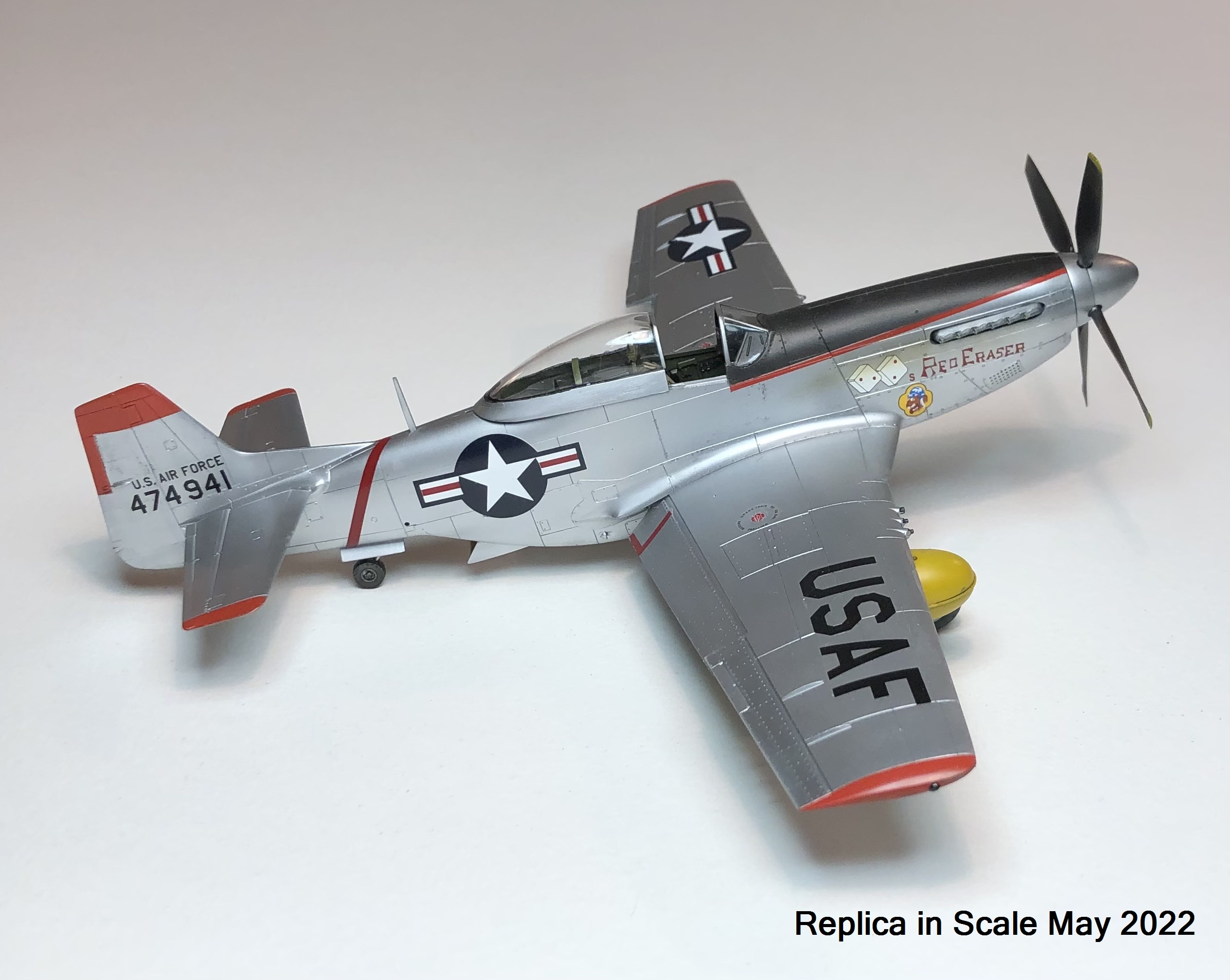
The model has been released multiple times, with each release being theme-based and reflecting markings specific to that theme. Our personal favorite is their Korean War boxing as shown here. The model features three different sets of markings, one of which we've used for this model---those of the 36th FBS/18th FBW. What you see before you is almost but not quite kit stock, which we'll explain in a moment. 

Tamiya's by now primordial F-51D still looks the part, even without weathering---yes, boys and girls, it's the usual RIS work-in-progress which, even with the very best of intentions, may never progress much further than what you see here, but the images make the point.

Now for the serious stuff. Every plastic kit has issues and this one is no exception to that rule, but the issues are minor indeed and have been enumerated at least twice previously on these very pages. We're guessing a great many of you can't remember them, so here's a quick and dirty review.

There's a notch in the flaps, on the upper inboard corners, that doesn't exist on the real airplane. Tamiya put it there to provide an easy option to model the airplane with its flaps down; lazy, that. The fix is an easy one using sheet styrene or putty and will take a few minutes to accomplish.

Tamiya measured a restored warbird when tooling the model and included a set of scab patches on the wings that are unique to that particular airplane. "Real" Mustangs don't have those patches nor their accompanying rivets.

The canopy reinforcement bow is molded solid on the kit, while the Real Thing has lightening holes in it. You can fix that with a drill (or maybe with a piece of Eduard aftermarket etch, although we can't remember that for sure, or you can ignore it since only the hard-core Mustang enthusiasts will ever notice it. I generally choose to ignore it but you don't have to do that.

The sprue attachment points for the windscreen and canopy are poorly placed and almost guarantee damage to those components, but Tamiya went back and re-did those parts years ago. Caution is still required but fine sandpaper and a polishing cloth can fix most problems related to what is admittedly an awkward bit of engineering. 

Finally, the kit's interior is a bit basic. In the past I've spiffed up that part of the model with an Eduard "Zoom" set, although the example of the kit you see before you has an ancient True Details set installed instead. There are options out there.

Another bit of aftermarket on the model is a set of Eduard's "VLR" Mustang tanks, which they offered separately at one time. They make excellent napalm tanks and offer a considerable improvement over the tanks offered in the kit, which are simply the normal 75-gallon gas bags. I also cut the rockets off their zero-length mounting rails on the model, primarily to put a little variety into the KW F-51Ds in the collection.

So what are we saying here? Is the Tamiya dinosaur a better kit than the far more recent Airfix or Eduard offerings? Nope, not by a long shot. It's an older model that's begun to show its age, but it's still way past viable since it's relatively inexpensive, easy to build, and still provides an excellent starting place if you want to build an accurate Mustang. You pays your money and you takes your choice!

We'll call this Inspiration; a 67th FBS/18th FBW F-51D on the ground in Korea on 15 July, 1952. Note the cuffed HamStandard prop, retractable tailwheel (sometimes locked down in-theater due to poor runway conditions), and the color of the gear behind the cockpit armor plate. The SNJ-5C in the background was assigned to the Joint Operations Center, hence the "J.O.C." painted on the nose under the windscreen. There were a lot of dogs and cats flying around in Korea, especially in the early days of the conflict.   Bob Cutts via John Kerr

NOTE: I had originally misidentified the F-51's unit in the caption. Thanks very much to long-time friend Mark Morgan for catching the error and keeping me honest!  pf


The Big Stick

We all remember Convair's B-36, the largest bomber ever built by anyone and a USAF staple of the early Cold War. Here, thanks to the folks at NARA, are a couple of images of a Peacemaker assigned to the American nuclear test program during the early 1950s.

Here's a glorious view of EB-36H 51-5726 of the 4956th Test Group Atomic, Special Weapons Command, at Indian Springs AFB on 15 March, 1953. The airplane was on display, along with a number of others used by the unit, during some sort of grip-and-grin public affairs event.   NARA 342-C-K-10161

And here's the unit emblem for the 4956th. The B-36 was truly a marvel of engineering, and possessed of incredible capabilities when new. Time and Progress passed it by rather quickly, however, and it became obsolescent quickly. The type still formed the backbone of SAC when this image was taken, however.   NARA 342-C-K-10162

Your editor's father was a plankholder at Limestone AFB, which became Loring, and in consequence I have many fond memories of the mighty B-36. What can you say about it other than WOW! What an airplane!

AND ANOTHER NOTE! Those B-36 images were taken at Indian SPRINGS AFB, not Indian Hills as misidentified by me---that's what happens when you write captions at 1 in the morning, I guess. Many thanks to Mark Morgan's brother Rick for snagging that one! Big sigh...

Another Favorite

Everyone who knows anything at all about me knows I have a passion for the F-104. Here's a shot you may not have seen of one of them; a Charlie from the Deep South.

56-0899, an F-104C from South Carolina's 157th FIS, is on the towbar and being moved in this wonderful shot taken at McEntire ANGB during May of 1962. The "Zipper" was a handful and only a few Guard units received them. This example went back to the USAF after its time in South Carolina and crashed in Spain during 1963. It was, and still is, tough when you're on the cutting edge of things.   Tom Ring Collection

And that's it for today. Future editions, which are intended to come far more often than they have of late, may be longer than this, or maybe they won't be, but we're still alive and well so don't give up on us yet. 

Oh, and you can still get in touch with us at replicainscaleatyahoodotcom should you be so inclined. Just convert that mass of letters into a normal email address and you're ready to rock!

Be good to your neighbor, ya'll. We'll meet again soon!