Just Tell 'Em How to Do It
When I was a kid I'd build just about anything anybody cared to release in plastic, and it didn't really matter very much to me what it was. I built Revell, Aurora, Comet, and Monogram airplanes, AMT, JoHan, and Monogram cars, Revell and Adams ships, Bachmann birds, Hawk insects, Pyro dinosaurs, and just about anything else you could imagine that came as an unassembled plastic kit. My friends all did it and I did it too; it was a rite of passage in the 1950s and 60s.
Way back in the beginnings of this blog I introduced our readership to Jack Dusenberry, an old friend of mine from Misawa who was more interested in model airplanes than in the more ubiquitous (for our age group at the time, anyway) model cars. Jack got me started off in a slightly more serious direction in terms of modeling, and from that moment the die was cast. I became a prime candidate for conversion to a hard core modeler when my dad was assigned to Lackland AFB in 1965, a fact I mention because that transfer led me to discover Dibble's Arts and Hobbies (right down the street from my high school; how convenient was that?!) and ultimately introduced me to Frank Emmett, John de la Garza, Frank Garcia, Jim Wogstad, and Mike McMurtrey, among others. Serious Scale Modeling raised its siren's call and I answered. I was pretty lucky too, because those guys I mentioned up there, as well as so many others who are going to have to remain un-named today (there were a
lot of those guys, because I wasn't a very good modeler!), mentored me and helped me get past all the mistakes we inevitably make when we set out on a new endeavor. I also bought a couple of how-to-do-it books by a well-known British modeler named Chris Ellis, which was when I discovered that the folks I just mentioned had already taught me what was in those volumes plus a great deal more. That helped me to form an opinion, which I'm going to share with you today.
There have always been books on how to do things, pretty much since people began, well,
doing things! Of late we've seen a plethora (that's your test word for today; look it up if you don't know what it means) of publications, as well as DVDs, on how to build this kit or that one, or how to airbrush, or how to do almost anything you might want to do in terms of building a scale model airplane. In point of fact there is now, right now this minute, a Brand Spanking New Book on how to build the airplane kits of one particular manufacturer (and
only that manufacturer) available for your perusal and potential purchase, and I have to admit that the concept seems somewhat peculiar to me.
In point of fact I own one or two of those
How to Build the Whatever It Is Mk I books myself, purchased when I was in a well-stocked hobby shop and between marriages, which means I had a small surplus of spending money and a rather largish surplus of Lack of Good Sense. I bought those books, read them, and at the end of it all wondered why I'd spent the money. They seemed like a good idea at the time but, to be brutally frank about things, they really didn't teach me much of anything. That was the point where I stopped buying those How to Do It modeling books.
What does this have to do with anything, you might ask. The answer's a simple one; those guys I already mentioned, plus a bunch of others scattered across the country, are my
de facto How to Do It guides. We look at each other's work and share ideas and techniques. We e-mail quite a bit. We send photos to each other. We discuss things and we learn. In consequence those various how-to-build-the-whatever-it-is guides rarely if ever grace any of our bookshelves.
That doesn't mean the aforementioned guides don't have merit, because they're generally authored by people who know what they're talking about and they're almost always worth a look. They can't and don't, however, replace discussion or that mentoring I mentioned up there in the beginning of this piece. The best way to learn is to
do; there are no Silver Bullets in this hobby of ours, and reading a book isn't the same thing as talking to somebody like Brian Phillipson when it comes down to learning a new technique. It takes most people a while to ramp up, which isn't always the preferred thing in our instant gratification kind of world. Taking a little time to learn is what's needed, and if you develop some good modeling assets of the human variety I'm willing to bet you won't need very many of those guides. You can go spend the money on a kit or some stickies instead. Just a thought...
That's my story and, as usual, I'm sticking with it.
Puttin' It to Those Paint Pedantics One More Time
One of the few down-sides of this great hobby of ours is the fact that it's inhabited by so many instant experts, folks who know everything there is to know about everything there's anything to know anything about, and who will tell you about it (generally at great length) at the drop of a hat. Their world seems to be extremely buttoned down, and consists of phrases like "never was", "couldn't happen", "that's color shift in the photo", and on and on and on. You know the type and, unfortunately, you probably number at least one of them in your circle of modeling acquaintances. That's how the hobby is, and will probably always be---we're an opinionated bunch at best!
Anyway, I was rummaging through a couple of storage boxes of old models the other day, and came across a 1/48th scale Monogram F-111A I'd built way back in the 80s. (Those of you who might be inclined to write and tell me that Monogram never did a quarter-scale F-111 need to cool your jets---they picked up the old Aurora "Aardvark" molds, cleaned them up and added what detailing they could, and released the kit under their name.) That kit was what's best called an "opportunity", not too good and not too bad, but needing a lot of work to be brought up to any sort of reasonable standard. I was a Jet Guy in the 80s, and I had to have a 1/48th scale F-111A for the collection, so I bought the kit, and I built it.
That 428th TFS/474th TFW F-111A that I did off the Monogram kit came out ok, all things considered, and it held a place of pride in the collection for several years. A move from The Big City to the country saw it placed in a plastic bag and put into a box to keep it safe during the transit. The move was made and when it was over some models came out of their boxes to go back on the shelf, but that "Aardvark" stayed in storage. It sat there, ignored and forgotten, for a little over twenty years. I rediscovered it one fine Sunday afternoon, and took it out to marvel at my handiwork (or lack of same), and was amazed, not at my plastic modeling expertise, but at something that had happened to the model during those years of storage. Let's take a look.
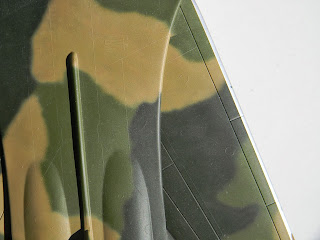
Since we're talking about a problem and not about building a Monogram F-111, this is all you get to see of the model today. The photo shows the starboard side of the wing glove, all painted and pretty. That paint is Floquil, real, honest-to-Goodness Dio-Sol laden Floquil. It's been on the model since the year the kit came out, and is now tough enough to survive the ravages of solar flares and small children. It's cured. It's set. It's color fast and bullet-proof. Maybe.
Or maybe not. Let's go back and do a quick review, and you'll understand just how significant this second photo is. That old Monogram (
nee-Aurora) kit had the option of operating swing-wings, and that's how it was built. Although capable of extension, the model spent the few years it was on display with those wings retracted, since having them at full span made the model too big for the shelf on which it resided at the time. They stayed retracted when the kit went into a box, and remained that way until it was removed from said asylum some eight months ago. The model sat in a closed, dark box, in a climate-controlled environment, for 20+ years. It was painted with the best, most color-stable hobbyist's paint known to man, and the model exhibited color shift while in storage. Not much happened to the greens, or at least I don't think much happened to them, but that tan! Holy Cow!
Now to the Great Mystery, and a small conclusion. The tan was one shade while the model was out on display but it's obviously shifted on all the exposed surfaces, while the portion of the starboard wing that was hidden under the wing glove remained the way it was the day the paint was mixed. While it was out
in the light, so to speak, it was in subdued lighting, and never direct sunlight. That's worth repeating---the tan wasn't two-toned while the model was on display---the shift occurred over a number of years, while the model sat in a dark box in air-conditioned storage. That's the mystery: How did it happen?
To my mind the damage started out during that handful of years while the model
was out on display. I think the paint took just enough light to start the ball rolling, color-shift wise, and the years the model sat forlornly in a dark box couldn't save it. Much like skin cancer on a human being the damage had been done years before, while the model sat on a shelf exposed only to indirect sunlight (a window) and incandescent light. The tan paint shouldn't have shifted like that, but it did.
I'm not a chemist, so I'm not going to try to tell you why that paint changed, although I personally believe that the red (a constituent color of tan paint) faded over time, because red isn't a particular stable pigment. The point, in terms of this particular model and nothing else, is that the tan faded. There's a bigger point to be considered, though; one that may cause you some personal soul-searching.
We all like to believe that we're building for the ages. We want our models to last, and to stay just the way they were when they came off the workbench, but that's probably not going to happen. Clear-coats will yellow over time, thus skewing the color shades a little bit (and if you don't believe me I've got a ten-year old slightly-yellow bottle of Future I'd like to show you), and model paint can, and evidently will, fade or change hue with time. We're dealing with chemistry and pigments here, folks, and paint changes as the aromatics in it out-gasses over a period of time. Just because the paint is "completely" dry and sealed doesn't mean it isn't changing, albeit at a rate most of us will never notice. It happens on anything that's got paint on it, from your house to your car to real airplanes, so why shouldn't it happen to painted models as well?
That's the premise, so what's the conclusion? To my mind it's simple. The paint on our models
will shift its hue over time. It's probably inevitable, with certain colors being more obviously effected than others. The Good News is that it probably doesn't matter very much at the end of the day. If that old F-111 model hadn't had operating swing-wings I never would have noticed the color shift it experienced, even though it was anything but subtle. There's now no doubt in my mind that some of my older models have also experienced a small amount of color shift, just like anything that's wearing a coat of paint will do. Now that I know it's probably happening I recognize it, but I also ignore it. It's a slow process and I honestly don't expect to have to be concerned about it during my lifetime. It ain't nothin' but a Thang, ya'll, but it's a Thang that'll give The Color Pedantics something else to worry about. For the rest of us, let's just build that model, paint it and seal it and decal it and seal it again, and then move on!
Opinions are welcomed. That address is
replicainscale@yahoo.com .
Some Naughty Novembers
We've got a thing for the 49th FG around here. Maybe it's the fact that they were successful with the P-40 when a great many other units weren't, or maybe we're just fascinated by the Group's heraldry. Whatever the allure is, we're fascinated by the unit, which means we're always excited when we receive images we haven't seen before. Johnathan Watson recently sent us some photos of 7th and 8th FS P-40Ns with nose art you might not be familiar with, and we'd like to share them with you today.
"Scarlet Night" was one of those rare 49th FG P40Ns to operate in natural metal, albeit briefly while assigned to the headquarters group. We suspect she was at Middleburg Island when this photo was taken, since a couple of other bare metal 7th FS/49th FG P-40Ns were operating out of the place as well, but we don't have definitive proof one way or the other. The spinner is most likely blue and white, and the side number is black. She's a beautiful enigma, isn't she? Johnathan Watson Collection
Some photos raise a whole lot more questions than they answer, and this shot of the 8th's "The Bastard" proves the point. There's a name, of course, and some very obvious nose art, but there's additional artwork in white, including a white female figure that partially overlaps the intake cover just forward of the exhaust stacks. If any of our readers have a better shot of this airplane we'd love to see it! Johnathan Watson Collection
There's no name on this side yet, just the ubiquitous nude female figure, but the aircraft will eventually carry the name "Dorothy Mae" above the figure. Some of the 49th's nose art was extremely well-done and rivals any to be found anywhere in theater, but this one wasn't among those masterpieces. It makes the point, though, doesn't it? Note the white gauze behind the perforated intake cover---it was a common mod to P-40Ns serving in the SWPAC and helped eliminate some of the ever-present dust. Johnathan Watson Collection
OK, scale modelers: Here's your Official Weathering Challenge for the day. #56 is beat to snot, to borrow a phrase from our youth. From those worn prop blades, which have virtually no black paint left on them, to the extensive staining on the nose (and no, Virginia, that's
not the remnants of a green-on-earth paint job; the 49th's N-models were all OD over NG), to the dented (and unpainted) gas bag hanging under her belly, this is one airplane that's seen better days. Check out the mud and slop that P-40 is sitting in; in the SWPAC you could go from choking dust to heavy mud in the blink of an eye. The sharp-eyed among you have probably already noted that this is the second #56 we've shown in this essay. Is it the same aircraft as "The Bastard", or is it a replacement airframe? We don't know, but if you do we'd like to hear from you. The address is
replicainscale@yahoo.com . Johnathan Watson Collection
A handful of 49th FG P-40Ns are famous among enthusiasts and modelers because they've been published often and are therefore well known. "Empty Saddle" is one of those airplanes---everybody's familiar with the nose art, although it's worth mentioning that the actual rendition is somewhat more crudely done that is normally displayed on decal sheets. Aficionados of the 49th probably recall that this aircraft carries the name "Keystone Katie" on the port side of the nose. Johnathan Watson Collection
One more thing before we leave The Forty-Niners today---the sharp-eyed among you have probably already noticed that all but one of the images we've just shown you are on the starboard side of the aircraft. That doesn't mean that that's all there was, however. From its earliest days the group tended to put nose art on
both sides of their aircraft, not just one, and that art was often completely different from one side to the other. That makes these images all the more fascinating, and gives us a small research project to boot! Many thanks to Johnathan for the use of the photos.
More Memories of Misawa
Some of you may, by now, be speculating that we would devote this blog to Misawa Air Base and the goings on thereof if it were in our power to do so. The simple truth is that we loved the place, and thoroughly enjoyed our stay there. Allow us to reminisce for a moment and tell you why by means of a couple of There I Was stories. (We know you're probably sick of them by now, but we're not. Feel free to skip on down to the pictures if you'd prefer not to endure yet another story of mis-spent youth!)
Story the First involved a very simple adventure, mundane to most but formative to a 14-year-old Phillip Friddell. There we were (I'm using that annoying third person again), standing out in the yard in front of Jack Dusenberry's quarters one fine Spring afternoon in 1963, when jet noise caused us to look upwards. There it was; the first
real F-102A we'd ever seen in our lives, and it was honking over the base housing area at what seemed to be a rather sporty rate of speed, all banked over (to the point where we could easily see the pilot sitting in the cockpit) and showing off a set of red and black checkerboards on its tail. It was a "Deuce", ya'll; a real live F-102A, and it was doing everything it needed to do to impress an aviation-struck teenager short of loosing a salvo of rockets. That was it---in that brief moment we knew beyond any doubt that we were going to enjoy living in Japan.
Story the Second was one of those things that a lot of folks don't think happens at American Military Installations, but they do, and in this case the hi-jinx resulted in an Article 15 for a pair of young airmen. The year was 1964, the last full year before the 4th FIS rotated back to the Land of the Big BX, and the place was the taxiway near the alert barns wherein the 4th kept a pair of '102s, loaded and cocked and ready to launch at a moment's notice if the whistle blew. Those alert birds were rotated out periodically for servicing, so there was a fairly constant stream of F-102s being pulled around the ramp by tow tractors.
Dragging airplanes around a flight line with a tug is a fun thing the first time or two you do it, but boredom sets in as soon as the shiny wears off that particular penny, which is what we presume caused the two young airmen operating said tugs to decide they needed to stage a drag race. Yep, you heard that right; a drag race. Each tug was hooked up to a fueled and armed "Deuce" which, in a sense, made it a fair competition for all concerned. A fellow conspirator served as the starting flagman, and it has to be presumed that another accomplice sat at the designated finish line, although he apparently got away before anybody could positively identify him. Imagine, if you will, how totally out of place it is to have a pair of jet fighters, firmly attached to tow tractors, sitting side by side on a taxiway while a third airman stands in front of them twirling his arms in the air in the finest Gentlemen, Start Your Engines tradition. The start was apparently something to see (and
was seen, in the control tower and elsewhere), but the finish was relatively anticlimactic once the Security Police got there. The story was all over the base by the next morning, and the tug drivers were minor-league celebrities for at least ten minutes. They probably didn't want a career in the Air Force anyway.
Story the Third was an ongoing one and probably made for great stories in the O-Club stag bar, but Story the Third was a scary story too in as much as it involved periodic incursions of Japanese airspace by The Bad Guys and intercepts of said Bad Guys by those checkerboard-adorned fighters. Things apparently got a little sporty from time to time (one of my friend's dads once told me of a twilight chase through the nearby mountains trying to catch a snooper), but it was all in a day's work. It's why they were there; it was all part of the job.
At any rate, the 4th FIS was a rarity in PACAF, a fighter unit that had spent The Big One flying in one of those other theaters of operations rather than in the Pacific. We're not interested in that North African and European service today, though, so we're going to skip right past it, at least for the moment. Instead, we'll take up the story in February of 1947, when the squadron took over the P-61s formerly flown by the 418th Night Fighter Squadron and assumed station at Yontan, Okinawa. The squadron transitioned to F-82s during 1949 (and briefly flew combat missions in them over Korea during 1950-51) and did TDY in Japan---the 4th gave up the last of its F-61s while there. The F-82s bit the dust in 1952, replaced by F-94s, which lasted until their replacement by F-86Ds in 1954. For our purposes the final chapter in the 4th's history began with the acquisition of F-102s in 1960, which the squadron kept until rotation back to the ZI in 1965. In Okinawa they were stationed at Yontan, Naha, and Kadena Air Bases, while their sole base in mainland Japan was at Misawa. Thanks to the kindness of Marty Isham we're going to take a look at several of the 4th's aircraft flown during their stay in the Far East.
.jpg)
OK, Gang: It's an F-61B from the 4th and it's operating out of one of the bases (probably Yontan) in Okinawa, but once you get past that we're stumped. We can tell that it's flying form with another
Black Widow and we know the unit, but that's it; no serial number and no markings of any kind reside on that airframe! We presume it's had a visit to an overhaul facility and is being test flown prior to a visit to corrosion control for paint, but that's as much as we know. Scale modelers, here's your challenge for the day! Maj J. Redrup via Isham Collection
Here's what a ramp full of F-82Gs looks like, just in case you've never seen such a thing before. The place is Okinawa, although we aren't entirely certain of the base, and those fighters are all Plain Janes without a distinguishing mark to be seen. On the face of things it's a boring photo, but it documents the 4th early in their ops with the
Twin Mustang, which makes it of considerable interest to us. Maj J. Redrup via Isham Collection
This is a poor shot at best, soft and out of focus, but it shows an F-82G in the air over the Ryukyus, which makes it of historical value. We can't make out the buzz number on the aft fuselage but we can definitely see the squadron markings. Kind of makes you wish for a decent kit, doesn't it? Maj J. Redrup via Isham Collection
Since we've just run two photos of F-82Gs where we can't see much of anything, it's time to make amends. Here's 46-0394, in flight during the last few months prior to the commencement of hostilities on the Korean peninsula. "Dottie Mae" was a looker but she didn't last long; she was reassigned to the 68th FIS and lost in action over Korea during March of 1951. Would any of our readers care to educate us as to the doohickey hanging off that outboard port wing station? Maj J. Redrup via Isham Collection
And here's "Call Gal", 46-0400, all tarted up with command stripes. Another transferee to the 68th, she crashed to her destruction near K-14 on 7 December, 1951. This shot provides us with an excellent view of her silver landing gear struts and the interior of her MLG doors, as well as her silver wheels---modelers would be doing themselves a considerable disservice by painting everything Jet on an F-82! Spry via Isham Collection
The 4th gave up their F-82s for F-94Bs but retained their all-weather fighter role. This ramp shot was taken at Naha shortly after the transition, and shows a lineup of really pretty 4th FIS
Starfires. It's interesting to consider that, at the end of the day, the F-94B was a highly modified F-80, and that it was a state-of-the-art interceptor while assigned to the 4th. Things were a whole lot simpler back then. Larry Chase via Isham Collection
51-5475 sits for her portrait on the ramp at Naha during 1952. All that wear and tear suggests she's led a full and possibly hard life but she's holding up well, and the squadron badge and lightning flashes on her flanks really compliment her lines. She was an F-94B-5-LO, and her appearance here typifies the way the Starfire looked in PACAF service. Minert Collection via Isham
You just never know where a sharkmouth will turn up, do you? In this form shot 51-5477 carries the marking on her gas bags as well as her nose---what a subject for a scale model! USAF via Isham Collection
After a stint in F-94s the 4th transitioned once again, this time to F-86Ds. It was during this period that the definitive red and black checkerboard markings were adopted for the tail. 52-3958, an F-86D-45-NA
Sabre, shows off those markings and a command stripe while sitting on the ramp at Misawa during 1954. The nose cap on the gas bags is also red, and that anti-glare panel is olive drab. The "Dog" wasn't the prettiest of the
Sabres but simple markings such as the 4th's checkerboard really showed off her lines to good advantage. Isham Collection
56-4004 sits off the wing of what we think is a C-46 (PACAF used them in Japan for hauling ass and trash until the mid-60s) while overflying northern Honshu. Her checkerboard has yet to be added but there's no doubt as to her unit or purpose. It should be noted that F-86D radomes were often black, but they could also be dark green or, sometimes, olive drab. This one appears to be faded black. It's something to watch out for if you plan on building a model of the "
Sabre Dog". USAF via F Klais via Isham Collection
You've all seen this shot of 52-4247 before; we ran it a year or so ago, back before we were watermarking our images, and it's subsequently turned up all over the internet, generally without provenance, on user groups and in photo-sharing sites. (Heavy sigh...) Note the difference in anti-glare panel treatments between the two aircraft in this photo---the one on 4247 is olive drab while the one on the unidentified aircraft immediately behind her appears to be black. That "gap" between the anti-glare panel and the radome is normal for the "Dog Ship". Menard Collection via Isham
.jpg)
The Opposing Team often flew near, and occasionally into, Japanese air space during the Cold War. Sometimes they got away with it but more often than not they got themselves intercepted. This photo shows what appears to be 52-4055 flying formation with a Beriev flying boat after one such intercept. The guys flying for the other side were highly disciplined and professional aviators, which made this sort of thing easier than it could have been---the chances of somebody (on either side) going cowboy and doing something stupid were relatively slim. Note the angle of attack on the "Dog"; the
Sabre didn't like to stooge around at prop airspeeds! USAF via Isham Collection
Any of our readers who've been at Misawa during the winter months will feel right at home with this image! The 4th got F-102As during 1960 and flew air defense missions with them through most of 1964. Misawa was snowbound (but almost always functional) from late November until early March; 56-0959 (an F-102A-51-CO) is being readied for flight, although it's going to take a while to get all the accumulated snow off her! The 4th kept a pair of "Deuces" in Misawa's alert barns at all times, guaranteeing that at least one section of interceptors could launch quickly if needed. There were no other USAF interceptor squadrons operating out of northern Japan during the 1960-64 time frame, which placed a great responsibility on the F-102s of the 4th. Thomas via Kerr via Isham Collection
.jpg)
If ever there were a classic shot of the 4th FIS this would have to be it. F-102A 56-0960, another -51-CO, was the squadron commander's bird when the USAF photographed her flying in close formation with F-100D 55-3765. Both aircraft were assigned to the 39th AD (the two-colored Alars on the tail of that "Hun" indicate wing level maintenance; prior to 1961 the 416th TFS wore blue markings and the 531st wore red) in what would be the twilight of the classic period of USAF operations at Misawa. "Red Striped Rascal" was immortalized on a MicroScale decal sheet in 1/72nd scale, and we think there may be a SuperScale sheet out there for her in 1/48th as well. You gotta love the Silver Air Force! (And yes; we know those "Deuces" were aircraft grey, so don't write in to tell us about it!) USAF via Isham Collection
Under the Radar
Every once in a while you find one of those books that becomes a favorite just because of the way it's written. Today's offering is one of those special books.
The F-86 Sabre, R.J. Childerhose, Arco Publishing, New York, 1965, a modest number of un-paginated pages, illustrated. Way back in the middle 60s there existed a series of aviation titles known colloquially as "The Morgan Books", so-named because Len Morgan caused them to be written and published. For the most part they're brief, and not what the contemporary enthusiast would expect in the way of an aircraft monograph. They're also factual and well illustrated by Richard Groh, and the ones on specific aircraft contain portions of the appropriate flight manuals as well. They're deceptively good books, particularly when we consider how old they now are. What sets this particular volume apart from its Morgan siblings is the author's writing style---Ray Childerhose, aka "Chickenhouse", flew Sabres with what was, at the time, the RCAF, which means he knew of which he wrote, and he wrote what he knew with great humor. The book is informative, extremely well-written by a man with a passion for the airplane, and is hilarious. We bought our copy in the late 60s and loaned it to contributor Rick Morgan sometime back in the mid-80s. When he returned it we asked him what he thought of it. His answer? "I'm still laughing!" He thought it was one of the funniest aviation books he'd ever read, and we have to agree with him. Humor can be a Very Good Thing!
If you want a copy for your own library you'll have to get it through one of the on-line booksellers or maybe at a trade table at a scale model show, since it's been out of print for many years. It cost a whopping three bucks when it was new, and probably won't set you back much more than that today. It'll be well worth the effort too. Don't believe us? Just grab a copy and flip to the chapter entitled "Forty Americans Cornered Over Bitburg". You'll understand what we mean. Recommended.
Mud Doesn't Care Who You Are
We're always talking about the crummy operating conditions prevailing in the SouthWest Pacific during the Second World War, and we've repeatedly illustrated that point with photographs sent to us through the kindness of Bobby Rocker. Here's another photo of that sort of thing to emphasize what we're talking about. We suspect, with no way of being absolutely certain, that this P-40 engine change is taking place in the Solomons. We know beyond any doubt that the airplanes belong to the RNZAF, and we're pretty certain that arguing that Allison into position in the bug-infested heat and humidity can in no way be described as fun. We rarely think of that side of the war but it was the harsh day-to-day reality; nobody would've ever gotten off the ground if it weren't for the guys doing this in all sorts of weather conditions. There were no easy days. RNZAF via Rocker Collection
The Relief Tube
We've got a couple of comments to share with you today, so let's get started:
First, from Doug Barbier:
Phil,
that last Happy Snap (in our most recent issue)
certainly caught me by surprise. It was a sad day in more than one way - I flew as #3 in the last mission the unit flew - a 6-ship demonstration for the rest of the unit. The only flying we did after that was to ferry the jets off to either another unit or the boneyard. So it was my last flight and the last of the fighters for the 171st. As an aside - I drove 777s not 747s but the end result was the same. My son Geoff took the picture.
Doug
Thanks, Doug, and apologies to Geoff for not properly crediting the photo.
In that 80s T-33 piece we ran a photo of an NAS Key West ramp full of ANG T-33s and commented that we didn't know what the occasion was. If you recall we asked the photographer, Rick Morgan, to explain what was going on. Here's his response:
Phil: The gathering of ADC-related T-33As at Key West occurred on 5 Dec 1980 and was related to an Operational Readiness Inspection (ORI) of the “Tarpon” radar site at the base as well as the Aerostat blimp that was tethered at Cudjoe Key. Three of the T-birds were from the 46th ADW at Tyndall (53-5818, 58-0632, 58-0527), 125th FIG (FL ANG) 53-5325, 177TH FIG (NJ ANG) 57-0715.
Rick
Thanks, Morgo! (And, for the record, we've got more T-Birds on the way as well as some pertinent comments from a former T-33 driver, so stay tuned!)
And that's it for today. Be good to your neighbor and we'll meet again soon!
phil


+mod.jpg)
+mod.jpg)
+mod.jpg)
+mod.jpg)
+mod.jpg)
.jpg)
.jpg)
.jpg)
.jpg)
.jpg)
.jpg)
.jpg)
.jpg)
.jpg)
.jpg)
.jpg)
.jpg)
.jpg)
.jpg)


.jpg)
.jpg)
.jpg)


.jpg)

.jpg)

.jpg)
