Sunday, January 27, 2013

Lookin' In, An Amazing Model, Some Thunderjets, and Any Landing You Can Walk Away From

The Incredible Hulk

As some of you probably remember, Replica in Scale started life as a print magazine way back in the early 1970s. We did some interesting things back then, including the reviewing of the many kits, books, and decals that were provided to us by industry. We also tried to actually build models of some of the subjects we wrote about, which is a lead-in that takes us to Right Now.

Earlier in the week we received an e-mail from Fred Hall, with whom we've had an ongoing correspondence regarding the old Monogram kits and how much better they were (and are!) than a great many of the current offerings by our ever-increasing list of "modern", state-of-the-art manufacturers. That discussion led to a few comments regarding new kits in general, which caused  Fred  to say this about the new Meng 1/72nd scale F-102A:

Well Phil, since the Hasegawa F-102 kit has grown so old, I couldn't wait to get my hands on the new Meng kit. I got it in December but had something else going on the bench so didn't start it until about 2 weeks ago. I went back into the Nov 1972 " Replica" to see what you had to say. I'm not sure what you'd think of this quote regarding that old kit "fortunately quite good and needs virtually no reworking to achieve a decent model." Amazing how times and techniques change because I thought the same thing too. The basic kit did have an accurate shape but trying to close those weapon bay doors was never easy, and I don't like to leave that stuff open as its not typically seen that way on the flight line except during maintenance or loading. I do like the Meng kit, but it's weapons bay is a little narrower than the fuselage so it still needs some attention. Fred

1972 was a very long time ago, and that November issue Fred mentioned was the second RIS ever published. We were still scrambling to find things we had enough information on to be able to write an article at that point; since we were only two issues into the thing we hadn't yet made the acquaintance of Marty, Dave, Jim, or Doug, although Norm Taylor was stationed in San Antonio at the time and was kind enough to open his collection to us. We didn't run very many photographs at that point since photos cost money, of which we had very little at the time, so most of that F-102 article was illustrated with Jim's drawings (a high point of our project both then and now---I still think they're great after all these years!). I also built a Deuce for the article based on a photo from Norm's collection, a bird from a USAFE outfit, the 496th FIS. The relatively new (1968 or 69) Hasegawa kit provided a canvas, and off we went. Since the "Deuce" was our lead article for that issue, we also featured it on the cover:
Here you are: Our second cover ever, giving the reader a strong hint as to which airplane we were featuring that issue! (Picture Pirates beware:  This is a copyright image! Republish it without proper credit at your own peril!)                                                                   James Wogstad, Copyright 1972


And here's what remains of that 1972-vintage Hasegawa kit of the F-102A:

The landing gear is trashed and the gas bags have been knocked off, as have the landing gear and weapons bay doors. Nobody was making accurate paint for the contemporary USAF way back then, so you pretty much had to figure it out on your own. In this case we fell back to our old standby Floquil SP Lettering Grey, which is actually far too warm a shade to properly represent Aircraft Grey. We thought it was ok back then, though, so that's what we used. The model was built 100% out of the box; we mentioned a few areas that could have benefited from change but didn't actually incorporate them into the project due to the pressures of our deadline and the additional influence of a tiny misfortune, which we'll explain in a minute. All the stripes, etc, were masked and painted, as were the anti-glare panels, radome, and intake walkways. The AIM-4s came direct from the kit and were somewhat sloppily hand-painted, although that really wasn't noticeable with the weapons bay doors in place. At the end of the day the model photographed well and looked like an F-102A, which was the whole purpose of the thing. It still amazes us that it took some 42 years to get a better kit in the scale!

And here's the tattered remains of the undersurfaces, broken landing gear, missing tanks and doors, and all!  Virtually nobody was weathering airplanes in 1972, or at least they weren't once you got past exhaust and improperly-done gun gas streaking, so our "Deuce" was a Clean Machine---that was ok in this case since the late, lamented ADC tended to keep their airplanes absolutely immaculate anyway. Those stripes on the nose were masked off with an extremely thin model car striping tape, while the stripes on the pitot boom and barrier cable hook were painted freehand. The exhaust was painted with a mixture of Floquil Antique Bronze and Old Silver, while the landing gear and weapons bays were painted with a Floquil craft color called Chartreuse, which was a pretty fair match for Mil-P-8585 Zinc Chromate Primer. There was no weight whatsoever in that model, because it didn't need any. In point of fact, the only member of the the Century Series of US fighters that actually does require weight in the nose is the F-100; on everything else the main mounts are situated far enough aft that ballast isn't an issue, although very few modelers realize that. Those decals weren't yellowed when the model was new...

A final shot to illustrate some things we hadn't previously discussed. The national insignia on the wings, as well as the "USAF" legend found there, came from our decal box, but the fuselage insignia, the "U.S. Air Force" markings on the fus, plus all of the stencilling were courtesy of the long-gone and much-lamented, at least by us, Letraset model airplane dry transfer decals. Those little F-102s behind the canopy were done with a Crow-Quill pen and India ink on a piece of MicroScale clear decal stock, and the shiny natural metal intakes were done with Bare Metal Foil, which still looks good some 42 years after their initial application. There's a pilot in that cockpit and that, plus the fact that the F-102A has a vision splitter on the instrument panel shroud and the kit has a really thick cockpit transparency, means that you can't tell that there's -0- interior in that model; zip, nada. (We used a ModelDecals instrument panel decal and actually did manage to scratch-build an optical gunsight but you can't see either one of them through that canopy! There's a lesson there, we think...)

There are a couple of other things you really ought to know while were visiting 1972 in our Wayback Machine:

First, we actually built two F-102s for that article. We got the first one built (with the weapons bay doors closed), painted, and decalled, and then decided to clear-coat the model with Krylon Kristal Klear, which was a lacquer-based aerosol available in art supply houses. It looked really good when we sprayed it too, right up to the point where the lacquer crazed the previously bullet-proof Floquil paint and made the entire model look like an F-102A-shaped football. We did a hasty re-build with another kit (which is why all the decals weren't dry transfer; we'd used the ones we had allocated to the wings on that first airframe) and managed to get everything finished in time to make our deadline. Lucky, we were!

Also, if you'll take a close look at that pitot boom you'll notice that it's far too thin and tapered to be plastic. We were fond of using steel insect pins for such things back when we could still see 1/72nd scale, and that's an insect pin on our "Deuce". It's epoxied and puttied in there, which virtually guarantees puncture injuries if you get careless with the model. Back then we didn't care, but we knew it was there and avoided stabbing ourselves with it! Nowadays such shenanigans would probably add to the coffers of some attorney!

Finally, there are those squadron markings, made by punching out a piece of decal stock with a paper punch and painting the 496th's insignia on them, a chore handled by the First Mrs. Friddell.

That "Deuce" was one of those models that just came together for us in spite of all the drama associated with its creation, and it looks pretty good right now this minute, although we may be somewhat prejudiced in that regard. Many thanks to Fred for inspiring us to drag that old dinosaur out and take another look at it. We hope you enjoyed our trip to the distant past!

Holy Cow; Wouldja Look at THAT!

When we run photos provided by Bobby Rocker we normally feature airplanes from his personal collection of WW II-era photography. This time we've got something a little different for you to peruse.

We usually say naughty words when we think of Flickr, since so much of our photography has ended up published there without bother of credit lines for the photographers involved, but this time around we've got nothing but good to say. This shot was uploaded by a Flickr member known as FabriaA78 and shared by another Flickr member known as P-38L5LO, and shows what we presume to be an RC model of a Yokosuka E14Y "Glen" being readied for flight. The model was apparently built in Germany, where this photo was taken, and is an absolutely remarkable bit of craftsmanship. Further details would be welcomed!  FabriaA78 photo.

Just Passing Through

That's what these 20th FBW F-84s were doing way Back in the Day. The images were provided to us by Mark Morgan---THANKS, Mark!

48-0727 was an F-84D-5-RE, and is seen here en route to England while taking gas at Goose Bay during the 20th's 1950 Fox Able 6 deployment. Note that both of the wingtip-mounted gas bags are being filled at the same time; a transient alert type of our acquaintance once told us how he actually managed to tip over an empty T-33 by filling one tip tank while leaving the other empty. Could that really happen? We honestly don't know, but there's got to be some reason other than enthusiasm that those guys are filling the tanks at the same time! USAF/AMC via M Morgan

Sometimes things get a little hairy on the transient ramp. Here's most of one squadron of the 20th being refueled at The Goose. It's tough to see the airplanes in this photo, but those interested in such things may well note the variety of truck pulling those fuel trailers. It would make a neat diorama...  USAF/AMC via M Morgan

If Goose Bay is a cold and remote place you really have to wonder how Sondrestrom compares! We guess it's No Contest, but that's just an opinion! However you cut it, the 20th was staging their F-84Ds through that somewhat remote facility when this evocative photo was taken. Of particular interest is the use of a Dodge weapons carrier as a tow vehicle for 48-0749. While we're talking about dioramas, that would sure be a neat addition to one!  USAF/AMC via M Morgan

Further on down the road. The unit is still the 20th FBW, but the airplanes are now F-84Gs, this time sitting on the ramp at Narsarssuack during 1952. It's easy to forget how many difficult places the Silver Air Force flew out of back during the 50s, but these photos provide a graphic reminder of the dangers involved in keeping the peace during that era.  USAF/AMC via Mark Morgan

And here's a row of the 20th's Golf models to end our essay. Narsarssuack is what might be called a desolate place, but it was an essential base in the early 1950s.  USAF/AMC via M Morgan

Everybody Has a Bad Day Every Now and Then

Of course, when most of us have that aforementioned Bad Day it's generally an inconvenience of some sort. If you fly for a living, however, those Bad Days can take on a somewhat different flavor. Let's take a look at some photographs from the Bobby Rocker Collection that prove that point:

This 54th FG P-38 bellied in up in the Aleutians, thus proving once again that it wasn't always the enemy that got you, even if you were in a combat zone when you stuck it in the ground. From that intact cockpit area you presume this one was a walk-away, but you just never know...  Rocker Collection

"Bolivar" was a moderately famous B-24J that got through a combat tour and came back to the ZI to participate in a war bond tour, where her luck ran out. This one appears to be a straight-up overshoot of the runway, but however it happened, "Bolivar" was a write-off.   Rocker Collection

One man's bad luck is another man's good fortune.  "Wolf Gal" had a bad day and was in turn reduced to produce, being stripped of her usable parts to keep other aircraft going. There wouldn't be much left by the time the salvage operation was done.  Rocker Collection

It probably isn't an outhouse, but the slapstick fan that lives inside us almost wishes it was. That B-29 is probably repairable but it's doubtful that anyone went to the trouble to do it; if there's one thing the 20th AF had plenty of it was airplanes.  Rocker Collection

NAS San Diego was a humming place during the Second World War, with a training mission dedicated to producing pilots for the Fleet. This early F6F-5 bellied in to a parking lot where it nailed a car. The accident was a walk-away for the pilot, but we're really hoping that car was unoccupied at the time of the crash!  Rocker Collection

When an airplane bellies in on the silver screen there's not much to it; the airplane slides to a stop while the pilot (read "actor" here) does his heroic best to look stoic. It was somewhat different in real life as is shown by this San Diego-based F6F-5, who's pilot took out most of a building when he bellied it in. Talk about having a bad day, although, once again, the crash was a walkaway. Do you guys think the pilot got a Board out of this one?  Rocker Collection

The Hellcat was a pretty tough bird. The way that number is presented on her nose could well signify that she was on either an acceptance or delivery flight when Drama overtook her. Either way there's not much left of the airplane, although the cockpit area is intact and this time, at least, our intrepid naval aviator has managed to avoid both buildings and automobiles. Nobody ever said it was safe!  Rocker Collection

It's easy to get the impression that everything's always going to be ok in an airplane crash. This San Diego-based PB4Y-2 provides graphic evidence that that's not always true. The guys in that Privateer never got any closer to combat than a training flight when their luck ran out. That sort of thing is every bit as true now as it was back then. Let's raise a glass...   Rocker Collection

Happy Snaps

Reader Mark Williams is no stranger to these pages, having shared images with us from his days as a Boomer a time or two before. He captured this F-18D waiting to tank a couple of years ago.

It's a placid sort of shot and almost makes it look easy. Almost.  Mark Williams

The Relief Tube

Let's start off today with an entry from Steve Stith, who's been going through some of our older issues:

I just was killing some time over lunch surfing the web and happened upon the photo of this aircraft from December 2010. As far as I know this is only one of two photographs in existence of this particular aircraft in this configuration. The other is in the book, the Age of Orion by David Reade and shows absolutely no national markings. As an ex-USN P-3 crewman, I found this picture interesting to say the very least!!

This is a REALLY unusual and rare P-3A Orion. It was modified to the configuration in the picture by the CIA along with 149678 and 149669. If this photo was indeed taken in 1967, it was very shortly after this aircraft was returned to US Navy custody from the CIA and Nationalist China. It was subsequently modified to an EP-3J and was operated by VX-1 (Nickname was “Miss Piggy”) for a while, then was converted to a UP-3A VIP transport and is currently in storage at the Davis Monthan boneyard. Throughout its long career, it still had the clam-shell double entry door.

                                          Stith Collection

                                         Stith Collection

The following text is from the P-3 Orion Research Group website ( a great source for interesting variants of P-3’s) CIA’s black P-3 program A small number of American Orions has always been involved in operations which cannot tolerate daylight. Between 1964 and 1967 three P-3As were assigned to the "PROJ AF" what probably stands for "Project Air Force". The Orions involved (BuNos 149669, 149673 and 149678) were modified by Lockheed and E-Systems for a clandestine "reconnaissance project" in June 1964. External modifications included extended exhaust pipes on the nacelles (to reduce heat radiation), shortened propeller blades (to reduce the noise), a bulged observation window on top of the fuselage, panel and blade antennas, an air intake device in the position of the forward starboard observation window, and a cargo door (created by adding a "mirror" door to the existing entrance door). Furthermore the MAD boom had been removed and all three aircraft were painted black. Mission equipment included a Side Looking Airborne Radar (SLAR), special communications systems and infra red detection systems. For self protection the aircraft were fitted with Sidewinder missiles and one of them even is believed to have shot down a MiG fighter. The area of interest for these Orions was communist China. They were flying signal intelligence mission along the Chinese border but also were conducting missions over the South Chinese Sea, Burma, Tibet and clandestine overland missions over China. The black Orions have also been involved in missions over Vietnam, flying at night out of Okinawa, Japan. In May and July 1966 at least two of these black Orions were handed over to the Republic of China Air Force which operated them for a short period in support of a CIA program. Like your blog!! Steve Stith

Thanks, Steve! We appreciate your update to our original photo caption!

In today's "Keeping Us Honest" department we've got a correction from Mike Furline regarding one of those F4U shots we ran an issue or two back:

Hi Phil. To start with, GREAT BLOG! Love the pics. In the Jan. 2013 pictures of the Corsairs, your description for one of the pictures is

“The "Hog" was too good an airplane to languish at the end of the War, and ended up with a career that took her well into the 1950s. This gorgeous photo shows VF-114 F4U-4Cs on the boat during 1951. Don't let the relaxed atmosphere of that shot fool you; a flight deck full of taxiing propeller-driven aircraft is one of the most dangerous places you'll ever be. Naval aviation was never safe, even in peacetime. Rocker Collection”

The F4U-4 with 20mm cannons was the F4U-4B model. The F4U-1 series used a “C” to designate 20mm cannons (F4U-1C), but the F4U-4 uses a B (F4U-4B). The “B” version was originally used to designate F4U-4s going to Britain, but Britain never took delivery of any so the “B” was used to designate the 20mm cannon armed Corsairs. The .50 cal. versions are just plain F4U-4. There was no “A” model. F4U-4 - .50 cal F4U-4B – 20mm F4U-4P – Photo-recon Thanks, Mike Furline

It's amazing the simple things you forget as time passes---thanks, Mike, for the correction!

And that's it for today. Please continue to send your corrections (or contributions---we're always on the lookout for good material!) to replicainscale@yahoo.com . In the meantime be good to your neighbor and we'll meet again soon.
phil

Wednesday, January 23, 2013

And Now For a Quick Word From---US!

Doin' the Right Thing

We suspect everybody who reads this blog is absolutely sick to death of the whole Picture Pirate adventure (and we can promise you nobody's sicker of it that we are!), but there's one more round   for you to endure before we get this whole mess put to bed.

The latest contributor to have his work compromised is another old friend, Ron Picciani. We've recently run a number of B-50 and P-51H shots from Ron's collection, and the bozos who keep publishing our photography have been having a field day. In response to that, Ron came up with a viable plan that we thoroughly agree with, and he's been modifying the images we published in order to help us with the whole piracy thing. He's been sending those modified images to us and we've been removing the "old" ones and replacing them with the modified ones as we've received them. It's a simple fix and it works.

There's a small down side to doing that, though. The folks who have joined this site will get a message that something new has been published every time we change out the photos, or at least we're pretty sure they will. Please be patient with us on that one---we want to get those photos corrected as quickly as we possibly can, which means we're presently doing two or three of them at a time. We ask that you bear with us while we replace those photos, and rest assured that we're very close to having a handle on the problem.

Finally, we'd like to extend a heartfelt apology to those photographers and collectors who have been so badly used by the Picture Pirates. We're doing the best we can, and we couldn't do it without those priceless images you guys shot over the years. Thanks for your contributions, and thanks for your patience!

We're in the middle of another issue and you'll see that in a few days. Meanwhile, be good to your neighbor and we'll meet again soon.
phil

Coming Soon!!!  
Here's one to whet your appetite!  USAF via M Morgan

Sunday, January 6, 2013

Fruitfly Tubs, More on That A-20G, Old Hose Nose, and A Blast From Our Past


Rub-a-Dub-Dub, That Fruitfly's a Tub

If you've been around NavAir for any length of time at all, you're aware that Naval Aviators have a tendency to give nicknames to their airplanes. The A-7 series, known as the "SLUF" to the Air Force Crowd, has always been the "Fruitfly" in the Fleet. "Tub" has long been the vernacular for any two-seat variant of a single-seat tactical aircraft, which leads us into today's continuation of the A-7 saga. We'll eventually get around to covering all the US variants of the type, but for today we're going to look at the NAV's two-seater A7s. Rub-a-Dub-Dub...

The "Fruitfly" started out as a single-seat light attack aircraft, of course, and was ultimately built in considerable numbers, which meant that a great many were available for conversion to the type-conversion trainer---24 A-7B airframes and 36 A-7Cs were ultimately converted to TA-7C standard, with a further 8 aircraft being modified to EA-7L configuration. The type proved its worth transitioning pilots new to the A-7 into the jet, and a great many ended up their careers overseas. Here's a photographic sampling of the Corsair II's training variant for your enjoyment.

David Balcer was a young Ensign undergoing flight training in November of 1979 when he snapped this photo of 156784 while she was operating with VA-174. While most of the TA-7Cs survived extensive service, 784 suffered a different fate. She was transferred to the Greek Air Force and crashed to destruction in 2003. David Balcer

156773 was serving with VA-122, the west coast RAG, in January of 1980, and was photographed transient at NAS Chase by a young Ensign Rick Morgan. The aircraft shared a fate similar, if not identical, to that of 156784---she was transferred to the Royal Thai Navy for use as a source of spares and ended up on the dump at U-Tapao shortly after the turn of the new century. Of particular interest in this shot is the red-painted APU dump and the color scheme on the gas bags. R Morgan

The PMTC had reason to own multiple TA-7C airframes. 156787 posed for this portrait in July of 1980, some 14 years prior to her transfer to DM and ultimate disposition to the Greek Air Force. The A-7 fleet lost its outboard pylons later in the type's service, but these early examples of the TA-7 retain all six stations.    David Balcer

156738 wasn't the very first of the TA-7 conversions, but she proudly wore the fact that she was one of them on her tail during 1981. She ended up in Greece but was assigned to the NWC when this shot was taken on the transient ramp at Chase. She's a moderately unique airframe, having been assigned FAA number N165TB upon being stricken from the Navy.  David Balcer

Some sources indicate that 156738 was assigned an N-number but that said number wasn't applied to that airframe. This photo indicates otherwise, and the condition of the airplane suggests that she may have been close to flight worthy when the photograph was taken.  John Kerr

Like many TA-7Cs, 156767 ended up in the Greek Air Force, although she was very much an active Navy asset when I photographed her at NAS Corpus Christi in the Spring of 1981. She was assigned to the east coast RAG, VA-174, at the time, and was an extremely well-used example of her type. Friddell

The TA-7 was well-represented on the American air show circuit during the 1980s. Here we see 156751 from VA-174 on the ramp at Randolph during their May, 1982, air show. Sharp-eyed readers (and we're convinced we don't have any other kind!) will notice her "USS Lexington" moniker on the aft fuselage. The "Lex" was a training carrier at the time with no assigned tactical air assets, but it was a common practice to paint her name on aircraft being use for CarQuals. 651 ended up being one of the rare TA-7C survivors, and is presently on public display in Illinois. Friddell

It's a little uncommon to find examples of aircraft from "equal but opposite" units at an airshow at the same time, but that was the case at Randolph in 1982 when VA-122's 156795 showed up on display alongside her counterpart from VA-174. She ended her days in Greece, but was in her prime with the NAV when this shot was taken. Friddell

154402 was on the ramp at Selfridge awaiting the arrival of some bad weather when her portrait was taken in October of 1984. TPS was rapidly becoming the norm in the Fleet, but most of the TA-7Cs were still in their Easter Egg paint jobs at the time. 402 was one of the older airframes assigned to the TA-7 program, and ended her days in the desert. R Kowalczyk.

By 1986 most of the NAV's tactical assets had been repainted in some variation of TPS, as illustrated by 154458 during her assignment to VA-122. The overall grey paint job makes her look a little more sinister, doesn't it? She ultimately ended up being sold to Eldorado Aircraft Supplies, although we honestly don't know her final disposition. Rick Morgan

July of 1988 saw frequent contributor Rick Morgan on TDY at Moose Jaw, where he managed to catch the NSWC's 156773 on public display. The tail markings are simple but tasty---compare this shot with the one we ran of the same aircraft a few images ago... R Morgan

Then there was that other two-seat A-7, the EA-7L. Never a true electronic warfare aircraft, the type served with VAQ-34 in a training role during the 1980s. This shot is as good a way as any to end today's look at the "Fruitfly Tubs", but we'll take a longer look at the variant in another edition. Stay tuned! R Morgan

They Called Her "Powerful Katrinka"

A couple of issues ago we ran some A-20Gs for you, including one photo of an aircraft bearing two different names on the nose. We stated at the time that we wished we could have read the lettering so we'd know what that name actually was; 3rd Attack owner and webmaster Gerry Kersey read that comment and decided to make things right. Here's what he had to offer:

We'd originally identified this 13th BS/3rd Attack A-20G as "Milly" with the notation that she bore a second name that we couldn't quite make out. We think that second name was probably painted in red, which wouldn't stand out very well when displayed on an OD aircraft that had been photographed in direct sunlight. Whatever the reason, here's another view of "Powerful Katrinka" that shows that nose art, although you have to really look for it in this photo. San Diego Air and Space Museum

And here's the Money Shot. That artwork, which is almost invisible in the previous photo, pops out nice and clear in this posed shot of photographer Jack Heyn. Gotta love those A-20s! 3rd Attack.Org

Hog Town

It's been quite a while since we've run any photography on one of our favorite airplanes, the Chance Vought F4U Corsair. We're thinking it's time to end that particular drought, so here's a selection of "Hogs" for your enjoyment!

The Corps ended up being one of the principal users of the F4U, as shown by this F4U-1D from VMF-323 being armed up at Kadena late in the war. By 1945 most Marine use of the "U-Bird" was of the air-to-mud variety, but there was still plenty of combat to go around. Rocker Collection

February of 1945 saw the first carrier-based strikes on Japan. This photo doesn't seem to offer much at first glance, but check out the way her "G" symbols are presented on the ailerons, and the presentation of the national insignia on her port wing. She's from the Bennington and is on her way to work in this photo. Rocker Collection

July of 1945 saw AirWing 9 heavily engaged. This photo is of particular interest because of the large "NO STEP" legend painted on her upper flap surfaces. That sort of stencilling wouldn't have been out of place in the 1950s or 60s but was a distinct anomaly in 1945. Rocker Collection

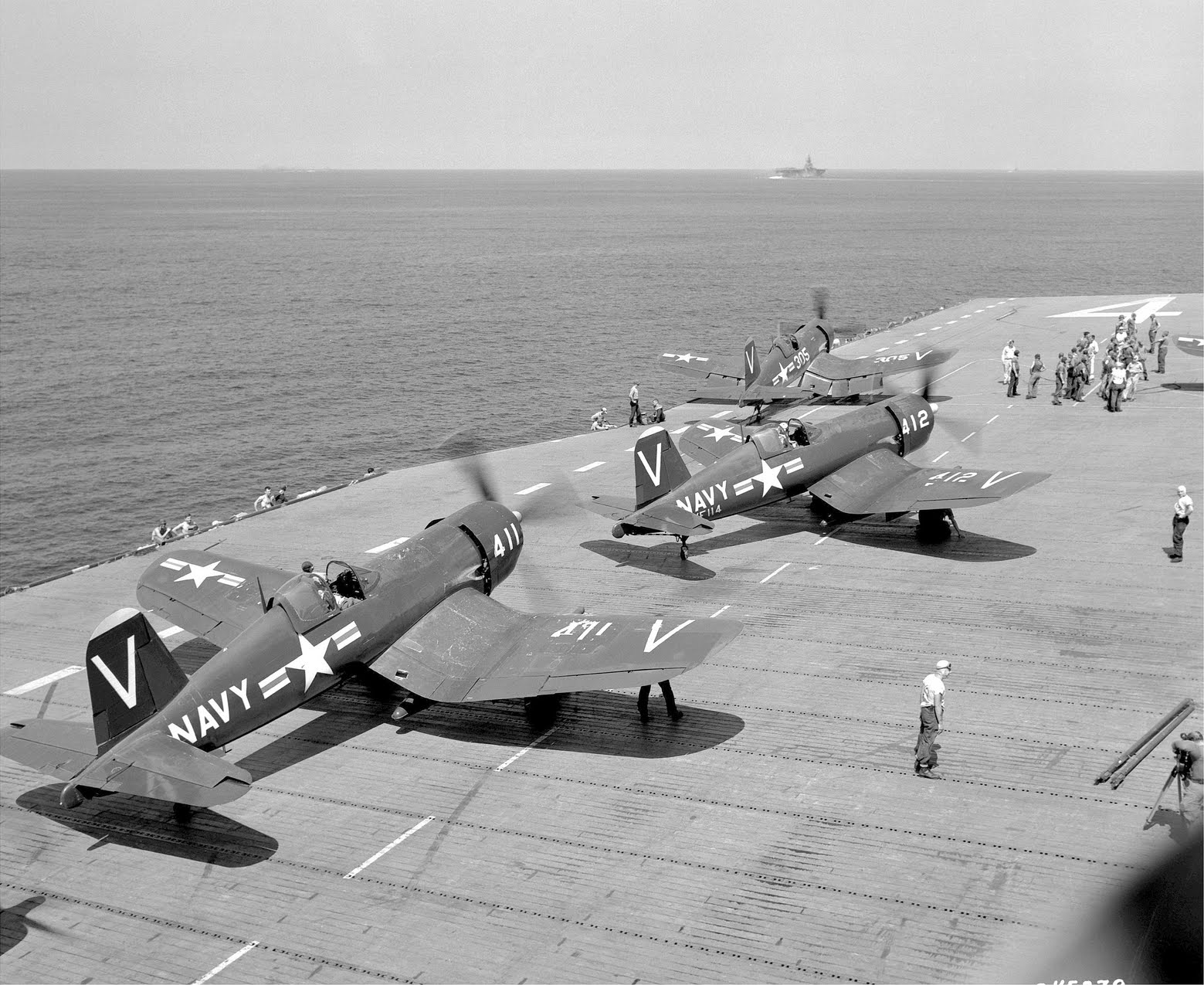
The "Hog" was too good an airplane to languish at the end of the War, and ended up with a career that took her well into the 1950s. This gorgeous photo shows VF-114 F4U-4Cs on the boat during 1951. Don't let the relaxed atmosphere of that shot fool you; a flight deck full of taxiing propeller-driven aircraft is one of the most dangerous places you'll ever be. Naval aviation was never safe, even in peacetime. Rocker Collection

The Big One was over, but that didn't mean the Corsair was through with combat. These VF-653 F4U-4s are getting ready to launch for a strike on North Korea off the Antietam in 1952. That deck looks relatively placid but the coats on the V-2 Division tell a story. Let's take that dangerous flight deck we were discussing a minute ago and add cold, lousy weather to the equation. It was always an adventure... Rocker Collection

VF-783 on the prowl. It looks pretty cold down there, but every airplane in this formation is flying with its canopy cracked open. No; we don't know why they did that either, but we like the photo. Rocker Collection

It's a carrier plane, so you fly it onto the carrier, right? Well, not necessarily, at least not in the Good Old Days. Back then you were just as likely to hook your airplane up to a sling and trice it aboard the boat, as is being done at North Island in this photo. The airplane's an F4U-4 and we're guessing she's from a training outfit, but once you get past that we're all out of ideas. Modelers might want to note the wing-fold jury struts that are installed to lock the wings in place during the hoisting operation.   Rocker Collection

Thanks once again to Bobby Rocker for sharing these images with us.

The Saga of Frantic Fraye

It's time to jump into the Official Replica in Scale Wayback Machine and take a look at what one of those late-60s English bands once aptly termed days of future passed. Today's big adventure carries us back to our one foray into the wonderful world of nose art. To wit:

Replica was long-gone, a victim of Life, Family, and General Stuff. In short, the project had run its logical course. Jim was continuing with it but in a completely different direction, birthing in the process a periodical called Aerophile that in turn produced some of the best aerospace journalism of its day. Meanwhile, your editor had abandoned all intent of publication to continue a life-long passion for off-road motorcycling.

That hiatus lasted for a few brief years, when Jim and I reassembled the team (that means we started working together again) to produce a handful of monographs under the Aerophile banner. We actually brought a couple of those projects to fruition and, therefore, ultimate publication, but most of our efforts were stillborn because, once again, we were long on Enthusiasm and Good Ideas and woefully short on time.

One of those projects that never quite left the ground was a special on USAAF and USAF nose art. we had the material to do it, and thanks to Jim's ongoing brilliance regarding Things Publicational we had the ability to make it happen. Planning began, and then came The Epiphany: If we were going to do a nose art monograph the cover of same ought to feature original artwork by the staff of Aerophile. It wasn't just a Good Idea; it was a GREAT Idea. There was only one tiny little fly in that particular glass of buttermilk---we wanted to do real nose art on a real airplane, and we didn't have an airplane to put it on. It was Time to Ponder.

Ponder we did, and, through the intercession of Mr. Shakespeare's slings and arrows of outrageous fortune we stumbled upon a solution. It seems that the part of the CAF's Central Texas Wing that based out of San Marcos had a TB-26B in flying condition that they regularly took to air shows, and your editor stumbled onto that fact while photographing one of said shows at Bergstrom. It began quite by accident, when we asked one of the crew what he might know about the history of the airplane. His reaction was classic; aviation wisdom at its finest:

"I don't know nothing about it except the damn thing's broke most of the time including today when the damn landing gear wouldn't come down and the airplane could've damn well killed us if I hadn't cranked the damn wheels down before we ran out of gas." (That's what we might call "perspective", except that today we're going to call it "opportunity knocking" instead!)

"Have you guys ever thought of putting nose art on this thing? It would look really great with nose art, and I know a guy (the guy being Jim, of course) who's ready, willing, and able to give you guys some killer artwork for your airplane. All we want is to be able to use a picture of it on the cover of a book we're doing."

"Hey, that would be great! Let me ask Mr. Stokes (that would be John Stokes, who actually owned the airplane at the time) if it's ok. Can you guys paint a nekkid girl on our airplane?"

And the conversation went on, the bottom line being that Mr. Stokes agreed to the nose art as long as we could work his wife's name (Fraye) into the design, and as long as it was tastefully done. We agreed and set to work.

The actual blow-by-blow painting of the nose art will be featured on these pages sooner or later (we have to find the slides first!), but suffice it to say that Jim and I drove out to Gary Field one Spring afternoon, MEK, Mil-Spec primer, and paint in hand, and set to work. Here's one iteration of how it all came out:

"Frantic Fraye/Aeros" in all its just-painted glory. The nose art was classic World War 2, based on a Vargas composition of that era and painted by Jim once we'd cleaned the airplane and laid everything out. We got our photography and the CAF got their nose art, but at the end of the day we never published that book and, unfortunately, "Frantic Fraye" continued to be broken most of the time. To add insult to injury, some well-meaning soul went back at a later date to modify the artwork, transforming "Aeros" into a far more buxom and considerably less artistic version of her former self. A lesson learned, as it were.  P Friddell

A Shameless Plug for a Friend

You've probably figured out by now that some of the folks included in our circle of friends are aerospace journalists. One of the people who falls into that category is Rick Morgan, a man who's becoming increasingly prolific in terms of this whole publishing thing. His latest is a monograph on the Grumman A-6 and its use in the Vietnam Fracas.

We haven't actually seen the book for ourselves so we can't review it for you. We can say, without fear of contradiction, that Rick's scholarship is impeccable, and his collection of naval aviation photography is superb. With that as a foundation we expect this volume will be one you'll want to add to your library. Rick's one of our go-to guys in terms of NavAir and yes, we really do expect the book to be well worth the price of admission.

Happy Snaps

Nope; not this time. We're still trying to get things back on some sort of viable schedule and just haven't had a chance to go looking for air-to-air shots in the collection. Maybe next time.

The Relief Tube

First, a correction from Dave Menard regarding a couple of those Texan captions from a few weeks back:

Phil, GREAT to see some more blogs again. But the shot I took a week before enlisting in Oct 55 was the yellow 991 bird, a Chanute AFB visitor. The red trimmed one was in instrument trainer markings, which was red nose,tail feathers, and 45 degree bands across the tops of the wings. Have seen these on T-33s, C-45s, and I think a C-54. Cheers, dave

Thanks, Dave---it's good to be back!

Next up is an image of a T-6 under restoration from a reader known only as Norm:

Beauty! Thanks very much for sending this one along, Norm!

We've picked up quite a few new readers over the past several months, which has resulted in a series of comments regarding some of our older features. Scott Leslie had this to say about one of our pieces on the TBM:

Hi, I was reviewing all the posts and saw the question on the TBM-3E from NAS Squantum in 1947. The question was on the Zulu Alpha tail code; Z or Zulu designated Squantum (later on NAS South Weymouth when Squantum was closed and all flying operations were shifted to what had previously been a mostly heavier then air NAS), and A or Alpha was for attack. Post war the USN dropped S for Scouting, B for Bombing, and T for Torpedo, deciding on A for Attack; S would become ASW squadrons, when the composite squadrons which did the ASW mission in WWII were disestablished. I could go on, but that's the gist of it. I wasn't sure if this had been answered yet. Thanks, Scott Leslie

And thanks to you for writing in, Scott! Another one of our readers had this to say about a different article:

That photo of F-84G FS-058-A is not a 27th FEW plane. The 31st FEW badge is visible under the side of the canopy. The pilot deplaning appears to be the wing commander, Col. David Shilling. FS-058-A also has an antenna just in front of the wind screen. That was a navigation antenna installed on the lead plane. FS-058-A was a 307th FES jet.

We'd like to give credit where credit's due, but this particular message came to us via the "comments" feature of the blog, which we don't use. We'd like to make certain that everybody gets the credit due them when they write in to us so please send your comments, photographic or literary contributions, etc., to replicainscale@yahoo.com .

Finally, we're still receiving reports of our photography showing up on other people's websites without any sort of provenance. While we used to see that sort of thing as an outright act of intellectual thievery, we now suspect that it's happening largely because the spiders that crawl websites on behalf of folks like Google and Bing just pick up random images (we discovered that by accident when we did a search on Replica in Scale in Bing "Images" the other day and saw dozens of photos we'd published hiding in there). Those photos all linked to our site just like they should, but anyone taking the images for their own use would have to be concerned about where they came from in order to note the source and properly credit them when they published them in their own blogs or user groups, and it's pretty obvious that the great majority of those guys just don't care. That's all the more reason for us to watermark the non-official photography we run, so we can give credit where credit's due and, hopefully, foil the Picture Pirates in the process. There doesn't seem to be any other way around it!

And that's what we know for today. Be good to your neighbor, don't steal our photography, and we'll see you again real soon.
phil

Thursday, November 29, 2012

That Unknown Fruitfly, Cry Havoc, and Another 109


Charlie the Fruitfly

Every family of military aircraft has at least one member in it that nobody really wants. In the case of the LTV A-7, that unwanted family member was the Charlie; the Navy's A-7C. An interim type that fell between the A-7A and B and subsequent E in the production cycle, the Charlie-model was essentially an Echo with the older TF-30-P-8 turbofan fitted in place of the E-model's definitive TF-41 powerplant. The NAV ended up with 67 Charlies while awaiting the arrival of the A-7E, and the type saw combat before ultimately being converting to E-models (or TA-7C models) themselves (VA-82 and -86 off the America).

A handful of Charlies survived post-war to be utilized in test and evaluation squadrons, and some 36 of them were subsequently converted not to A-7E but to TA-7C standard. Today we're going to look at those Tail-End-Charlies that weren't converted to anything and managed to remain C-models until the end of their service lives, except, of course, for 156777, which did become a TA. See how we are? Oh yea, and we don't apologize for that horrible play on words about Tail End Charlies. It was there, just sitting and waiting for us, and we  had to do it!

156797 was serving with the Naval Air Test Center when David Balcer photographed her in September of 1979. She survived a service career to end up as a museum exhibit in California, at the Naval Weapons School in China Lake. Few people ever model the NATC birds, which is a shame. They certainly don't lack for color!  David Balcer

Most of the Charlies were subsequently brought up to Echo standard by virtue of the installation of the A-7's definitive TF-41 powerplant, but a handful remained as straight C-models. 156777 was serving with VX-5 when photographed at a public air show in January of 1980, shortly after which she was converted to become a TA-7C. You might want to take note of that filthy weather---military aviators regularly fly in that sort of clag. It's not a job; it's an adventure.  David Balcer

In stark contrast to the photo immediately above, the sun was shining and there wasn't a cloud in the sky when this photo was taken at an airshow in October of 1981. It became the norm to remove the outboard stations on the A-7 during the 80s, but it's early enough in the decade in this photo and 772 is still wearing hers.  Tom Ring

We'll end today's brief essay with yet another airshow bird, this time at NAS Pt Mugu during 1984. 156797 was assigned to Pt Mugu and was carrying a full load of dumb bombs for the public when this shot was taken. (The type could do that in the Real World too, but it couldn't go very far with all that weight and no extra gas!) The bird ended up staying on at Pt Mugu and is currently on display there.  M Morgan

Cry Havoc!

Attack Squadron, that is. The Douglas A-20 was a key element in the success of the AAF in the Southwest Pacific. In theory the type should have been limited by her lack of range, but in practice her versatility, coupled with her performance, made her the ideal platform for low altitude attack as envisioned by General George. Here, thanks to Bobby Rocker, are some images of the A-20G during the final days of her service. Most are identified as being from the 417th, but a couple are not. We expect to hear from Gerry Kersey shortly...

When we think of the A-20 we all tend to think of it roaring over the jungle, or maybe the ocean, at minimum altitude with guns blazing, and the airplane most assuredly did her share of that sort of thing. She could also function as a "normal" bomber, however, and that's the role she was performing when this photo of "Sack Time" was taken. Note the way the bomb bay doors are positioned when opened; this is a detail most modelers miss.  Rocker Collection

She's named "Sally" something-or-other, but we just can't make out that other name. Aside from that, this shot illustrates both the bomb bay doors and pilot's canopy in their opened positions. Notice how light the covers on her mains are; we're guessing they're in squadron colors but have no way to be certain. It's time for somebody to write in and tell us what's going on here; that address is replicainscale@yahoo.com .  Rocker Collection

There are famous A-20s, and then there are famous A-20s. "Green Hornet" was one of the better-known examples of the type, thanks in great measure to the inclusion of her markings in the Matchbox kit of the A-20G. This photo shows those famous markings to good advantage, and also illustrates how tight and cramped the A-20's cockpit was.  Rocker Collection

The Havoc wore her share of ribald nose art, as illustrated by the 417th's "Amorous Amazon". The airplane is fairly beat up but the nose art is pristine. It was all a matter of priority...  Rocker Collection

"Georgia Bull Dog II" was a little more restrained, but the nose art was extremely well-done by any standards. We suspect that's Charlie Weir in the cockpit; like all of his breed he was young, and yet so very old. There were few easy days in the SWPAC.  Rocker Collection

Here's "Milly" of the 3rd Attack. She's beat to snot and is carrying another name (look just in front of the skeleton's face) that we can't quite make out. We don't know the details of this shot, but those guys sure look a lot alike! Maybe they're brothers? We hope they both made it home in one piece, but there were never any guarantees of safety in the 5th.  Rocker Collection

There's nose art and then there's nose art. We would tend to put "Contented Lady" in the latter category, but maybe that's just us. The airplane is obviously well-used and has, to be somewhat blunt about it, been through the wringer, but the mission markers and nose art are pristine, as is the paint beneath them. You did what you could...  Rocker Collection

Sometimes you might have time to get everybody together for a family portrait.  Rocker Collection

That's when you'd get everybody in the same place at the same time, all in their best uniforms, and pose in front of the airplane.  Rocker Collection

Sometimes you'd take the same shot a couple of times, just to make certain it was right.  Rocker Collection

It could be just a few guys in front of the airplane.  Rocker Collection

Maybe just the ground echelon.  Rocker Collection

Or maybe it would be a whole bunch of guys on the airplane.  Rocker Collection

You hope you put the right name on your ship, because there are people out there who want to kill you and every little bit helps.  Rocker Collection

Because at the end of it all you're going to have to go again, and it's as easy to buy the farm on the last day of a war as it is on the first. Let's lift a glass...   Rocker Collection

Under the Radar

Voodoo Warriors, The Story of the McDonnell Voodoo Fast Jets, Group Captain Nigel Walpole, Pen and Sword Aviation, 2007, Hardbound, 303pp, illustrated.

McDonnell's F-101 Voodoo was a seminal aircraft for the USAF. It was intended to be a long-range penetration fighter and also had quite a career as an interceptor, but its main claim to fame was a brief and violent career as a recce bird in the skies over Southeast Asia. Group Captain Walpole flew the type as an exchange pilot, which means he knew both the Voodoo community and its people intimately, which in turn made him uniquely qualified to write this book.

The volume is well-written and highly readable, and is as technical as anyone could want. The technicalities are well balanced by well-told accounts of the "One-O-Wonder's" operational history and the two facets put together provide a remarkable history of this often-neglected aircraft. A bonus is the selection of photographs, a great many of which are previously unknown to us; they lend greatly to the story told. We found the book to be impossible to put down and read it cover to cover in one sitting. You may not choose to do that yourselves, but we strongly suspect you'll spend more than a little time absorbing it. We consider this book to be an essential volume if you're interested in the topic and recommend it without reservation.

Enter the Eduard "Emil"

Those of you who were with us Way Back When, in those halcyon days when Print was King, probably remember that we had an editorial stance regarding Things Luftwaffe. We've mellowed considerably since those days and have rediscovered the heraldry and, therefore, the interest we once had in modeling things with black crosses on them, and in consequence we've built quite a few WW2 German fighters over the past several years. That renewed interest takes us to the sort-of new Eduard Royal Class Bf 109E offering in 1/48th scale---we recently obtained one, were suitably impressed, and thought we'd share our enthusiasm for the kit with our readership.

Let's start out by mentioning that Eduard's 1/48th scale "Emils" (their Royal Class kit accomodates all of the major variants of the type, all of which will ultimately be offered individually) are more or less an offshoot of that company's star-crossed 1/32nd scale offering of same, but not really. That big 109E had, and, by and large, still has, more problems than you can shake a stick at, and getting a decent replica out of it is a difficult chore at best. By contrast, its smaller-scale siblings offer far more detail, more logical assembly, and far fewer problems to deal with. They're what Eduard should have done with the 1/32nd scale kit but didn't.

So what do you get if you buy one of the new Es? We'll qualify our response to that particular question by stating that we lucked into a Royal Class boxing of the model, which comes with more bells and whistles than you can imagine; two kits with three sets of wings (so you can build an E-1, an E-3 or -4 with modified E-1 wings, or straight E-3/-4/-7 wings), multiple canopy sets, substantial photo-etch, Eduard's own "Brassin" wheels, stickies for 12 different aircraft, a 1/4-scale Bf 109E instrument panel, and a metal coffee cup. There's a lot of stuff in that box.

That said, let's get down to business. The basic kit (by which we mean the plastic parts for the airplane and nothing else) is close enough to dimensional accuracy to be acceptable without undue Modeler's Angst, and surface detailing is both engraved and petite. It's well-detailed in terms of cockpit area and landing gear, and it comes with a nicely detailed DB601 engine and cowl gun suite, of which more later. It also comes with a gas bag, bombs, and all three associated stations to hang them off of. One of the windscreens (there are 3 different ones in the kit) accomodates Adolf Galland's famous telescopic sight (which is also included), even though we doubt many people will chose to build that particular airframe. Both spinner styles are included, and all the kit is really missing are the Fiesler air intake mod and extended wings to allow the construction of the Bf 109T-2; otherwise you can build every 109E variant from this kit and do a great job of it in the process.

As for problems, there are two that actually bother us; that funky bulge that was in the upper fus of the 1/32nd scale kit, just aft of the cockpit opening, is still there, albeit less-obtrusively done, and the wing slats are still marginally too wide, but just barely. (We'd also like to have seen a cover for the tailwheel well included with the kit since some Es had that, and because everything else you could possibly want seems to be included in the basic kit!)

That's just the basic kit, you understand, with no aftermarket. Since Eduard also includes really nice instrument panel decals (or at least they do in the Royal Class iteration of the kit) you honestly don't need much more than a set of belts and harnesses to be able to produce a really nice model straight from the box, which makes the inevitable "Weekend Edition" kits the bargain of the century should your taste run to early 109s.

As for the "candy" that comes with the model, the photo-etch is done to excess, or at least it is in our opinion. If you want to build an "Emil" that's hard down for maintenance you might be able to use all that stuff, but we suspect most people will leave the vast majority of it on the frets. The same thing applies to those "Brassin" wheels and tires; they're nice, but so are the kit items, right out of the box. You pays your money and you takes your choice...

Construction of this uber-kit is actually quite simple, but that's with a couple of caveats. First, this isn't really a very good model for the newby or ham-fisted. Many of the parts are petite, and more than a little bit of care is required in order to get things together properly. Secondly, as just as important, is the fact that the modeler is going to have to out-guess the instructions in a couple of critical areas. It's easy if you want to build a model with everything hanging, but if you intend for your airplane to be buttoned up you'll become Fast Friends with Step 15, which tells you how to put things together with the cowling closed and the engine and gun deck suitably modified to allow same. Breech those instructions and you'll end up with a frustrating mess that you'll probably condemn to the trash heap.

The rest is all downhill, as they say. Painting instructions are more than adequate, and the kit decals, at least in the Royal Edition boxing, are absolutely superb and among the best we've ever used. We like this kit, and we recommend it.

Here's what you end up with if you've got a little experience under your belt. Both models are from the Royal Edition issue of Eduard's Bf 109E, and both were built entirely from the kit, although the JG5 bird utilizes decals from one of those Kagero books on the Luftwaffe. We managed to break the pitot tubes on both models while removing them from their sprue, but replaced them with items scratched up from plastic rod; no harm, no foul! Tires and wheels are kit stock, not "Brassin", and virtually no photo-etch was used, mostly because it really wasn't necessary for completion of the models.

Almost, but not quite, the same view. We're including this shot so you can see the leading edge slats better, since they're a little bit too wide. They didn't bother us enough to make it worth our while to fix them, but if you can't live without doing that you can easily cut off the offending section of the slat and use it as a filler for the wing opening, after which you---what else---put the modified slats on the airframe. We didn't, and still don't, think it's noticeable enough to mess with, but the choice is yours.

One thing Eduard still hasn't fixed is the bulge that they put on the upper fus just behind the canopy. It's always possible it's supposed to be there, of course, although we doubt that. At any rate, it's only noticeable if you paint your model in the "high demarcation" Battle of Britain scheme and then look down at your model from directly above. Otherwise, you just can't see it, so we didn't worry about ourselves about it. You can fix it if you want to, but then you'll have to put those really petite rivets back on the fuselage, which is honestly a whole lot more trouble than it's worth, at least to us. You pays your money, you takes your choice...

So here's the Bottom Line: The 90s-vintage Tamiya and Hasegawa kits are still very nice and perfectly buildable, and the new Airfix offering is quite a bargain at the price, if somewhat clumsy in comparison to its competition. On the other hand, Eduard's new kits are, at least in our opinion, the new Gold Standard for the type and are easily our kit of choice which it comes to modeling any variant of the Bf 109E. Follow the instructions, learn the kit, and you'll be absolutely amazed at the results.

The Relief Tube

We received a really interesting question from Pablo Zielger, one of our Argentinian readers, that we ended up deferring to Marty Isham and Doug Barbier regarding the fitment of an AIM-9B on an F-102A:

Here's the photo that started it all, which originally appeared in the forum over at ARV and was submitted by Grant. The original photographer is unknown to us at this time.

Mr. Phillip Friddell,

My name is Pablo Ziegler, from Buenos Aires, Argentina. I'm a regular
reader of your blog and a fan of the work you perform from Replica In
Scale.

I've been following your excellent articles on F-102 Delta Dagger, and
it becomes clear for me your interest in this wonderful airplane.
Since I am trying to find information on a particular bird, I dare to
write this message, which I hope is not a nuisance!

Some time ago I found a curious picture of the F-102A 61016, through
the forum of Aircraft Resource Center. This is the link:
http://s362974870.onlinehome.us/forums/air/index.php?showtopic=179961

It really surprised me to observe the installation of AIM-9B missiles
in an F-102, and I would like to both make a model of that plane and
necessarily find out a little more about it. Beyond the information
given in that thread, I could find little or nothing about FC-106,
except brief notes about the units in which it operated (*). Nor could
I find more photos with this installation, or a precise date for it.
So, I have not clear, for example, if this aircraft was equipped with
the IR Ball, or some other characteristics of the airframe or the
scheme in that moment.

(*) USAF 318th FIS, at McChord AFB, WA. / USAF 325th FIS, at Truax
Field, WI. / USAF 48th FIS, at Langley AFB, VA. / Arizona ANG 152nd
FIS, at Tucson APT, AZ. / 10/1969: Transferred to the Greek AF. /
114th Wing, at Tanagra AB, Greece.

I know that the search is complex, but I dare to share these questions
with you, hoping to have a "clearer picture" of this aircraft.

I thank you in advance for your time, and I'll follow your excellent
work through "Replica In Scale".

By the way, If you need any information of your interest about
argentine aviation, be sure to contact me!

Warmest regards from Buenos Aires,

PZ


That simple request got the ball rolling. Your humble editor had nothing in the archives with which to answer Pablo's questions, which in turn resulted in an e-mail to Mr. ADC himself; Marty Isham. Marty wasn't too sure either, and forwarded the request on to Doug Barbier, who had this to say about the "mod":

Marty & Phil,

My 'real' computer', which has all the a/c data cards for all of the deuces on it is sitting on the floor in the bedroom in pieces, so you'll have to wait a bit for the assignments, but the AIM-9 in the photo is definitely a "dummy" or captive version & it is certainly the early external pylon, so with the Buzz number present, we'll call it c.1965. Don't know if that jet is also the one with the refueling plumbing & IR, but that would have made it '65'-66 again..... but it really brings up some interesting questions - not the least of which is just exactly HOW they got that launcher hung on the pylon? The early deuce pylon / tank combination was basically a 'one piece' affair, so they would have had to break one apart (which was easy enough to do), and they did NOT have the "standard" 28" lug spacing (although the later one did), so it must have been a very jury rigged affair. Second, although you really only need 28VDC to launch an AIM-9,  the wiring in the deuce was certainly NOT capable of handling any missile on the pylon - you'd have had to have added a seeker head 'uncage' capability, wiring to get the the aural tone to pilot earpieces, etc, etc - not to mention finagling some sort of weapons selection, seeker head uncage & trigger capability.

     Remember, in those CV jets, what was a "trigger" in every other a/c, was a "pilot consent switch" in the delta's - which is to say you were simply allowing the computer to shoot when IT was ready, NOT when you pulled it. In fact, if you pulled & then released the "trigger" before the computer was ready to launch a missile, nothing happened at all. This isn't to say that it would be particularly difficult to do, but it would have required some seriously extensive rewiring and a 'one of a kind' test bird would certainly have never been assigned to a tactical squadron - esp one as far away as a Guard unit in Hawaii. Tyndall, Edwards, White Sands, OK. Guard unit? Nope. Enroute to SEA? Far, FAR reaches of "maybe". Jack Broughton talked about trying to get the AIM-9 on the SIX but HQ USAF wouldn't hear of it & TAC hated that jet. So I'm guessing it was a gag. Heck, we loaded not one. not two, but FIVE gun pods on one of our F-4's - wall to wall Vulcans. You might have been able to fly with them, but there was no way you were ever going to shoot all of them - but it sure looked impressive on the ramp! BTW - if you look really closely on that bombed up Six in Korea, the MER is mounted BACKWARDS on the pylon - apparently that was the only way they could get it on. That's my 2 cents worth.

  Doug


Thanks for your question, Pablo, and thanks to Doug for that detailed response. There's yet another model to add to the bucket list...

Here's a comment from someone we know Back in the Day. Those of you who have been at this hobby for a while may remember Gordon Stevens, if not by name then at least by his company, RarePlanes, who were reknowned for producing some of the best vacuum-form kits around. Gordon recently read one of our F-51H pieces and had this to say about it: 
Dear Mr Friddell -
Just checking out your July blog on the elusive P-51H and enjoying the many
pictures. A couple of times you had bemoaned the lack of a model kit of this
version of the Mustang, yet I seem to remember seeing a 1:48 kit - was it
Aurora - way back in the 1960s. I am more sure about a 1:72 scale vacform
from the RAREplane stable of just the fuselage which was to be mated to
modified P-51D wings and I also know that several thousand of them reached
the USA between 1970 and 1990. One result is shown in my picture where I
used the wings from an M-News P-51H Mustang injection kit, but rejected the
fuselage - because it was actually a plain P-51D - and used the vacform
fuselage instead. But the M-News kit had a decal for 484481 'Ahm Available'
which allowed the colourful banding on my model.
Sincerely -
Gordon Stevens
Poole, England
 
Boy, does that photo ever bring back memories! We built a couple of RarePlanes kits Way Back When and, in point of fact, had the remnants of one (a Dewoitine D.510) on the shelf until just a few years ago. The folks raised on Tamiya and Hasegawa probably won't understand, but there's a lot of satisfaction to be gained from building one of the oldtimers, particularly if it's a vacuum-form kit. Oh yeah, and we built that Aurora kit about a hundred years ago, and got another one a few years back thinking we might make something out of it---no joy, as it were. Thanks, Gordon, both for your comments and for triggering an interesting walk down memory lane!

And finally, from Joe Vincent:

Phil,
Just joined your blog and am now catching up on past issues. Presently on 12/18/2010. You were wondering what “DNIF” in the name of a P-47N nose art meant. In case no one else has come forth, DNIF is USAAF and USAF-speak for Duties Not Involving Flying. If you were grounded for a bad head cold you “went DNIF.”
Enjoyed the issue on Dibbles. I used to go cross-country to SAT, and always made it a point to visit Dibbles.
 
Love the blog, especially the photos. I used to have a copy of all of the paper RIS. Can only find a few now. I’ll try to send you some photos when the honey-dos slack up. Some of my buddies at FedEx let me copy their Kodachromes from the 50s (F4U-5N, RB-57A, etc.)

Joe

Thanks, Joe, and we look forward to seeing your photography, which leads us to an entirely shameless plug to our other readers who might have photography they'd like to share: Please consider scanning it and sending it on to replicainscale@yahoo.com . Full credit will be given for all photography used, and we'd all love to see it!

That's about it for this time and Yes; it really is 2 blogs in 2 days. We figured we owed you after that long silence!

Be good to your neighbor until next time---we'll see you again real soon!
phil