Hey Ya'll, Read This First!
If you're reading this post any time after it was first published, you may or may not know that we had an issue with the images within. We normally publish our photos as large as we possibly can so everyone can see the detail of the aircraft/markings, etc, but we had a problem with our 100th edition and about half the photos came out dramatically smaller than they should have. We found the problem and fixed it, so you can bring everything up to scanned size now, and we should have no further problems in that direction. Thanks for your patience and now, back to our program...
Who'da Thunk It?
Wow! Today's an amazing sort of day around here, a milestone of sorts as we said up there at the top, because today marks the 100th issue of the electronic version of
Replica in Scale. Think about it; since February of last year we've somehow managed to crank out 100 of these things! Holy cow!
We knew, way back when we started this project, that it would be an ongoing effort with no finite number of issues and, just like Way Back in The Good Old Days, no set schedule. That no-set-schedule thing has proven to be a blessing, because there's been no pressure to make any sort of deadline. You'd think that would result in fewer installments, but such hasn't been the case thus far---there were times, way back in the beginning, when we were cranking out two or more editions per week. That's since settled down to weekly, more or less, and that's pretty much where we want to be. (And speaking of that, our intent is to publish every Monday, but last week's came on a Friday and today's is appearing on a Friday as well because of the holiday weekend. Schedule is still a fairly loose concept around here...)
Now then, how about milestones? We've had a couple, to be sure. There's the whole 100th issue thing for one, , although you'd think everybody would be down with that by now. The other milestones are the truly amazing ones, at least to us. The big one, as far as numbers are concerned, is the stat that says several thousand of you are looking in on what we're doing each and every week. We're grateful, we're more than a little amazed, and we'd like to say Thank You to everyone who takes the time to keep up with what we're doing. It's a humbling thing, to be sure, and we're grateful.
There are other milestones too, perhaps less tangible but definitely more satisfying in the long term. The most important thing that's come out of this project thus far has been the re-establishment of friendships with a whole bunch of folks from Back in the Day, people we'd lost contact with. You see their names here every week, because a great many of them have become our regular contributors. They're amazing people, each and every one of them, and this blog would never have become what it is without them, which brings us to the part where we say a heart-felt Thank You to everybody who's helped with the effort. In that regard we'd like to give a very special nod of appreciation to Jim Wogstad, who taught us more about doing this sort of thing than we ever could have learned on our own, and who's patient mentoring back in The Day has made this a far better publication than it would otherwise have been. Thanks, Jim!
Another big round of thanks is due to you, our readership. Your response has been extremely favorable from the very beginning of this project, and invariably supportive. It's a great feeling knowing that our efforts are appreciated, and we hope we can continue to deserve that response and support. Thanks, ya'll, for helping make this project a success.
So, what will the future bring? Heck if we know; we pretty much shoot from the hip around here! About all we can tell you about that is that this deal is very much a labor of love on our part, and an important part of that philosophy is that the site continue as a blog, so nobody has to pay anything to view it, and that we do the best we can with everything we put in here. We don't know about you folks, but we're looking forward to our 200th issue, and hope you're all with us when we get there.
And now, back to our regularly scheduled progamming...
We Really Like A-1s Around Here
We really and truly do. It was a neat airplane while still in service, and a couple of our contributors have had significant involvement with the type during its operational days. There are decent kits of it available in every scale except 1/32nd, and there are persistent rumors that a model will soon be available to fill that particualar niche too. It was a colorful aircraft when in Navy and Marine service, and its Air Force plumage wasn't too shabby either; it was, not to put too fine a point on things, a Classic Airplane.
Today's the day for another look at the A-1, but it's going to be a somewhat more focused look than you may be used to, because we're going to deal with one tiny moment in time. Let's go back to the Southeast Asia War Games and the 56th SOW,
ca. 1968:
Bet you've all seen the unit before (we've even run a few shots of aircraft from it ourselves), but you don't see all that much original color of the 602nd SOS/56th SOW so it's a fitting way to start things out. The 602nd was working out of Naked Fanny in Thailand when this series of photographs was taken in 1968. Everybody's heard the A-1 described as a flying dump truck. This photo shows how the name came about. G. Merritt
And another A-1H from the 602nd, not quite as heavily loaded as 517 above. Everybody loved "Sandy", from grunts in contact to special ops guys to downed aviators; she was everybody's darlin' during that war. Loads of ordnance and
beaucoup loiter time made it so. G. Merritt
Here's a view of 713 from the starboard side, to help define the camo for the modelers out there. Note that the finish has a substantial sheen to it except where the exhaust has dulled it. The Skyraider was a notoriously dirty airplane; between the exhaust staining and the oil leaks the maintenance guys stayed busy keeping them clean. G. Merritt
The 602nd flew Echos too. The A-1Es were fully combat capable and could haul anything the single-seaters could, they were just a little bit uglier. Uglier, that is, unless you were on the ground in need of a little help from a friend, when they rapidly became the most beautiful airplane ever built. It's all a matter of perspective. G. Merritt
Taxiing out. The 602nd did quite a bit of SAR work during the 1967-69 time period. It was the right airplane for the job. G. Merritt
This view of "Anita Michelle" gives us a better understanding of just how much the A-1 could drag around. Some
Skyraiders flew with only two wing guns during the SEA fracas, but the 602nd seems to have always carried four. 20 Mike-Mike can be a Very Good Thing in quantity. G. Merritt
The nose art says it all. If you were there you can probably hear the roar of that engine along about now, and feel the heat and humidity; it's easy enough to imagine even if you weren't there. If you're a military aviator you might consider raising a glass to "Sandy" the next time you're in a bar. She deserves it if any airplane ever did. G. Merritt
Those Things Aren't Supposed to Fly, You Know
We've all heard the jokes about flying only because they beat the air into submission, and all the other cliches that get applied to rotary-wing military aviation, but they're an essential part of the scene and perform missions that no other type of aircraft can. We don't run many photos of them around here, but Mark Nankivil has sent in some photography on the HH-43 and CH-54 that just may get you interested in helicopters.
When the HH-43
Husky first entered Air Force service, it was intended to operate near the bases to provide a rescue capabiity for crashed aircraft. This shot depicts 59-1543, an HH-43B, practicing one of its varied roles in conjunction with that mission. It was a tiny aircraft, but a highly capable one. Greater St Louis Air and Space Museum via Mark Nankivil
One of the neat things about a helo is that you can set it down almost anywhere, as depicted by 61-2922, another HH-43B. It's sitting on what passes for the beach near Thule, Greenland; the date is 8 January, 1968. By that time the
Husky was being called by its unofficial name, "Pedro", in USAF service, but the mission hadn't changed. Spering via Greater St Louis Air and Space Museum via Nankivil
If you've just stuck your airplane into the ground, or had to jump out of it, this is about the most beautiful sight you'll ever see. HH-43B 60-0286 is in a low hover in this photo, although rescue doesn't seem to be on anybody's mind since the guy in the door is holding a camera. Still, it gives an idea of what a typical rescue mission can look like from the perspective of the downed aviator. Greater St Louis Air and Space Museum via Nankivil
"Pedro" started out in natural metal and went to war that way, but service in SEA quickly showed camouflage to be a good idea. 62-4560, another HH-43B, was serving with the 3rd AARC when photographed in March of 1975. It's only an opinion, but the camo doesn't do much for that airframe's looks. Greater St Louis Air and Space Museum via Nankivil
The US Army has been a believer in the rotary wing concept from the beginning. The Sikorsky H-54
Tarhe was designed to give that service a badly-needed heavy lift capability, and it proved itself up to the task. 54-18588 of the Kansas National Guard is shown here carrying a basic shelter that could have been configured for any number of different missions. That shelter looks big and heavy, but you ain't seen nothin' yet! Greater St Louis Air and Space Museum via Mark Nankivil
OK, that looks impressive, but he isn't really going to pick it up, is he? In a prime illustration of the
Tarhe's heavy lift capability, 67-18422 from the Kansas NG is preparing to lift an ANG C-47A-90-DL, AF 43-15635. The wings have been removed from the C-47 and the fuel tanks emptied, but it's still a lot of weight, not to mention being an awkward load. Can he do it? Greater St Louis Air and Space Museum via Mark Nankivil
Well, I guess he
can carry it! A few additional bits and pieces (such as the props and cowlings) have been removed from the "Gooney Bird", but it's still quite a hunk of aluminum to be dragging around. The neat thing about carrying an airplane under the
Tarhe is the fact that the airplane tends to weathercock because of the way it's designed, which points the nose of the airplane in the direction of travel. Most of the time... Greater St Louis Air and Space Museum via Mark Nankivil
SpADs for Our Friends With the Boats
It could be construed as massively unfair to run a piece on Air Force A-1s and then neglect the guys who caused the airplane to exist in the first place, so we're tossing in a couple of AD-5s (or, if you happen to be a fan of that McNamara guy, A-1s) for your consideration. Fair is fair, right?
The entire Skyraider family was built on the notion of attack, but some went rather quickly into other professions within the Navy and Marine Corps. This AD-5N, BuNo 132616, was serving with the NATF when this shot was taken. Check out the paint on the centerline tank, and those doohickeys hanging off the starboard wing tank; they appear to be cranials for the ground guys but someone else may have a better notion of that. Modelers, check out the dark stains running down the length of that fuselage; that's residual exhaust staining. Reynolds via Kerr
When McNamara caused all the aircraft designations to be lumped into one interservice system back in 1962, the AD became the A-1. 132506 was one of the more obscure sub-types of the family, an EA-1F, and was serving with the precurser of VAQ-33, VAW-33, when this photograph was taken. The staining on this bird is even more pronounced than it was on 616; it's hard to keep anything clean when there's a round engine involved. Miller
Strummin' That Banjo One More Time
Naval fighters of the 1950s are a fascinating subject, and to our mind one of the most interesting of the bunch has to be the McDonnell F2H
Banshee family. The type was a bridge aircraft in the truest sense of the term, very much a product of the 1940s but lasting until the mid-60s with the Navy. During the course of its career it saw considerable change, first as a photo-recon bird and then, later, as a significantly enlarged fighter-bomber. We run shots of the "Banjo" from time to time because of that evolution, and also because we like the airplane. These photos define a little bit of the evolutionary process with the type:
In the beginning there was the F2H-1, but this airplane isn't one of those. They weren't used much, and really don't typify the breed to those of us around here (that would be me), so we're not running a photo of one today. Instead, we're starting off with this shot of a semi-cocooned F2H-3 from VC-3, being off-loaded from the boat (CV-47) in 1954. The tip-tanks have been removed, and the aircraft has been secured for hoisting; the location is Ford Island at Pearl Harbor. Puckett via R. Morgan

The entire F2H family was stable and reliable, and lent itself handily to airframe modifications. The first such mod of any significance was a minor but highly significant production article, the F2H-2P. The extended nose was filled with what were then state-of-the-art cameras, and the airplane was a capable performer. 125689 is seen here in Korea while serving with VMJ-1, and is beginning to get a little bit shopworn. Most of the markings are in white, but look between the BuNo and the designator back on the aft fuselage; for reasons now unknown the word "MARINES" has been painted there in light blue. It adds variety to the markings! Friddell Collection
There was a major re-design of the
Banshee after the F2H-2P, resulting in a significantly larger aircraft. Here's an example of the change; an F2H-3 from VF-41/ATG-181. The airplane has just recovered aboard the
Bennington (note the cross deck pendant retracting behind the aircraft) and is slick, with no tanks or stores. That paintwork appears to be white overall but it's a trick of the lighting; the aircraft is in the standard Light Gull Grey over Insignia White scheme. Check out the candy cane treatment on the IFR probe---too cool! Southerland via R. Morgan
We could, with some justification, run this shot as an example of what happens when you don't pay attention to lighting and ASA settings, but we won't. Instead, we'll offer it up as an example of the F2H-4 in service. 126404 was assigned to Fighting Sixty-Four when this photograph was taken. "Heavenly shades of evening fall, it's twilight time"... OK, so the attempt at humor was a stretch; enjoy the photo! Friddell Collection
Sometimes We Remember
A long time ago, and we'd be lying if we said we remembered exactly when, we ran a scan of a natural metal A-26 from the Air Guard Bureau. It was a crummy scan because the photo, which had originally been a slide, had been done as a print on that horrible wrinkled paper they used to use back in the 70s. We promised at that time that we'd run the photo again once we had the ability to scan slides instead of that awful print and that slide-scanning thing has finally come to fruition around here so, as promised, here's the photo.
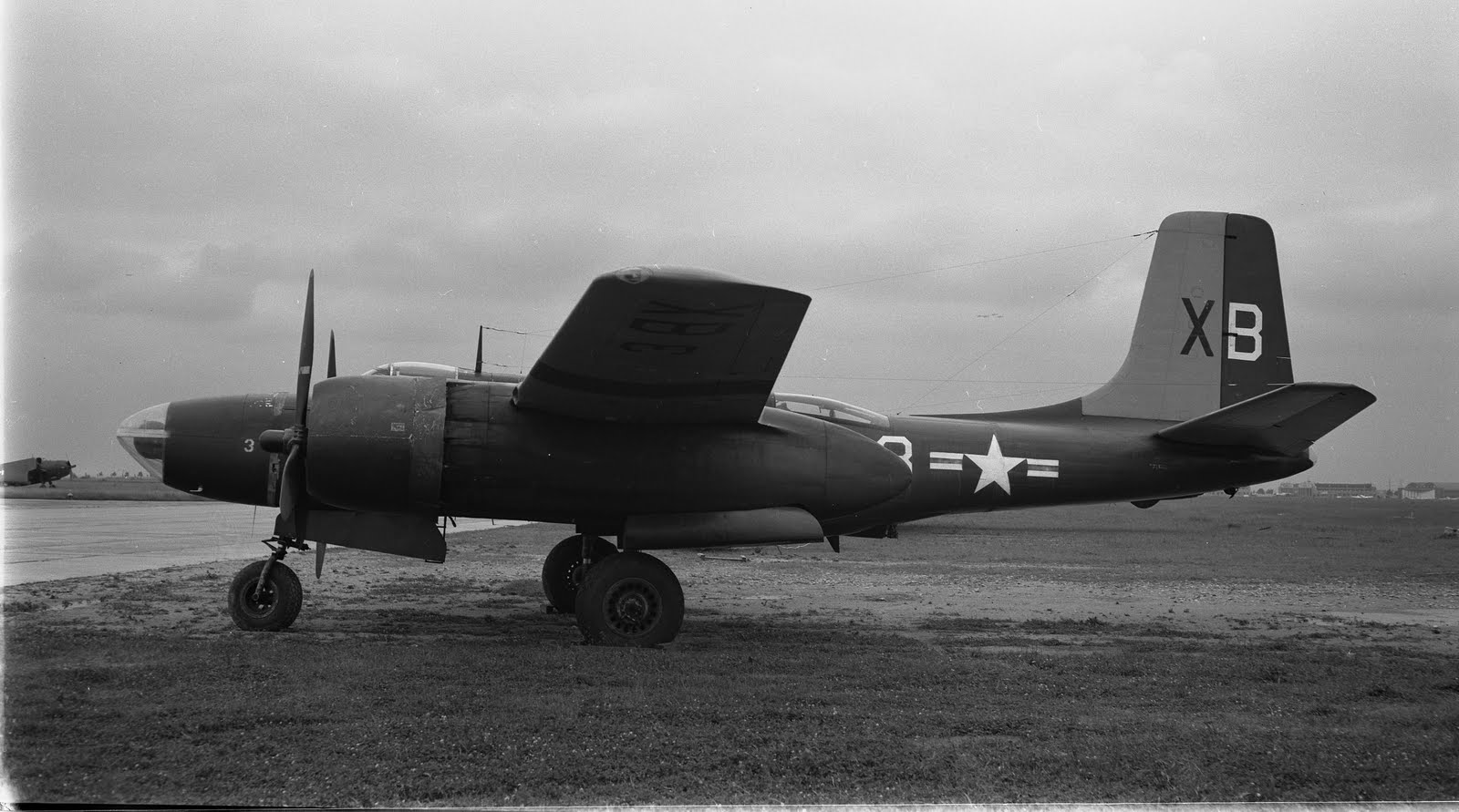
Is that airplane shiny or what? 44-34610 was built as an A-26B-61-DL, but had been redesignated as a B-26B long before this photo was taken at Randolph in June of 1972. She was a hack bird for the Air Guard Bureau, and was absolutely immaculate---you could've used her skin for a mirror. We think they called it "pride". Friddell
What a Difference a Couple of Years Can Make
As most of our readers are aware, the current USAF is dealing with what we're going to term "a somewhat smaller force" than it had in days past. That's largely due to the seeming demise of what was once the Number One Potential Adversary, although there are still plenty of Bad Guys left in the world, but the simple fact is that American air power has morphed into a smaller, highly technological fighting force. The wind-down didn't happen overnight, or even recently, as these two photos will attest:
The year is 1960, the place Ellington AFB near Galveston. The occasion is an annual Air National Guard conference, and that ramp depicts the attendees. Every unit sent a bunch of airplanes, but it's still an impressive shot; "Holy cow, Martha---look at all them airplanes!" Boy howdy! Friddell Collection
Let's time travel ahead to January, 1982. this time the place is the late Kelly AFB, and the occasion is the same; an ANG conference. Most units sent a two-ship, and if memory serves there were twenty or thirty airplanes in attendence. Times change... Friddell
A Modeling Publication Ought to Have a Model Every Once in a While
We honestly don't do that very often because, much as in The Old Days, we're spending most of our time trying to provide our readership with primary resource material (that would be photographs, in case you weren't sure). Be that as it may, today is a special day for us, so we need to have a few pictures of a model airplane in this edition, that being some variation of The Right Thing to Do.

This should have been a model of a P-40, since that was the very first plastic airplane we ever talked about in this publication, way back in our very first issue. It should have been, but it isn't; instead, you get to look at yet another 109, but there's a reason. This is Hasegawa's 1/32nd scale Me109G-6 kit, and when it first saw daylight as a completed model it was wearing Eagle Edition's decals depicting Gerard Barkhorn's G-5 from JG-52. We were never really happy with the model, and when the decals (properly applied and sealed, we swear!) began to flake off we figured it was time for a change. One of our primary modeling interests is the Eastern Front, and one of the Kagero 109 monographs had the artwork for this winter-camouflaged aircraft from JG-54, so the die was cast. The model you see here is a rework from a previously built kit, which might imply that you could rework some of your own stuff if you so desired!

Here's what the other side looks like. The Hasegawa 109s are excellent kits and used to be a great bargain in the world of what-you-get-for-what-you-pay, although recent price increases on all Hase offerings has changed that to some extent. The kit is still a great starting place and there's quite a bit of aftermarket available for it, although this one is a stocker except for the belts and harnesses plus a few scratch-built handles and such in the cockpit and proper antennae and drains where appropriate. Those white "stencils" on the mlg wheels are found on most of Eagle Edition's Me109 sheets and are part of the airplane's normal stencilling suite, but you don't see them in photographs very often, and they probably weren't on this airplane. This was the second big 109 we built (the other one has since been reworked too) and using all the stencils and placards seemed like A Good Idea At the Time. In retrospect it probably wasn't.

We'd been wanting to do a winter-camouflaged airplane for quite a while, and this seemed our best opportunity to do that. All the old decals were stripped, an easy thing to do since they didn't want to be there in the first place, and the paint was sanded smooth with 1500 grit polishing cloth. Then the model got itself repainted with one of JG-54's signature green-on-green schemes following the pattern defined in that Kagero book we were discussing. The yellow ID and theatre bands were then applied, as were the decals. The "white" winter camo was our normal off-white bottled by Testor as 36222 in their ModelMaster enamel range, thinned approximately 60% and sprayed at low pressure using a series of individual strokes. We think it worked, but you be the judge.

The proof of the pudding, we think. It took two hours or so to get that "white" applied, but it came out looking the way we think it should have, and the greens show off their contrasting shades under the winter whitewash. Even a blind squirrel finds a nut every once in a while!
The actual airplane didn't have gear doors on the mains, which was a pretty common thing on
Luftwaffe aircraft operating in the East, so they were removed during the stripping and re-painting process. Weathering was done with Grumbacher pastels (our norm), with the mud on the wheels being applied with Mig pigments; we normally don't use that stuff very often but it worked well here.
And an overall view of the port side of the aircraft once again showing how well the winter camo worked out. Some units within JG54 used the Gustav until late in 1944, and we really enjoyed seeing a G-6 done up this way. It's just that little bit out of the ordinary! Next time around we'll try to do a subject that isn't 2nd World War
Luftwaffe, but no promises---in a complete turnaround from our position Back in the Day, we've come to like those airplanes!
What's He Doing Here?
Our long-suffering readers have been enduring the vissicitudes of shot after shot of RAM 90 of late, and to our way of thinking there's no reason to stop while we've got momentum. Here, then, is a somewhat unexpected participant of that legendary (in our minds, if no-one else's) event:
Bet you didn't expect to see
this airplane on the pages of RIS, but he was a participant in RAM 90 and worthy of inclusion. The airplane is, of course, a BAC
Jaguar GR.1 from 41 Sqdn RAF, s/n XZ362. No, it's not American, but your editor has always had a soft spot for the type, so it gets to be included. Jags are just
neat, ya'll! The RAF has become a smaller force with every passing year (or so it seems) but those guys can
fly! It might be a short war if you had to fight them, but you'd definitely know you'd been in a scrap! Friddell
Give the Right Guy a Camera...
Somebody really famous said this once, which makes it ripe for the paraphrasing: We hold this truth to be self-evident; a great many of our readers are military aviators, past or present, and a great many of them are really good photographers to boot. Some of them are
exceptionally good photographers, a category occupied by contributor Doug Barbier, among others. In recent months you've seen a fair amount of Doug's work in our "Happy Snaps" section, but today we're giving him his own space. The airplane is the F-4E, the unit the 57th FIS, and the place is Keflavik, Iceland.
Every single one of these photos could easily be a painting, and the photography is to be envied. We're going to deviate a bit from our norm and let Doug explain what's going on rather than giving you a blow-by-blow via individual captions:
In honor of your 100th blog post, I've gone back to the scanner.... here are a few you won't see every day of the week. Keflavik Iceland, 57th FIS 1979.
1- #2 turning urea into vapor on takeoff. When the runway got icy, they put down urea. Trouble is the AB turned it into fog - Lead got the free pass, every one else had to wait until it blew clear and you could see.
2- The ramp on an icy early winter morning. Loftleider DC-8 taking the runway in the background. Early morning "sun" time... mid-day by the clock.
3
- 5-ship with T-bird leading enroute to the Reykjavik Airshow. We made it up as we went..... Tommy Porter, who was a T-38 IP with me at Willy was flying wing in an F-4 - I'll see if I can find the b/w print that Baldur shot from the ground, but lead sucked up the gear so low on a low approach there that Tommy was afraid he was going to land on the external tanks. He couldn't have been more than a couple of feet in the air
And a couple of shots of Iceland and F-4's.
Military aviation has never been an easy date, no matter how it looks from the outside. Thanks, Doug, for those remarkable photographs, and for sharing your memories with us.
Somebody Had to Go First
It's easy to take certain military airplanes for granted, because it seems as though they've always been there. That's particularly true when we're talking about classic airplanes such as the McDonnell F-4
Phantom. Here's some insight into that:
It's a
Phantom, but it hasn't yet become an F-4. This is the 6th F4H-1 prototype, BuNo 145306, during carquals. Even at that early stage the
Phantom was a remarkable airplane, and a quantum leap over anything that had come before. American naval aviation was about to introduce a legend into service, and the world of military aviation would never be the same. Greater St Louis Air and Space Museum
The Deuce Redux
You might think we'd be tired of the F-102 by now, but we've got that momentum thing going again so we're gonna to keep on chooglin' and take another look at the some of the aircraft belonging to USAF's first true weapons system. We like the airplane and we hope you do too...
Let's start off with one of the best known, and most colorful, of all the USAFE "Deuces". 56-1131 was an F-102A-60-CO serving with the 496th FIS out of Hahn AB, Germany, during 1961. She was transient at Bitburg for an air show when this photo was taken, and may well have been the most colorful airplane on the ramp that day. There's yellow and black on the tail, red on the speed brakes, a two-tone yellow and red pattern on the wing fences, and those F-102 zaps on the nose. It doesn't get much prettier. Kerr Collection
The 525th FIS was resident at Bitburg during the early 60s, and this aircraft, also a -60-CO, was being prepped for flight when this photo was snapped. The day-glo treatment on the wing fences is remarkable because it's been applied as stripes rather than a solid color. R. Franke
The 431st FIS spent its USAFE days at Zaragoza AB in Spain, but 55-5431 was photographed at McChord AFB in May of 1987. Her airframe was getting tired by then, but the markings were as gorgeous as the day the unit first applied them. Note the placard affixed to the outboard side of the port drop. Parrish
The NASA has flown a wide and unusual variety of aircraft during its history. N617NA was built as 56-0996 and was an F-102A-55-CO, and wound up first with the agency and finally in MASDC in February of 1974. Sharp-eyed observers will note the incongruous appearance of the armament placard just forward of the port intake. H. Muir
And here she is on the ground at MASDC. The deployed weapons bay doors are of interest. The airframe was being prepped for long-term storage when Hugh Muir photographed it in July of 1974. H. Muir
Mystery meat! What, you might rightly ask yourself, was an F-102D? We can honestly say that we don't have a clue, which gives our eagle-eyed readers an opportunity to spring into action and e-mail us at
replicainscale@yahoo.com to let us know what it was. Normally we'd consider this a mis-labled photo, but it's from an impeccable source so there's room for doubt. We'd be interested in the mods and the mission; anybody got an answer?
Kuykendall via Kerr
Bet You've Been Wondering When We'd Run Some of These
It was the late 70s, and the original print version of RIS had run its course to be replaced with a joint project of Jay Miller and Jim Wogstad called
Aerophile. Jay soon left the publication, but Jim carried on with it and your editor assisted him with the writing and production of a couple of monographs, one of which covered the Grumman EA-6A and B electronic warfare aircraft.
Replica contributor Rick Morgan had begun to work with us as both a contributor and an authority on Things Navy by then, forging a friendship that has lasted until this day. As a result of that friendship, a great number of original slides of
Prowlers ended up in South Texas. Today's the day the lid comes off that box, with some exceptional air-to-air photographs. ZAP!
Learnin' to fly. A section of Prowlers from the RAG, VAQ-129, get airborne on a training hop out of NAS Whidbey. There are two things of particular interest in this photograph; the first is the very obvious Insignia Red coloration underneath the slats, which ought to answer the question a lot of modelers have regarding this area. The other thing to notice is the pilot of 158649, because he's doing exactly what he's supposed to be doing---watching Lead. This has been a favorite photograph of ours for years. Can you guess why? R. Morgan
In February of 1988 Rick was on yet another training hop with VAQ-129, which gave him the opportunity to snap this dramatic photo of 160433. It's not a job... R. Morgan
Sometimes you just stooge around at altitude and practice things like landing the airplane in an environment where impact with the ground is unlikely. 158039 is doing just that in this February 1984 photograph. Note that the ALQ-99 under the port wing is in TPS, while the aircraft itself is still an Easter Egg. The tinted canopies (but not the windscreen) are extremely evident in this shot. R. Morgan
1986 found Rick at sea with VAQ-139's
Cougars. Here we see one of their birds taxiing for the cat. Those guys in the V1 Division don't make much money, but they've got one of the most dangerous jobs in the world. Feel the thunder! R. Morgan
Air ops over the western Pacific. These VAQ-139
Cougars are flying a little form in the SoCal Ops Area. That TPS paint is a moderately effective camouflage, but it sure gets dirty! R. Morgan
Because of the EW mission it's sometimes easy to forget that the
Prowler's sire was a dedicated low-altitude attack aircraft. Here's a reminder of that parentage; an EA-6B from VAQ-141 does a little bit of hill hauling in Puerto Rico. Bet that's not how you think of the
Prowler, is it? R. Morgan
And now it's time to say goodbye to the EA-6B for a while. The speedboards are deployed as the pilot of 163529, a
Prowler from VAQ-141, banks away from the camera aircraft, once again over Puerto Rico. She's carrying a full complement of ALQ-99 pods and gas bags, and is in operational trim. Go get 'em! R. Morgan
Invaders in the Peacetime Air Force
Up to this point we've run a couple of shots of WW2-vintage A-26s, plus more than a few from Korea and even a couple from the Vietnam War, so it's only fitting that we round things out (for a while) with some post-Korea birds. Valued friend and contributor Jim Sullivan has sent us some truly unique images, so let's get going!
SAC would be just about the last place you'd expect to find an A-26, but it's possible that this
Invader was assigned to that command. 44-35614 was built as an A-26C-40-DT, and was photographed at Wilmington, NC, in 1949. The
Invader was one of those airplanes that looked like it was going the speed of heat when it was standing still, bearing witness to that old adage "if it looks right, it'll fly right". The A-26 did both. McDaniel via Sullivan
Here's a 3/4 stern view of 614, once again showing off the A-26's sleek lines, which only improved once the turrets were removed. The emblem on the vertical stab appears to be that of the 1st AF. Normal aircrew ingress and egress were via ladders in the fore and aft portions of the bomb bay, which is the reason those doors are often seen open on the ground; the only other ways out are for emergency exit, the movies notwithstanding. Sullivan Collection
The South Carolina ANG operated the
Invader for several years. 41-39491 was based at McEntire ANGB but photographed at Wilmington in 1948. The markings on this aircraft are just the least bit different from the norm; the national insignia has been removed from the fuselage, although it's still present on the wings. It was a fairly common markings anomaly on Guard aircraft of the late 40s and early 50s. McDaniel via Sullivan
43-22609 may win today's A-26 prize in the "What's That?" department. In every other respect a standard A-26C, she wears a somewhat unusual nose---check out what appears to be gun ports in front of that emblem up there. (And while we're discussing things up front, if any of our readers can positively
identify that emblem we'd be grateful!) The nacelles have been painted in flat black, a common occurrence with the type, but it has failed to hide the extensive staining of those engines. Recips are
dirty, ya'll. Sullivan Collection
You just never know where you're going to find a sharkmouth, do you? That particular marking style rarely appears on A-26s, but 41-39443 of the SC ANG wears this one with considerable pride. The cowlings are either yellow or red; our guess is yellow, but we've been wrong before. The faces of those props are in polished natural aluminum, with the normal flat black on the backsides. McDaniel via Sullivan
It's now 1954, and 44-34632 is sitting on the ramp at Wilmington. That dark panel, probably blue, with the two stars on it would suggest that this bird is a VIP transport, but at this remove it's almost impossible to know for sure, even though the overall condition of the airplane suggests that it's something special. McDaniel via Sullivan
Wright Field got into the act too and this airplane was designated as an EB-26C when its picture was taken in 1955. The nose is unusual in that its got an odd bit of electronics attached to it. We have to admit that we know virtually nothing about this airplane, except that it's a highly enigmatic
Invader. Bowers Collection via Sullivan
The end of the road. The A-26 was fast, had long legs, and could carry a moderate payload. Those attributes assured the type a place in the commercial world, and with lesser air arms, once it had been surplused out of US military service. 44-34642 was one of the survivors; she's shown here at Tucson in April of 1968 while being refurbished for sale to Brazil. At least she'll fly again---nobody likes to see airplanes turned into pots and pans, which is the fate of most old military aircraft. Sullivan Collection
Happy Snaps
Since this issue is a special one for us, we're going to offer
two reader-taken air-to-air shots for your enjoyment today:
Our first offering today is one from a friend of the original
Replica in Scale and its
Aerophile successor, Marshall Smith. Marshall was a Marine aviator when he took this evocative form shot in April of 1980. The unit is VMAQ-2. We like the
Prowler around here, ya'll! Marshall Smith
This is what you might call a classy photograph. Doug Barbier took it while assigned to the 57th FIS, so we'll let him explain what's going on.
(The Phantoms are from) 56 Sqdn RAF. The Brits sent a couple of F-4's over every month to play in our "war games". Best intercepts I've ever seen came from these guys - those Rolls Royce engines really made a difference. Not to mention the doppler radars.... those guys were GOOD.
The Relief Tube
Before we get to our normal entries for this section, there's something we need to talk about. We get a fair amount of correspondence from our readers evrey week, and we try to either publish or answer every one of the messages, depending on which thing is the more appropriate to do. The point to be made is that we almost never let things go without a response of some sort, except for in one special circumstance which we're about to discuss.
We encourage our readers to offer up comments, criticisms, and to share photography with us at the
replicainscale@yahoo.com e-mail address. We
don't encourage spammers, marketers, or other folks like that, but we hear from them too, and far more frequently than we'd like. Usually their messages are glaringly obvious, and most of the time they dump directly into our spam filter, but sometimes they manage to get through. We combat that sort of thing as best we can, but if you've tried to contact us and failed, try putting part of your message in the subject space on your header; as long as it's something to do with airplanes we'll check it out. If it doesn't fit that criteria, its a goner! And please, use e-mail rather than the "comments" feature on the blog itself, because we can't respond to you in that feature and we want the opportunity to look things over before they go to print. Thanks for understanding, Gang.
OK, now we're off the soapbox and back to business. First up is a comment from Marty Hogan:
Just wanted to say thanks for putting out those Phantom photos! I agree the world is a lesser place for the loss of the Phantom. I never got to see her fly in US service, but did see her a little bit in Egypt and Germany. That is one gorgeous bird! I'd love to see more phantom posts plus other Vietnam era birds and the F-14 if you could! Thanks- I LOVE your blog! Marty
The F-4 was special, Marty, and there's no disputing that! She was
the iconic American fighter for nearly three decades, and you'll definitely be seeing more of her as we go along. And who knows; we may even find our way around to publishing a few more F-14 shots too---stay tuned!
Now we'd like to share a personal story with you. It has direct bearing on a feature we ran several months ago, back when we were covering the "Stoof", and specifically addresses those two shots of the burning TS-2A; call it closure, if you will.
Richard Adams is a pretty neat guy. I first met him when he was the biz-jet manager at the now-extinct Dee Howard Company, and we became friends. Richard's background is one of an aviation professional, and his entire career was spent in close proximity to airplanes, both military and civil. He was a naval aviator for a while, then later became personal pilot for former Texas governor Dolph Briscoe, and then went on to a career with Mr. Howard. He's been around.
He and I were talking back in February, and in the course of conversation I asked him if he'd seen the blog yet (he's not much on computers and doesn't have a whole lot of use for them). His answer was no, and I told him he ought to look in on it every now and again---one of his favorite airplanes is the "Stoof", and I told him about some of the photographs we'd run back when we were covering the type. I described that burning TS-1A to him, and his jaw dropped open. "Did it have a 3G tailcode?" Yep! "Was there a CH-19 hovering in the background of one of the pictures?" Yep! "I was
there!" And it turns out he was, flying co-pilot in CH-19E 154 during the accident. You can see the helo in the background of one of the photos of that Bad Day on 2 November, 1964. There's more to it than that, however, because Richard's a thorough sort of guy, and he kept the article regarding that crash which appeared in the March, 1965 issue of
Approach Magazine, and he loaned them to us
. We've taken the liberty of using the piece to provide closure to our original piece; please remember that the following two items originally appeared in
Approach. Here are scans of that article:
It was a scary deal all around, but it does make us think. The life of the military aviator is exciting and sometimes glamorous, and just may be one of the most dangerous things a person can do as a regular job. That's something worth remembering when you look at
any of the photos we run here.
Finally, here's a picture we've been wanting to run for a while, but hadn't quite figured out a reason to do it. Today we decided we didn't need no stinkin' reason, so we're running the photo. Look on it as family history.
Long ago and far away; Jim and I were attending an airshow at NAS Corpus Christi when we persuaded our young PAO escort to take this photo. That's Jim on the right, and me (carrying every bit of photographic gear I owned at the time!) on the left. We were hip-deep in researching the Douglas SBD for an upcoming
Aerophile monograph we ended up never publishing, so the choice of background material was a no-brainer that day. There was humor (for us, anyway) involved in it too, and a There I Was story seems the right way to end this issue, so without further ado:
When you photograph stuff on an American military installation, and if you're shooting on a press pass, you'll have yourself an escort from the Public Affairs Office. That's a Fact of Life, and it's usually the only way you're going to be allowed on an active ramp. That's how it was on that sunny morning in April of 1986, when Jim and I were out far, far away from the maddening airshow crowd at NAS Corpus, shooting late arrivals as they taxiied. in. The CAF's RA-24B, painted up to resemble an SBD-3, had just recovered and been parked on the civilian portion of the ramp, and we decided it would be a great opportunity to get a frontispiece shot for that SBD book we were attempting to produce. Our escort, a young Navy enlisted man who was dressed in his very best whites because of the airshow, graciously agreed to take the photo, and his efforts produced the shot you see above. That wasn't the end of it, though. There was Adventure, albeit mild, to come!
While our Fine Young Escort was immortalizing us on T-Max 100, another CAF bird, this time a TB-25J disguised as a PBJ, had landed and begun his taxi to the very ramp we were occupying. That TB-25 was too big for the spaces left near the rest of the warbirds, though, and when he got to the intersection of the taxiway that we were occupying he turned away from us to get to his reassigned parking slot. Jim and I looked at each other and began a quick walk to get off that taxiway, which caused our escort to turn to us and say "Where are you guys going? He's headed away from us! There's no problem staying here."
That much was true; the B-25 had just turned off to the left and was well and truly heading away from us, maybe 100 feet away from where we were standing. Either Jim or I, and I honestly can't remember which one it was, hollered "You better move---you really don't want to be standing there!" at the escort as we continued to Beat Feet away from the centerline. He looked at us like we were nuts (not an entirely unfounded conclusion on his part, but we digress), turned back around, and watched as the
Mitchell trundled off to it's parking space.
"Wow! You guys should've stayed where
I was! That bomber was taxiing directly away from me, and I could feel the air coming off his props and everything---it was NEAT!" Jim and I looked at each other with the same sort of False Remorse look you give somebody who's just slipped on a banana peel and busted his keyster. Why, you might ask, did we do that?
Remember that part where we said our escort was wearing his best whites? His freshly-washed, crisply-ironed whites? Well, gang, they were still freshly washed, and they still had ironed creases in them sharp enough to cut metal with, but they weren't quite white anymore; the B-25 had seen to that when it turned away from us and its propwash sprayed down the entire area with fine droplets of Mobil's very finest aviation engine oil. I still laugh about it to this day, and I'm willing to bet Jim does too; almost-harmless fun unless, of course, you were the owner of that splotched uniform...
And that's what I know. Thanks again for looking in on our effort and, at the risk of being repetitious, thanks again for making this production the modest success it's become. Be good to your neighbor, and we'll meet again soon!
phil

 Here's another example of the basic TraCom scheme, this time on an aircraft nominally assigned to Training Wing 3. 158713 was photographed at Randolph AFB in 1989; she's basically a Clean Machine but check out all the grime on her otherwise pristine gloss white paintwork. If you plan on modeling a white bird from the NAV's training command, this is what they generally looked like. Good luck with that grime! Friddell